
MARGINALIA
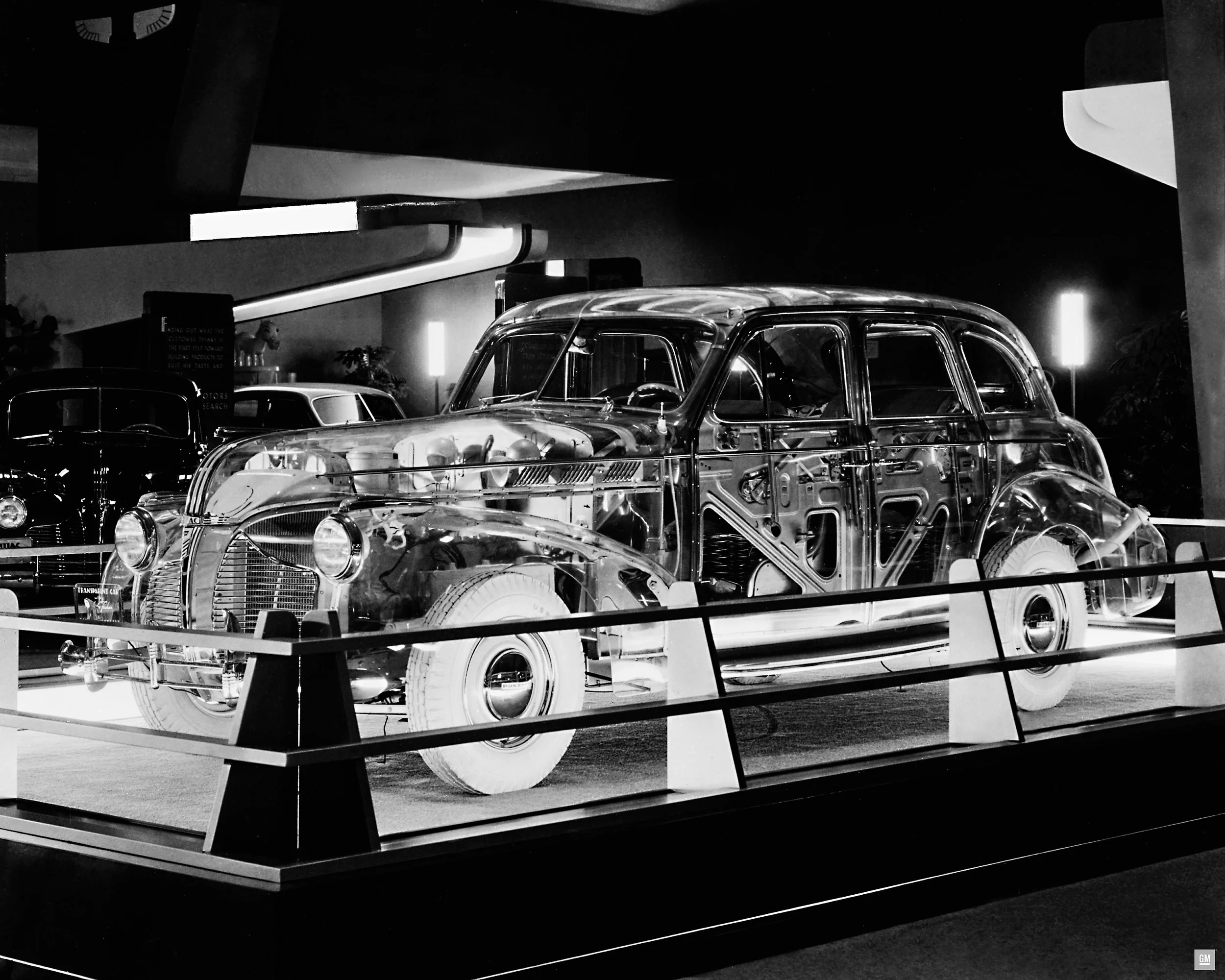
General Motors, the transparent Pontiac Ghost Car was unveiled at the 1939 World’s Fair in New York as part of General Motors’ Futurama exhibit, 1939. General Motors Archive.
The Yurikamome Elevated Train passes behind a Plexiglas map of the Shiodome Sio-Site business complex, located in Minato Ward in central Tokyo, Japan, April 14, 2008. J. Lumiere / Alamy.
Grosfeld House Plexiglas bedroom, 1942. From Decorative Art 1942 – The Studio Year Book, edited by C. G. Holme. [The Studio Ltd., London, 1942]. The Print Collector / Heritage Images / Alamy.
Telephone acrylic dome in the Palace Hotel, Stockholm, Sweden, 1950s. Photo Kristoffersson ref cb23-2 / Classic Picture Library / Alamy.
Airplane - no caption
Rohm and Haas Company. “Woman Polishing Plexiglas at Rohm and Haas Facility,” 1940–1949. Rohm & Haas Company Archives, Box 18 (Photographs), Folder 12. Science History Institute. Philadelphia. https://digital.sciencehistory.org/works/rf55z867q.
Denture sign - no caption
Dentures - no caption
Jane Rieger of Golders Green seen with the first all-plastic greenhouse at the First International British Plastics Exhibition, July 7, 1957. Keystone Pictures usa / zumapress / Alamy.
A Farnsworth table model television receiver installed in a Lucite cabinet to show the operation of the components, 1949. rbm Vintage Images / Alamy.
Barbara Kasten, Intervention, 2018, Steel and fluorescent acrylic. Courtesy Bortolami Gallery.
A McDonald’s in Chicago, 2008. James Kirkikis / Alamy.
50. Ocular prosthesis. Evil Kahn / iStock.
51. Climate measuring devices, Mt Zugspitze summit station, Garmisch-Partenkirchen, Bavaria, Germany, Europe, November 10, 2011. uwl / imagebroker.com / Alamy.
52. Color plastic acrylic shapes, Plexiglas, April 2, 2020. Opreanu Roberto Sorin / Alamy.
53. Red, green, blue, beige, aqua, brown, yellow and navy rows of a horizontal multi-colored crochet lines pattern, June 11, 2023. Dorin Puha / Alamy.
60. Orlon acrylic by DuPont, “Just for Kicks,” 1960. adsR / Alamy.
61. Heart-shaped sunglasses. William Dondyk / iStock.
70. Blurred view through protective glass. Hockey player on the ice surface of the stadium, February 13, 2023. Edophoto / Panther Media Global / Alamy.
76. Haruka Kojin, Contact Lens, 2011. Museum of Contemporary Art, Tokyo. Photo: daici ano.
77. Unknown. Handbag, early 1950s. Engraved perspex. Given by Peggy Marchant, © Victoria and Albert Museum, London, 1996/2203.
84. Pigeonholes full of safety glasses high school workshop in Western Australia, March 5, 2018. Chris de Blank / Alamy.
85. Plexiglas milling on a CNC machine at a furniture factory, October 22, 2019. Marina Demkina / Alamy.
90. Outdoor basketball backboard and hoop rim with chain net in urban residential district, Serbia, 2023. Igor Stevanovic / Alamy.
91. Walkway, Centre Pompidou, Paris, France. Kate Hockenhull / Alamy.
92. Plexiglass screens on metal stands for social distancing in Trastevere, Rome, Italy, September 12, 2020. Daniele Cossu / Alamy.
93. National Guard members at the Metro Detention Center in Downtown Los Angeles on June 8th, 2025, amid protests against federal immigration raids, June 8, 2025. Jim Newberry / Alamy.
97. Acrylic earrings and bracelets, 1960s. Photo, Wynne Patterson.
98. Glowing red exit sign, Plexiglas, July 11, 2019. MirrorImages / Alamy.
———-
QUOTES
More than a substance, plastic is the very idea of its infinite transformation.
—Roland Barthes
The NHL theory of violence goes something linke this: Hockey is by its nature a violent game. Played in an area confined by boards of unbreakable glass, by players carrying sticks travelling at speeds approaching thirty miles per hour, collisions occur.
–Ken Dryden
Your shield like a wing, protects your bulletproof heart from the wind, your right arm black in the cloth of your brothers. Full face visor. Baby gladiator.
—Riot Police, Sun Yung Shin
———————-
Plexiglas hits the road
Regina Lee Blaszczyk is Professor Emerita in history at the University of Leeds in the UK. Her work focuses on capitalism, material life, and consumer culture. She is the author or editor of thirteen books, most recently Capitalism and the Senses. This article draws on research for her centennial history of the Rohm and Haas Company of Philadelphia, the firm that developed Plexiglas acrylic plastic and the quick-drying acrylic paints that you use to paint your walls. For more on these topics, see her book Rohm and Haas: A Century of Innovation.
14. Rohm & Haas Company Plexiglas advertisement, 1960. adsR / Alamy.
16. Detail, Mobil badge / logo / trademark on a filling station wall. Paul Shawcross / lgpl / Alamy.
17. Sunoco vintage print ad, Saturday Evening Post, May, 1962.
19. Old Coca-Cola sign in the historic French Quarter of New Orleans, Louisiana, USA, March 2, 2022. iStock / Ampuero Leonardo
20. Sign with pertol prices at a Chevron gas station, USA. Nathaniel Noir / Alamy.
—————————
Plastic goes pop
Catharine Rossi is a design historian and Professor of Architecture at uca Canterbury School of Architecture, Art and Design. A curator, researcher, writer and educator, her interests include Italian design, craft, nightclubs, feminism, environmentalism, and contemporary design and architecture. Publications include Crafting Design in Italy (mup, 2015) and the co-edited The Italian Avant‑Garde (Sternberg, 2013) and Beyond the Dancefloor (Bloomsbury, 2026). She has co/curated exhibitions including Night Fever: Designing Club Culture 1960 –Today (Vitra Design Museum, 2018–2022) and At Home: Panoramas de nos vies domestiques (Saint-Etienne Design Biennale, 2022).
24. Gae Aulenti, Pipistrello light, (originally produced for Olivetti’s Paris store in the late 1960s): 1965; (yellow-based pop version produced by Martinelli Luce): 2023. Stainless steel and acrylic. Martinelli Luce. Despite The Chipstone Foundation’s efforts to contact Martinelli Luce, the necessary rights for this image have not been obtained. 94
27. Achille Castiglioni, produced by Flos, Frisbi lamp, 1978. polymethylmethacrylate, steel. Despite The Chipstone Foundation’s best efforts the necessary rights for this image have not been obtained.
28. Flare coffee table I, Flare coffee table II, and Flare totems, designed by Draga & Aurel exclusively for Todd Merrill Studio. Photo courtesy of Todd Merrill Studio.
—————————
Plastics as an art form
Isabel Elson‑Enriquez is a PhD candidate in art history at the cuny Graduate Center. Her dissertation explores the emergence of plastic as an artistic medium in the postwar period, specifically tracing the evolving relationship between plastic and the human body as synthetics took over the material environment. Her research is supported by a Luce/acls dissertation fellowship, and she has held positions at institutions including the Oakland Museum of California, Dia Art Foundation, the Harvard Art Museums, and the Whitney Museum of American Art.
34. Freda Koblick posing with her sculptures, date unknown. Archives of American Art, photograph by Robert Lackenbach.
36. Installation images of Rohm and Haas mural included in Rohm and Haas Reporter, 1966. Archives of American Art.
37. Freda Koblick, (title unknown), date unknown. Plexiglas subjected to di-electric currents. Archives of American Art, photograph by Stanford University.
38. Installation photo of mural for Rohm and Haas, 1965. Archives of American Art.
39. Freda Koblick meeting with Rohm and Haas execs during installation of mural for Rohm and Haas, 1965. Archives of American Art.
————————-
Layer by layer
Daniel Belasco is an art historian and Executive Director of the Al Held Foundation, overseeing the collection, archive, educational programs, exhibitions, and historic home and studio in the Catskills. As an independent scholar, his archive-based research in modern and contemporary art, including focused studies of Louise Bourgeois, Helen Frankenthaler, Roy Lichtenstein, Dick Polich, and Bradley Walker Tomlin, has been published in a variety of journals and catalogues. His monograph Women Artists in Midcentury America: A History in Ten Exhibitions was published by Reaktion in 2024, and he is currently editing the dialogues of Al Held and Irving Sand ler for a forthcoming book.
42. Al Held, Untitled, ca. 1958. Oil on canvas. 67 x 49 in. (170.2 x 124.5 cm). Courtesy of the Al Held Foundation.
44. Al Held, Taxi Cab IV, 1959. Acrylic on paper over canvas, mounted on board. 108 x 276 in. (274.3 x 701 cm). Courtesy of the Al Held Foundation.
46. Al Held, I Beam, 1961. Acrylic on canvas. 114 x 192 in. (289.6 x 487.7cm). Courtesy of the Al Held Foundation.
48. Al Held, Eagle Rock IV, 2004. Acrylic on linen. 180 x 360 in. (457.2 x 914.4 cm). Courtesy of the Al Held Foundation.
—————————-
Infinity on our fingertips
Chenoa Baker (she/her) is a curator, writer, professor, and descendant of self-emancipators. She has contributed to major exhibitions including Simone Leigh and Simone Leigh: Sovereignty, Gio Swaby: Fresh Up, and Touching Roots: Black Ancestral Legacies in the Americas. In recognition of her curatorial work, she received the wbur Maker Award and was featured on npr’s All Things Considered in 2024. In 2023, she won the aica Young Art Critics Prize for her writing. She writes for Hyperallergic, The Brooklyn Rail, Public Parking, and Studio Potter, among others.
54. Acrylics worn by the artist Wavy Wednesday in her studio. Nails by Kamela Gissendanner.
56. Decorated nails of Sha’carri Richardson are seen after the Women’s 4 x 100m Relay final during the Paris 2024 Olympic Games at Stade de France in Paris (France), August 09, 2024. Team United States placed first, winning the gold medal, 2024. Insidefoto / Alamy.
————————
Privacy control
Caitlin Anklam is a writer living in Brooklyn. She is currently pursuing a Master’s in art history at Hunter College, City University of New York. She is a regular contributor to The Brooklyn Rail, and has held curatorial and collections positions at The James Howell Foundation, The Solomon R. Guggenheim Museum, The Newberry Library, and The John Michael Kohler Arts Center.
63. Basera Khan, Privacy Control, 2019. Installation at bric Arts Media, Brooklyn, ny. Acrylic two-way mirror, steel pipes, vinyl text. 16 x 8 ft. Installation view, bric Arts Media Brooklyn, NY. Curated by Elizabeth Ferrer. Photo: Benny Krwon. Image courtesy the artist.
64. Baseera Khan, Privacy Control, 2019. Installation at bric Arts Media, Brooklyn, ny. Acrylic two-way mirror, steel pipes, vinyl text. 16 x 8 ft. Installation view, bric Arts Media Brooklyn, NY. Curated by Elizabeth Ferrer. Photo: Benny Krwon. Image courtesy the artist.
66. Baseera Khan, Privacy Control, 2018. Acrylic two-way mirror, vinyl wall text, steel scaffolding mounts. 8 x 8 ft. Installation view, Simone Subal Gallery, ny (to the left: Planet Fitness, 2016, 20-minute running performance set to a custom soundtrack). Photo: Dario Lasagni. Image courtesy the artist.
69. Beseera Khan, The Liberator, from the series Busts of Canons, 2023. fdm (Fused Deposition Modeling), 3d-printed petroleum-based acrylic, artist’s hair, custom steel pedestal. Image courtesy the artist.
——————————
Support structures
Jessica A. Cooley (she/her) has two decades of experience as a curator and scholar of disability art. Her work focuses on histories, material conditions, and curatorial methods that shape what disability art is, how it is cared for, and why it matters. Cooley recently served as an acls Fellow and Guest Curator for the Liberal Arts Engagement Hub at the University of Minnesota—Twin Cities, where she coordinated the community-curated art exhibition The Art of Disability Justice Now. She is currently the Postdoctoral Curatorial and Teaching Fellow at the Haggerty Museum of Art at Marquette University.
72. Neo Walk, Gatsby DNA Starry Skye Light Up Walking Stick. Image courtesy of BravoMikeMedia.
75. Claes Oldenburg (American, b. Sweden 1929), Soft Screw [installation in the Chazen Museum of Art’s Objects Study Room], 1975, 121.3 x 37.2 cm (47 3/4 x 14 5/8 in.), cast elastomeric urethane with a mahogany base. Collection of the Chazen Museum of Art, Terese and Alvin S. Lane Collection. Accession No.2012.54.44.6. Photographer credit: Jonathan Prown.
———————-
The joy of plastic
Carrie Moyer is known for her sumptuous, materially-experimental paintings. For over 30 years, she has exhibited throughout the US and Europe. Moyer’s work was included in the 2017 Whitney Biennial and has been the subject of several museum shows. Between 1991–2008, Moyer and photographer Sue Schaffner collaborated as Dyke Action Machine!, a public art project that dissected commercial advertising through the insertion of lesbian imagery. A monograph on Moyer’s work was published by Rizzoli in 2021 and includes writing by Johanna Fateman, Lauren O’Neill-Butler and Katy Seigel.
78. Carrie Moyer, Rosewater and Brimstone, 2020. Acrylic and glitter on canvas. 78 x 60 in (198.1 x 152.4 cm). Private Collection. Courtesy the artist and Alexander Gray Associates, New York. © 2025 Carrie Moyer.
81. Carrie Moyer, Grassroots Harmonic, 2023. Acrylic, glitter, and pumice on canvas. 72 x 52 in (182.9 x 132.1 cm). Private Collection. Courtesy the artist and Alexander Gray Associates, New York. © 2025 Carrie Moyer.
82. Carrie Moyer, Etna’s Folly, 2024. Acrylic, pumice, glitter, ground garnet, and fiber paste on canvas. 72 x 50 in (182.9 x 127 cm). Courtesy the artist and Alexander Gray Associates, New York. © 2025 Carrie Moyer.
———————