Cuckoo for coconuts
Kirstin Kennedy
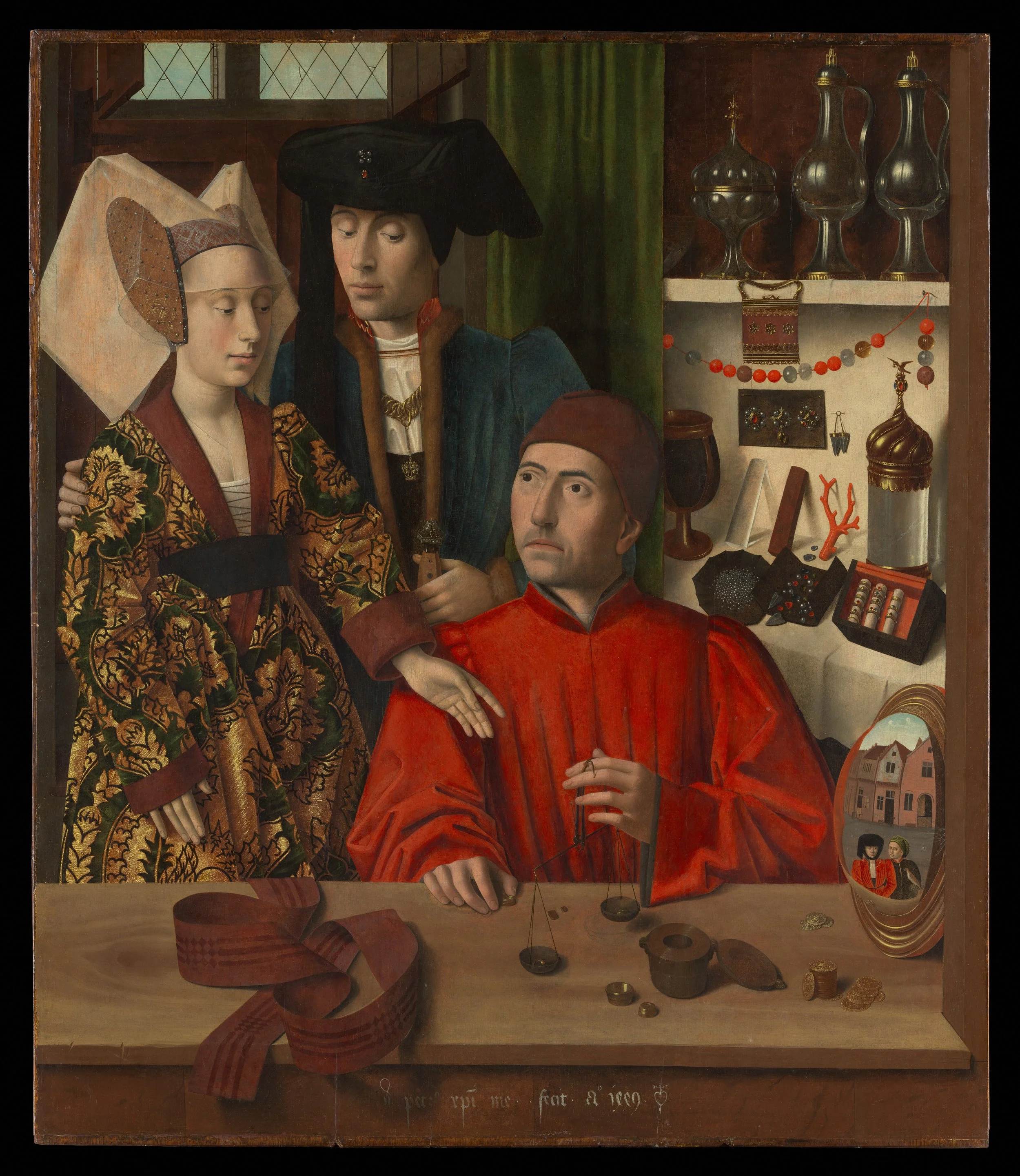
Petrus Christus, A Goldsmith in his Shop, 1449. Oil on oak panel. (overall): 39 3/8 x 33 3/4 inches. The Metropolitan Museum of Art, New York. Robert Lehman Collection, 1975, 1975.1.110. www.metmuseum.org.
In 1510, the Italian traveler and diarist Ludovici de Varthena praised coconut water as ‘a most excellent thing to drink.’ At that date, even the most affluent Europeans barely knew what a coconut looked like, let alone had tasted its contents. Some, however, did see one of these exotic shells. Since the Middle Ages, coconut husks had been set into metal mounts and thereby turned into cups and containers – part of a tradition in Western European decorative art which embellished any materials considered technologically ingenious or naturally beautiful, such as Chinese porcelain, turned maple wood or nautilus shells.
A painting by Petrus Christus of a goldsmith in his workshop, dating to 1449, includes a coconut cup among other precious items that he would adorn with precious metal mounts (it can be seen peeking out from behind a curtain next to his head). The skillful transformation of such rarities made them still more valuable. The earliest surviving example of a mounted coconut, for example, dating from 1230-1250, is a reliquary in Munster Cathedral (the coconut is described as a ‘Calcutta nut’ in a 1558 inventory). The rock-crystal animal on the lid is a 10th or 11th century Fatimid carved lion, here reworked as a Christian lamb, a more appropriate guardian of the 47 relics within.
The earliest documentary reference to a mounted coconut is also from a church: a 1255 inventory of Angers Cathedral records that a tiny reed (‘cannula’) that belonged to St Bartholomew was kept in a coconut cup.
Coconut shells began circulating more widely in Europe in the thirteenth century, and from then on were not all that rare, unlike other curiosities such as ‘unicorn horns’ (which were in fact narwhale tusks). More than thirty coconut cups are recorded in the papal treasury at Avignon between 1295 and 1371. By the early sixteenth century, these vessels were being made in many forms, often mimicking existing designs in metal. The brown body of the nut could be carved with edifying scenes from the Bible or set with wings, claw feet and a silver head to make a vessel in the shape of an owl (the head was the detachable cup), or, taking advantage of the three ‘eyes’ at the end of the fruit, the grotesque face of a fool. In one example, the coconut became an outlandish, clawed, creature with a mane and ram-like horns. More practically, cups set on a high foot – secured by intricately pierced or engraved straps, and sometimes embellished with stones – appeared regularly in inventories of princely and noble collections.

Samuel Kassborer, Cup, ca. 1600. Cast, raised and chased partially gilded silver (parcel-gilt), carved coconut shell and carved semiprecious stones. LOAN:GILBERT.61:1, 2-2008. © Victoria and Albert Museum, London/ © the Rosalinde & Arthur Gilbert Collection, on loan to the Victoria and Albert Museum, London
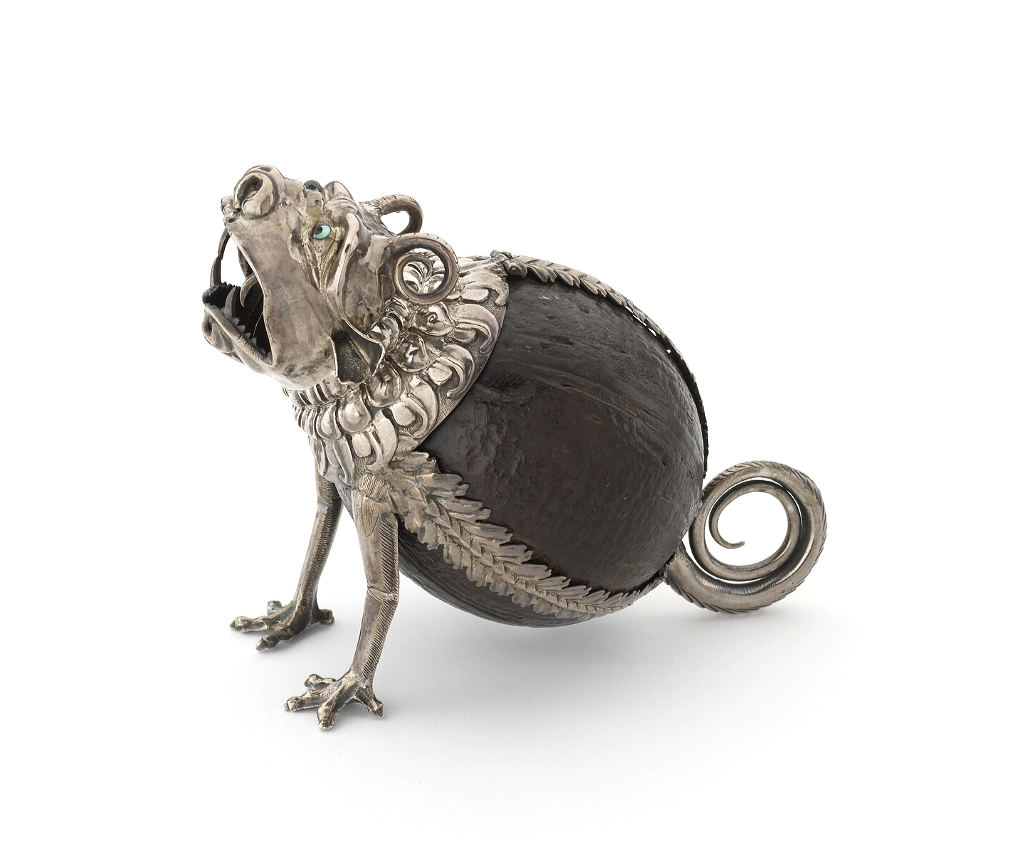
Flanders, Coconut cup and cover, ca. 1510–1600. Coconut, silver, and glass. Ashmolean Museum, University of Oxford, Bequeathed by Michael Wellby, 2012, WA2013.1.49. © Ashmolean Museum, University of Oxford.
Coconut cups were particularly common in Northern Europe, where they were used for display and drinking. Several of the elaborately mounted cups that are today in Dresden’s “Green Vault,” established in 1723 by Augustus the Strong, were used for wine, offered by their aristocratic owners to visiting dignitaries as a gesture of hospitality. Metalsmiths typically lined the shells with silver to prevent leaks.
Later Europeans found further uses for coconut shells. Exceptionally, an Antwerp inventory drawn up in 1601 records ‘an Indian nut with silver setting being a pepper pot’. The renowned eighteenth-century Newcastle engraver Thomas Bewick (of History of British Birds fame) had a carved coconut cup as a sugar bowl as part of his tea service; it had a wooden stand, upgraded by his wife to a silver one in 1779. The firm of Josiah Wedgwood & Sons set plaques of Jasperware onto a polished coconut to make a two-handled vase in the neoclassical taste, echoing more familiar silver examples.

Josiah Wedgwood and Sons, Cup and cover, ca. 1785. Coconut, mounted in silver gilt; cover, stem and base of wood, mounted with silver gilt; the medallions of Jasper ware. 815:1, 2-1891. © Victoria and Albert Museum, London.
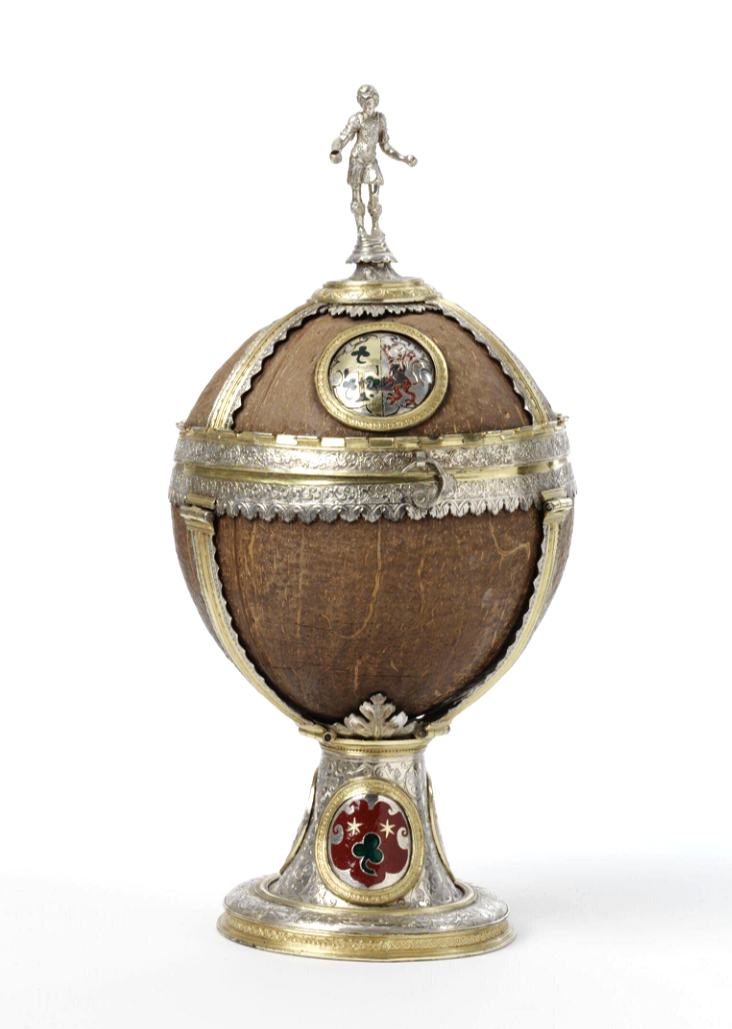
Switzerland, Cup and cover, after 1571. Coconut shell, silver, parcel-gilt, and enamel. 2118:1, 2-1855. © Victoria and Albert Museum, London.
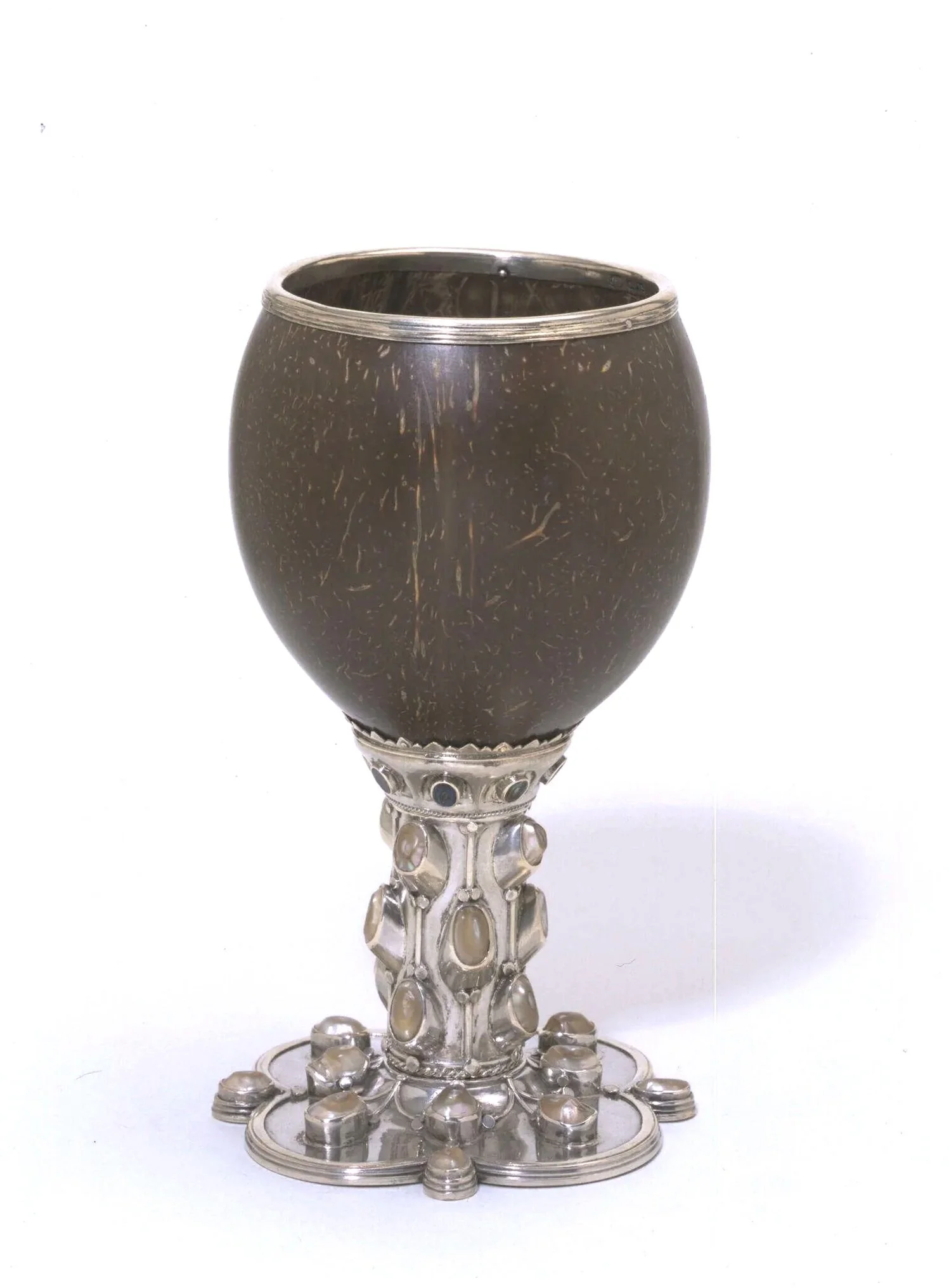
John Paul Cooper, Cup, 1915–1916. London. Silver mount; coconut and mother-of-pearl in two colors. Formerly in the collection of Charles and Lavinia Handley-Read, M.33-1972. © Victoria and Albert Museum, London.