Introduction
Glenn Adamson

Barbara Kasten, Intervention, 2018, Steel and fluorescent acrylic. Courtesy Bortolami Gallery.
What is the ultimate futuristic automobile? Many would say the DMC DeLorean—a commercially unviable but amazing-looking sportscar with gullwing doors, which famously conveyed Marty McFly to the 1950s and back. Others, Buckminster Fuller’s 1933 Dymaxion Car, essentially a plane without wings, memorably described by its creator as “4D twin, angularly-orientable, individually throttleable, jet-stilt, controlled-plummeting transport.” Even these iconic and improbable cars, however, are positively pragmatic in comparison to the Pontiac “Ghost” sedan, presented in the Futurama at the 1939 World’s Fair. The DeLorean’s body was made of stainless steel, the Dymaxion’s of aluminum. The “Ghost” was clad in something even more extraordinary: acrylic.
Pontiac used the “synthetic, crystal-clear plastic” everywhere in the car that sheet metal would normally appear, admitting a view of its interior structure and mechanical parts, accessorized by custom all-white tires and rubber fittings. Construction cost $25,000—about 30 times the selling price of a conventional vehicle—but from the marketing point of view, this was money well spent. The effect was even more astonishing than it is today, for solid acrylic had been introduced to the market just six years earlier, by the German company Rohm and Haas. The 1930s were a time of intensive research into thermoplastics (liquid when heated, solid when cooled) including nylon, polystyrene, and vinyl. Within this family of synthetics, acrylic was special because it is completely transparent. Its story is hardly clear, though. Even today, most people still don’t know what this stuff is or how it’s made.
Matters aren’t helped by the profusion of terms that manufacturers have used for the material. The technical term for acrylic is Polymethyl Methacrylate (PMMA), but it has been marketed as Plexiglas (the trade name used by Rohm and Haas), Lucite (the equivalent from DuPont), and Perspex (still the most common term in Britain, originally introduced by Imperial Chemical). Over the decades its qualities have diversified tremendously. Color can be added through dyeing. An “edge-lit” effect can be achieved by engraving the perimeter of the sheet, which diffuses the light and makes the material appear to glow. It can be readily shaped—molded, machined, incised, even cut and textured with lasers—and acrylic resin can be injected into fabrics and other material structures to make composites. In 1941 DuPont trademarked an acrylic fiber named Orlon, though it took a while to figure out what it might be good for. It was initially impossible to dye, so that, as Regina Blaszczyk has noted, customers could have “any color they wanted, as long as it was beige.” By the 1950s, Orlon was established as an important material for knitwear, often in wool blends.
The word “acrylic” itself, borrowed from a similar German term, first appeared in 1843, long before the material was commercially manufactured. It contains the Latin root acri-, meaning sharp-smelling, as in “acrid.” This is because the naturally occurring liquid from which it was first synthesized, acrolein, has such a pungent smell. Acrolein is flammable enough that it has been used in military grenades, and so toxic that it is a common herbicide; it is also found in cigarette smoke. The process of making acrylic from this base involves thermal polymerization, which creates long molecules joined by double-bond carbon atoms. This chain structure is what makes acrylic so strong (unlike glass, it is shatterproof) and the molecules are arranged in such a way that they do not absorb light at visible wavelengths, accounting for its transparency.
Somewhat counterintuitively, these same qualities make acrylic an ideal binder for paint; it dries to a tough, clear film in which colors will appear true. To make it, the polymer is put into suspension and combined with water and pigment, and usually other additives. Rohm and Haas actually patented a binder of this type back in 1915, but it was only in the 1930s that acrylic paint was commercialized, initially for industrial applications, by the German chemical giant BASF, which remains the largest producer of acrylic raw products in the world. Practically speaking, acrylic paint offered tremendous advantages over traditional oil-based formulas, as it is odorless, dries more quickly, and is more durable. During the building boom that followed World War II, acrylic (also known as latex or emulsion paint) quickly became a popular choice, and today it is dominant. A little appreciated fact is that most buildings in most places are sheathed inside and out with thin coatings of plastic.
It was in the form of housepaint that acrylic first entered art history, as Abstract Expressionists like Jackson Pollock and Franz Kline began using it for their large gestural canvases. This was principally a matter of economy—they could not have afforded to make these works from tube after tube of expensive artist’s oils. Its other advantages quickly became evident, though. In the late 1940s, New York City’s Sam Golden and his uncle Leonard Bocour, previously known for their hand-ground oils, developed Magna, the world’s first acrylic paint intended specifically for use by artists. It was outstandingly vibrant and glossy, and helped define the look of paintings by Helen Frankenthaler, Morris Louis, and Roy Lichtenstein.
The main problem with Magna (and the reason that you won’t find it around today) is that it was toxic, due to the solvents used to bring the acrylic into emulsion. The challenge was to work out how to use water rather than solvents as a vehicle, a chemical process first perfected by a Cincinnati-based firm called Permanent Pigments. They called their new paint Liquitex—short for “liquid texture,” it was released in 1955—and the principle was rapidly adopted by Golden and Bocour in their brand Aqua-Tec, a name that clearly signaled the new formulation.
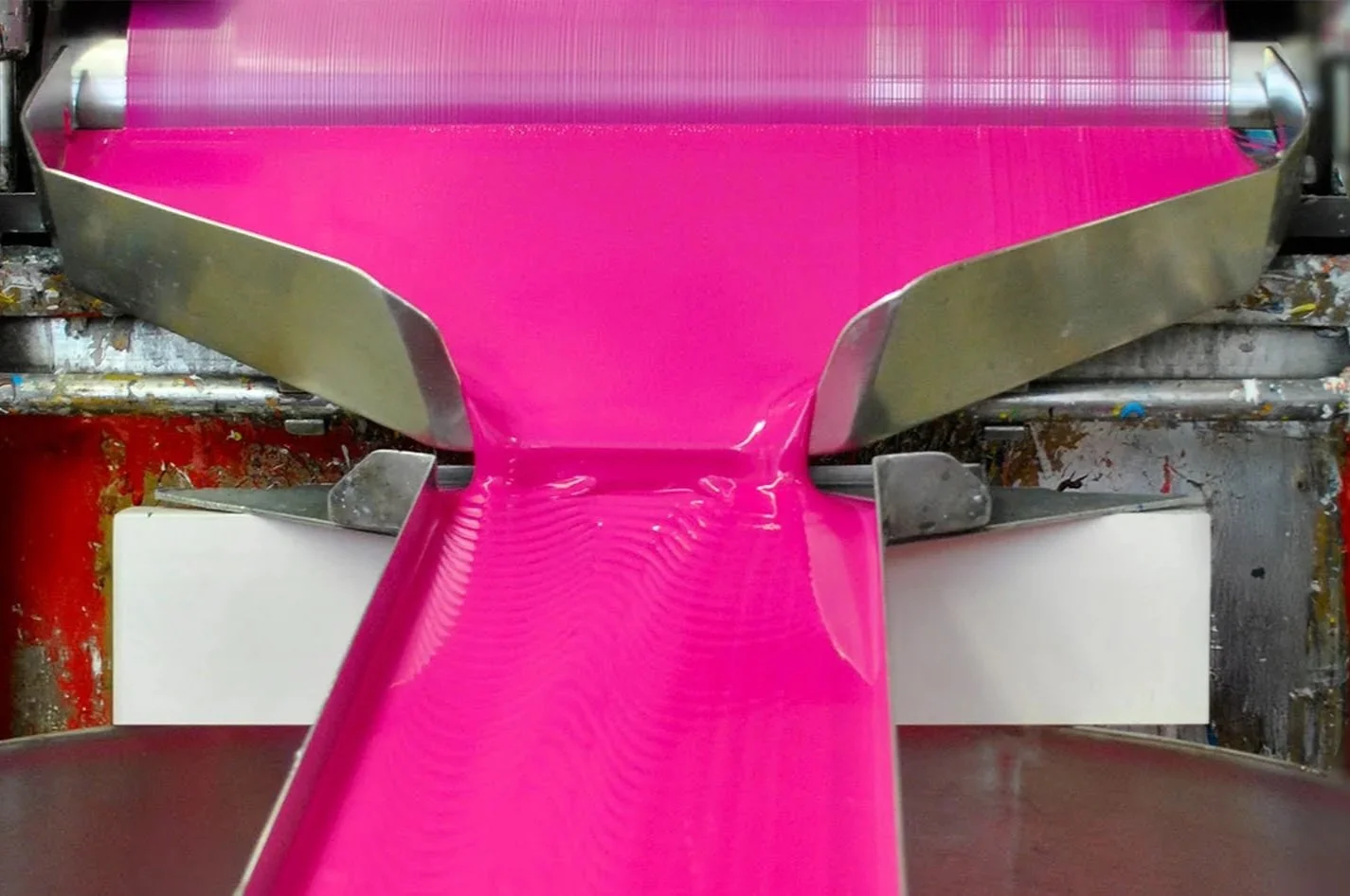
Mill Roller in the production of the Swiss Artist acrylic manufacturer Lascaux Colours & Restauro
Water-based acrylics are now the norm, but experimentation continues. Barbara Diethelm, the owner of Lascaux Colors—a Swiss company founded in 1963, and the manufacturer of some of the highest quality artists’ paints on the market today—says that making acrylics is much more complex than making oils, because of the amount of chemistry involved. Today the company works with about twelve unique acrylic binders (each paint color has a unique combination of twenty or so total ingredients), depending on the working properties desired: opacity, brilliance, as well as special effects like metallics, iridescence, and fluorescence. “It’s like building a house,” Diethelm says. “The foundation has to be good.” Some paints are formulated for intensive application, others for large, sweeping gestures. Lascaux also manufactures primers to seal the canvas, mediums that increase transparency and adhesion, gels and pastes that build up texture, varnishes and fixatives to finish the surface.
While many artists certainly still prefer to work in oils, one could argue that it is acrylic, as much as any stylistic or conceptual trend, that most sharply distinguishes the past half-century of painting from that of all previous eras. An especially dramatic example is seen in Aboriginal painting, which traditionally had been made with ochre earth pigments on eucalyptus bark, using emu egg yolks, animal fat, or plant resins as binders. In the early 1970s, the Papunya Tula Collective in the Western Australian Desert began adopting acrylic and canvas, resulting in more transportable, durable, and conventionally displayable paintings. Other artists followed suit, and millennia of precedent was overturned in a matter of a few years, the material transposition indexing a more profound reorientation from local spiritual practice to art’s global marketplace.
Meanwhile, PMMA has taken over the modern museum, in the form of exhibition display cases that protect objects from visitors, dust, humidity, and UV light. While these do not have the elegance of glass vitrines—or the durability, as acrylic scratches easily—they are an improvement in most other respects. Acrylic is just as transparent and colorless as glass is, while being lighter, cheaper, and less reflective, which reduces glare from overhead lighting. These qualities make acrylic extremely common as a barrier material for other purposes, too. It divides not only gallerygoers from historic artifacts, but also customers from bank tellers, passengers from taxicab drivers, prisoners from visitors, hockey fans from ice rinks, diners from all-you-can-eat salad bars, and noisy highways from the neighborhoods they pass through. You’ll also find acrylic used in the windshields of boats, though not cars (the Pontiac “Ghost” sedan notwithstanding) as its susceptibility to scratching compromises visibility over time; this is also why it’s not used for smartphone screens.
What acrylic can’t protect us from, unfortunately, is acrylic itself. Like all plastics, it is an important contributor to ecological degradation. While it can be chipped, melted down, and shaped into new product—sometimes known as “recrylic”—this is a specialist process and in practice it very rarely happens. Most people are unaware that it’s even possible to recycle acrylic; museum display cases, for example, are too often jettisoned after a single use, due to limited storage. Once discarded, it is either burned, releasing greenhouse gases, or put in a landfill, where it will not biodegrade. Another problem is that like nylon and other synthetics, microparticles are shed when acrylic fibers are washed, which then circulate through the water system.
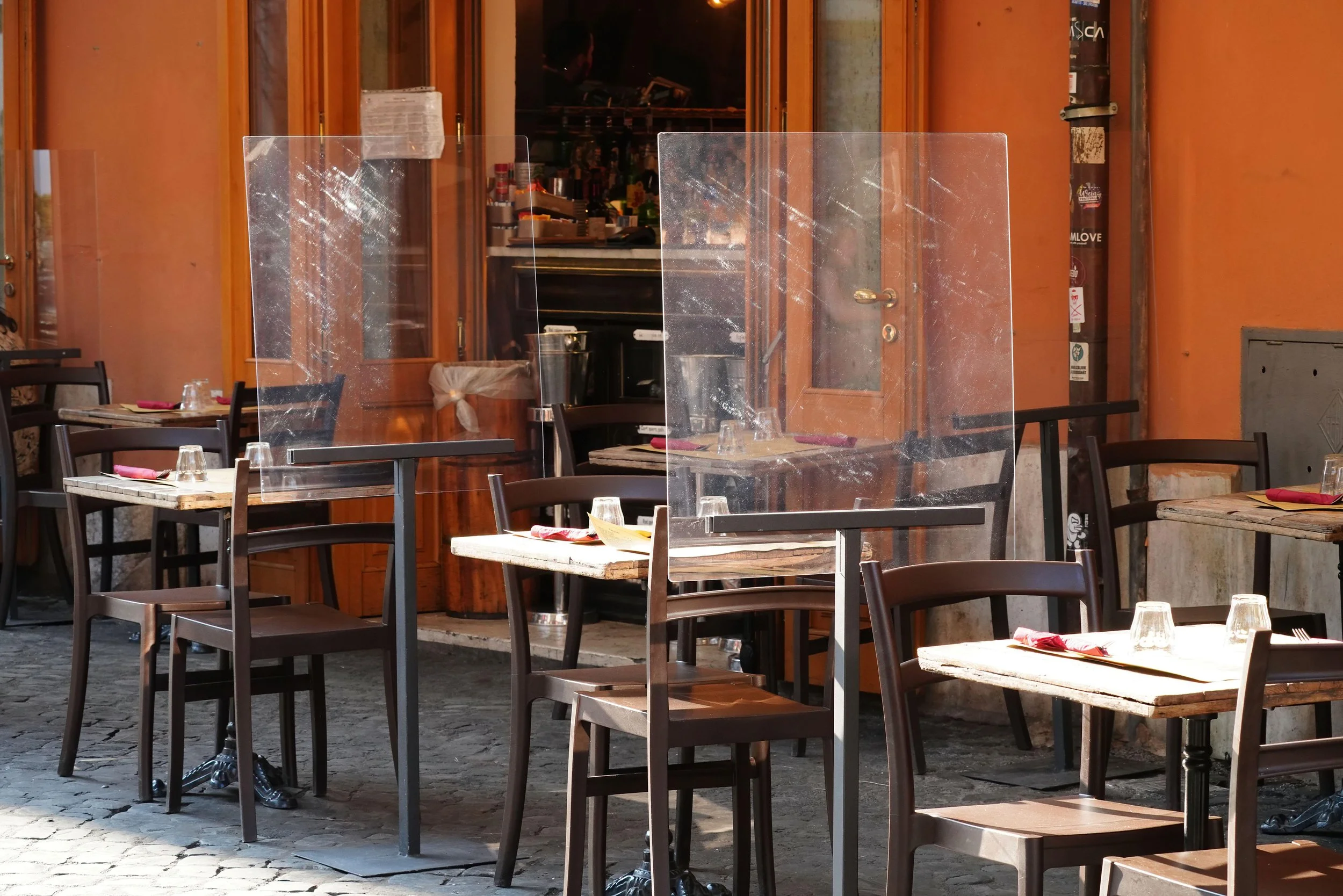
Plexiglass screens on metal stands for social distancing in Trastevere, Rome, Italy, September 12, 2020. Daniele Cossu / Alamy.