Plastic as an art form
Isabel Elson-Enriquez

Freda Koblick posing with her sculptures, date unknown. Archives of American Art, photograph by Robert Lackenbach.
It was summer 1965, and Rohm and Haas’s newly commissioned Plexiglas mural had finally made it to their new corporate headquarters in Philadelphia. The artwork by Freda Koblick was months behind schedule, and the chemical company had grown impatient. Each letter from her San Francisco studio had brought news of another delay. “My recent correspondence seems to be turning into a chronicle of disaster and woe,” Koblick wrote apologetically to her commissioner, detailing exothermic explosions, curing problems, and electrical fires. Her explanations became increasingly technical as she tried to communicate to Rohm and Haas the complexity of working the very material they manufactured. “I wish it were possible to estimate correctly in doing a first-time experimental job,” she wrote bluntly. “If it were I should certainly be richer than I am.”
By this point, Koblick had been working with acrylic for over twenty years. In 1943, she became the first woman in California to receive a degree in plastics engineering. This had not originally been her objective; after graduating from San Francisco State College, in the city where she was born and raised, she had received a scholarship to study design, but had trouble finding a program that focused on process, rather than what she described as “the superficial aspects of design.” She decided to go to technical school instead, and a mentor sent her a brochure for a new program in Los Angeles: the Plastics Industries Technical Institute. It was wartime, and there was tremendous pressure to keep up with demand for nylon parachutes, PVC weapon components, acrylic aircraft cockpits, and other military supplies manufactured in plastic. Acrylic was among the youngest of these synthetics, having only just been brought to market in 1936 by Rohm and Haas under the tradename Plexiglas.
Among her classmates, Koblick was one of the few to grasp the creative potential of this highly moldable material. “Appalled by the lack of imagination” in existing acrylic work, she increasingly turned her attention from learning the material’s rules to creatively breaking them. Her favorite trick was to overheat the plastic, forcing it to bubble into roiling surfaces. In some sculptures she combined multiple polymer formulas, their varied viscosities and curing times resulting in complex, layered textures. She even subjected the material to electric current, creating microfissures that look like delicate tree branches or veins. No sooner did she master a technique than she would devise a new one. The results, despite their artificial constitution, appear surprisingly organic. Her Plexiglas chandeliers hang like stalactites; her bubbling sheets resemble the mottled surface of a frozen lake. In her mural for Rohm and Haas, reds, yellows and browns swirl as if sucked into competing eddies.
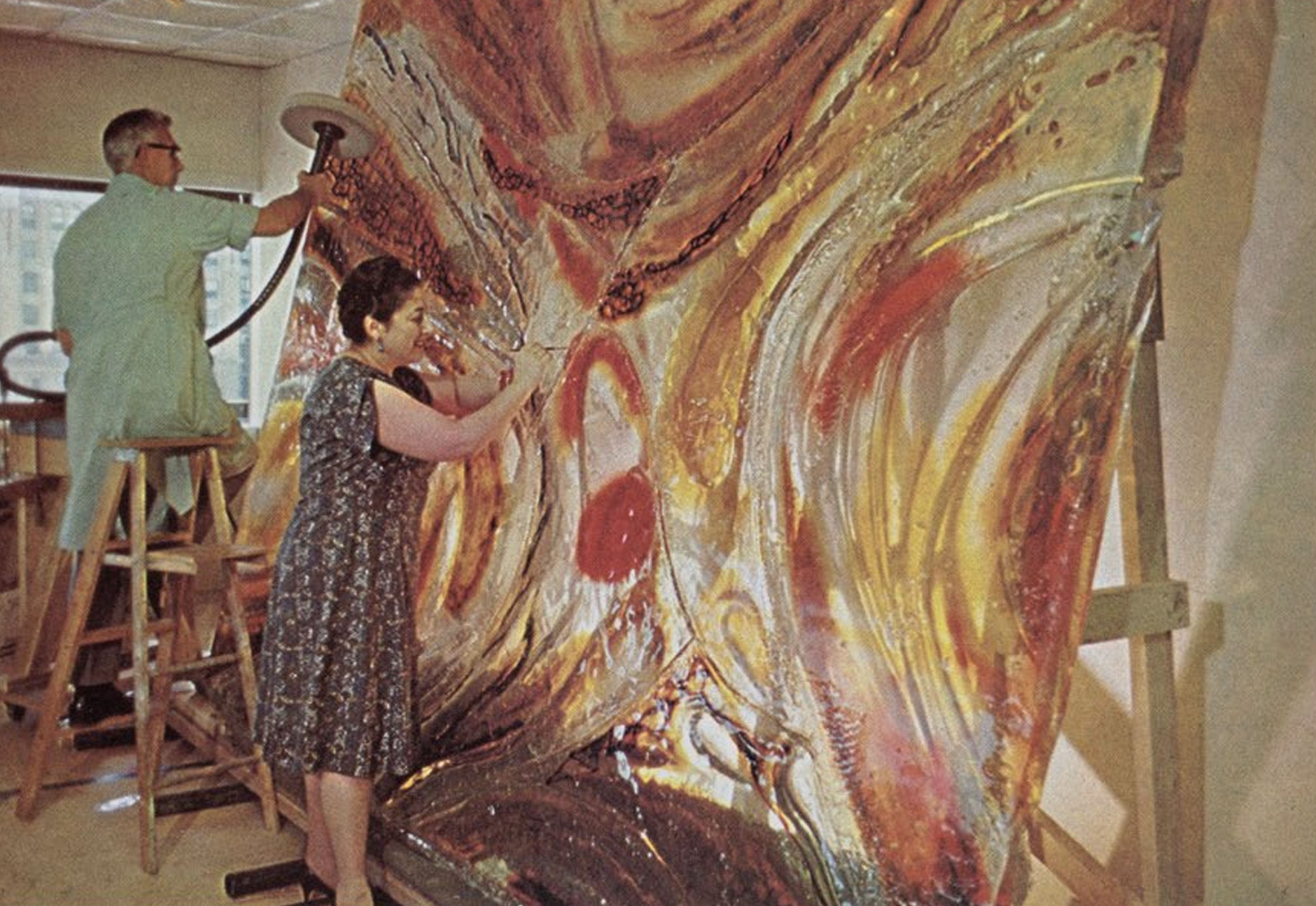
Installation images of Rohm and Haas mural included in Rohm and Haas Reporter, 1966. Archives of American Art.
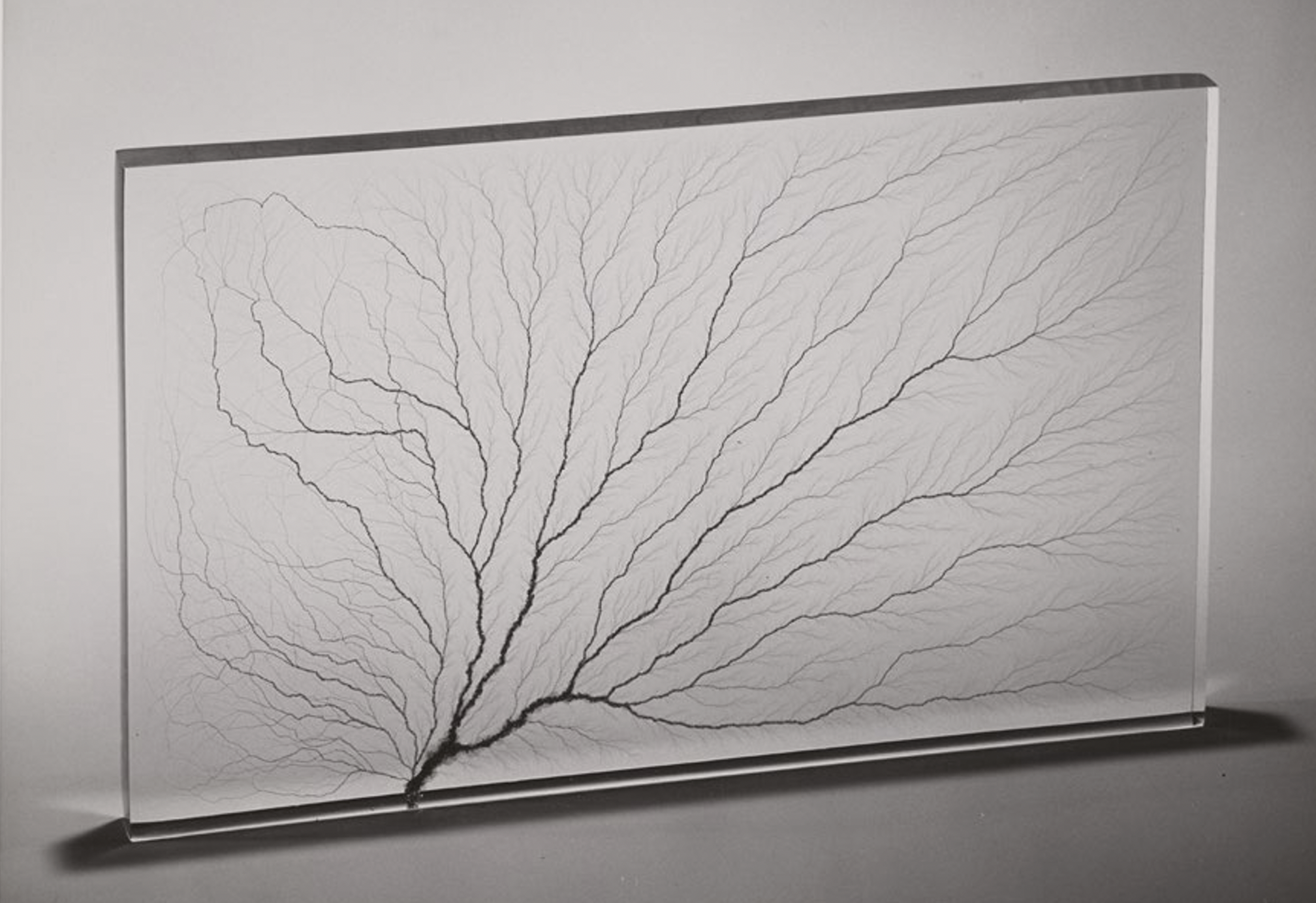
Freda Koblick, (title unknown), date unknown. Plexiglas subjected to dielectric currents. Archives of American Art, photograph by Stanford University.
Even as acrylic gained commercial popularity for its obliging consistency, predictability, and clarity, Koblick allowed for the material to misbehave. It could abruptly and stubbornly impose its autonomy, exploding in the autoclave or refusing to take to her molds. These collaborations resulted occasionally in “some real blobs,” as she conceded, and frequently, as Rohm and Haas learned, in missed deadlines. Despite their complaints, however, the company was a real supporter of her work. During the installation in their headquarters, executives filed through to meet Koblick and admire the work as she and her team applied the finishing touches. The following year, the company featured the mural in their in-house magazine The Rohm and Haas Reporter alongside several other artists they identified as creating particularly exciting work in their trademarked Plexiglas.
Of the nine artists featured in the article, six were women, a statistic all but unheard of in the mid-1960s. Among these others were Alyce Simon, who pioneered the use of a particle accelerator, or “atom smasher,” as a tool to create intricate three-dimensional crazing in acrylic, and Thelma Newman, whose 1964 book Plastics as an Art Form was a guiding text for a growing cohort of plastic sculptors. Koblick once suggested that women had opportunities in plastics engineering because it was a new industry, unburdened by a history of male domination. Perhaps this was what also attracted women to plastic as an artistic medium—the wide-open expanse that came with a brand-new material.
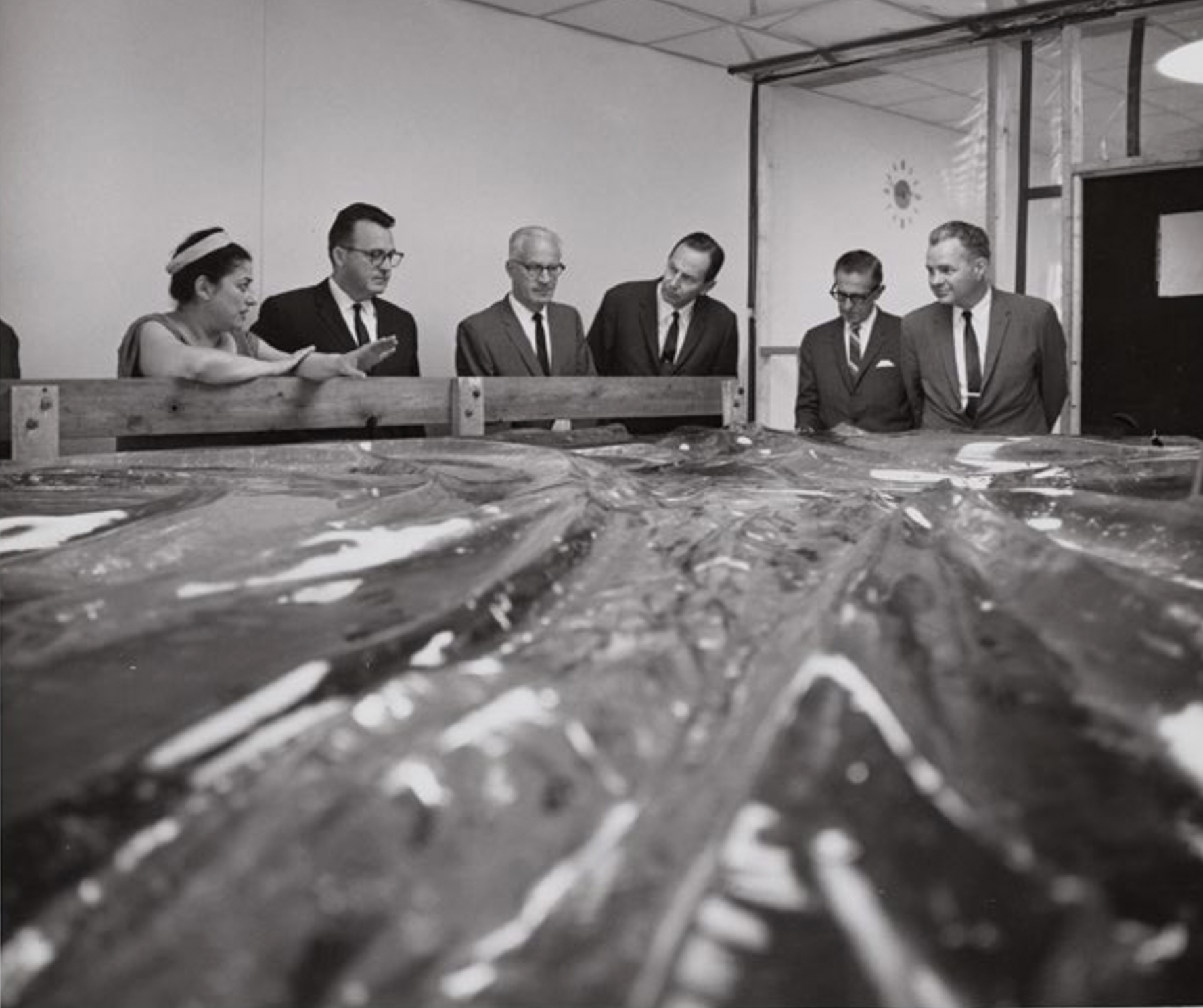
Freda Koblick meeting with Rohm and Haas execs during installation of mural for Rohm and Haas, 1965. Archives of American Art.
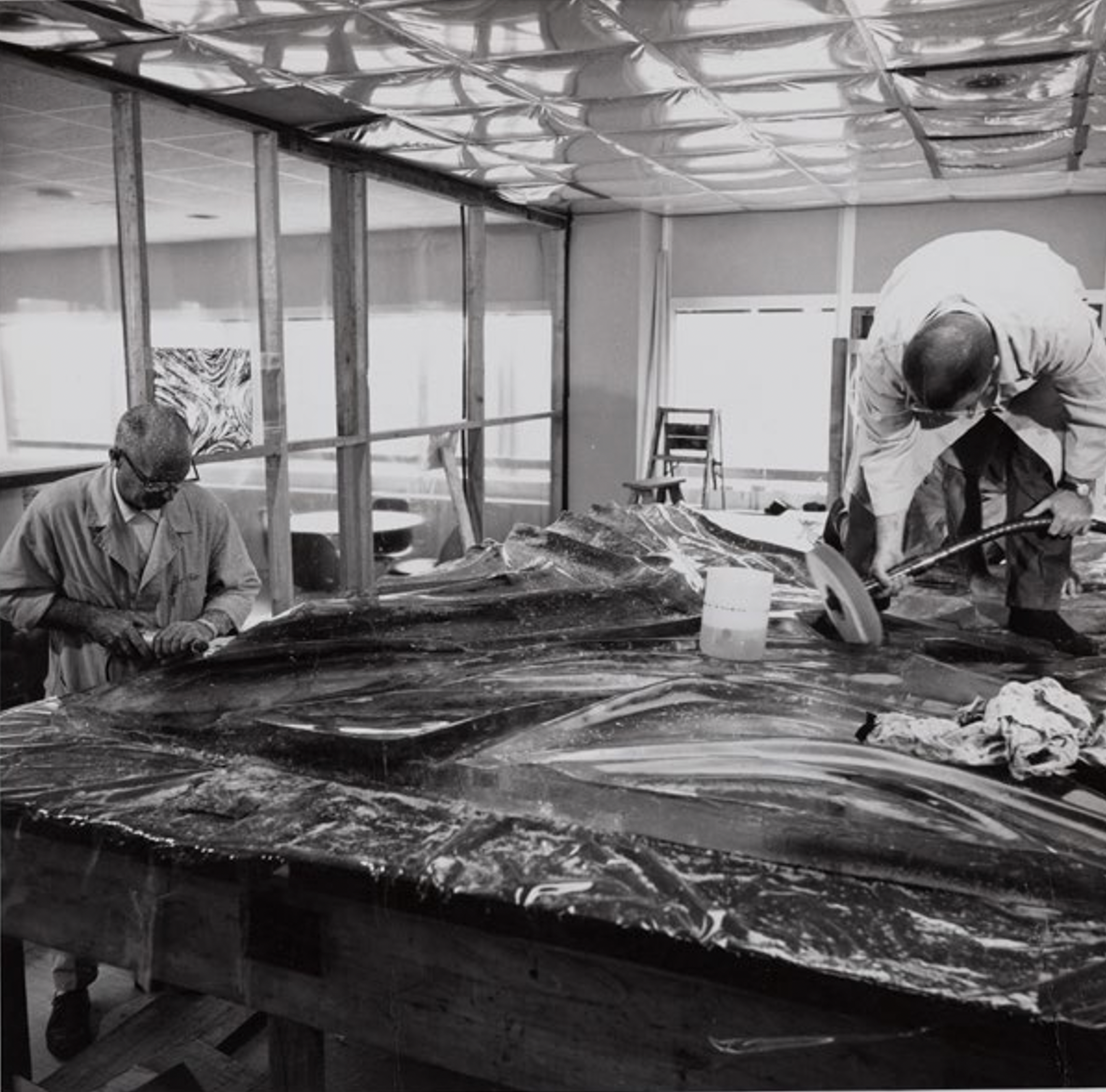
Installation photo of mural for Rohm and Haas, 1965. Archives of American Art.