
Support Structures
Jessica A. Cooley

Neo Walk, Gatsby DNA Starry Skye Light Up Walking Stick. Image courtesy of BravoMikeMedia.
Polymethyl methacrylate (PMMA), more often known by its tradenames Plexiglas, Perspex, or Lucite, is an ever-present yet often unnoticed medium of the museum. Not that solid acrylic is commonly used to make art; rather, it is used to encase, support, and cover. Acrylic is valued in exhibition display and conservation because it is transparent, durable, lightweight, malleable, and protective. These same characteristics have been important throughout the material’s history, whether during World War II, when it served as a shatter-proof substitute for glass in aircraft cockpits, or in succeeding decades, when it revolutionized prosthetics. Acrylic sustains and protects, offering customizable support to human bodies and art objects alike. Yet, its very inconspicuousness can obscure this vital role of care.
When I introduced my concept of crip materiality, I argued that ableism—the belief that disability is an inferior state of being—affects our understanding and valuation of the chemical structures of art materials, their fabrication, curation, and conservation. It does so partly by framing some materials, those understood to be unintentionally deteriorating, as having inherent vice, a characterization that moralizes fragility by treating deterioration as failure. Such language reveals the pervasive nature of ableism that insidiously affects all things, not just human beings.
For example, Claes Oldenburg's 1978 polyurethane sculpture Soft Screw, in the collection of the Chazen Museum of Art in Madison, Wisconsin, is unexpectedly reverting to a liquid state, and in the process, is challenging the ableist ideals of stability that shape how art is valued and cared for. Consider the accommodations that sustain Soft Screw in its instability. The custom-cut and padded acrylic mounts that hold it are as integral to the work’s ongoing physical manifestation as the sculpture itself. The use of acrylic in art conservation participates in a longer history of prosthetic care where PMMA was fashioned into dentures, contact lenses, bone cements, and facial prostheses; it also now enables the survival of artworks like Soft Screw, which are deemed too fragile for their own weight.
In his essay In Support of Difficult Shapes, Philip R. Ward emphasizes that “at every stage in an object's museum life…we are concerned with its proper support… because all materials have weight and all are, to some extent, flexible. These two factors, multiplied by a third, time, will eventually result in damage if the object is not suitably supported.” Ward’s point, echoed across mountmaking literature, is that while universal factors like time and gravity affect all artworks, conservation solutions must be tailored to the specific vulnerabilities of each piece. The same logic explains why acrylic transformed prosthetics—because their lightweight malleability allows for precise, unobstructive and unobtrusive customization.
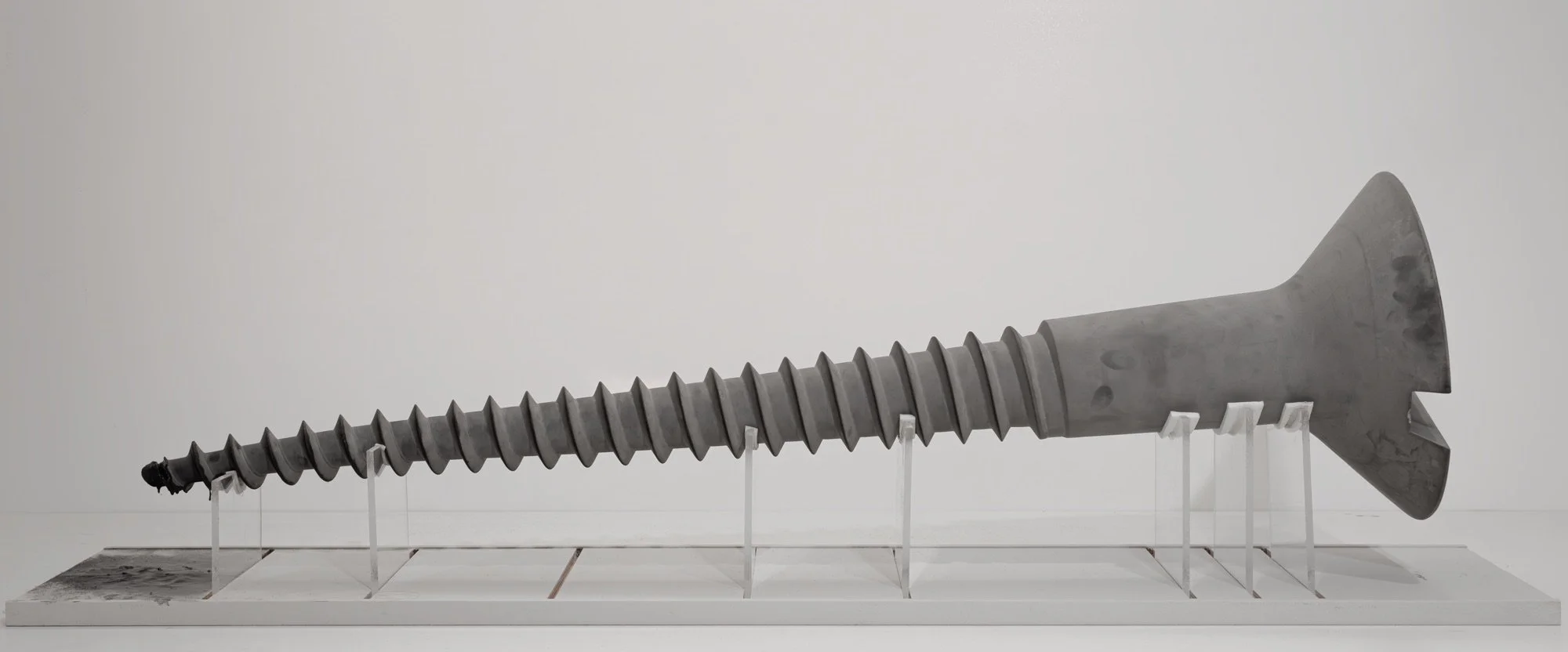
Claes Oldenburg (American, b. Sweden 1929), Soft Screw [installation in the Chazen Museum of Art’s Objects Study Room], 1975, 121.3 x 37.2 cm (47 3/4 x 14 5/8 in.), cast elastomeric urethane with a mahogany base. Collection of the Chazen Museum of Art, Terese and Alvin S. Lane Collection. Accession No.2012.54.44.6. Photographer credit: Jonathan Prown.