Introduction
Glenn Adamson
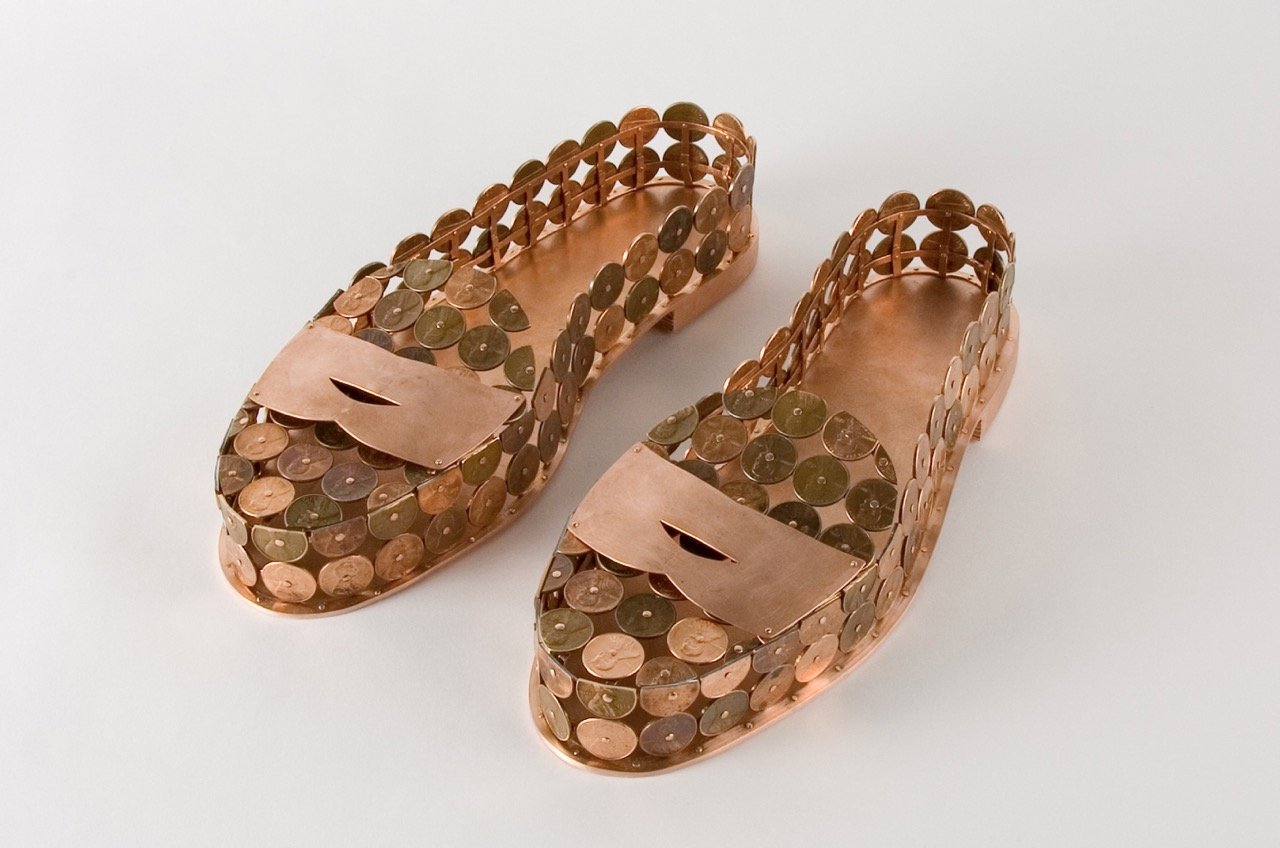
Penny Loafers by Sonya Clark, 2010, Copper and pennies. Courtesy of artist.
Find a penny, pick it up, all the day you’ll have good luck.
But what exactly will you have in your hand? The seemingly obvious answer is copper – simple, but almost entirely wrong. An American cent is only 2.5% copper, just a thin plating on the exterior. The core is made of zinc, because it’s so much cheaper, about one-fifth the price. It’s been like that since 1982. The coins were reformulated to reflect the rising cost of copper, driven by the demand in the electronics industry (it’s the most electrically conductive metal, apart from silver, and nowadays about 70% of global copper use is for wiring). In 2023, the penny will be phased out entirely, with the last batch minted on April Fools’ Day. Yes, these days, metal is just too valuable to make money out of it.
If it makes you feel any better, pennies were actually never made from pure copper. Mainly, they have been composed of a bronze alloy, which includes small quantities (about 5% total) of tin and zinc. Though it’s not strictly legal to do so – this is government-backed currency, after all – you can actually take a fistful of these old coins and beat them into mokume gane (“woodgrain metal”) with whorled, contrasting patterns. It won’t be a very good version of the technique, mind you, because of the low percentage of copper. Better to use quarters – which are mostly copper, 8% nickel – or, much better still, do it the way that master Japanese smiths do it, meticulously stacking thin sheets of copper, silver, and gold into a billet, then heated as it’s worked to create a new alloy between the various materials, binding them together.
In 1943, there was even a brief moment when pennies were made of zinc-coated steel, with no copper at all. This was a bit of a disaster, materially speaking – the zinc oxidized to a dull grey, and when the plating wore away it exposed the underlying steel to rust. But it did save on copper, which was needed for the war effort: in radios and other equipment, and to make gun cartridges out of brass, an alloy mostly of copper blended with zinc. More recently, copper-based World War II metals have been in the news. With the ongoing increase in copper’s value, Japanese vessels sunk in the Pacific have become targets for unlicensed salvagers who are intent on reclaiming copper pipes and brass propeller blades. Diving for 75-year-old metal scrap is just one, admittedly ambitious, example of the way that copper circulates. This is possible because, like aluminum and steel, it is infinitely recyclable. It suffers no loss of its ductility, conductivity of heat and electricity, resistance to corrosion, and other physical properties when it is melted or reshaped.
The visionary polymath Buckminster Fuller was fascinated by this universal exchangeability of copper, and went so far as to make a full inventory of the world’s supply in 1936. “Out of all the copper mined in all history,” he wrote, “only 14 percent is not at present in an averagely recirculating 22 -year cycle of use… within decades, as much as 98% of all the copper that has been mined by all man will be in constant recirculation” Those statistics don’t bear very close inspection, but amazingly, Fuller did predict the salvaging of “munitions ships at the bottom of the ocean. We know where all that copper is, and in due course, it will be brought back into use.”
In fact, the current annual rate of copper recycling is only about one-third, but that is the highest rate for any metal. It would be even higher but for the difficulty of separating the metal from plastics, notably the PVC used to insulate wire. This gets us to the heart of the matter: copper is the ultimate chameleon, useful in its own right, but far more so when put into combination with other materials. Unless you happen to be an electrician, or own a lot of expensive copper pots and pans (highly responsive to changes in heat, thanks to the metal’s high conductivity), you probably have very little experience with the metal in its pure form. It is almost always encountered in combination with other substances. This points to a key aspect of material intelligence: an appreciation for the inherently fluid and multivalent nature of substances, even one as fundamental an element that appears as number 24 on the periodic table.
The story of copper’s mutability is as old as technology itself. The nineteenth-century Danish curator Christian Jürgensen Thomsen coined the term “Bronze Age,” the earliest copper alloy and a material that marked a critical shift in human development - supplanting rudimentary stone tools, but not yet arriving at the harder tools (and more destructive weapons) of the succeeding Iron Age. From that ancient time to the present day, copper alloys have remained at the forefront of innovation. Bronze and brass between them dominate the artistic and technical history of metals, having been used for everything from astrolabes to zoomorphic sculptures.
Bronze medal winners at the Olympics do actually receive an object made of cast bronze (95% copper, 5% zinc), using modern techniques of casting and etching. For the Tokyo Olympics in 2020, all the metal needed (the silver and gold too) was reclaimed from used electronics donated by the public. Copper also plays a key role in the production of brass musical instruments. The timbre of the instruments in an orchestra’s brass section depends on the alloy used, with more zinc resulting in a brighter but less expansive tone. (“Yellow brass” is a 70/30 blend of copper and zinc, while “Gold Brass” is 85/15.) Wynton Marsalis’ trumpets are made by a company called Monette in Portland, Oregon, whose horns are considered the best in the business. Staffed entirely by trumpet players, they put together four feet of straight and flared brass tubing – about 150 parts total – into each of their handmade instruments. Marsalis gets a new one of these copper-based horns about once a year, each an incremental improvement on an ever-evolving design.
A little-known but crucial aspect of the metal’s history has to do with the introduction of copper sheathing to oceangoing vessels in the 1780s. This marginally increased a vessel’s speed and maneuverability, but more importantly, doubled its years of useful service by protecting against rot and infestation. Chillingly, this sheathing contributed substantially to the expansion of the Atlantic slave trade, as it meant greater returns on investment. Like the concurrent development of the cotton gin, this was a technical innovation that inadvertently led to untold human suffering.
Sometimes copper’s role in an alloy is minimal, but nevertheless essential. Pewter, which is mainly tin with a small admixture of copper (typically 1-2%, to harden the alloy), was first developed in ancient Egypt. Due to its low melting point it could be readily cast in molds, and it was also cheap – the two factors together making it the only rival to ceramics and wood for inexpensive tableware throughout European history, all the way until the synthesis of plastics. An even less expensive option was “ley” or “lay” metal, a softer and cheaper alloy that had too high a lead content (15% or more) to eat or drink from. In 1844, the pioneering political economist Andrew Ure warned his readers that “the tendency of the covetous pewterer is always to put in as much of the cheap metal as is compatible with the appearance of his metal in the market” – so they had best watch out for lead-rich flasks of vinegar and wine!
Copper even played a role historically in the production of the finer metals. For example, early modern consumers in Europe aspired to own objects and accoutrements made of sterling silver, which includes a small quantity of copper (7.5% or so) to harden the metal, or the slightly less expensive but visually alluring alloy known as Paktong, a Cantonese word that literally means “white copper.” This traditional Chinese alloy was composed of about two-thirds copper and one-third nickel, sometimes also including zinc. Both durable and tarnish resistant, it found widespread use in household wares such as candlesticks, furniture hardware, and fireplace fenders. Paktong made a passable substitute for silver, and rather like true porcelain it remained something of a mystery material in Europe, as nickel itself was not identified as a distinct metal until 1751. That metal got its name from German miners, who believed that a mischievous sprite or Nick had interfered with what appeared to be copper ore, ruining its usual properties.
In 1905, the International Nickel Company smelted a natural ore in the Sudbury Basin in Canada that was the material inverse of Paktong, about 67% nickel and the rest mostly copper. Immodestly, the company president Ambrose Monell named it after himself, proclaiming the discovery of the wonder-metal Monel®, “Modern as Tomorrow.” As design historian Ana Lopez comments, “it may have been just that, had it not been for the rising price of nickel,” for it could be machined, forged, spun, cast, brazed, stamped, or welded, without losing its silvery appearance. After a brief heyday being used in architectural metalwork – including by the blacksmith luminary of the age, Samuel Yellin – price increases drove this short-lived alloy into obscurity.
While copper alloys like bronze, brass, and cupronickel are a complex and rich subject, they are only one aspect of this elemental metal’s story. As hinted above, it is quite rare for copper to appear in nature in a pure form, a state known as “native copper.” Instead, it is usually encountered in the form of compounds, most often as an oxide, that is, in combination with oxygen. This is chemically analogous to iron rust, though copper does not corrode physically to the same extent as it oxidizes, instead turning green in color. It may surprise you to know that the Statue of Liberty shone like a new penny when its installation was completed in 1886. Fifteen years later, its copper skin (31 tons of it, only 3/32” thick) was already acquiring the protective patina called “verdigris” that it bears today.
The role of copper in pigment production deserves attention as well. If not for naturally-occurring copper compounds, humans throughout most of our history would have had few options to introduce bright shades of blue and green to our material culture. A phosphate of copper and aluminum is present in turquoise, an important decorative stone in the ancient Americas, and a material also used as a pigment in paint. Azurite and malachite, both forms of copper carbonate, likewise were ground into pigments for painting. The blue skies and gowns in many Renaissance paintings, for example, were painted with azurite.
Copper oxide also is a critical colorant in glass - used to make a ruby red - and in pottery glazes. If fired in a standard environment, it produces a green color but amazingly, turns bright red when reduction-fired (that is, with oxygen choked out of the kiln atmosphere, traditionally by burning wet straw or some other organic material in the kiln). This is how the Chinese produced the legendary “oxblood” or sang de boeuf glaze – first achieved in the Ming dynasty for high-prestige ceremonial wares, and later perfected in the imperial kilns of Jingdezhen, under the supervision of Lang Tingji (hence its Chinese name Langyao Hong, “Lang kiln red”). Western potters worked long and hard to duplicate this stunning copper-based red glaze; among them was Hugh Robertson, who has been called America’s first art potter. Obsessed by his “struggle to master the Blood,” Robertson ended up bankrupting his business for a time, but was successful in creating extraordinary red copper glazes, sometimes gorgeously streaked with green when the kiln was only partially in reduction.
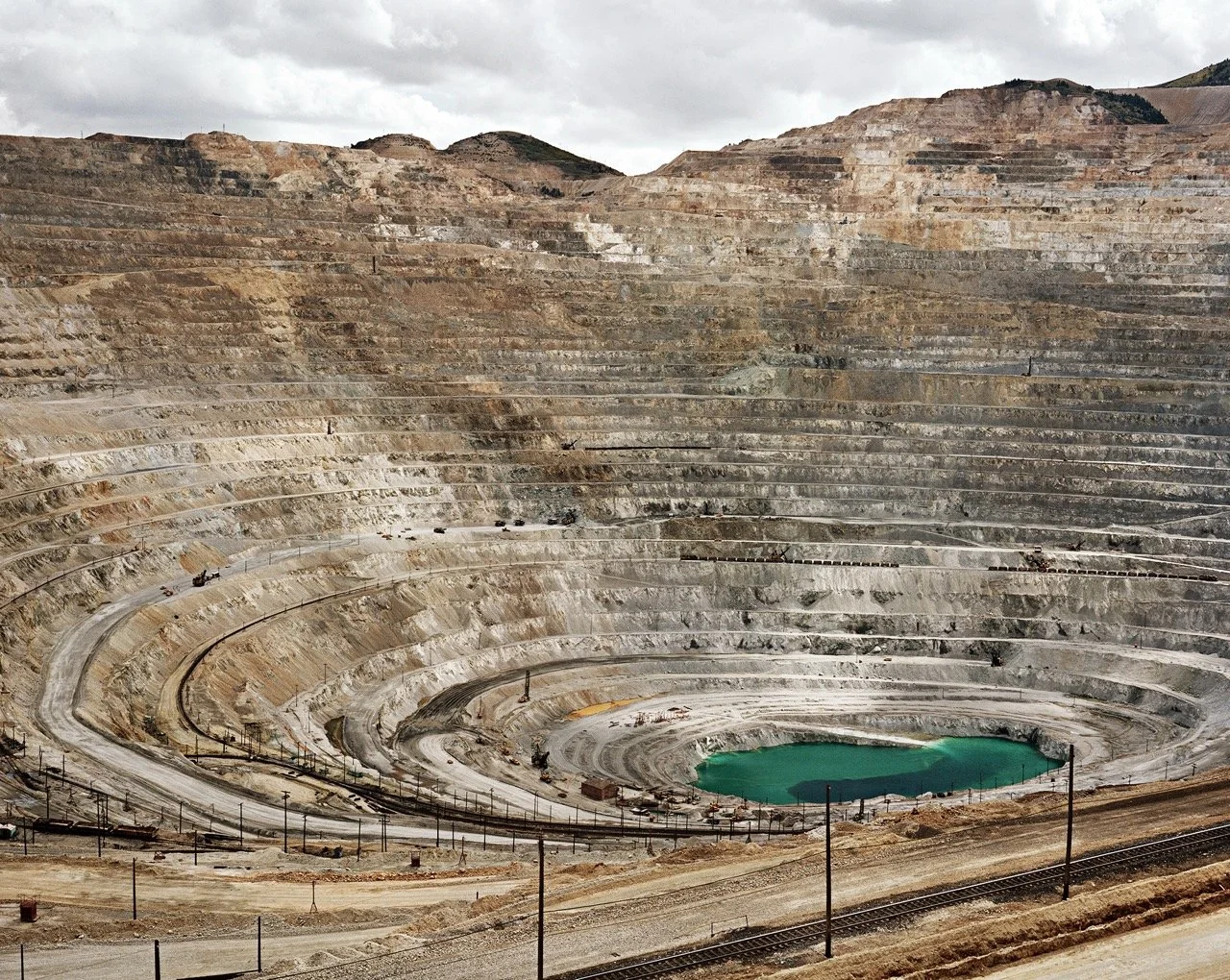
Mines #22, Kennecott Copper Mine, Bingham Valley, Utah, 1983. Photograph by Edward Burtynsky.