Introduction
Glenn Adamson
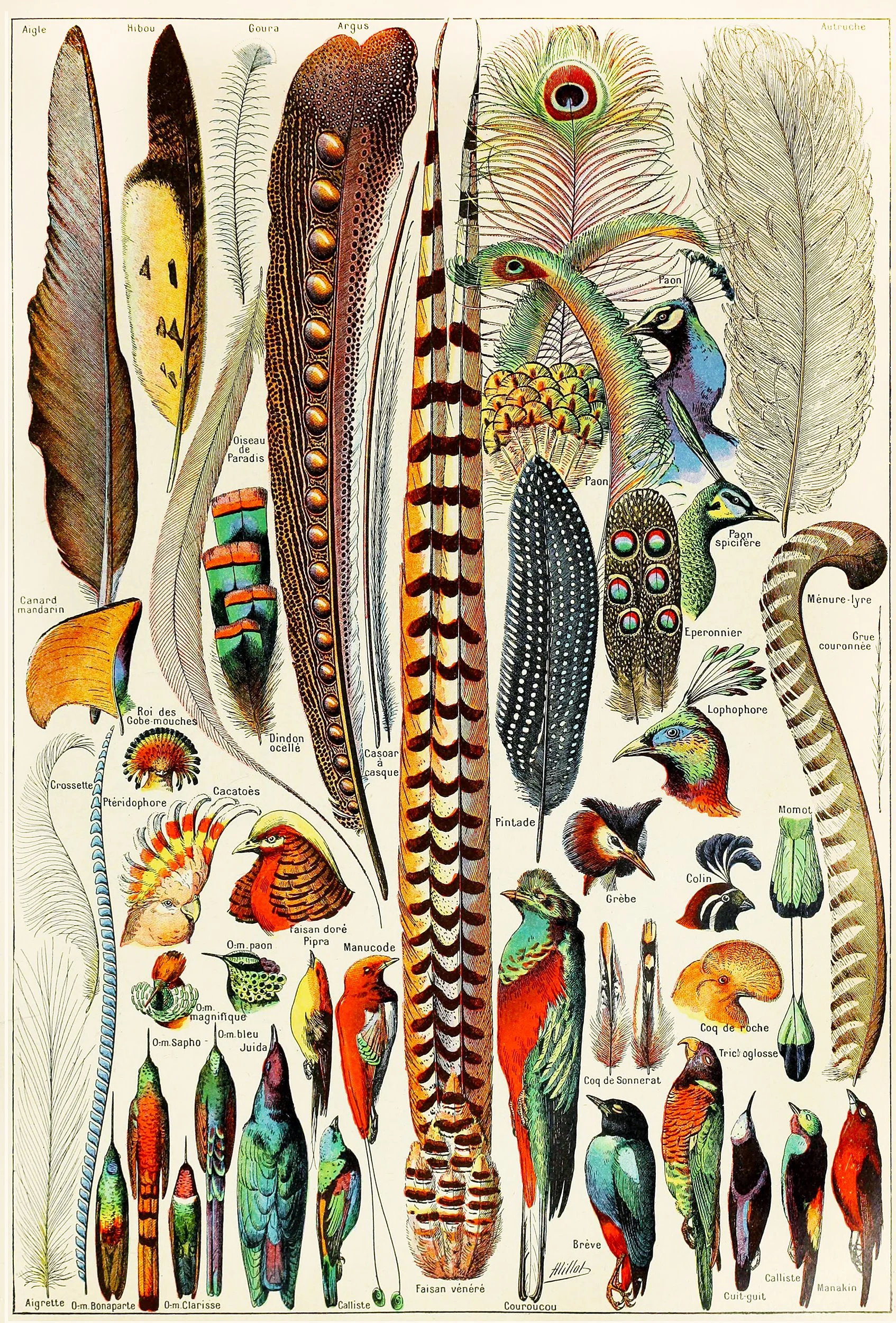
Adolphe Philippe Millot (French, 1857–1921), Illustration of Feathers and Birds, ca.1923. Lithograph. Credit: Private Collection Prismatic Pictures / Bridgeman Images.
A resplendent quetzal (Pharomachrus mocinno) perched on a branch, its long tail hanging down in an elegant s-curve: it’s the very definition of sitting pretty. The bird ranges from Mexico to Panama, living mainly in cloud forest habitats. As with many avian species, the female is earth-toned in color. But the male! It is exquisiteness incarnate, crested in gold, bright ruby at its belly, with amazingly intense emerald-green tail feathers, which grow up to three feet long in mating season.
It was Darwinian evolution that brought this marvel into the world – but people who decided it was magic. The name of the bird is derived from the Nahuatl word quetza, “to raise, or lift,” making it conceptually synonymous with transcendence itself. In keeping with this association, ancient American civilizations accorded the quetzal a very special place. Its feathers, alongside those of scarlet macaws, roseate spoonbills, and other brightly colored species, were used for ceremonial headdresses and clothing. When poets were depicted in speech, green-blue scrolls were shown issuing from their mouths to suggest that their words were flying up to the heavens.
A compound deity was made of the quetzal by combining it with a snake. Called Quetzalcoatl by the Aztec, Kʼukʼulkan by the Maya, this powerful god embodied the force of creation itself, and presided over agriculture, the sun and wind, and all the human crafts. The “Feathered Serpent” was understood as existing in opposition to Tezcatlipoca (“Smoking Mirror”), the personification of war, night, and sacrifice – identified with the volcanic glass obsidian, as we discussed in our issue on that material.
Is it any wonder that feathers should inspire such reverence? After all, they impart the power of flight, and that once seemed miraculous. Until 1783, when the Montgolfier brothers engineered their first untethered balloon trip (a sheep, a duck and a cockerel were on board, and arrived safely to ground eight minutes after takeoff), birds, bats and insects were the only sentient creatures that could take to the air. And who aspires to a bat or a bug? “‘Hope’ is the thing with feathers - that perches in the soul,” Emily Dickinson famously wrote, and that notion has found its way into the metaphorical repertoire of nearly every culture.
Christianity has its angels, of course, which in the middle ages were sometimes depicted not only as having wings, but as covered with feathers from the neck down. The ancient Romans made a cautionary tale of skyward ambition in the story of Icarus, whose wings of real feathers inset into yellow beeswax melt away when he flies too close to the sun. (The real waxwing, so named because its feathers are tipped in the color of red sealing wax, has no such troubles.) The Han dynasty Chinese conjured the pixiu, a mythical beast with the wings of a bird, the body of a lion, the antlers of a deer, and the head of a dragon; symbolic of wealth, it was said to have an insatiable appetite for gold and jewels. In the traditional religion of both the Yoruba and Igbo peoples of present-day Nigeria, hens are often ritualistically sacrificed, and the feathers of eagles and parrots incorporated into ceremonial regalia.
Peacock feathers are also a longstanding emblem of kingship in India, and the bird is strongly associated with Shiva, the cosmic creator of the Hindu pantheon. The Peacock Throne, completed in 1635 after seven years of work under the direction of master artisan Said Gilani, served as the regal seat of the Mughal empire until it was looted in a Persian invasion, its gold and jewels eventually stripped and dispersed. A humble manifestation of power known in the British Isles is the “witch’s ladder,” a simple arrangement of rope and cock’s feathers to which various spell-casting powers have been attributed. (One example, found hidden in an attic in Somerset and now in the Pitts-River Museum, Oxford, was “said to have been used for getting away the milk from neighbors’ cows.”)
Still today, in common English, feathers stand for our various states of mind. They are what we imagine putting in our caps when we’re successful, what gets ruffled when we’re annoyed, what we’re knocked over with when astonished. This edifice of mythology and metaphor rests on an organic structure of incredible complexity. If you’re not an ornithologist (or a paleontologist, because some dinosaurs were also feathered), you likely have no clear understanding of how birds actually manage to fly, though Wikipedia does a pretty good job of explaining it. In brief, they have two types of flight feathers, rather wonderfully called “remiges and retrices,” from the Latin words for “oarsmen and helmsmen.” The remiges, positioned on the wing, provide thrust and lift. The retrices, on the tail, help with steering and braking. The body of a bird also has two basic types of feather: soft down on the underside, for warmth, and contour feathers, which provide streamlining and waterproofing.
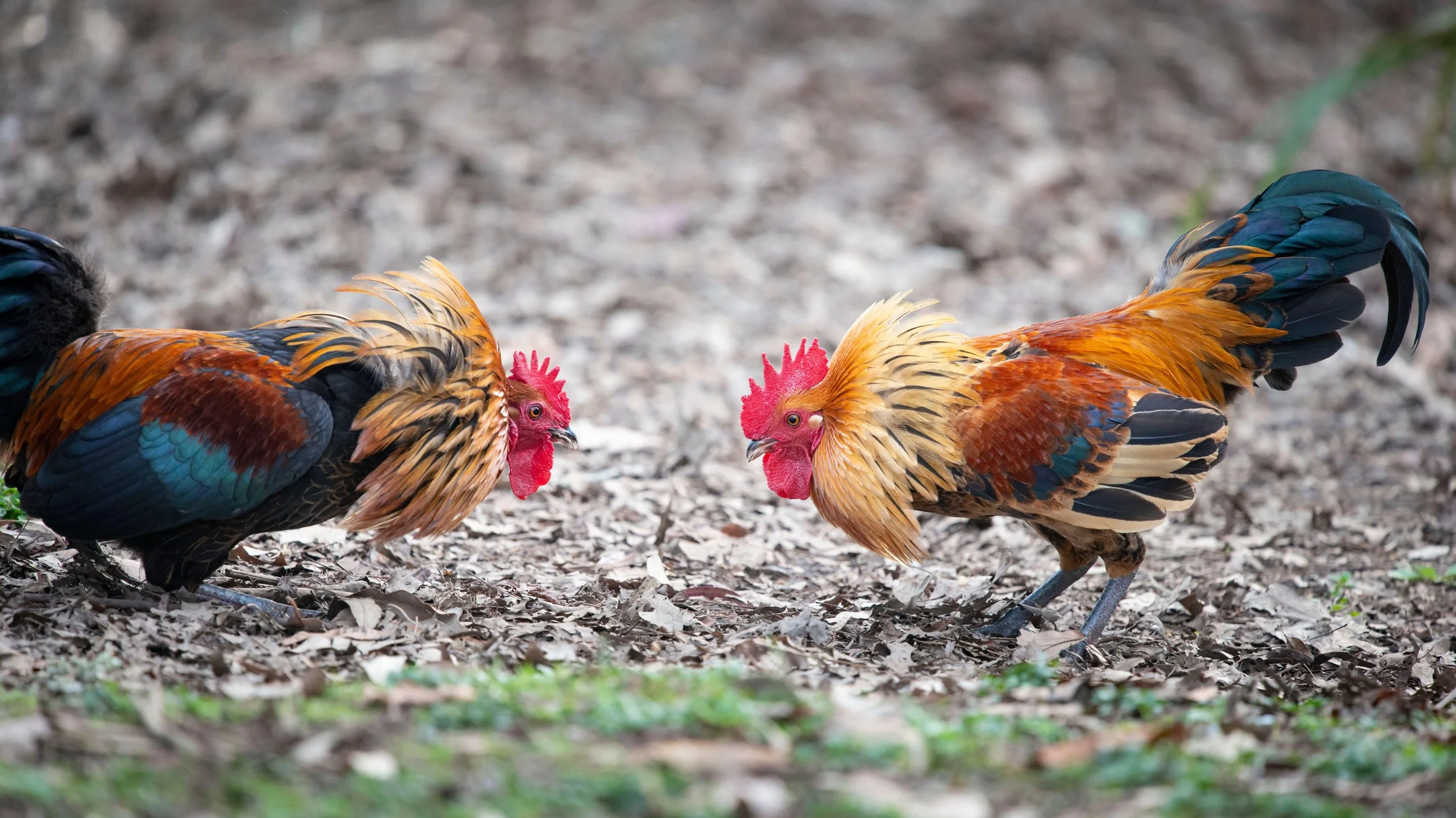
Wild roosters standing off in Austrailia. Photo: Alamy.