Hair
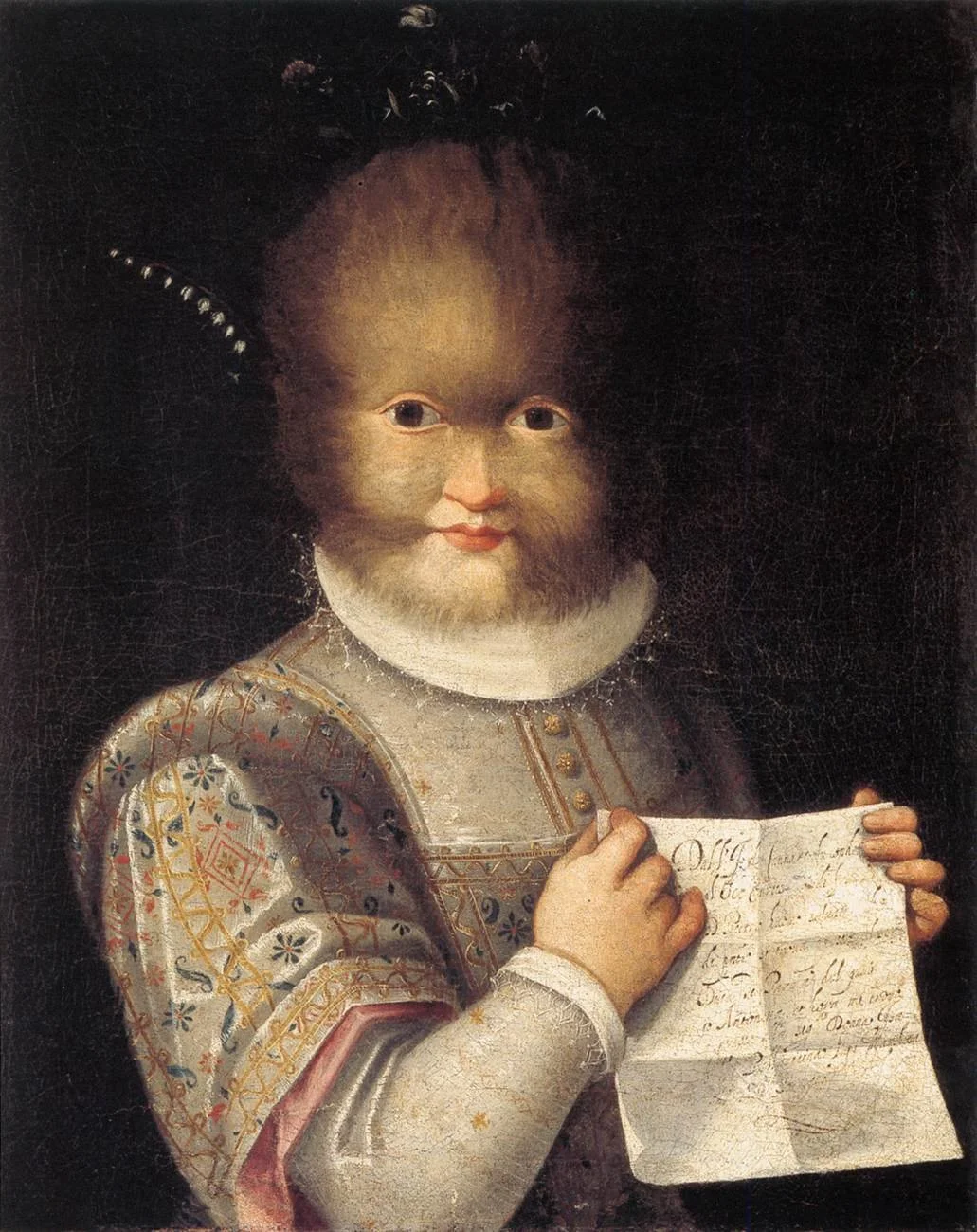
Lavinia Fontana, Portrait of Antonietta Gonsalvus, Daughter of Predro Gonsalvus ("The Hairy Man"), ca. 1593. Oil on canvas. Musée des Beaux-Arts de Blois, 997.1.1.
Glenn Adamson
“I want it long, straight, curly, fuzzy, snaggy shaggy, ratty matty, oily greasy fleecy shining, gleaming steaming flaxen waxen, knotted polka-dotted, twisted beaded braided, powdered flowered and confettied, bangled tangled spangled and spaghettied!” If you’re of a certain age, you’ll probably recognize these lyrics from the title song of Hair, the “American tribal love-rock musical” that brought hippie culture to the Broadway stage in 1968 (and subsequently to television and movie theaters). Compared to the real experimentation happening in the counterculture, Hair was pretty mainstream, a branding exercise of sorts for the astrologically-attuned “Age of Aquarius.” But the show was nonetheless purposefully controversial, mostly for a brief nude scene and a song celebrating the pleasures of sodomy, but also for its celebration of “down-to-there hair, shoulder length and longer,” of unshaved armpits, of natural Afros, of the hirsute body in all its natural splendor.
In the late 1960s, this was fighting talk. The era’s culture war between the squares and the “longhairs” was fought out in salons, schools, and workplaces. And this is only one of countless episodes of hair politics throughout history, which are strikingly various in their expression. Ancient Romans took the hair of their defeated enemies as war spoils and made it into wigs for high-born women. When the Emperor Hadrian began wearing a beard, indicating his admiration for Greek culture, men across the empire followed suit. At the other end of the social spectrum, slaves had their hair cropped short, making their status instantly visible. Domination over the body, indeed, has very often been signaled and symbolized by the enforced removal of hair. Across many different circumstances – in military units worldwide, the African slave trade, and Nazi concentration camps – shaving the head has been a means of taking away individuality, removing cultural identifiers in an attempt to systematize, and sometimes to dehumanize.
The Chinese Qing dynasty – recently established by Manchu invaders – undertook a particularly large-scale experiment in this kind of social control. In 1645, they imposed an edict known as the tifayifu, literally “changing clothes and cutting hair,” which required all male subjects to wear their hair in the Manchu style, shaved up front and in a long queue at the back, as a sign of fealty. After fierce resistance and ensuing brutal reprisals – thousands of people were slaughtered simply for refusing the hairstyle. Centuries later, the symbolism was still there: rebels associated in the 1911 Revolution against the Qing cut off their queues as a gesture of self-conscious modernity.
Meanwhile in England, Victorian moralizers were strictly regulating hairstyles for girls and young women, with those unlucky enough to have frizzy or curly hair generally struggling to meet the standard. “I have again and again intimated that I desire the hair to be arranged closely, modestly, plainly,” the dreadful school master Mr. Brocklehurst declares in Charlotte Brontë’s novel Jane Eyre. “We are not to conform to nature.” In the 1920s, flappers like Josephine Baker signaled their modernity by rejecting such tidy buns and braids, adopting daring styles like the “Eton Crop” (so-named for its schoolboy appearance). This is also when lesbians began wearing short hair as a way to reject patriarchal norms, and while it took a half century, this “butch” look eventually became dominant, so much so that some queer women came to feel it had become its own kind of conformity.
These days, there is conflict over the Muslim practice of veiling – covering the hair entirely or partially, as an expression of modesty, in keeping with the Quranic verse, “O Prophet, ask your wives, daughters, and believing women to draw their cloaks over their bodies. In this way it is more likely that they will be recognized as virtuous and not be harassed.” Critics both inside and outside the Islamic faith have seen this proscription as a form of sexist oppression. Adherents of modest dress, conversely, argue that veiling does indeed discourage the objectification of women in public, just as the Quran says. Without adjudicating on this complex issue, it is worth noting that other religions also have long traditions of veiling, including Christianity. The Bible (1 Corinthians 11) decrees that “every wife who prays or prophesies with her head uncovered dishonors her head,” while men are told to keep their hair fully on view. It’s a gender-based disparity that can be observed in traditional wedding ceremonies to this day.
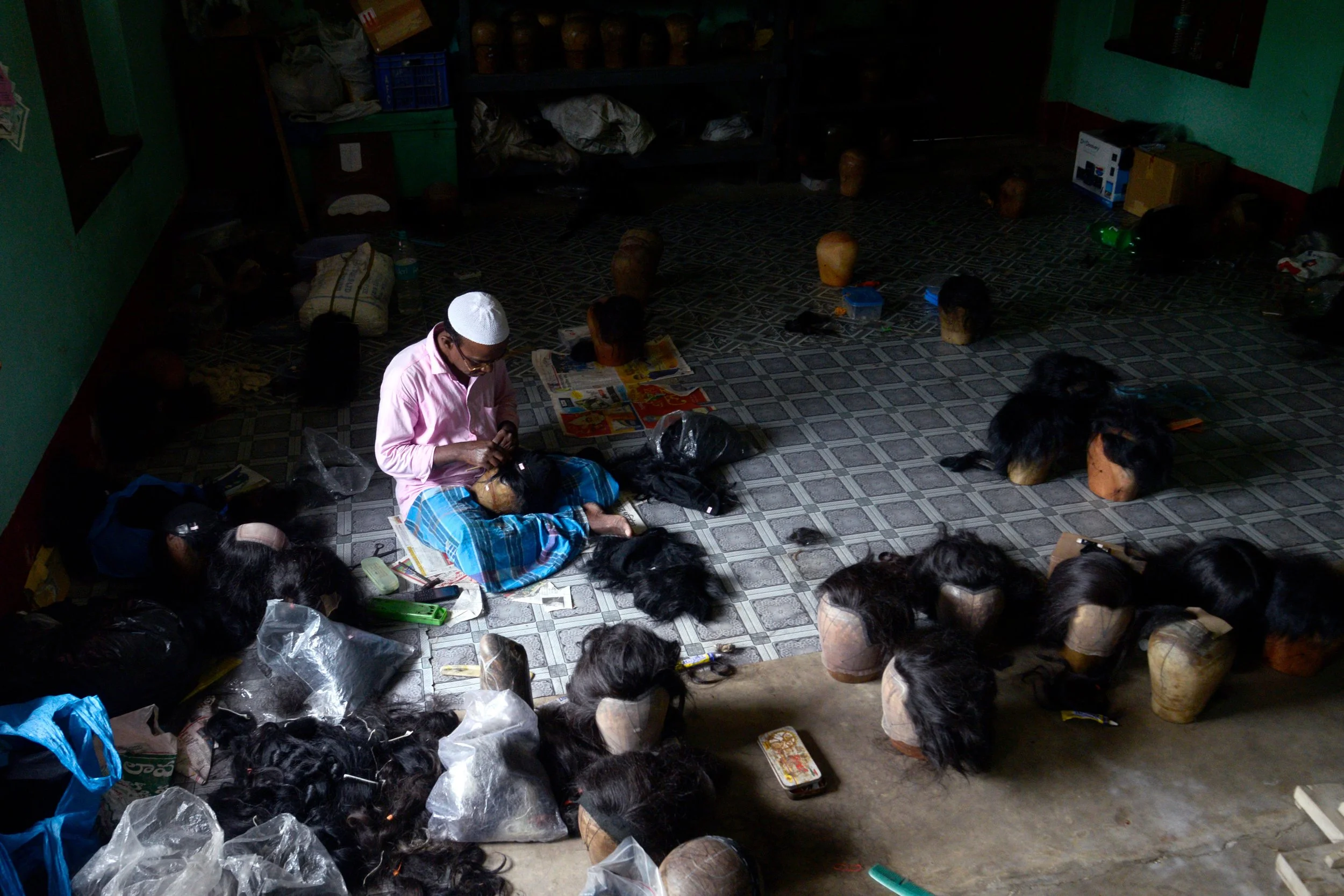
Wig manufacturer in West Bengal, Kolkata, India, 1 May, 2018. Credit: Saikat Paul / Pacific Press / Alamy Live News.
What accounts for the amazing prevalence, and sheer intensity, of hair-based politics? As so often, it’s helpful to apply a little material intelligence. Lisa Jones, author of a terrific piece of investigative reporting on the trade in wigs and extensions, points out that human hair is “of the body, bodylike, and, to quote shampoo ads, ‘full of body,’ yet not a body part.” Like our finger and toenails, the hooves of horses, and the feathers of birds, human hair is made principally of a protein called keratin, which has a strength-to-weight ratio approximating steel. It has no nerve endings – which is why it doesn’t hurt when the barber cuts it – and while it’s only a myth that hair keeps growing after death (it only appears to, because of the retraction of the skin), the fact is there’s something eerie about this stuff. Hair sprouts continually from us, propagated by stem cells in the skin; in itself though, it is inert.
The anthropologist Mary Douglas famously observed that any substance that has “traversed the boundary of the body” is inherently unsettling, because it is a reminder of our physical vulnerability, and ultimately, our mortality. This, she argued, is why we have such unease around blood, faeces, spit, and urine, and why they are so often central to ritualistic prohibition. Hair is a special case. It fascinates us when still attached to our body, and disturbs us irrationally when it has separated. The very same strands are beautiful on the head of a loved one and disgusting in the shower soap, because, as Douglas puts it, “a half identity clings to them.”
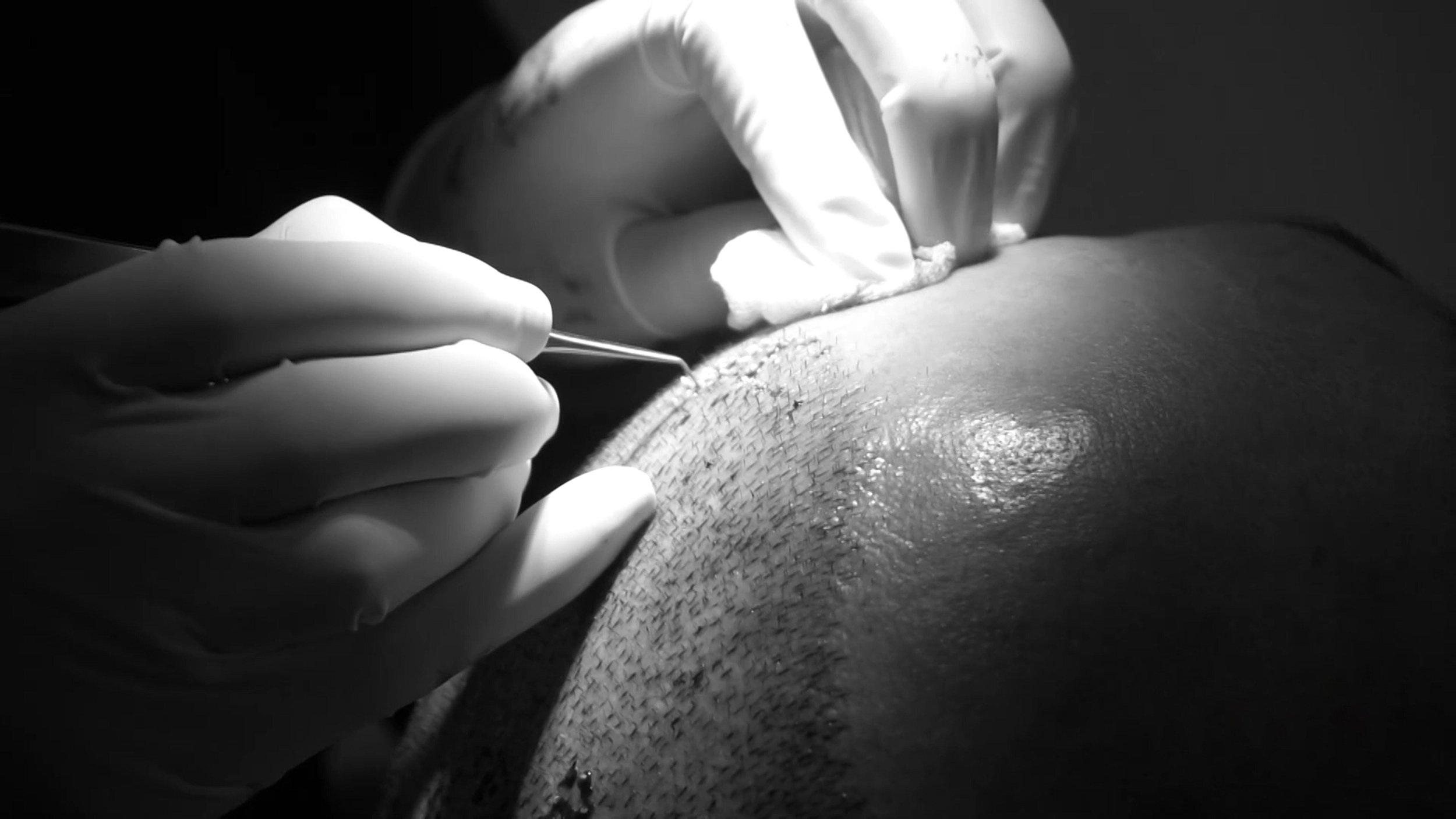
Close-up shot of hair transplantation procedure, 2021. Gokhan Uzunalan / Alamy.