Introduction
Glenn Adamson
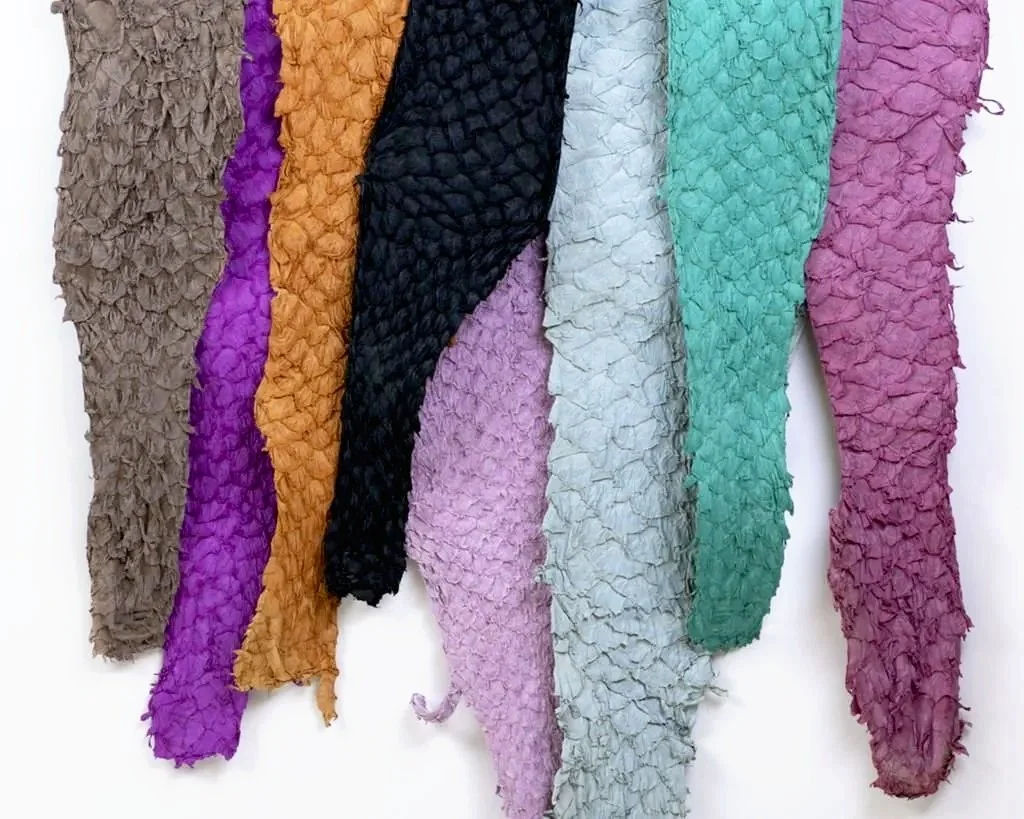
Sea Leather Wear, Sueded Carp Fish Leather. University of Pennsylvania Fisher Fine Arts Library Material Collection.
At the end of the world, all the leather scraps that ever were will be gathered together and made into one big shoe. So we read, at any rate, in the so-called Prose Edda, a compilation of Norse mythology and prophecy, attributed to the thirteenth-century Icelandic scholar Snori Sturluson. He tells us that at Ragnarök – a climactic battle of the gods against their enemies – the All-Father Odin will be slain by the great wolf Fenrir. In vengeance, Odin’s son Víðarr the Silent will step on Fenrir’s jaw, and rip the beast apart: “he wears on that foot the shoe that has been assembled through the ages by collecting the extra pieces that people cut away from the toes and heels when fashioning their shoes.” Now that’s recycling.
It’s a good story, and one that feels strangely relevant today, with the wolf of climate change at the door. In Sturluson’s day, leatherworking would have been familiar to anyone telling or hearing such a legend. It was a labor-intensive process, and in its initial preparatory stages an extremely foul-smelling one, usually relegated to the outskirts of a settlement. When the Vikings made the skin of a deer, cow, pig, goat, or sheep into leather, they first had to de-flesh it, and then de-hair it using urine or lime. The cleaned hide was then “bated,” soaked in water and animal excrement to soften it. Then it was placed in another bath containing a large amount of oak bark and leaves, which are naturally rich in tannic acid (the English word “tanning” derives from tann, the ancient Celtic word for oak).
As the hide soaked – possibly for more than a year, depending on the thickness and intended purpose – the collagen proteins in the material bound to the tannins, sealing the surface and making it resistant to water and decomposition. Finally, the leather was “curried,” a finishing stage of stretching and burnishing. If softness and flexibility, rather than durability, is desired then the underlayer can be split from the top grain; this is what we call suede. Each of the steps in this process could be varied depending on the intended use of the leather, and also tinted with dye.
All that before a shoemaker could even set to work. The material intelligence applied to leather is wondrous in its extent. It is also quite variable, depending on local traditions and available materials. Native American tribes have long used the brain matter of deer, raccoons, or beavers to tan their skins, and have applied elaborate ornamental and symbolic beadwork to the finished leather. In East Asia and the Middle East, the cartilaginous skin of rays and sharks is used to make shagreen, used to sheathe boxes, footwear, and sword hilts. (It had a vogue in France in the 1920s, as one of the orientalist ingredients in the cultural cocktail of Art Deco.) In Moorish Spain, a beautiful but tough leather was made from the hindquarters of horses. It came to be called Cordovan, after the city of Cordoba; this is the etymological source of the word cordwainer, a synonym for shoemaker. Chaucer, who was England’s controller of customs for wools, skins and hides and presumably knew his leather, gave one of the characters in his Canterbury Tales “shoone of Cordewane.”
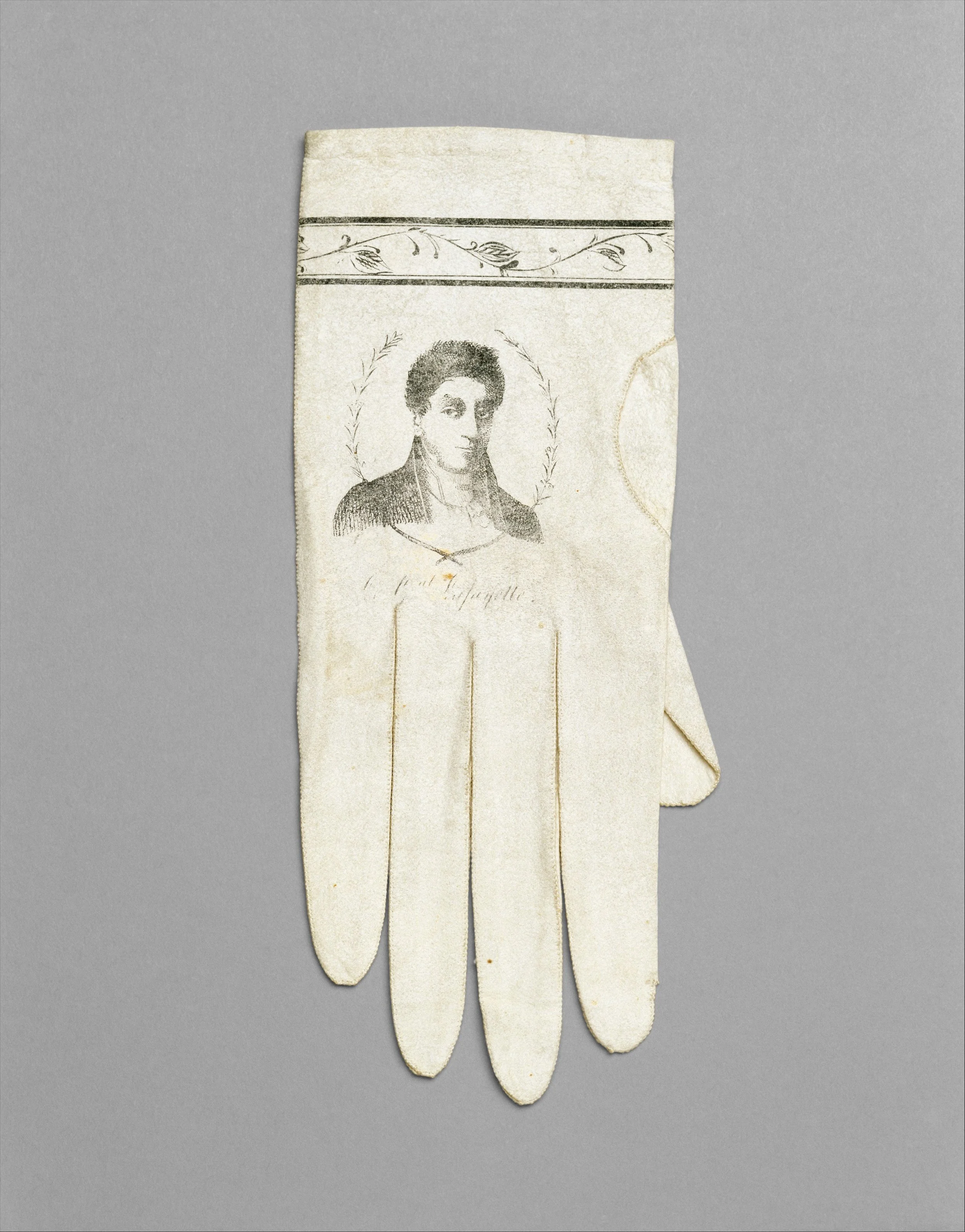
Gloves, 1824, France, Leather, Metropolitan Museum of Art, C.I.46.59.15a, b.
A thin, soft leather called chamois, used mainly for glove-making, originated in France at the end of the seventeenth century. It was named after a European antelope whose skin was often used for the purpose. The British quickly followed suit with a similar leather made from the hides of young goats, eventually giving rise to the saying, “handle it with kid gloves.” A hundred years after that, industrialists began developing new varnishes for leather, which could raise it to a high gloss; they took out patents for these processes, and the name stuck. In 1857, Scientific American reported one recipe for patent leather – equal parts linseed oil and lead oxide, mixed with chalk or ochre, and then polished with pumice – and voiced the justifiable concern that so much lead near the skin might be quite dangerous: “persons who so indulge look shiny about the feet at the expense of their health.”
As with so many other materials, however, the culturally-specific richness of leather has been “improved” almost out of existence. That story begins in the 1840s, when a Swedish chemist named Carl Hyltén Cavallius developed a new way of tanning hides with chromium salts, rather than organic materials. (Like a natural tannin, the process bites into the hide with acid, then cross-links the collagen protein, making waterproof leather.) It had several advantages: it only took about a day, resulted in a pliable but strong product, and stank much less than the old way. Cavallius died of blood poisoning before he could put his method into widespread use, but in the 1880s, chrome tanning was commercialized by Augustus Schultz, a German immigrant in New York City, and it remains the basic method for tanning worldwide today. Unfortunately, chromium easily oxidizes into a toxic pollutant, which can then find its path into waterways. One recent study found that 25% of Bangladeshi chickens have dangerous levels of chromium in them; another found that half of the workers at one Pakistani tannery had been poisoned in their workplace.
Meanwhile, faux leathers have been in manufacture since 1920, with the invention of Naugahyde – a combination of leather fibers and rubber, laminated over fabric. (Readers of a certain age may remember Garfield the Cat complaining to his owner Jon: “do you know how many Naugas had to shed to make this leash?”) Vinyl plastic was eventually determined to be a superior imitation; at the 1964 World’s Fair, the chemical giant DuPont released a fake patent leather called Corfam, hoping to duplicate their earlier success with nylon. With constant improvements in quality, these imitations have become increasingly convincing, so that it can sometimes be difficult to tell, nowadays, whether or not a sofa is upholstered in the genuine article.
But perhaps this makes a certain amount of sense, for leather has always been as much metaphor as material. It’s used to describe the flavor of wine and whisky, an association based on the common presence of tannins. (The most ancient surviving leather artifact, a shoe found in a cave in Armenia, dates to about 5500 BCE; the world’s oldest winemaking site is right next door.) The warning “I’ll tan your hide for you!” is attested as early as 1731. Potters speak of their work as “leather-hard” once it’s dry enough to work the surface without deforming the overall shape. And of course, we speak of overcooked food as being like shoe leather – a saying that inspired one of Charlie Chaplin’s best bits, in The Gold Rush (1925), where the poverty-stricken Little Tramp is reduced to making a dinner of his footwear. (He licks the hobnails clean.)
Perhaps the most common of these sayings is only half-metaphor. When we speak of someone as having “leathery skin,” we’re unconsciously analogizing their life experience to the tanning process. It’s one of those figures of speech that seems innocuous enough, but on closer inspection, has troubling overtones. On the one hand, Clint Eastwood, in The Good, the Bad and the Ugly (1966), seems all the more heroic because his weathered skin matches his gun belts and boots. (He got the part after starring in the tellingly-titled TV show Rawhide.) Women in westerns, on the other hand – the romantic leads, anyway – invariably appear fresh-faced and lily-white. In the real world, leathery skin is what you get from working outside in the sun, so it can also be a marker of class. Far more disturbing are these facts: the Nazis made leather out of the skin of their victims during the Holocaust; according to a Philadelphia newspaper in 1888, a “prominent physician” in the city boasted of having shoes made from “the skin of negroes”; and a 2016 study discovered that fully half of a random sample of white medical trainees believed that African Americans had thicker, less sensitive skin than white people.
These are unwelcome reminders of a highly unusual and provocative aspect of leather, as a material: it comes close to the human skin in more than a literal sense. Taken from a living body, it has an uncanny relationship to our own. As design theorist Ulrich Lehmann points out, we can feel it, but it can no longer feel us in return. Leather thus occupies a liminal condition, as if it were a membrane between life and death itself. This is perhaps why it is usually lined, or worn as an outer garment, rather than touching our own flesh; maybe we don’t want that strange power right up against us. It’s also, probably, why leather is so often eroticized, in the “kink” or fetish scene and in popular culture more generally. The crass obviousness of the gender dynamics at play, here – stiff leather for boys, supple for girls – have made them easy to manipulate for effect. The celebrated queer illustrator Tom of Finland gave his beefcake musclemen impossibly body-hugging leather trousers, while attitudinal female pop stars like Joan Jett, Debbie Harry, and Beyoncé have all worn the classic “butch” biker jacket. (As for Madonna, her career-long involvement with leather merits a PhD dissertation.)
The dynamics of embodiment cling to leather even when it’s used at a remove from our own skin. Here things get subtle. Leather recommends itself as an upholstery material partly for practical reasons. It’s easy to keep clean, tougher than fabric, warm in winter and cool in summer, and ages well. But surely it’s no coincidence that chairs, the most anthropomorphic of objects with their legs, arms, seats and backs, are covered with leather exactly where we place our bodies? Then there’s the deluxe coziness of a leather automobile interior, metaphorically speaking, a womb with a view. Or the atmosphere of a library lined with leather-bound volumes – each one, we so easily forget, taken from a different living creature – reinforcing the tacit idea of immortality that is inherent in all books: the survival of the written record after the death of its collective authors, a triumph over time itself.
Not too many of us have a car or library like that, of course, and some would say that leather has had its day, that its luxuriousness and practical benefits can’t possibly warrant the environmental damage caused by the industry. Marketers, keen to exploit this instinct, have begun selling synthetics as “vegan leathers” (though there is considerable debate about which is more harmful to the planet, tanning with chromium or turning oil into plastic). Some companies, like Chahin Leather in Veracruz, Mexico, have returned to historic vegetable tanning techniques, which are much less hard on the environment. More niche, but perhaps more promising in the long term, are experiments in making leather out of renewable materials like cork, cactus, mycelium, pineapple, and seaweed.

Suzy Bennett (British), Leather tannery, Fez, Morocco, 2015.