Introduction

Glenn Adamson

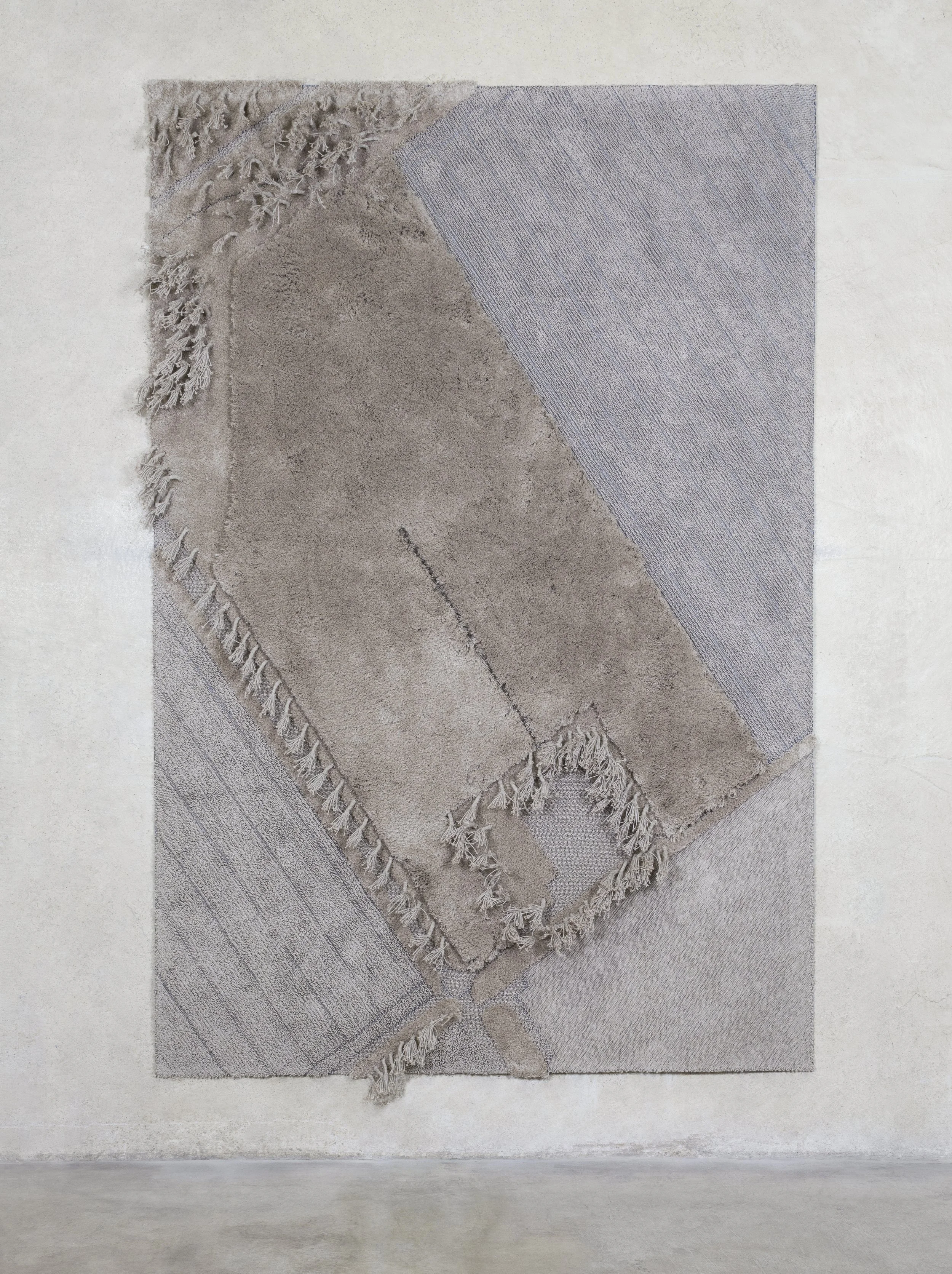
Christien Meindertsma, Flax Field, 2019. Robot tufted linen rug, made of flax that grew on plot Gz69 – West in the Dutch Flevopolder.  Grown by farmer Gert-Jan van Dongen. COMMISSIONED BY: CS Rugs/Richard Hutten as part of the Freedom Collection PHOTO CREDITS: Daniel Kukla (Courtesy of Friedman Benda), Christien Meindertsma

Like a lot of things that came to define European culture, linen came originally from the Middle East. It is the made from flax, one of the plants whose domestic propagation gave the Fertile Crescent its name. The most ancient textile remnants now known to exist, 30,000 years or so old, were found in 2009 in Georgia – not the one in the American South, but the country tucked just between Turkey and Russia, at the eastern edge of the Black Sea. They are nothing more than fragments of spun linen thread, which were probably braided into basketry or rope. What’s especially interesting about them is that they are made not from wild flax, but its cultivated variant, Linum usitatissimum, the latter species term aptly meaning “most useful,” and Linum being the etymological root for the English word linen. (This etymology is paralleled by “woolen” and “silken,” but “cotton” has a different derivation, from the Arabic qutn.) The oldest actual garment known, a dress found by archaeologists in Tarkhan, Egypt in 1913, is also of linen. Having been buried for five millennia, it sat in storage for a further sixty-four years before a group of conservators were asked to clean it, and realized that it was a bodice, complete with pleats. Now at the Petrie Museum of Egyptian Archaeology in London, the Tarkhan Dress has been radiocarbon dated to between 3482 and 3102 B.C.

When linen did come to Europe, it became central to life and culture, so much so that (paradoxically) it can easily be forgotten. The beautifully carved drapery on classical statuary represents linen fabric. So were the sails of trading ships: Pliny the Elder marveled, in his commentary on the flax plant, that “out of so small a seed springs a means of carrying he whole world to and fro.” (Natural History XIX, 1:6) Linen is often mentioned in the Bible, both in connection with holy garments, (Proverbs 31:24, in the King James translation), and as a way to tell a virtuous woman: “she maketh fine linen, and selleth it.” In later centuries, not just the fiber of the plant but its seed oil would take on an important role in art history. “Oil on canvas,” a phrase that appears on a million museum labels, simply describes two of its products in combination: linseed oil used as a binder for pigment, applied to a canvas woven from linen threads. In the nineteenth century, it also gave its name to Linoleum; that’s just the Latin for “flax oil,” which was one of its primary ingredients.

Technically linen is a “bast fiber,” like hemp, jute, and ramie (the last of which is common in East Asia). This means that it is taken from the interior lining of the plant stalk, the layer just beneath the skin; chemically, it is composed of about 70% cellulose. Prior to spinning it into a workable yarn, the stalk must first be dressed, which consists of three processes: retted, scutched, and heckled, three of the most delightful words in the vocabulary of materials. Retting is a soaking of the fibers, which rots and softens the pectin-based bonds between the stalk’s parts. Historically, this was often done in rivers, to the dismay of downstream fishermen, for the process is highly polluting. Scutching is the mechanical process of beating the fibers into their separate parts: the line, which is the best for weaving; a coarser, more broken-up fiber called tow; and the boon or shives, which are the waste, woody parts. The usable parts of the flax are fine and bright white, hence the terms that the blondes among us will have heard, “towheaded” and “flaxen haired.” Finally, the fiber is heckled - straightened out and split into finer fibers by pulling through it through a many-toothed comb.

The fiber is then ready to be spun, a process historically done on a distaff and drop spindle, or using a spinning wheel, but of course now mechanized. Like any yarn, it can be spun either clockwise (Z-twist) or counter-clockwise (S-twist), the latter most common in ancient textiles, for this is the direction that results when a right-handed person spins by hand. To encourage regularity in the yarn, and also to reduce the considerable “fly” (loose dust) that comes off the material, flax is usually spun wet – using water, linseed oil, or simply a bit of spit. It is a good deal easier to spin the long flax line than the shorter fibers in tow.

Linda Heinrich, author of a full-length book on flax and linen, records a Swedish “what am I?” style riddle that elegantly summarizes these various procedures, culminating in the use of linen in both life and death:

First they put me down in the soil
Then I grew to a long stem with flower
Then I was hung until my back got stiff
Then they threw me out on the ground
And there I had to lay until I got pale
Then I could sit with the great at table
And then I followed the dead to their grave.

It is worth meditating on this last line for a moment. Linen and death have been closely acquainted for most of human history; one of the earliest known paintings on a textile substrate is the Shroud of Hori, another discovery from ancient Egypt; likely dating ca. 1295–1070 B.C. trapezoidal shape, and curvature in the horizontal threads; when it was acquired, a museum curator suggested it may have been wrapped around a vessel, like the black-topped jars shown under the table in the picture. This is an exceptional example from the tomb of an elite, but whatever a person’s station, no matter what course they took through their lives, it’s quite likely – particularly if they lived in the Middle East and Europe – that they would up at the same destination, a linen shroud. Jesus Christ himself was buried in linen, according to scripture, the textile rubbed with myrrh and aloe. The controversial Shroud of Turin, which many have believed to be this very wrapping, is actually a fourteenth century fake. The “blood” that stains its fibers is actually tempera paint, containing red ocher, vermilion, and small amounts of rose madder, a typical medieval red pigment blend. About the only thing accurate about it is the material; it’s made of linen, as is another false relic, the Sudarium (“sweat cloth”) now in the Cathedral at Oviedo. Long believed to have been used to wrap the face of Christ after he died, scientific analysis has established that it actually dates to about 700AD.

People continued to be buried in such shrouds right through the middle ages and beyond – the great modernist architect Carlo Scarpa, thinking of his medieval forebears, directed that he be buried upright and wrapped in linen in a Cemetery which he himself designed. By that time, such a funerary practice counted as highly unusual. Linen shrouds had gone by the wayside, along with many other historic uses of the fabric: glued together in layers and used as armor (linothorax) among the ancient Greeks; used for wicks in oil lamps; as the base for pictorial embroidery; and perhaps most importantly, for paper-making. This key technology was first developed in China during the Han dynasty, and in that context was made using mulberry and other barks, as well as hemp. But when paper began to be manufactured in the Arabic and Christian lands, it was made from pulped rags - fabrics that had outlived their useful life. Cotton would be used for this purpose eventually, once imports from Asia and America made that fiber more widely available; but in the early explosive years of the European print revolution, paper was almost exclusively made of recycled linen. Most copies of Gutenberg’s Bible, for example, were printed on high-quality linen rag paper imported to Germany from Northern Italy.

Around this same time, linen was becoming an increasingly important global commodity. A unique but indicative moment was 1613, when a ship called the New Year’s Gift sailed from London all the way to Japan, carrying diplomatic tokens of esteem. As historian Timon Screech explains in his forthcoming book on the voyage, included in this cargo were some 120 pictures, including both portraits, some of which were painted on wooden panels as was the medieval custom, but others of which were mythological subjects on linen canvas. It made sense to include these technically innovative artworks for such a long journey. Canvas would not warp or crack en route; it was also much lighter, and a large canvas could be rolled and sealed for easy transport. These properties of scale and portability helped make oil paintings a tradable commodity, and also – equally importantly – allowed painters like Peter Paul Rubens to dramatically expand the scale of their art, far beyond the size easily achieved using multiple joined panels.

Art was only one tiny part of the expanding linen trade of the 17th and 18th centuries, when it really came into its own as a global commodity. Appropriately, given that fabric itself is a matrix of crossings, the shape of this commerce was dispersed and anchored at many different sites. The names of linen-producing centers are preserved in the terminology for various types of fabric: damask, a textile with a woven-in pattern, associated with Damascus; lawn, a plain weave linen from Laon in northern France; fustian, a heavy fabric with a linen warp and a cotton weft, from Fustat, the capitol of Muslim Egypt; and ozenbrigg, a tough and durable textile from Oznabrück, Germany. Cambric, a fine white linen, often used to make the spectacular pleated ruffs immortalized in Dutch portraiture, got its name from the Flemish town of Kamerijk (in Dutch) or Cambrai (in French). You may know it from the traditional English ballad “Scarborough Fair,” in which a bitter ex delivers an impossible list of demands to his former lover:

Tell her to make me a cambric shirt
Without no seam nor needlework
Then she shall be a true love of mine

In an age before brands, these terms were generalized beyond their geographic origins, as a way to conceptually organize the wonderful diversity of woven textiles.

The legacy of the linen trade still lies palpably upon the European landscape, anchoring the local identity of such towns as Kortrijk, Belgium, which has a whole museum devoted to the history and techniques of linen production; as well as the politics of whole regions, including Northern Ireland. It is impossible to fully understand the vexed history that led to the Troubles – the devastating conflict between Catholics and Protestants that unfolded in Belfast and beyond in the late twentieth century – without knowing that England had long manipulated the Northern Irish economy to maximize profit from linen.

This story began somewhat inadvertently, when Irish wool was suppressed through duties and outright export prohibition, as a way to protect English wool producers from price competition. Assisted to some extent by newly arrived Hugenots – an exemplary figure was Louis Crommelin, who himself hailed from near Cambrai - the Irish threw themselves into making linen instead, which put them into competition with continental producers instead. The British government, realizing the potential, passed a Parliamentary Act in 1696 removing all duties from Irish and Scottish linen exports to the Americas and Caribbean. The result was that, a century later, linen from Northern Ireland accounted for fully half the value of all Irish exports. It was, among other things, to protect this lucrative trade that the British retained such a tight grip on their nearby colony.

The most tragic consequence of the trade was the Great Famine of the 1840s, which was significantly exacerbated by the dominance of linen production. The diversified agriculture that had once typified the island was disrupted twice, once by the widespread adoption of flax as a cash crop, and then again with the industrialization of linen spinning and weaving, which put many rural artisans were put out of work. They turned to potatoes as their sole source of income, and when the blight came, had no foodstuff to fall back on. Desperate Irish, many of them children, went into lace-making as a way to make ends meet – lace, of course, that was made from linen – and charitable English aristocrats patronized this manufacture, congratulating themselves that they were doing such good things for the poor. Little of this history is remembered, when lace is celebrated as an emblematic craft of Ireland; even so, it is densely woven into the fabric of the nation’s history.

Throughout the British empire – which was itself powered by linen sails, flown from ships manned by linen-wearing sailors - there are similarly unsettling stories to confront. The USA is no exception. Kathleen Brown, in her book Foul Bodies: Cleanliness in Early America, has described linen as “a crucial prop in the European performance of civility.” Wearing bright white linen was considered a reliable indicator of social refinement; it was out of animal skin garments and into linen that indigenous Americans were coaxed, when they were aggressively compelled to assimilate to white culture. The color of linen was also indexed to the color of skin, with the wealthy wearing the finest-spun fabrics, laboriously laundered, and enslaved people forced to wear rough “Negro Cloth,” also called “brown linen,” as our contributor Jonathan Square describes in this issue of Material Intelligence.

For white people in the eighteenth and nineteenth century, conversely, the maintenance of clean linen was a way to indicate status, demanding considerable labor by servants or, for the vast majority of the population, their own hands. This is stressed in no uncertain terms in period advice books such as Catharine Beecher’s Treatise of Domestic Economy (1841), which counseled its largely female readership: “buying linen, seek for that which has a round close thread, and is perfectly white; for, if it be not white, at first, it will never afterwards become so.”

Some help was provided by innovations like the detachable collar, purportedly invented by a woman named Hannah Montague in Troy, New York, in 1827. Tired of the frequent laundering of her husband’s shirts, she had the thought that she could simply unpick the collar, which soiled most frequently, wash it and reattach it. A local entrepreneur saw the commercial possibilities, and a local industry was born: to this day, Troy carries the nickname of “Collar City.” A further improvement was the disposable ‘Linene’ collar, a laminated produce composed of starched paper with linen cloth on the inner and outer face by the Reversible Collar Company of Cambridge MA. Cheaper and much easier than laundering, they were a huge hit, with that one firm manufacturing over three million annually. With the decline in fashion of the separate collar (a development linked to the invention of the washing machine), this business plummeted until it was only the military and clergy who continued buying.

A poignant portrait of the psychological weight that working-class people attached to the ideal of “clean linen” is found in a story by that title by the British writer Llewelyn Powis. Written sometime in the early 1930s, though not published until later, it tells of an ancient woodsman of considerable material intelligence: “with deftly adjusted wedges,” we read, “he could regulate the final fall of the timber to within an inch.” He is hardly a model of elegance, knobby kneed, with “ancient animal feet with hooked and blackened nails that had for so many long years been confined in rough hobnail boots.” But he sets great store by his dress nonetheless. Discovering one morning that he is without a decent collar – his were all frayed from continual washing – he steals one from another tradesman. It is too tight, however, a fact that he discovers only too late: “At last by pulling and wrenching he got the stiffly starched button hole over the knob of the stud. It was too tight. He felt as though he was being throttled. For desperate minutes he sat before the window, trying to tear the white band from off his neck.” Ultimately, the tale ends with the woodsman lying dead of strangulation, “the loops on the back of his polished boots pricked up like the ears of a listening cat.” The story conveys through grotesque exaggeration what historians such as Victoria Kelley have demonstrated through their research: clean linen was both a Sisyphean task for servants and an important aspect of working class self-fashioning in the Victorian era and early 20th century.

For all that the history of linen is bound up with specifically Euroamerican narratives of aesthetics, race, and class, it is also – like most any material – a topic best viewed through a global lens. When one thinks of the Indian subcontinent, for example, cotton is doubtless the first textile that comes to mind (though flax has been grown there since ancient times). So one might not expect Britain’s colonial involvement there to have much impact on the story of linen. Yet it did, partly because linen was less in demand once Indian calicos (cotton textiles) began to be important en masse, and also because mixed fibers could be woven together into a single fabric. To this day, cotton/linen blends are commonplace because the two offset one another’s characteristics: cotton is limper, linen stiffer; cotton more flexible, linen less clingy. The distinctive hand feel of a US dollar bill is thanks to its mix of the two fibers, about 25% linen and 75% cotton.  The interwoven nature of this history is curiously reflected in the linen and cotton garments offered by a company called BritishIndia, which makes an explicit appeal to colonial nostalgia in its branding, but is based in Malaysia, but while sourcing its materials from Italy, Italy and Ireland.

Complicating the geographical picture still further is the recent global spread of the flax industry. The current leader in production is not the Netherlands, as in centuries past, or even Canada which dominated the market in the late twentieth century, but Kazakhstan – a very recent development, as the country was not even in the top ten as of 2006.  It’s also a significant industry in South Africa, Argentina, and – of all places – North Dakota, which recently accounted for about 90% of US flax production. These new centers are primarily dedicated not to producing linen fiber, but linseed oil, which is in turn manufactured into paints and varnishes, and used for livestock feed.

These days, according to the CFDA (Council of Fashion Designers of America) Materials Index, linen accounts for less than 1% of textiles fibers manufactured worldwide. Because it consumes far less water than cotton agriculture, though, it’s a more ecological option, and it also is claimed to have superior sanitation properties, being naturally anti-bacterial. The Dutch designer Christien Meindertsma, motivated both by her own country’s deep involvement with linen, and its inherent sustainability, recently developed a chair made almost entirely of flax, combining woven and felted structures. It’s made from a single 60 x 100 cm sheet, and is entirely biodegradable. Will linen be the fabric of the future, as well as the deep past? Only time will tell.

Brilliant Move

Brilliant Move is the Brooklyn-based creative studio of Marci Hunt LeBrun specializing in building websites on the Squarespace platform – among many other things.

I love working with small businesses, nonprofits, and other creatives to help them organize their ideas, hone their vision, and make their web presence the best it can be. And I'm committed to keeping the process as simple, transparent, and affordable as possible.

https://brilliantmove.nyc
Next
Next

Gallery