Introduction
Glenn Adamson
Think of the fierce energy concentrated in an acorn: You bury it in the ground, and it explodes into an oak! Bury a sheep, and nothing happens but decay.
– George Bernard Shaw
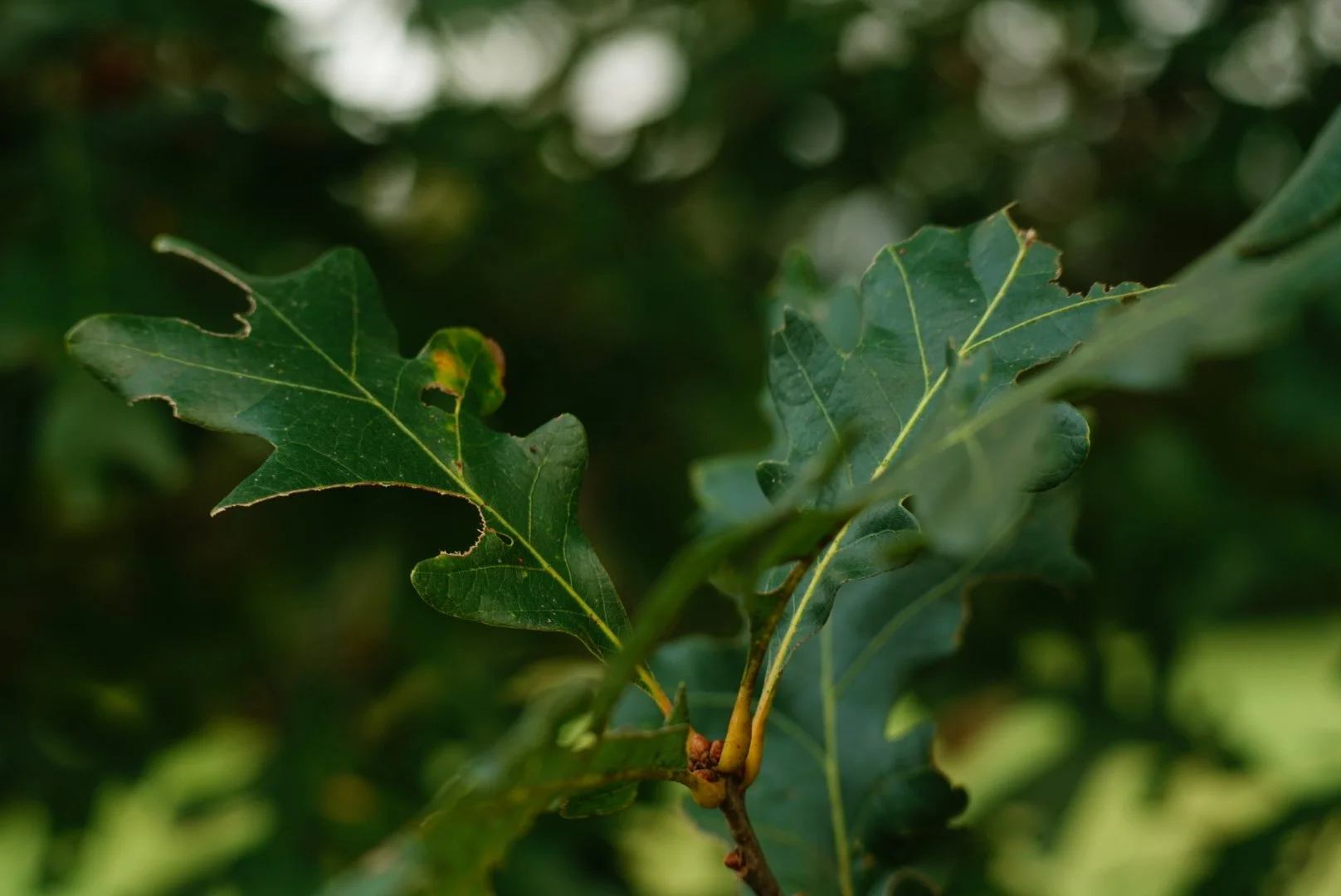
Photography, Carolyn Herrera-Perez
A cup with a lid in which a seed sits, waiting to explode: a nice way to look at an acorn. It captures the raw dramatic potential contained within this little thing, so easy to ignore, or to crunch underfoot in a forest. Pick one up instead, and consider the wonderment that it has to offer. Driveway nuisance, squirrel food? Perhaps, but marvel at the efficiency of its structure: the hat-like cupule at the top, partly covering the nut body with its hard pericarp or outer skin, and the familiar pointed spike at the bottom, from which an embryonic taproot journeys into the earth, even as a second shoot prepares to burst through the top and up into the sky.
Not too many people could explain how such a tiny object can transform itself into such a big one (an acorn weighs around 10 grams, while a typical mature oak will weigh many tons). Nor how the same little objects could, if fed to the right kind of pig (the Pata Negra), be transformed into jamón ibérico de bellota (bellota meaning ‘acorn’). They can also be eaten straight, as Native Americans have done for centuries – by leaching the acorns in water, drying them, and pounding them into a flour – or, as the Koreans do, by extracting the starch and turning it into a jelly called dotorimuk. Acorns can also be used to tan animal hide into leather, altering the protein structure enhance strength and durability (the Latin tannum means ‘oak bark’). And that’s just for starters – and just from acorns.
With an actual mature oak tree the possibilities diversify still further. There are over 600 variations within the Quercus species, which yield (among other things) the most historic of all structural timbers. Oak is used to make barrels and barn doors, firewood and flooring, shingles and ships. Even the miniature ecosystems that oak trees support in their leaves and branches can lead to surprising things. When attacked by wasps, midges, or mites, oaks grow tumors or “galls,” and these can be ground up to make ink. One species, the Kermes oak (q. cocciferra), attracts insects (Coccus ilicis) that can themselves be crushed, making a crimson dye once used for the robes of Roman senators.
No wonder that when Aristotle sat down to think about materials – his was arguably the first systematic attempt to do so, at least in European philosophy – his mind drifted naturally to the forest. Because there was no existing Greek word for “materiality” as such, he simply adopted the word for “wood,” hulê. It seemed to him that basic, that fundamental, precisely because it could be transformed into so many things. He developed a theory, known since as hylomorphism, which holds that every object is composed of this “matter” – as we might put it today, “raw material” – which assumes a particular form or shape (eidos or morphe, in Greek). As things change, the matter in them remains constant while also constantly taking on the new forms that are imposed upon it.
According to Aristotle, then, matter is defined by its potential to become… something. It’s this inherent transmutability that makes material intelligence such a powerful concept. Oak, like so many other materials, offers a common ground of interest, viewed in different ways by different people. For example, a contemporary wood botanist might look at a Japanese blue oak and describe it as Quercus glauca, a deciduous ring-porous hardwood species well suited to climate zones 7 and 9. The seventeenth-century poet Matsuo Basho looked at the same tree and came up with this:
The oak tree
Not interested
In cherry blossoms
In ancient Britain, Druids worshipped in oak groves. In the middle ages, medieval joiners saw in a giant curved oak branches the perfect material source for architectural “crucks”, the curves of roof trusses. In 1651, King Charles took refuge from Cromwell’s Roundheads in the boughs of a pollarded oak; a little later, independent-minded colonists in Connecticut hid their Royal Charter in a Hartford oak tree, wanting to elude the agents of the king. Both trees – the Royal (or Boscobel) Oak and the Charter Oak – remain potent symbols to this day. Another inheritance from the distant past is the tune “Hearts of Oak,” still the official marching song of the Royal Navy. Its lyrics, by the eighteenth-century actor David Garrick, allude to the timber’s usage in the tough sides of vessels:
Heart of Oak are our ships,
Jolly Tars are our men,
We always are ready: Steady, boys, Steady!
We'll fight and we'll conquer again and again.
Those ships were crucial to the brutal operations of the slave trade and imperialism, which has left its trace in ways both tragic and unpredictable. When the British colony of the Gold Coast gained its independence in 1957, it assumed the name of Ghana; but the football team in Accra is still called Hearts of Oak, a vestige of former British rule. The team’s anthem makes a rousing end to this short tour of oak and its symbolic potency:
Arose, arose, arose, be quiet and don’t be silly
We are the famous Hearts of Oak
We never say die. Phooooooobia!
Never say die until the bones are rotten.
Material intelligence crosses over such radical differences in perspective. It puts matter at center stage, encouraging reflection not just about material properties and histories, but also the many hidden ways that it connects us, even across the most profound gulfs of geography and cultural difference.
Material intelligence also involves considering the impact of materials on human culture – an approach demonstrated, for example, in Michael’s Pollan’s book Botany of Desire: A Plant’s-Eye View of the World, which recounts the dramatic social impact of cannabis, apples, potatoes, and tulips. And we can go further still, considering materials truly in and of themselves, outside of any particular human need or desire to use them, or give them form. In this respect, material intelligence can be a pathway out of anthropocentrism, and the drastic problems it has led to – most pressingly, the destructive forces of climate change, which define the era that has come to be called the Anthropocene. It releases a kind of centrifugal intellectual energy, inspiring new understandings and new connections.
This all sounds pretty ambitious, probably; but one of the most attractive things about material intelligence is that a little goes a long way. At its simplest, it’s just a matter of recognizing that materials all have their own stories; that they don’t come from the ground in neat blocks, each exactly the same. There actually is a world like that – where resources can be extracted from the earth and reshaped into useful items at the click of a button. But that world is not real (or anyway, not what is usually meant by the word ‘real’). It exists only in the minds of machines: for it is a videogame, the most popular that has ever existed. It’s called Minecraft. In any given month, it is played by more than 100 million people worldwide. Created by a Swedish developer and released in 2011, it is now owned by the international conglomerate Microsoft, who purchased it for $2.5 billion. As its name implies, the game is all about crafting things; but this happens on a digital workbench, or “crafting table.” This is represented in the user interface as a series of boxes, a “crafting grid.” Players follow “crafting recipes” controlled through a drop-down “crafting menu.” To make a barrel, for example, you take oak slabs and make them into planks, drag them into the grid, and hit the button. Presto: you have a barrel.
Minecraft is wildly popular worldwide, and as an indicator of where we stand when it comes to making things, it is hard to beat. The know-how that was once commonplace is now an endangered thing. Our collective material intelligence is on the wane; little is understood about how the things around us are made, or even what they are made of. Not too long ago, villages, farms, and cities alike were richly populated by makers and making. People did it, they saw it, and as a result, they knew it. Even non-artisans were well acquainted with modes of production, manufacture, and with material properties of all sorts. This type of shared knowledge is no longer widespread. Our age of global production, instant delivery, and increasingly specialized modes of manufacturing makes us all feel a little like Minecrafters: just point at what you want, and click.
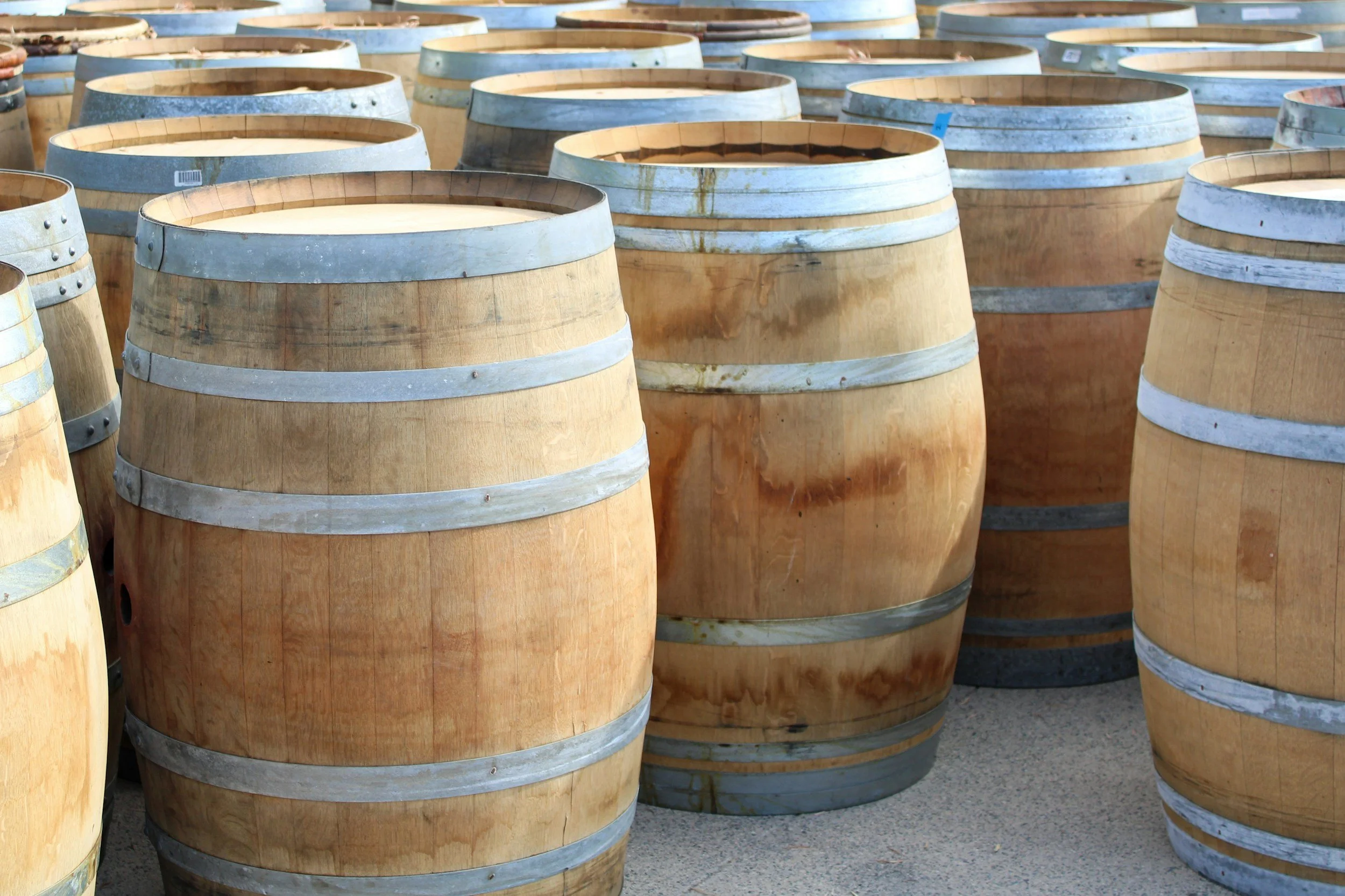
Many wooden barrels. Photo by shawn kim / unsplash.
How do we shake off the distortion field generated by such automated fantasies? Certainly, watching a maker at work is a good start. When a real barrel is made by hand, each edge of each stave is shaped in a gentle arc, so that it will fit exactly to its neighbor when the staves are bent into a convex form. When green (unseasoned), it is easy to rive into the needed staves, and because of its ring-porous structure, oak planes beautifully. The bending of the staves can be done with either heated water, steam, dry heat or heating by fire. The top and bottom of each stave are beveled, its inner face slightly hollowed. After the staves are pieced together, a series of hoops are successively affixed to them. The metal hoops go on blazing hot, and are doused with water to shrink them against the wood, ensuring a tight fit. Finally, the interior is scorched or “toasted.” These final stages of cooperage are dramatic, all hiss and steam and pungent fragrance. Far easier, of course, to sit in front of a screen – but it’s not quite the same.
It’s entirely possible to make oak barrels all your life - indeed, for centuries - without understanding quite why they make many wines and whiskeys taste mellower and less astringent. Coopers were already at work in Aristotle’s time, and we can be sure that they knew about this effect; but it’s only thanks to organic chemistry that we really understand the barrel-ageing process. As Hervé This, author of the book Molecular Gastronomy, explains, tannins interfere with the lubricating proteins that are naturally present in human saliva; by preventing these proteins from playing their natural role, they make the mouth feel dry. A fresh, young wine has a strong concentration of tannins, extracted from grape seeds, skin and stems. As the wine ages, these tannins soften, even as more tannins and other flavors are gradually imparted to the liquid by the scorched oak – among them volatile aromatic compounds like phenolic aldehydes and lactones, which lend the wine flavor notes of vanilla, smoke, coconut, and caramel.
Even though the chemistry is now clear, there are so many variables at work – among them the species of the oak, how (and how long) it has been allowed to dry, and the degree to which it has been scorched. Each of these material factors interact with particular types of grape in different ways, such that wine-making (and the closely related process of whisky-making) remains a combination of subjective, intuitive art and objective, measurable science. In this respect, it can serve as an exemplar of the domain of material intelligence at large. Artisans often know that without knowing why. There have been previous moments in history, particularly during the rise of industry and formal science, when traditional craftspeople and their knowledge were derided as being uninformed and unsophisticated. The erudition of the laboratory was presented, rightly or wrongly, as being more objective, exacting, and repeatable, and by extension ultimately more profitable. Yet this opposition between tacit and explicit know-how is easy to overstate. Chemists are often described as having “good hands,” while craftspeople may well know a great deal about the underlying structures of the materials they work.
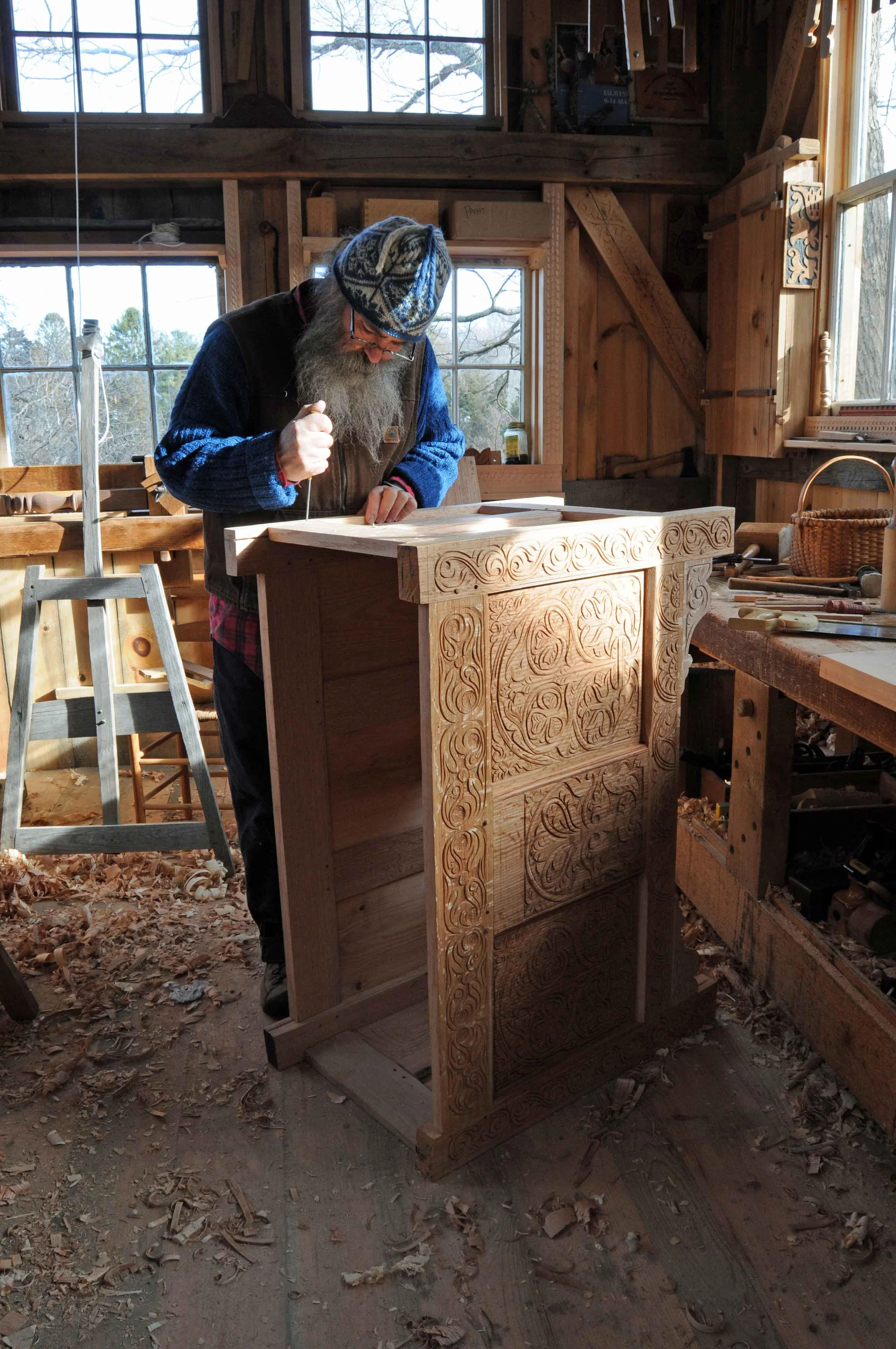
Peter Follansbee scribing a paneled chest in oak.