
Paintings out of dust
Chris Murtha
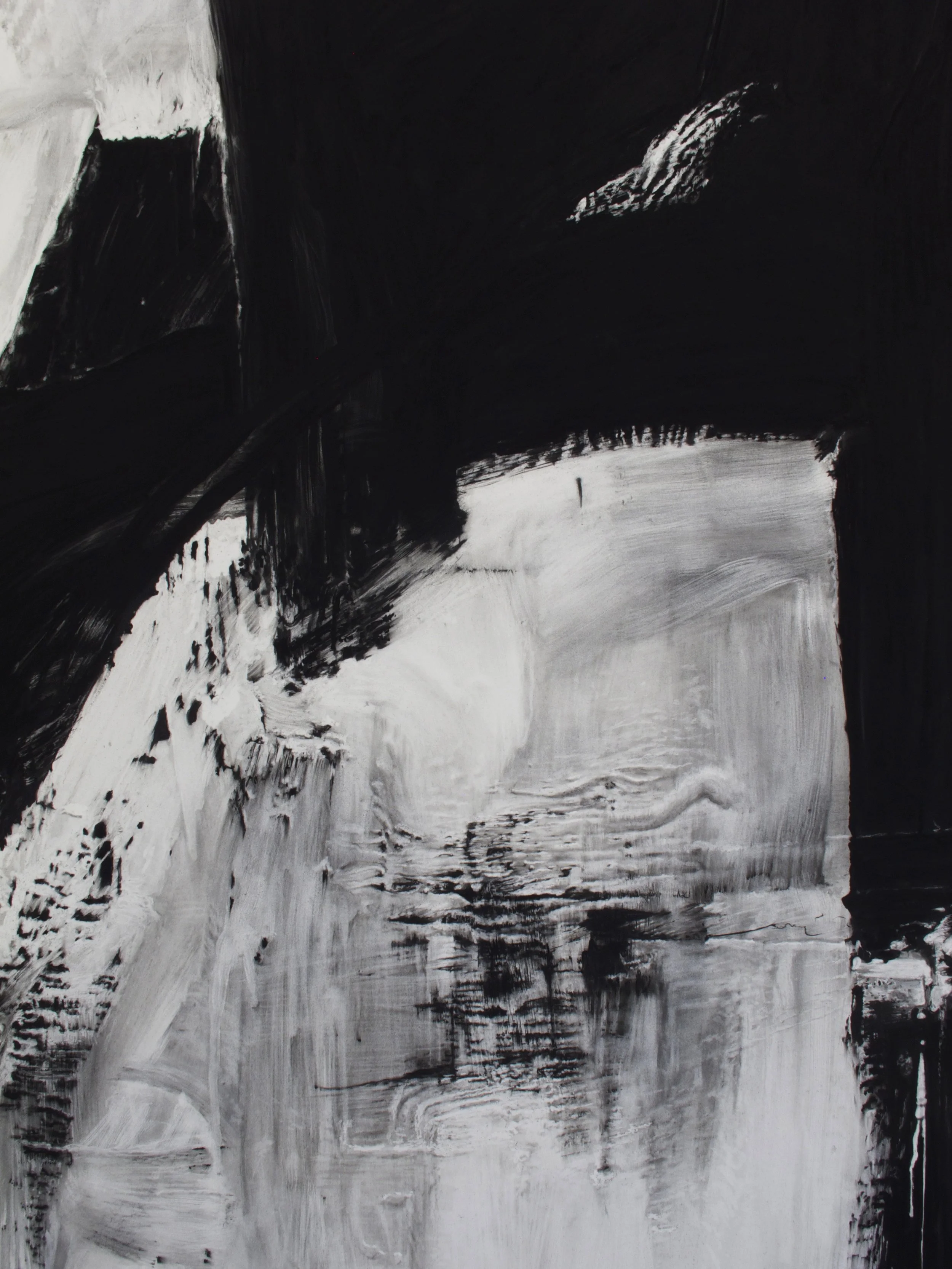
Robert Longo, Detail of Untitled (After Kline, New York, NX, 1953), 2014. © Robert Longo / Artists Rights Society (ARS), New York.
Charcoal is elemental, produced by using fire to remove water from wood. More pliable than graphite, it is easily blended and erased, but also stubborn: while it never fully adheres to paper, it’s hard to completely remove. Like dirt, dust, and ash—or soot and smoke from increasingly prevalent wildfires—charcoal powder pervades everything it touches: it stains hands and lodges itself under fingernails. It gets into the air, we breathe it in.
From early in his career, artist Robert Longo used charcoal mainly to augment his graphite drawings. Since 2000, he has used this fickle material almost exclusively to meticulously recreate photographic images at a grand scale. This may seem counterintuitive, but the two mediums have surprising affinities. Both photographs and charcoal drawings are unstable, and must be fixed by chemicals. Charcoal, like a gelatin silver print, can produce rich blacks and a satiny range of grays, and its particulate matter is a surprisingly effective mimic of photographic grain. Beginning with the deepest blacks and using blank paper for highlights, Longo’s drawings “develop” as if in a darkroom. When he made actual-sized, black-and-white facsimiles of Abstract Expressionist paintings for “Gang of Cosmos,” his 2014 exhibition at Metro Pictures in New York, he was recreating the photographic reproductions from magazines and exhibition catalogues as much as the works themselves.
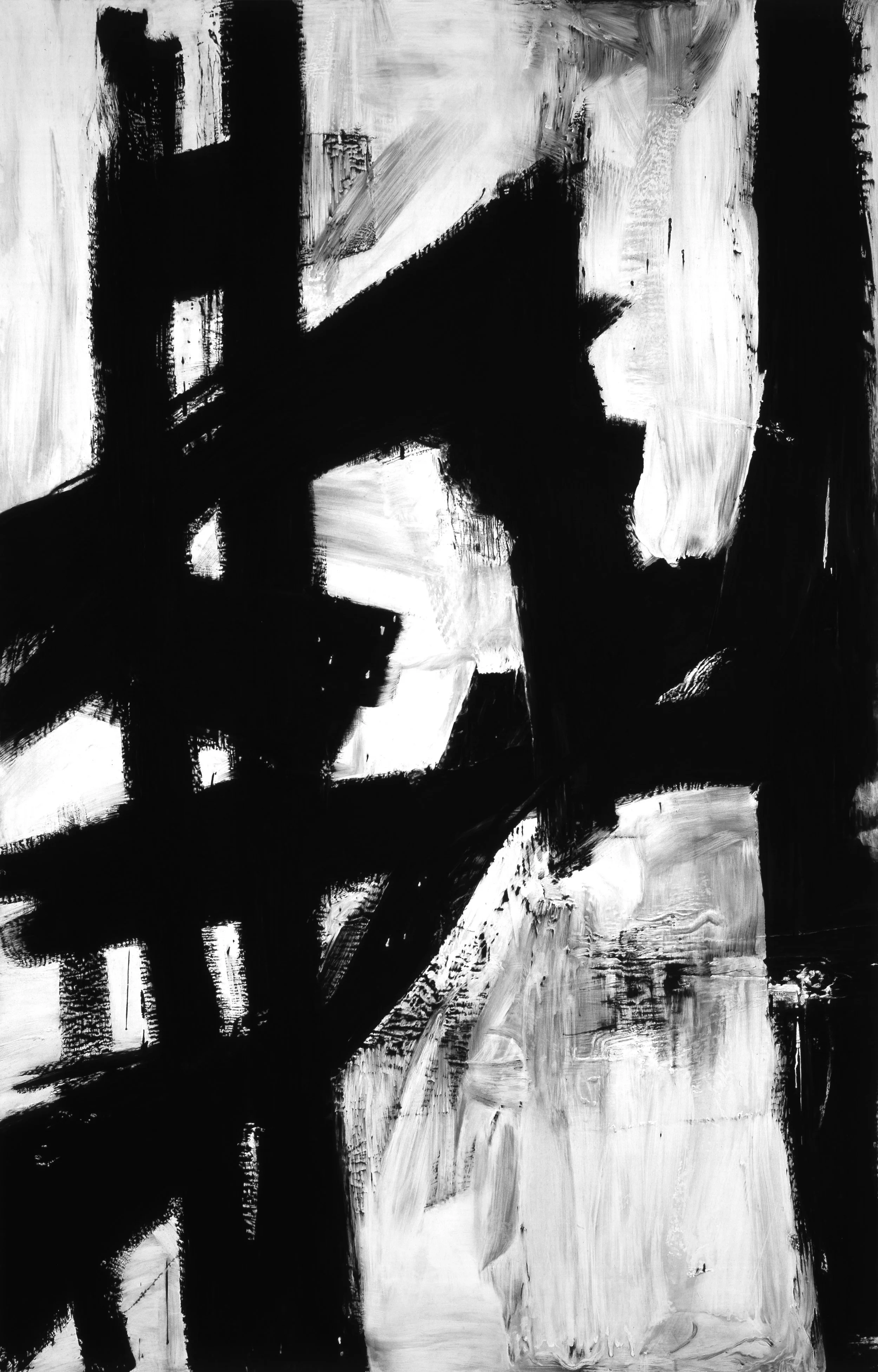
Robert Longo, Untitled (After Kline, New York, NY, 1953), 2014. Charcoal on mounted paper, 109 1/4 x 70 inches (277.5 x 177.8 cm). © Robert Longo / Artists Rights Society (ARS), New York.
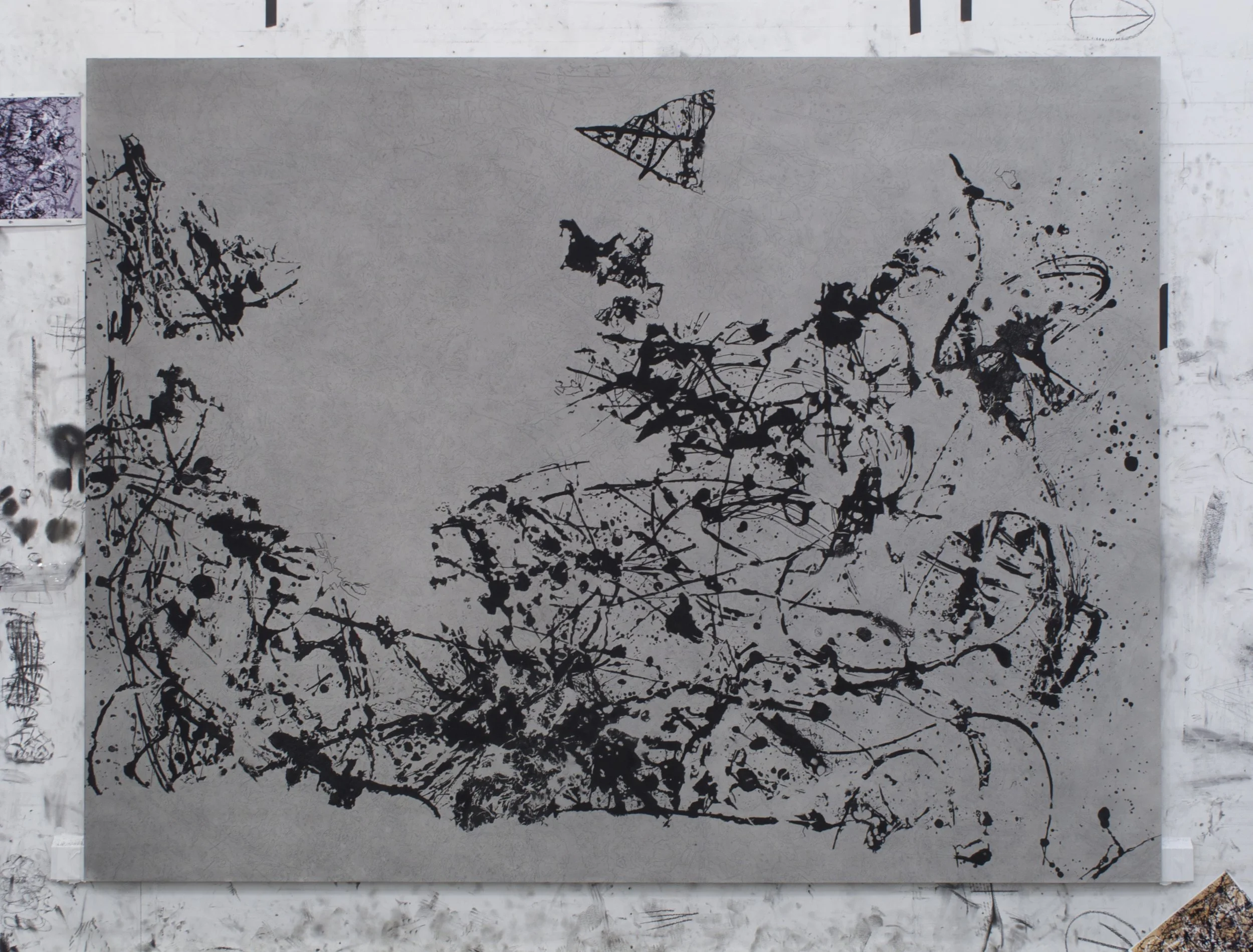
Robert Longo, Untitled (After Pollock, Autumn Rhythm: Number 30, 1951) in progress. © Robert Longo / Artists Rights Society (ARS), New York.
In art, charcoal is most typically used for preparatory sketches and intimately scaled drawings. As Longo likes to note, however, some of our oldest images were made in caves using charcoal—pictures in fleeting dust that have survived millennia. Many of the Abstract Expressionists used charcoal in their practice; its material makeup lends itself to messiness and experimentation more readily than graphite, a harder, more dense form of carbon. Yet, to faithfully translate oil paint on canvas to charcoal on paper, Longo’s methods had to be far more deliberate and methodical than those used by the original artists, more controlled than flaky cinder seemed to permit. He had to work both with and against charcoal’s materiality.
Longo viewed each of his subjects in person, but it was the dozens of color photographic details he took that formed the basis of his process. In what he described as “a combination of archaeology and forensics,” he used these closeups to deconstruct the paintings and recreate them, one small area at a time. Material differences necessitated certain procedures. Aside from the obvious disparity between dry, powdery charcoal and wet, viscous paint, there is no such thing as white charcoal. Though artists have traditionally used white chalk, Longo chose instead to produce highlights in the negative, either through erasure or by leaving the paper untouched. Longo has described this method in sculptural terms: “Rather than painting the image…I’m carving it out with erasers and tools like that.” But charcoal lacks the physical weight and textural thickness of accumulated paint. His drawings possess an undeniable flatness that relates them more strongly to photography (and printmaking) than painting or sculpture.
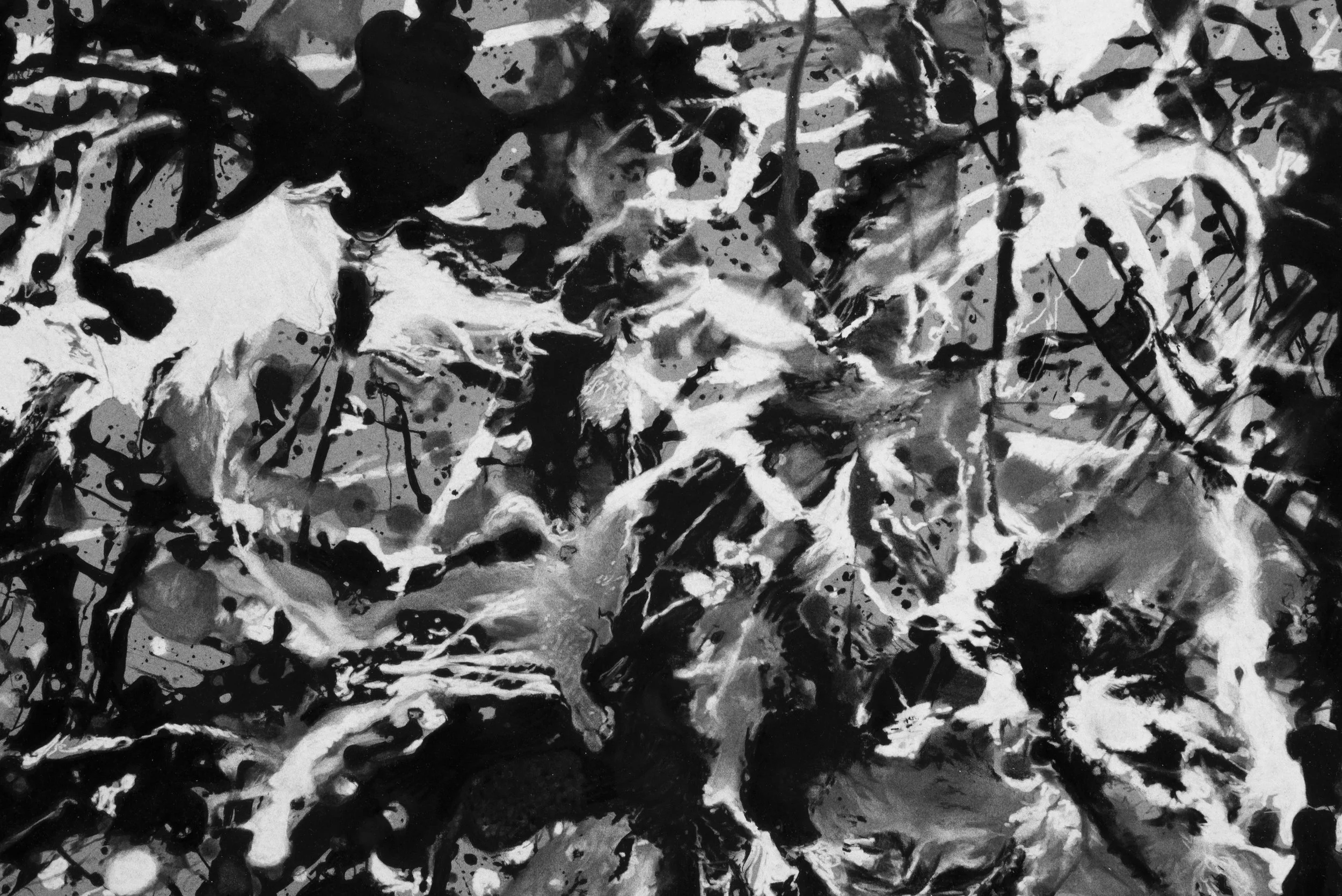
Robert Longo, Detail of Untitled (After Pollock, Autumn Rhythm: Number 30, 1951), 2014. © Robert Longo / Artists Rights Society (ARS), New York.
As documented in process photographs, Longo drew the darkest elements first. To reproduce Franz Kline’s broad, angular brushstrokes, for instance, he initially defined the edges and then filled them in. By the end Longo has, somewhat miraculously, recreated the most intricate details and textures of Kline’s oil painting: marbled swirls, coagulated drips, the dry scumbling of black paint over white ground. Just as impressive is how he transforms the ashen material into something more aqueous in appearance—without the addition of any liquid medium—in appropriations of works by Helen Frankenthaler and Lee Krasner. With dryly rendered stains and splatters, Longo reimagines Frankenthaler’s atmospheric, pastel-hued landscape as an inky Rorschach. In his rendering of Krasner’s Birth (1956), Longo applied dry charcoal powder with brushes to achieve a more painterly effect. If we consider that paint is at base a powdered pigment, perhaps this is not so strange an alchemy.
Unlike paint, however, which can be easily layered because it dries and hardens, charcoal is tough to layer without mixing. Longo was nonetheless able to painstakingly map and recreate Jackson Pollock’s haphazard web of splatters, strikes, and whirling drips. Untitled (After Pollock, Autumn Rhythm: Number 30, 1950) is the crowning achievement of his charcoal conversions. Atop a dry “wash” of charcoal powder that mimics the original’s unprimed canvas and establishes a neutral ground, Longo started with the black enamel arabesques Pollock laid down first. But he had to leave space for the overlapping marks that followed, inserting pauses into what was previously a record of continuous, fluid motions. The result is an astonishingly precise, if desaturated, likeness that possesses a very different energy than the original. Longo’s charcoal “Pollock” is not improvised or effortless, nor subject to chance; it is an ordered vision of chaos, charged not with the dynamism of action but the vigor of attention.
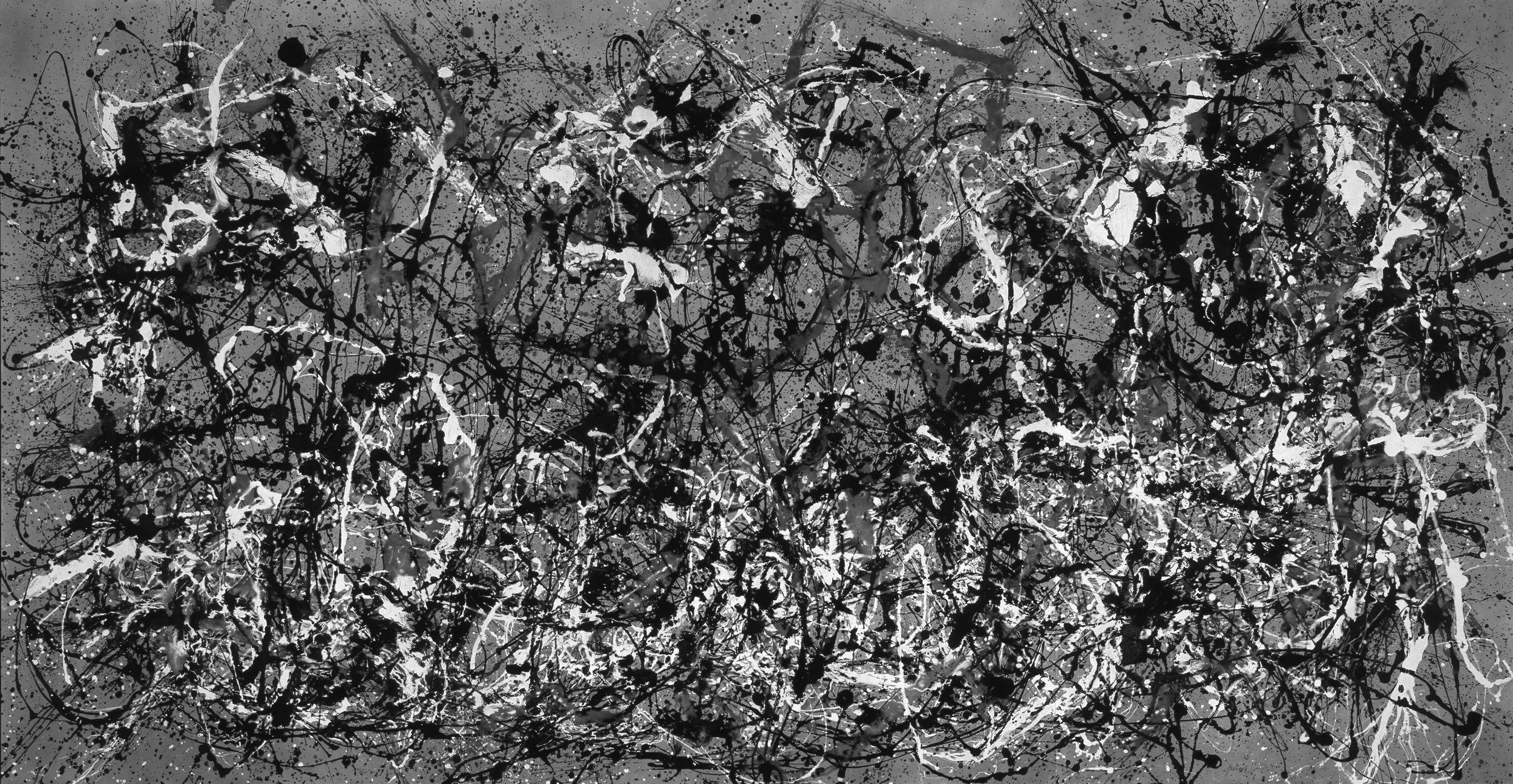
Robert Longo, Untitled (After Pollock, Autumn Rhythm: Number 30, 1951), 2014. Charcoal on mounted paper, 91 1/4 x 180 inches (231.8 x 457.2 cm). © Robert Longo / Artists Rights Society (ARS), New York.