Introduction
Glenn Adamson
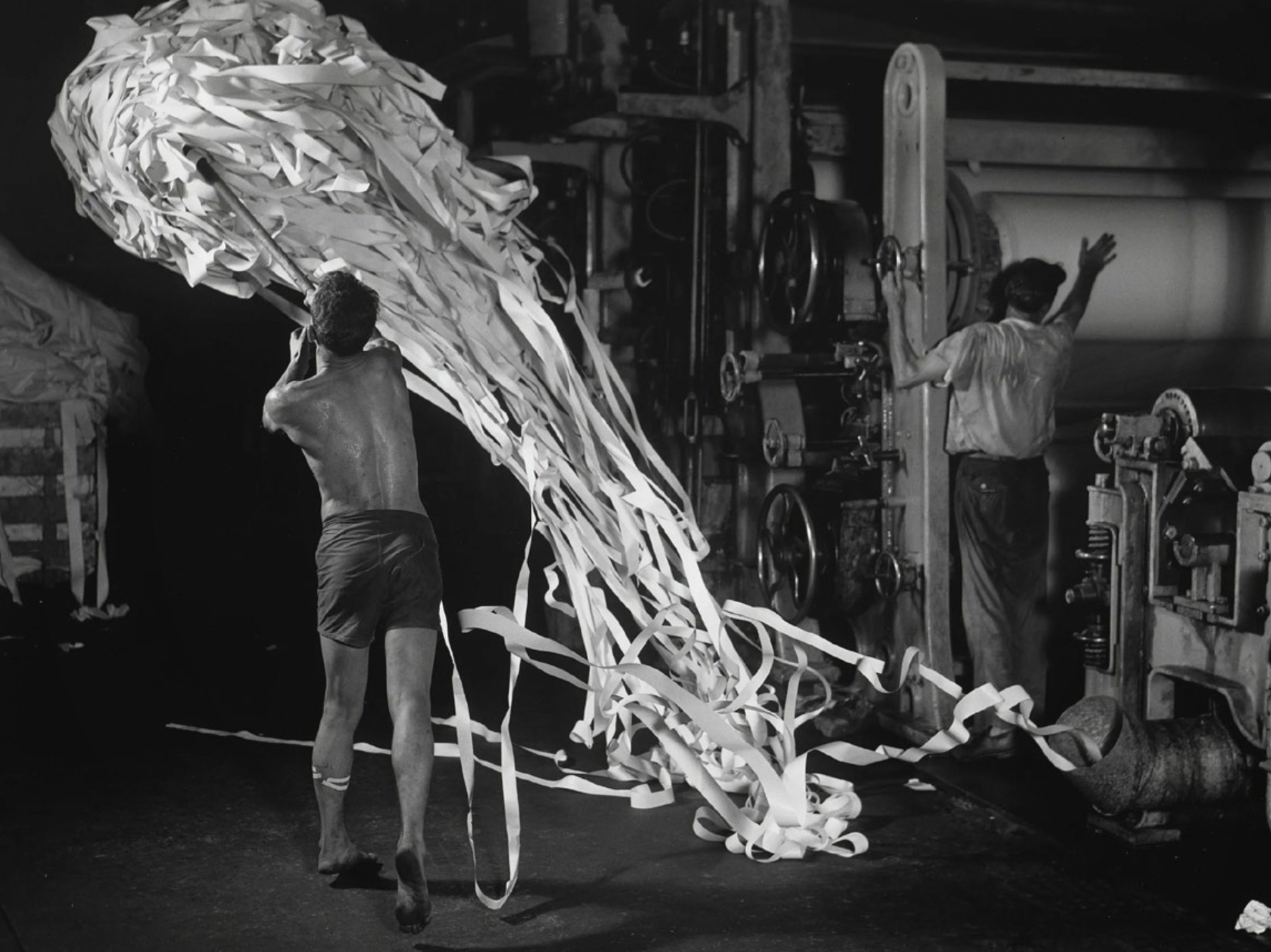
Harold E. Edgerton (American, 1903-1990), Paper Mill Worker, 1937, printed 1986, gelatin silver print, sheet: 15.9 x 19.9 in. (40.3 x 50.5 cm.), Smithsonian American Art Museum, 1991.89.15 © Harold Edgerton/mit, courtesy of Palm Press, Inc.
Rock, Paper, Scissors. Is there a more materially intelligent game out there? While the items in play are entirely notional – conjured with simple gestures, fist, flat hand, or V-sign – their interrelationship bespeaks an ancient understanding of how real things fit together, not in a strict hierarchy, but a perpetual cycle of cause and effect. According to the World Rock Paper Scissors Association (yes, you read that right), the game dates back fully two millennia, to Han Dynasty China, though this archaic version seems to have involved animals – Slug, Snake, Frog. The modern version was codified only in the seventeenth century, in Japan, where it was initially called sansukumi-ken, roughly, “the hand-game of three who are afraid of one another.”
A pleasant conundrum to consider is how, exactly, paper beats rock. The other scenarios are clear enough: The rock smashes the scissors. The scissors cut the paper. Rocks, paper and scissors all draw with themselves. But what does a stone have to fear from a sheet of stationery? The WRPSA hypothesizes that the paper wins through an epistemological maneuver, “making the rock invisible to the rest of the world, rendering it useless.” It’s a satisfying theory, partly because it accords with the way that paper – and paperwork – assert potency in real life. Physically flimsy, easily destroyed by tearing, burning, or wetting, paper nonetheless has a good claim to be the single most powerful material that has ever existed. It is how knowledge itself moves though the world.
Like gunpowder and porcelain, paper was invented in China – as it happens, around the same time as Slug, Snake, Frog. The very earliest fragment known from a hand-drawn map dating between 179 and 141 BCE; it was found in a tomb lying on the chest of a high-ranking (but long dead) official. Tradition has it that about a century later, a eunuch advisor at the Han court called Cai Lun introduced paper into widespread use. This material would have been made from mulberry bark, pulverized with pestles into loose cellulose fibers – in this case, stone did beat paper – which were floated on water over a screen. The screen was pulled from the bath, picking up a layer of the fibers, which were then dried into a stiff sheet.
It would be centuries before this method and its many refinements spread westward. In 313 CE, one cache of paper documents got as far as the western border of China, on its way to a merchant in Samarkand, who sadly never received his mail (an old story). By the 7th century papermaking had come to India and Baghdad; in the early years of the Renaissance, to Italy and Spain. Before this, people had been making do with clay tablets, birch bark, palm leaves, papyrus (which provided paper with its misleading etymological root), or animal skins fashioned into parchment. Paper was much cheaper to produce than any of these options, but it did not become a world-transforming technology until it was paired with the printing press.
At first, the economic impact of mechanical printing was small; much like the internet, it initially circulated amongst a small elite, but the longterm consequences would be enormous. Religion, politics, literature, philosophy, science, language itself: all were reshaped so that they fit on to paper. A public sphere emerged page by page, built out of broadsides, magazines, and newspapers. Capitalism could not have emerged when and how it did without the sudden availability of inexpensive paper. Bookkeeping, until quite recently, has been no idle metaphor. And despite widespread skepticism – George Washington thought it would “ruin commerce, oppress the honest, and open the door to every species of fraud and injustice,” while Thomas Jefferson called it “poverty, the ghost of money, and not money itself” – paper currency would become the dominant means of global exchange in the nineteenth century, a consequential detachment of value from actual materiality.

Charles Ray (American, 1953– ), Return to the one, 2020, handmade paper, 59.5 x 63 x 55.5 inches (151 x 160 x 141 cm) © Charles Ray, courtesy Matthew Marks Gallery, Photo by Ron Amstutz.
Alongside these massive cultural shifts, people were finding plenty of other things to do with paper. It was made into lanterns, umbrellas, hats, wallcoverings, art prints, packing material. Toilet paper, as you may be wondering, was also invented by the Chinese, as early as the 7th century CE; during the Ming Dynasty, specially perfumed sheets were prepared for the imperial backside. Paper was mashed and mixed with glue to make papier mâché, and layered up to make cardboard [corrugation]. One of the first US patents ever granted to a woman went to Margaret E. Knight, a former textile mill worker who invented a machine for making flat-bottomed brown paper bags, in 1871.
No matter what it was used for, paper was almost invariably cheaper than any alternative, because it was made from waste to begin with. By the eighteenth century, most paper was made from rags, that is, old clothes, bedlinens and other textiles – a noteworthy example of early industrial recycling, though it did have major downsides. The job of “picking” the rags – gathering them up and delivering them – made for a precarious and difficult livelihood, and unlaundered clothing spread smallpox and other diseases into paper mills. Another common ingredient for papermaking was old shipping ropes, including ones made of abaca (a type of hemp), obtained by the USA via its imperialist colony in the Philippines – the origins of the Manila folder. Eventually though, these materials would be replaced by wood pulp, using a process invented in Germany in the 1840s. A single pine tree yields, on average, about 10,000 pieces of paper.
The twentieth century may someday be thought of as the Age of Asphalt – the time when endless tracts of the stuff were laid down, to the dismay of future generations who may no longer need it. Equally, it was a century defined by paper, unprecedented amounts of it. The USA alone manufactured 30 million metric tons of paper and cardboard in 1960, and triple that by the end of the century. That was the peak; digital technologies began to supplant paper-based ones, and production did begin to decline. The overall quantity of paper made these days is about on par with what it was in 1985, when Terry Gilliam’s satirical film Brazil depicted a hapless worker continually besieged by pneumatically-delivered documents. In desperation, he finally connects the incoming and outbound tubes to one another, hoping it will all go on without him. But this inadvertently creates a jam: the whole system backs up, and finally explodes, showering the office with countless pages, floating gently downward – bureaucracy rendered momentarily beautiful, a sequence that will touch a chord for any email user.
To the extent that contemporary communication is paperless, its conceptual domain is anything but. We speak of desktops, inboxes, folders, and files. To attach a document, we click on a paperclip. To get rid of it we put it in the trash, and when we do, we hear the sound of paper being crumpled. The technical term for this sort of thing is skeuomorphism, and its pervasiveness suggests the difficulty of decoupling human beings fully from their material intelligence. Even as we migrate increasingly into digital space, we still think in terms of paper.
So we may as well think about it seriously. Push past the mental image of paper as a blank, featureless carrier of information, and there is a wealth of material specificity to be discovered. It comes in various thicknesses, which are measured by the weight of a ream (that is, 500 pages). The very thinnest commercial stock, about nine or ten pounds, is sometimes called onion skin; it’s ideal for printing books with many pages, like the Bible, or for sending letters by air mail. Laid paper has fine ridges, resulting from parallel wires in the mold (the wires are “laid” together), while wove paper is picked up on a fine mesh, and is therefore smooth. Either way, a manufacturer’s logo can be placed on the mesh before the pulp is put into the vat, leaving a permanent impression in the paper – a watermark.
And there’s more. Paper made from wood pulp is naturally acidic, but by using an alkaline filler it can be rendered pH-neutral, so that it won’t degrade. Paper can be pressed through hot rollers, making it smooth, or cold-pressed, leaving its surface more variegated and absorbent – a popular choice for watercolorists. And it can be coated or uncoated, which determines how ink will sit on the surface; an image will be far more vibrant on a coated sheet.
Then there’s all the things you can do with paper once you have it. It’s ideal for absorbing liquids: not just ink, but also skin oil, kitchen spills, whatever happens to be up your nose, and of course, LSD. It is one of history’s great coincidences that acid hit just as quill pens were disappearing, thus providing an exciting new use for blotting paper. (Alan Watts, the Zen guru and an early proponent of both taking LSD, said it was impossible to explain the experience: “As well try to understand a book by dissolving it in solution and popping it into a centrifuge.”) Almost as mind-blowing is a “nanowire paper” developed at MIT, which researchers hope will be capable of cleaning up oil spills on the open sea.
Paper is also perfect for folding, because unlike a woven textile, its interlocked fibers weaken when creased. Running a thumbnail along a fold, getting it nice and crisp, is a good example of intuitive material intelligence in action. It’s this property that makes possible the wonders of origami, holiday gift wrapping, and the simple paper airplane, which has gotten a lot less simple of late. Just last year, a new record for flight distance was set by a trio of young engineers from Boeing: 290 feet, almost the full length of an American football field. And that’s nothing compared to the aerospace scientists who hope to launch a large-scale paper airplane from orbit – the main problem being that no one knows where it would land.
Juanma Aparicio / Alamy Stock Photo