Introduction
Glenn Adamson
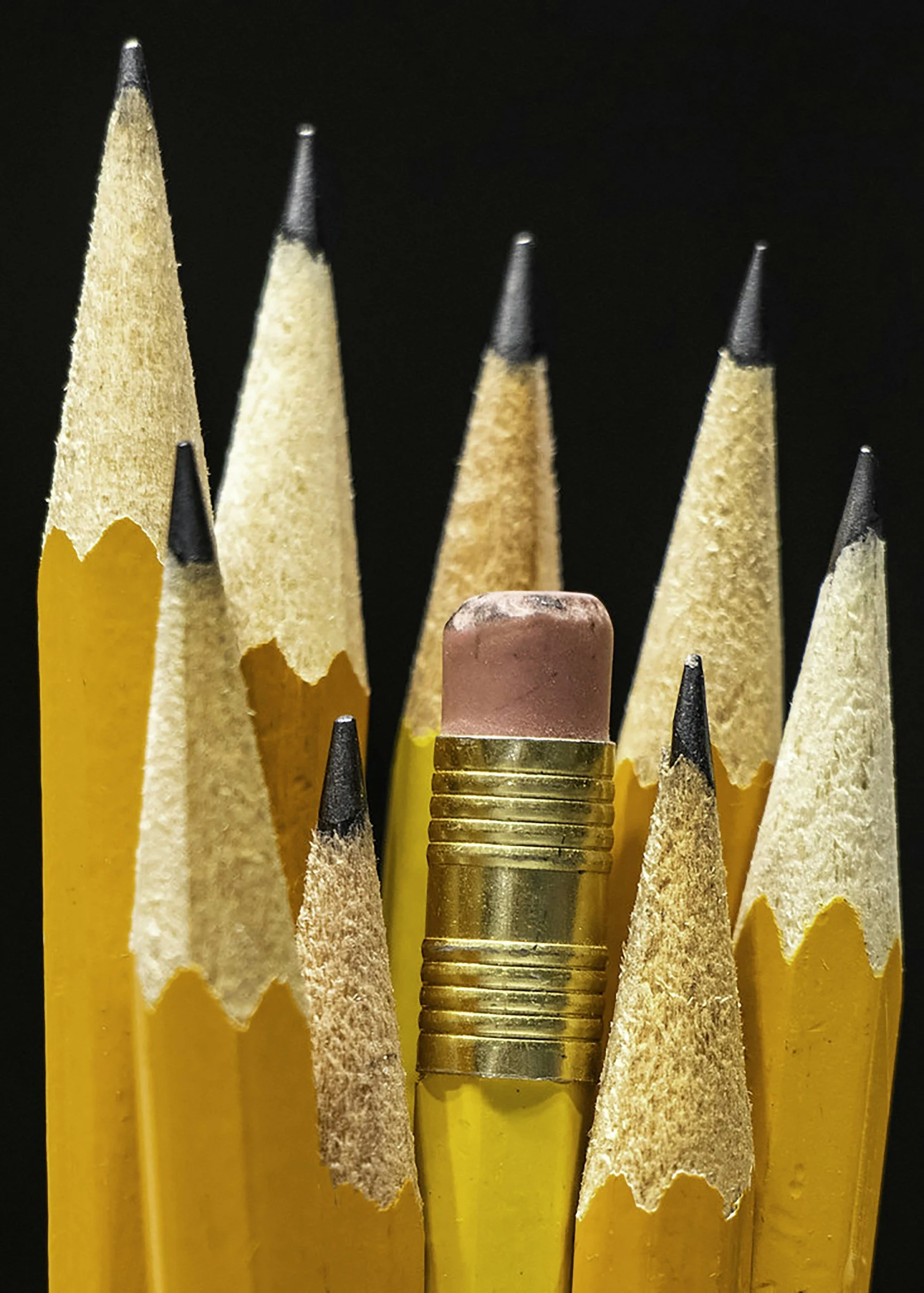
A Group of Yellow Pencils with a Pink Eraser, 2023. Photo by Tracey Parish on Unsplash.
You know that flat round rubber disk that has long sat in the kitchen drawer, the one that helps loosen the lid on a glass jar? When I was growing up in the 1970s, my family had a funny name for it: a “Rubber Husband.” It’s a phrase that conjures a whole worldview: that of a midcentury housewife who is obliged to do pretty much everything around the house, and can replace even her husband’s one reliable contribution with a fifty-cent piece of rubber.
Reductive gender dynamics aside, the “rubber husband” now fascinates me for a different reason. It’s about as close as household object get to physics in pure form. The reason it grips so well is that rubber is made of polymers, long chains of hundreds of even thousands of molecules - repeating small units called “monomers.”) The molecules of other materials, like those in a metal jar lid, tend to adhere to polymers, getting caught up in them at a micro-level. This producing a high friction coefficient, the same reason that erasers work: the rubber acts frictionally on the graphite particles sitting on the paper.
There’s a whole branch of engineering called tribology that devotes itself to such surface-to-surface interaction. These are the people who can tell you, quite literally, what happens when the rubber hits the road. Somewhat counterintuitively, tires have more traction when they are totally smooth, at least in dry conditions, because this maximizes the surface area of the rubber – that’s exactly how high-performance Formula 1 racing tires are designed. The treads on typical consumer tires are there not to improve grip, but to displace water, snow and mud.
In addition to rubber’s inherent stickiness, it is valuable for its amazing elasticity. Take your average rubber band. When in a resting state, the long molecule chains that make up the material are arranged in nested coils. But when you stretch it out, and this inner structure extends, becoming more linear in orientation. Release the tension, and the molecules snap back into their former tangled structure. A rubber band ball is an intriguing demonstration of this principle: it is itself tangled at its core, and in increasing tension as you add bands. Finally, when you use your thumb to launch a rubber band, two separate force waves travel through the material, one in the front preserving the inertia imparted by the “snap,” and a slower wave in the back caused by the relaxation of the band. This tiny difference in speed is just enough to let you get your thumb out of the way.
Rubber bands, which are cut from extruded cylinders to avoid the necessity of seaming, are generally made of natural rubber – that is, latex from the Hevea brasiliensis tree (other tropical plants produce the substance too, in smaller quantities). From the tree’s point of view, the purpose of the latex is protective: if its bark is scraped or cut, the milky sap forms an impermeable layer that prevents insect incursion. Civilizations like the Olmec, Mayans, and Aztecs employed natural latex in a manner comparable to its botanical function, t seal containers and garments waterproof, to line the soles of sandals, and to make strap-like tool handles. Indigenous material expertise also extended to the chemical processes necessary for the production of solid rubber objects, like the heavy, bouncy balls used in the ritual game ulama.
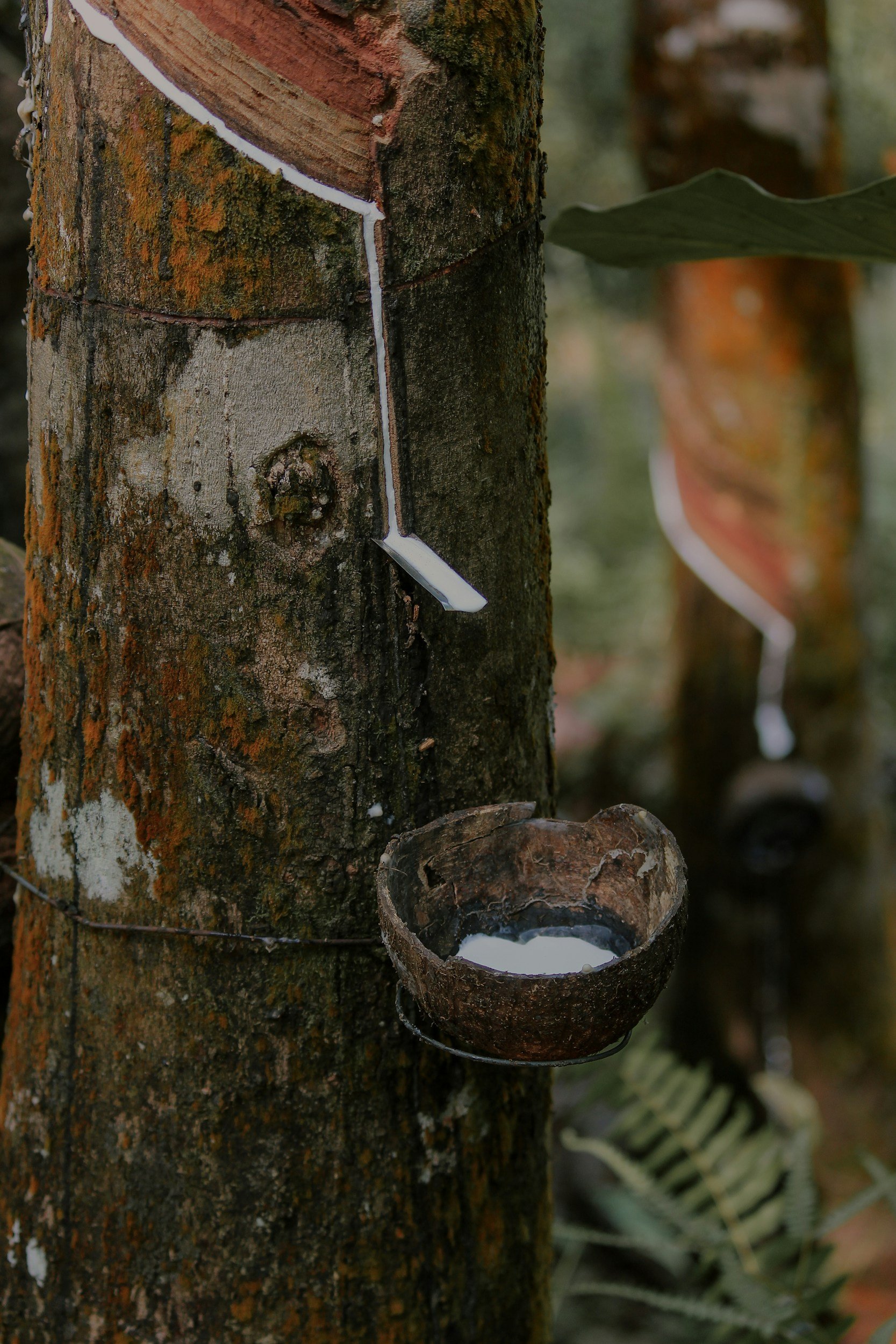
A Tree with a Bucket Hanging from its Trunk, 2023. Photo by Isuru Ranasinha on Unsplash.
The European exploitation of rubber was limited until Charles Goodyear developed the process of vulcanization, named for the Roman god of fire and the forge. This involves curing the rubber with sulfur, which forms structural connections between the polymers in the material, giving it more strength and stability in both hot and cold conditions, an important consideration in a non-tropical climate. After this technical breakthrough, a vast panoply of other uses became possible, paving the way for a worldwide extraction industry that exemplified the very worst of Euroamerican imperialism. The enslavement and brutalization of indigenous people on rubber plantations was the terrible equal of what was happening in the cotton fields of the American South.
Sad to say, neither this ugly labor history nor the sheer ecological impact of natural rubber harvesting were the key drivers for the development of alternatives. Rather, it was the upward-spiraling cost of the material. Research in this area had begun in the late nineteenth century, but it was not until the 1930s that scientists in the USA (which was consuming at least half of the world supply at that time, due to its booming automotive industry) and Germany began to make serious headway. The solution was to refine oil or coal into monomers like isoprene, butadiene, and styrene, which could then be polymerized and vulcanized, like natural rubber. In 1933, giant American chemicals firm Dupont released what is now called Neoprene on to the market; German and Soviet synthetics followed shortly thereafter.
These countries were of course to become principle combatants in World War II, and as is so often the case in material histories, military demand led to rapid innovation and up-scaling. Easy access to natural rubber was almost totally cut off because of the war, and the synthetic rubber industry exploded. The horrors of slave labor again returned to the story of this material: the chemical giant IG Farben – which also manufactured the pesticide Zyklon B, the gas used in Nazi concentration camp gas chambers – had thousands of prisoners from Auschwitz working in its rubber factories. In America, the production of synthetic rubbers neared a million tons annually by 1945, enabled by innovative strategic collaboration between the government, universities, and manufacturers. The effect was to create interlocking, mutually beneficial power networks, which only grew in scope and strength after the end of the conflict. In 1961, when President Dwight Eisenhower departed office warning of the dangers of the “military-industrial complex,” this was exactly what he had in mind.
In the years since, rubber-like synthetics have become among the world’s most widely used materials. Depending on the desired application, they may be combined with natural rubber – as in vehicular tires – or used independently, as is the case with kitchen spatulas made of silicone rubber (first commercially produced in 1947). The uses of this temperature-resistant, waterproof, durable, easily cleaned wonder material can seem endless: prosthetics, hoses, belts, gaskets, surgical gloves, sneakers, party balloons, even condoms (particularly helpful for people with latex allergies).

Chakaia Booker (American, born 1953), El Gato, 2001, Rubber tires, and wood, 48 x 42 x 42 in. Collection of the Kemper Museum of Contemporary Art, Kansas City, Missouri, Bebe and Crosby Kemper Collection, Museum purchase, Enid and Crosby Kemper and William T Kemper Acquisition Fund, 2004.12.01 © Chakaia Booker. Photo: E. G. Schempf, 2017.