Introduction

Glenn Adamson

Pictorial Press, Superman 1978 Warner/Walter Salkind film with Christopher Reeve. Pictorial Press Ltd / Alamy.

Two issues back, we suggested that despite its flimsy physicality, paper might be the most powerful material ever devised. True, it is currently being dethroned by ghostly digital hands. Over long centuries, however, in combination with reproductive printing, paper has been the means of comprehensive cultural transformation. It’s hard to think of another material with comparable importance.  

But then there’s steel: if paper has been the software of historical change, it has been the hardware. It is from steel that our machines are made, and it’s with those machines that we have made our steel weapons, transport, and architecture. Since the industrial revolution – often described as an “age of steel,” just as stages of Neolithic culture have been defined by the successive mastery of wood, bronze, and iron – the material has been identified with power itself, in whatever form power takes, from Josef Stalin (a nom de guerre adapted from the Russian word for the metal, stal) to Superman, famously a “Man of Steel.”

Steel can be defined as iron alloyed with a small amount of carbon. Like other materials we have covered in our pages, however, it is not really one substance but rather a whole family, as it often incorporates other metals, added for specific purposes. Nickel, silicon and manganese can all be mixed into the alloy to make it harder and more resistant. About 18% of chromium makes steel “stainless,” bright in appearance and impervious to corrosion. Weathering steel, often known by its brand name COR-TEN (from “corrosion resistance” and “tensile strength”) and widely used in modern sculpture, includes a high percentage of copper, which encourages the development of a protective patina.

“Steel yourself,” we say to someone when they are about to undergo an ordeal. We mean something quite specific: gather your strength, but also be ready for whatever comes. It’s a good example of material intelligence entering everyday language undetected. Steel really is strong – among metals, only tungsten, whose name is from Swedish for “heavy stone,” has a higher yield point – but its power is as much in its ductility as its durability. Stone is plenty hard, after all, but we don’t build skyscrapers out of it, because it does not flex. In the curtain walls of modernist architecture, the steel grid provides just the right combination of movement and rigidity. The glass and marble panels hung on to that framework of girders provide no more structural integrity than paintings do on an art gallery’s walls.
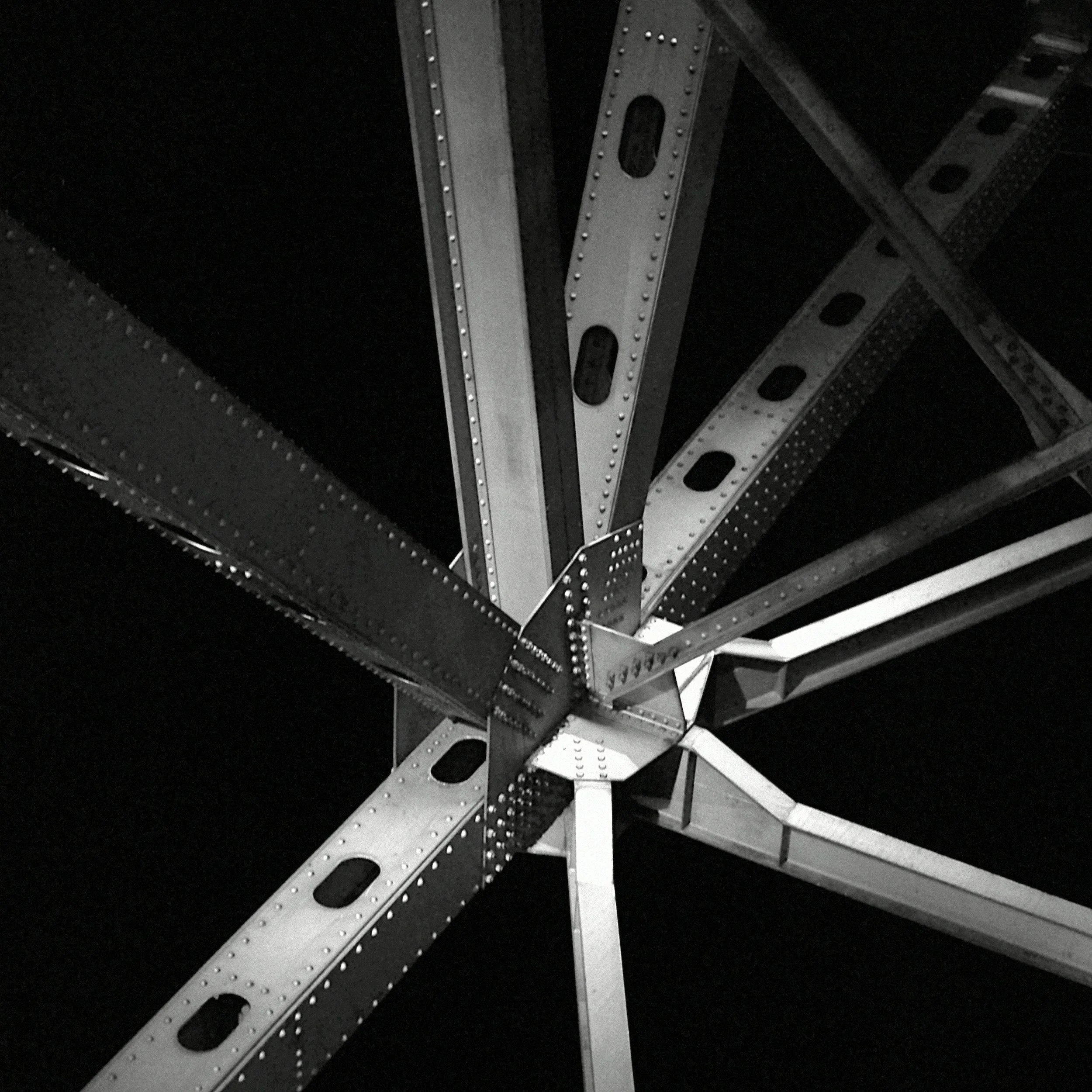
Photo by Random Thinking.

Long before the Bauhaus came along to pioneer this type of modernist architecture, alongside its iconic tubular steel furniture, I-beams were already one of the signature products of modern industry. Like their smaller cousins, train track rails, they seemed to be extruded from factories in an infinite, ever accelerating flow. The technical breakthrough that made this production possible was the Bessemer process, patented in 1856, in which the open crucibles traditionally used for melting and combining steel were replaced with giant converters, lined with heat-resistant material (initially of clay, and later other refractory minerals). Pig iron could be turned into steel less expensively, with higher consistency, and above all, in far greater volumes. Upton Sinclair, in The Jungle, would later describe the caldrons of a Bessemer steel mill as “big enough for all the devils of hell to brew their broth in, full of something white and blinding, bubbling and splashing, roaring as if volcanoes were blowing through it.”

These melting-pots – all those mammoth egg-shaped furnaces disgorging their contents, standing like alien landers in Sheffield and Birmingham, Cleveland and Pittsburgh – were the brainchildren of Henry Bessemer. He was one of those Industrial Revolutionaries who almost didn’t seem to care what innovations he loosed upon the world. (As he wrote in his autobiography, “it was my misfortune that inventions sprung up in my mind without being sought.”) Before getting into steel processing, Bessemer had earlier developed a bronze powder for making gold paint, and at the Great Exhibition of 1851, showed off a centrifuge for separating molasses from white sugar. By then he was patenting a new invention about once every other month. But it was only with the Crimean War that his restless ingenuity finally found a ready market. Steel from his new converters was first used to make heavy artillery, then enabled Britain to extend its imperial dominion over the succeeding decades. Investment in infrastructure, global connectivity, brutal violence: it was all done with Bessemer steel.

There is another side to story of steel, though, just as important to tell. The term craft itself is etymologically derived from the German word for “power,” and much of steel’s history has unfolded at artisanal scale. To be sure, Bessemer’s process involved deskilling: one of his stated objectives was to eliminate the dependency on the expert artisans who mixed the alloy in crucibles, a process known as “puddling,” and then ladled it out by hand. A few of these highly skilled workers remained in the new mill towns, but as one historian has written, city boosters struggled to reconcile claims of modernity with the actuality of debased labor: “while civic tour guides pointed to the puddler or the blower, the eyes of mill tourists wandered to unskilled labor gangs or the semiskilled machine-tenders who shared the work floor.”

LIFE magazine cover of a steel worker, published August 9, 1943. Photographer: Margaret Bourke-White. The LIFE Picture Collection/Shutterstock.

On the other hand, those multi-storey furnaces weren’t going to erect themselves. Nor were bridges, buildings, or ships. Among the highly skilled trades involved in these projects were welding and riveting, both of which demand high material intelligence – including about how steel performs at given temperatures, the same knowledge that lies at the heart of traditional blacksmithing. In this issue of Material Intelligence – based on a symposium organized jointly with Kate Smith and her colleagues at the Centre for Material Cultures and Materialities at at the University of Birmingham – we’ve focused mainly on such individualistic experiences of steel, against the historical backdrop of its imperialist and industrial applications.

One clear sign of skilled steelworkers’ ongoing importance is the prominent role they played in modern mythmaking. In Communist China and the Soviet Union, no figure struck a more heroic figure than the steelworker, who was envisioned as a warrior of the home front; the hot, noisy metallic surroundings of the foundry and factory did indeed suggest those of a pitched battle. We might be inclined to think of such propaganda as totalitarian kitsch – but as Ezra Shales has pointed out, there was a direct equivalent in the pictorial celebration of the workers who built the Empire State Building and other American skyscrapers. One of the era’s essential interpreters was Margaret Bourke-White, who had her first encounter with a foundry at the age of eight. The photographs she later captured in Russia, Cleveland, and Manhattan helped to create the iconography of the machine age, with steel at its heart.

Actual steelworkers, unsurprisingly, took a more pragmatic view, one that acknowledges the brutality of real laboring conditions. A famous example is the folk legend that grew up around John Henry, the “steel-driving man,” who supposedly worked himself to death in a race against a steam-powered drill. European immigrant millworkers, similarly, invented Joe Magarac, who is literally made of steel, seven feet tall, with arms the size of smokestacks, able to take molten metal in his hands and fashion it into perfect train rails. In the end, like John Henry, Magarac is undone by his own productivity. When he eventually creates an oversupply of rails, his mill shuts down; his last act is to hurl himself into a furnace, transmuting himself into yet more steel for the company. Magarac, it turns out, means “jackass” in Croatian.

These tales are meant to be satirical, but they also dwell on the magic of steel. It is, quite simply, amazing what can be done with this material, and characters like Henry and Magarac embody that sense of wonder. Nor is this anything new, or particular to modern times. In Japan, the prowess of medieval swordsmiths, who discovered the secrets of steel and then folded the metal again and again to create blades of incredible strength and beauty, found its way into origin myths centered on the creator god Izanami, who wielded a magical “ten-hand-breadth” weapon (Totsuka-no-Tsurugi) against his foes. From their blood, the deities of rain, mountain and thunder sprang fully-formed.

In Africa, the history goes back still further: archaeological finds of carbon steel in present-day Tanzania date back two millennia, greatly anticipating the advent of the material in Europe. In many African cultures, smiths are regarded as endowed with great potency; among the Yorùbá people, they are seen as shapers of àṣẹ, the performative power inherent in metal that can be channeled not only for violence, but also divination, medicine, and the honoring of ancestors. This complex understanding has proved as durable and adaptable as steel itself; the Yorùbá deity Ògún is now considered the patron god not only of blacksmithing, but also automobiles, laptops, and cell phones.

For a story about the extraordinary capabilities of metalsmiths, it would be difficult to top “The Steel Flea,” written by Nikolai Leskov. It tells of a competition between England and Russia, carried out through craftsmanship. When the tsar visits England, he is given a marvel of miniature workmanship: a flea made of steel, held in a walnut-sized diamond case. The steelmakers of Russia’s metalworking center, Tula, are confident that they can do better. They take the flea away and work on it, then bring it back to court. At first, it seems they have done nothing at all. Under magnification, though it’s possible to see that the flea now has tiny horseshoes nailed on to each of its feet. What’s more, the tsar is told, “If you had a better microscope that could magnify five million times," he said, "you would see that each gunsmith had put his name on the shoes he made.” The finishing touch, provided by the most skilled of the Tula smiths, is the nails attaching the shoes, which are too small to see even under a microscope.

As Walter Benjamin noted in his essay “The Storyteller,” Leskov’s elaborate description of the smiths’ feats mirrors his own embroidery of a traditional folk story. It is an example of the close parallel that Benjamin sees between craft and narrative, both of which fulfil our urge to imaginatively reshape reality. There is something fundamentally human in such transformations: as Benjamin beautifully puts it, “the traces of the storyteller cling to the story the way the handprints of the potter cling to the clay vessel.” With steel, perhaps more than any other substance, we see how knowledge (which, as they say, is power) can be wielded to many ends, at scales from the enormous to the infinitesimal, for good or ill. It’s material intelligence, all the way up, and all the way down.

Brilliant Move

Brilliant Move is the Brooklyn-based creative studio of Marci Hunt LeBrun specializing in building websites on the Squarespace platform – among many other things.

I love working with small businesses, nonprofits, and other creatives to help them organize their ideas, hone their vision, and make their web presence the best it can be. And I'm committed to keeping the process as simple, transparent, and affordable as possible.

https://brilliantmove.nyc
Next
Next

Gallery