Introduction
Glenn Adamson
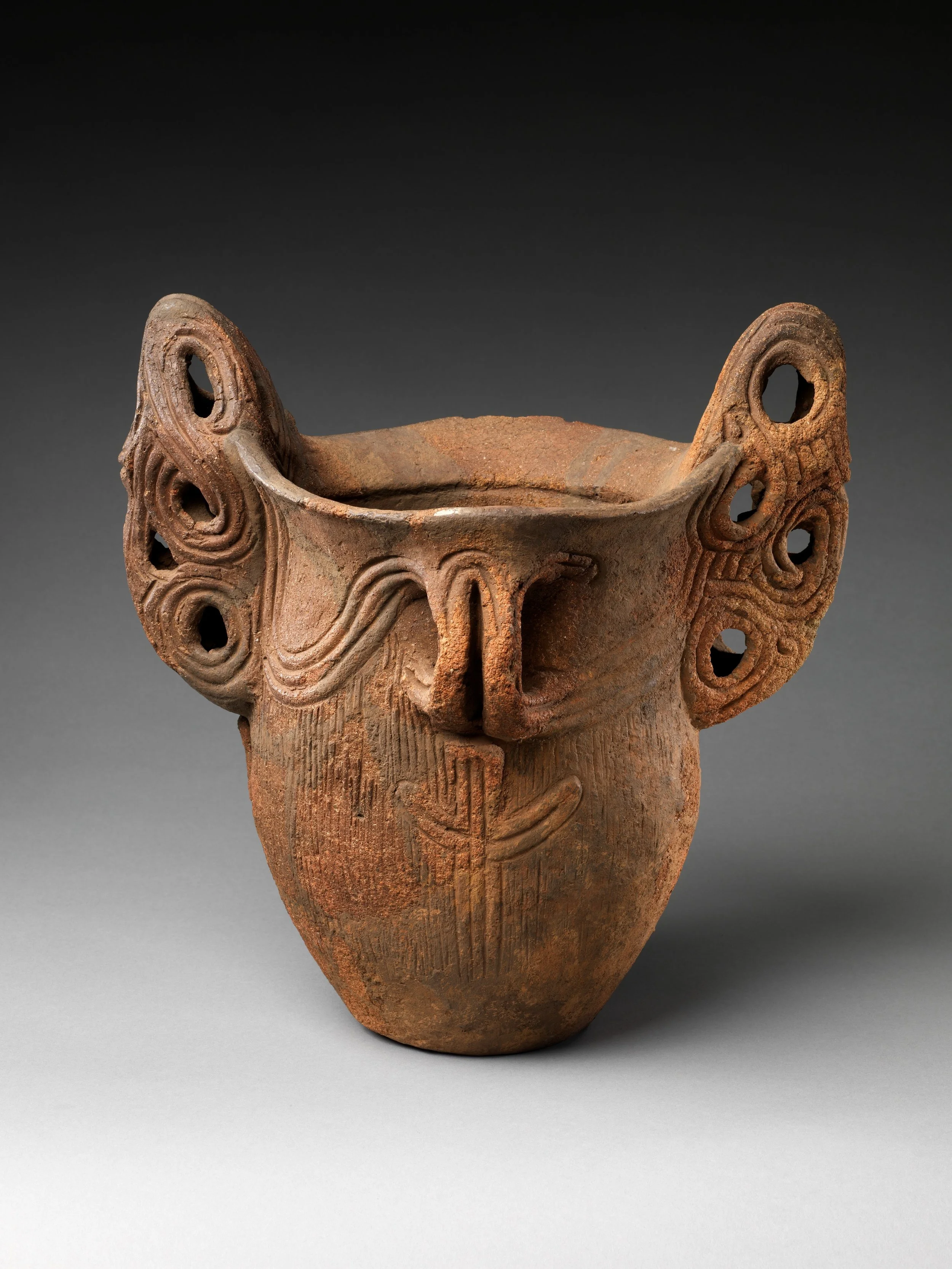
Deep Vessel with Handles, 3500–2500 BCE, Japan, Terra cotta with carved and incised decoration, The Metropolitan Museum of Art, 1975.268.183.
Benjamin Moore describes its paint color 1202, Baked Terra Cotta, as a “playful” hue with “rosy pink undertones.” The company also offers tints called Terra Cotta Tile, Colonial Brick, Pottery Red, Southwest Pottery, Santa Fe Pottery, Fresh Clay, Onondaga Clay, Baked Clay, Copper Clay, Egyptian Clay, Savannah Clay, Sonoma Clay, and Rich Clay Brown – all slightly different shades.
This is a case of art – or paint, anyway – imitating life. For terra cotta is a material of extremely imprecise character. The English term, taken from the Italian, means simply “baked earth.” But in practice, it can also refer to raw, unfired earthenware clay. Also confusing: it can be one word, or two, with a hyphen or without. (In the USA, “terra cotta” is the most frequent spelling, so we’ve used it here. “Terracotta” is more common in the UK. And if you prefer “terra-cotta” that’s fine too.) Despite all this confusion, has been widely adopted into other languages. In French, it is terre cuite; in Russian, терракота; in Hindi, टेरा कोटा (pronounced “tera kota”). Go on to Amazon.co.jp and enter テラコッタ, and you’ll find an endless choice of flowerpots, in quite a range of colors. As you might expect, the Japanese also have their own word for clay, nendo, as well as for ceramics, yakimono, literally “fired things.” They also have many other ways of talking about clay: pots are spoken of as having a particular tsuchi-aji, literally “earth flavor,” and connoisseurs may praise a teabowl for its zanguri – a soft appearance, as if the clay had not yet been fired.
Technically, terra cotta is a secondary clay, meaning that it has degraded over many centuries from various rocks and stones, then traveled some distance as a silt, picking up impurities along the way – notably the iron oxide that gives it its typical redness –finally ending up deposited in a bed. A primary clay, by contrast, has weathered at its site of origin, and so is relatively homogenous. All this means that terra cotta, as raw materials go, is quite variegated, the result of its complex mineral parentage; if this clay were a dog, it would be a mutt rather than a pure breed.
Despite its motley makeup, though, it does have certain defining characteristics. It is a type of earthenware – that is, a ceramic body that matures in the kiln at a fairly low temperature, such that it is still porous when finished. (Stoneware and porcelain, fired to higher temperatures, are fully vitrified and hence waterproof). Often, though not always, terra cotta is left unglazed. As mentioned already, it is usually red-brown in color – and is generally carefully kept separate from white clays in the pottery, to avoid staining – but you can also find buff-colored and gray terra cotta. You can buy it in many formulations, some smooth and ideal for throwing, some loaded with bits of fireclay and grog, good for making sculpture.
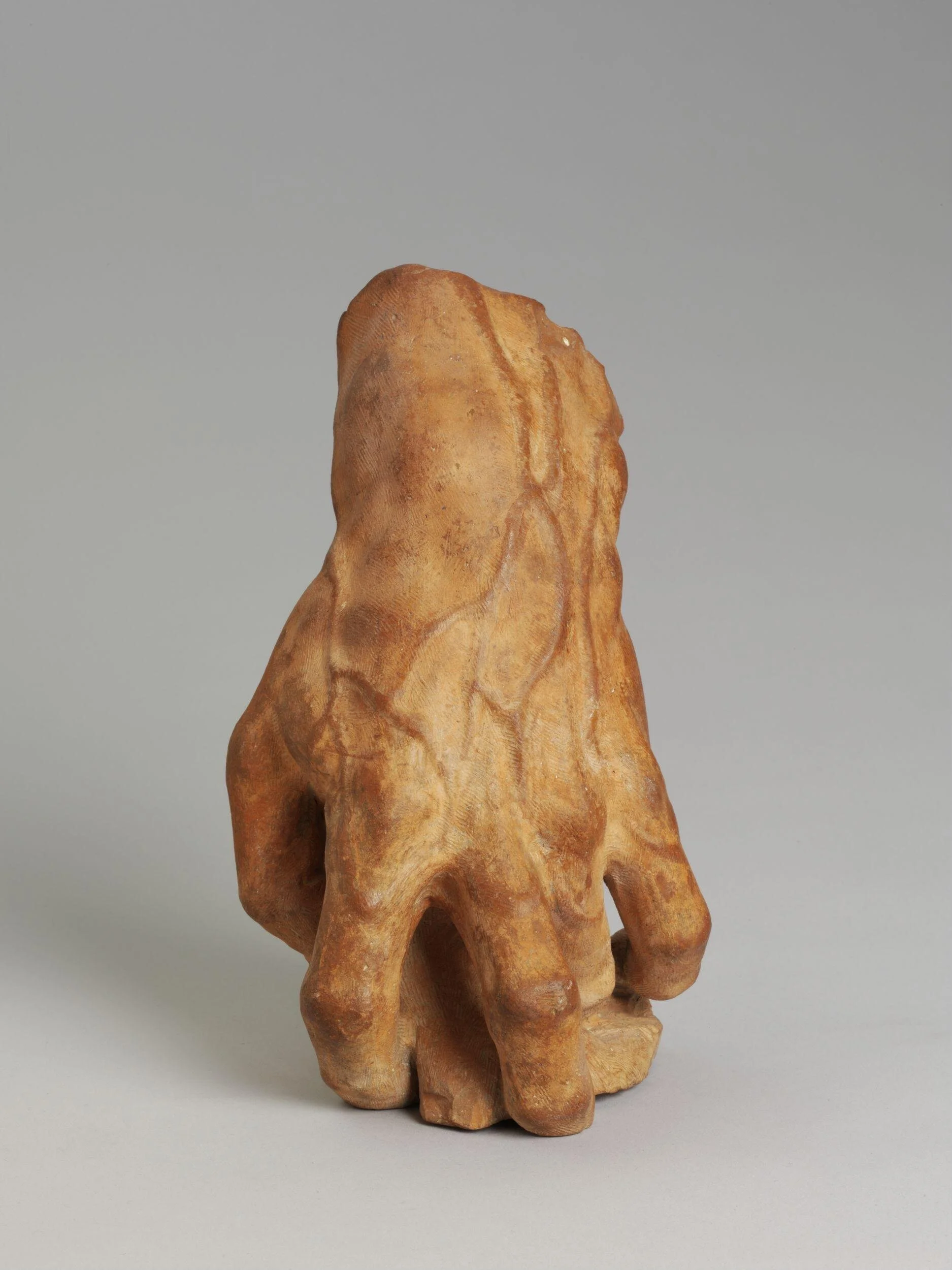
Michelangelo's Hand (Model), Italy, ca. 1580, Terra cotta, The Victoria and Albert Museum, 4104-1854, © Victoria and Albert Museum, London.
Then there is the question of what can be made from it. Art museum visitors are apt to encounter terra cotta most frequently on labels for sculptures from the Renaissance through the nineteenth century– works by specialist ateliers like that of Andrea and Luca Della Robbia, and also quickly rendered models for larger works in marble or bronze, by artists like Gianlorenzo Bernini and Antonio Canova. Today these rapid, three-dimensional sketches are prized as evidence of what the Italians call sprezzatura,the artist’s hand and mind caught in full creative flow. It was in the context of fine art that “terra cotta” got into the English language in the first place. The first occurrence seems to have been in 1722, in an account by the English painter Jonathan Richardson following his grand tour of Italy. A century later, it was still fairly uncommon – the Library of Entertaining Knowledge, in 1836,described it “as a word of very recent adoption,” and stated that it was limited mainly to the discourse of art academies.
The term was just about to proliferate, however. The economist Andrew Ure, in his Dictionary of Arts, Manufactures, and Mines (1839), defined terra cotta very precisely, as “a paste made of pipe or potter’s clay and a fine-gained colourless sand, from Ryegate, with pulverized potsherds, slowly dried in the air, and afterwards fired to a stony hardness in a proper kiln.” This was a modern material, belonging not to the artist’s studio but the factory, where things far less elevated than statuary were manufactured: drainage and sewer pipes, flowerpots, and tiles for roofs, floors, and stoves.
Like anything industrial, this new version of terra cotta was subject to technical research. Over the course of the nineteenth century, it was made stronger, more consistent, and at ever larger scale. Eventually, the term acquired a new, quite specific connotation: now, it meant a ceramic that could be applied en masse to architectural façades. Relatively inexpensive and entirely weather-resistant, it could be mass-produced in sections, so that a single pattern could be repeated across a wide surface. “I cannot abide it, I must say,” William Morris complained, arguing that terra cotta had a “fatal ease in the matter of ornamentation,“ and lacked an authentic relationship to the architectural structure behind.
Terra cotta-clad buildings look plenty impressive to us today, though. It probably doesn’t even occur to most American city-dwellers that the early skyscrapers around them are made of fired clay, not carved stone. (Hence the slogan of preservation group Friends of Terra Cotta, “don’t take it for granite!”) Nonetheless, terra cotta has long occupied a low rung on the hierarchy of materials. The pioneering art historian Maud Cruttwell, despite writing a whole book about Luca Della Robbia, thought it was a shame he had worked in clay: “In appreciating the stately strength and classic simplicity, the splendid composition and workmanship of these noble sculptures, we cannot but feel regret that he should ever have worked in the slighter material of glazed terra-cotta. For, charming and attractive as is the art, its disadvantage, from the sculpturesque point of view, cannot be denied.” Curiously, Cruttwell made exactly the opposite argument about terra cotta to the one that now tends to prevail among art historians: “Subject to three modifying processes — the baking of the clay, the glazing, and the firing of the enamel — it must needs be less directly expressive of the artist’s thought than either marble or bronze.”
Terra cotta has generally been held in low regard for a simple reason: it’s everywhere, an inexpensive material, “common as muck,” as the British say. It’s what you give to children in a pottery class. The annals of ceramic history are filled with the experimental innovators who developed high-fired stonewares and porcelains, or more-or-less convincing imitations of them: potters serving the Tang dynasty court; European innovators like the Elers brothers, John Dwight, Johann Friedrich Böttger, and in colonial Philadelphia, Gousse Bonnin and George Anthony Morris.
The inventors of terra cotta, by contrast, remain unknown to us, their names lost in the far more distant past. It is the ground (literally, as well as figuratively) against which more sophisticated clay bodies are distinguished. “Simple configuration in terra cotta, requiring no complexity of ideas, was the first step made in the art of imitation,” the Scottish politician Sir John Sinclair ventured, two hundred years ago. (He also, by the way, coined the term “statistics.”) Today, it’s easy enough to find experts telling you that, when it comes to potting houseplants, “Compared to all the beautiful colors, patterns, and styles you can find in ceramic, terra cotta can seem a little dull in comparison.” Never mind that terra cotta actually is a type of ceramic; in this context, it doesn’t even deserve the name.
Yet the very simplicity of terra cotta – the sense that it remains close to the earth – has given it value in the eyes of many observers. Arts and Crafts-era ceramics producers like the Grueby Faience Company embraced its vernacular quality, making fireplace surrounds that were essentially decorated bricks. Another prominent manufactory of the era transitioned from architectural ornament - of the kind that William Morris so disliked - to making beautiful sculptural vessels. They renamed themselves with an abbreviated form of their preferred material, Teco.
In the 1960s, hippie-inclined craftspeople embraced what they called “primitive pottery,” heading out into the hillsides to dig their own clay and fire it, “as though through the eyes of early man.” It’s an impulse that is alive and well today: on Youtube, you can find advice about making terra cotta pots entirely on your own, from digging to the clay through processing, forming and firing it. It’s a gesture of proud opposition to the complicated, hard-to-reconstruct supply chains that bring most commodities to market. Meanwhile, people all around the world are still making things out of terra cotta. It remains the primary material, for example, for Native American potters working in a huge range of idioms, from Autumn Borts-Medlock (Santa Clara Pueblo), who gathers her own clay and employs traditional Tewa motifs, to Diego Romero (Cochito Pueblo), who presents long-effaced histories of indigenous resistance through slip-painted sci-fi imagery, to Mashpee Wampanoag potter Ramona Peters, who describes her revival of lost ceramic practices as a way of “bringing a long relative back home.”
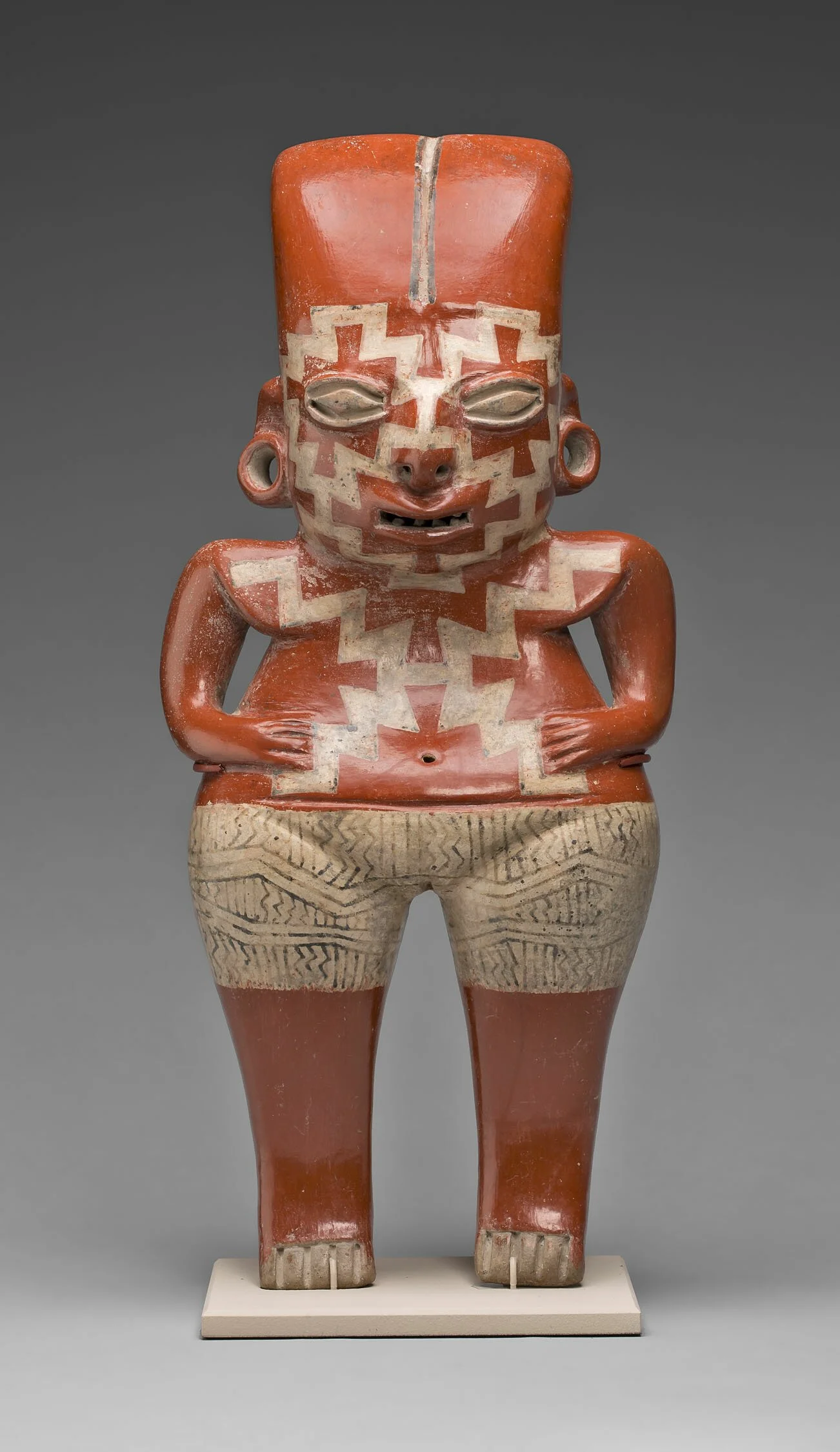
Chupícuaro, Female Figure with Geometric Face and Body Paint, 200–100 BCE. Frederick W. Renshaw Acquisition Fund; purchased with funds provided by Cynthia and Terry E. Perucca, Jamee and Marshall Field, and Helen and Sam Zell; Edward Johnson, Grant J. Pick Purchase, and Henry Horner Straus Memorial funds; purchased with funds provided by Lynn and Allen Turner; African and Amerindian Curator’s Discretionary Fund, The Art Institute of Chicago, 2007.348.