Introduction

Glenn Adamson

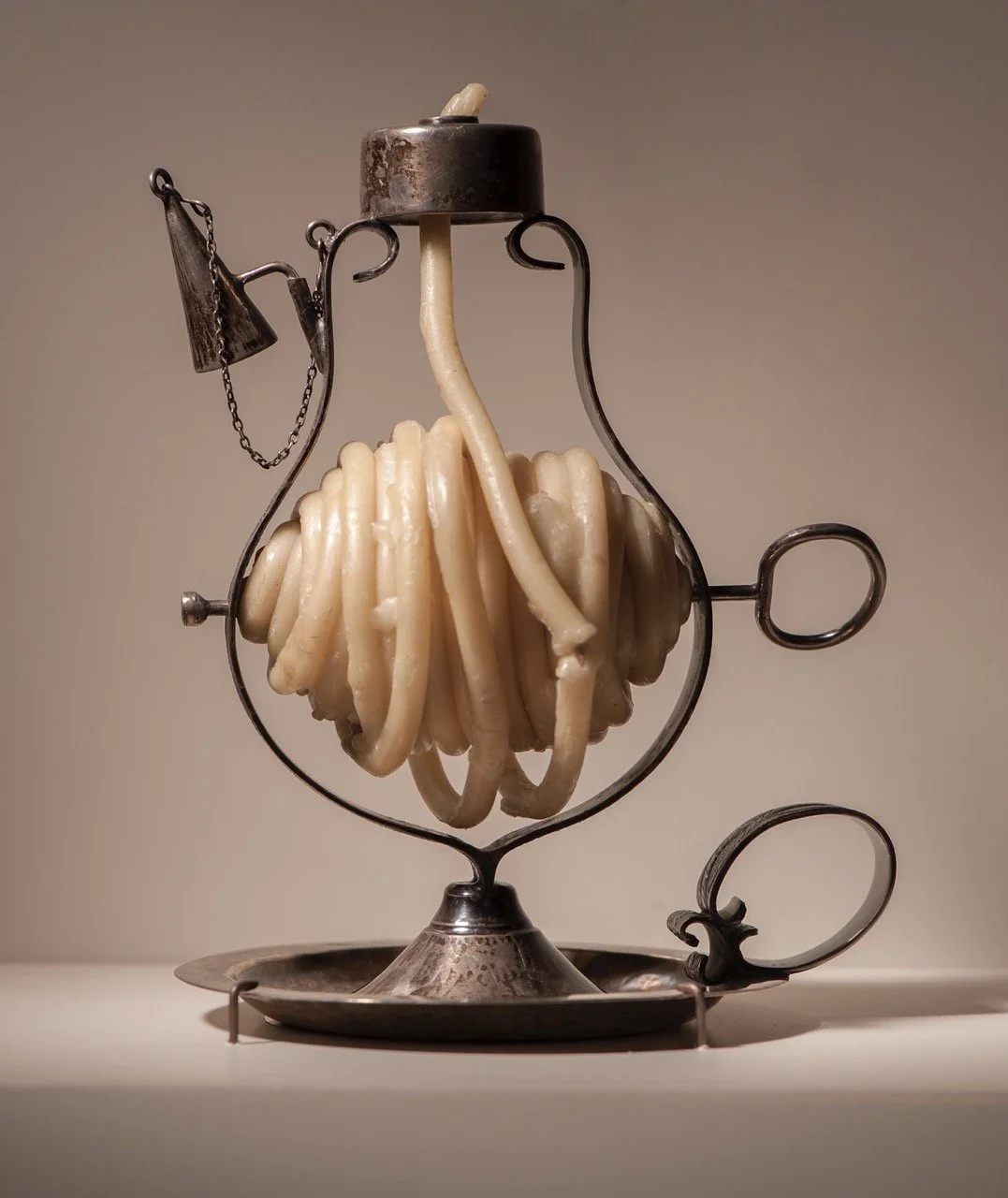
Wax jack owned by the Dennis Family, early 19th century. Britannia metal, silver, beeswax, and cotton.      6 3/4" × 5 1/8". Collection of the Smithsonian National Museum of African American History and Culture, Gift of M. Denise Dennis, in honor of the Dennis Family, 2014.273.1.

Animal, vegetable, or mineral? In the case of wax, it’s all of the above. Bees make it, of course, but so do sheep and sperm whales, soy plants and sunflowers. It can also be extracted from coal (this is called Montan wax) and petroleum (which yields parrafin). Wax is defined not by its ingredients, then, but rather its characteristics. It’s solid at room temperature, liquid when heated past its low melting point. Also water resistant, pliable, slightly lustrous. Above all, it is extremely impressionable, useful in a craft context mainly because it can be easily manipulated. It’s about as close to injection-molded plastic as we had available to us for most of human history: useful but bland, a material that seems to lack a strong personality of its own.  

Don’t underestimate it, though, for wax is the great shapeshifter among materials. Easily shaped, pigmented, and carved, it can readily be made to imitate other substances. It is also an extremely forgiving medium; if adjustments are needed, it can simply be softened and reshaped. Once applied and allowed to harden, it can be buffed to a high sheen. For all these reasons, it is a great way of keeping up appearances. People have been using wax to mold and fill teeth for about 6,500 years, and for almost as long, it has been a key ingredient in cosmetics. Traces of lipstick made from wax and crushed gemstone have been found in ancient Sumeria. To this day, Hollywood special effects technicians use a thickened “scar wax” to simulate wounds, warts and even fake noses. 

It’s no wonder, given this extraordinary malleability, that we speak of the moon “waxing” as it becomes larger and more luminous in the night sky. Look inside a living hive, or your own ears, and you’ll see a deposit gradually growing. Or just hand a kid a box of crayons and watch the magic happen. Give wax sufficient consideration, in fact, and you may begin to see it as an embodiment of creation itself. 

This is certainly how it was viewed in ancient times. The Egyptians believed that honeybees were spontaneously generated from the tears of the sun god Ra. They used wax to make magical amulets and when embalming their dead. Wax tablets for writing, approximately the size of an iPad, were popularized by the Greeks. A metal stylus was used not only to inscribe the letters, but also, after gentle heating, as an eraser. Wax was quite literally the ground from which new knowledge emerged. Many classical authors extended this idea, taking wax as a metaphor for the workings of the human mind. Plato, for example, proposed that “every man has in his mind a block of wax of various qualities, the gift of Memory, the mother of the Muses; and on this he receives the seal or stamp of those sensations and perceptions which he wishes to remember. That which he succeeds in stamping is remembered and known by him as long as the impression lasts; but that, of which the impression is rubbed out or imperfectly made, is forgotten, and not known.”
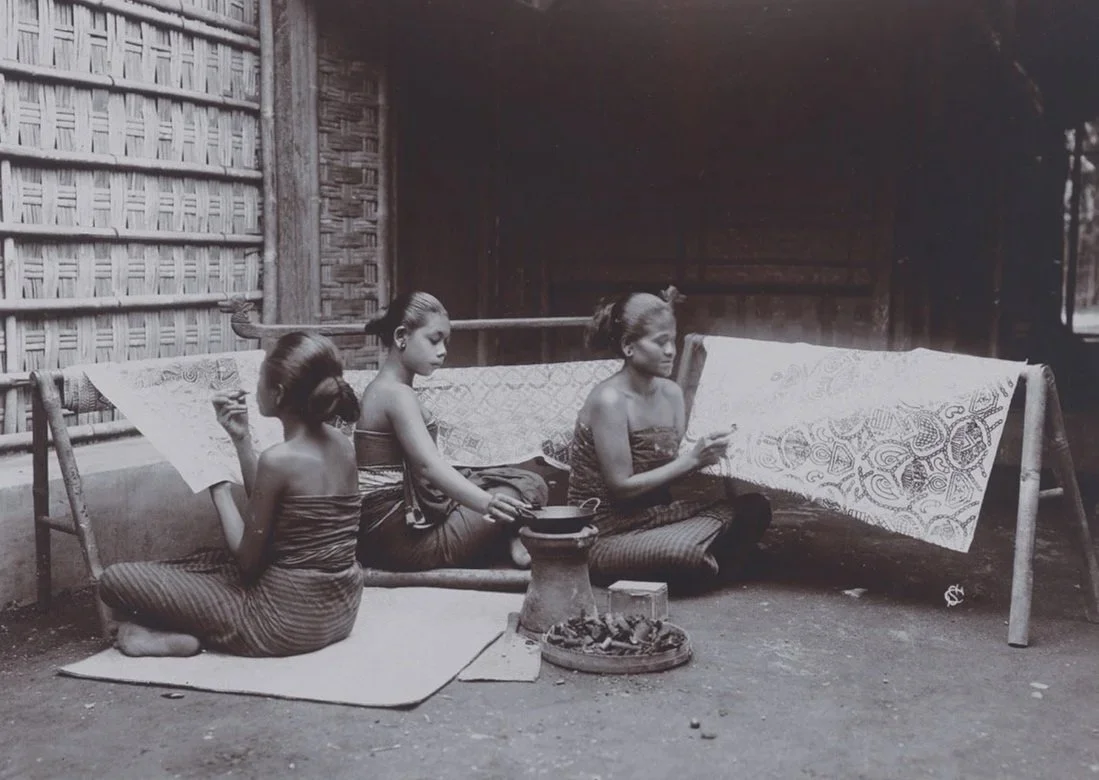
Possibly Kassian Cephas (Javanese, 1845–1912), Three Javanese Women Drawing Batik Designs on Cloth. Ca. 1867-1910. Albumen print on pasteboard. 6 3/16" x 8 9/16". Rijks Museum, Gift of J.H. Marmelstein, 2005. rp-f-2001-17-71. 

As this analogy suggests, ephemerality is another of wax’s key traits. Plato gives the example of seals, the earliest form of intellectual property protection. When one is released from the document, there is no way to reattach it without melting the wax, which would also destroy the stamped impression. And it’s by performing a disappearing act that wax has proven most useful to artisans and manufacturers. Best known is the technique of lost wax casting, in which a plaster mold is built around a wax model, which is then allowed to melt away entirely as bronze or another material is poured in. In textiles, similarly, wax is applied as a resist, preventing dye from penetrating the underlying fibers. When the wax is removed by heating and washing, the pattern is revealed. Sounds simple, but the process can be used to achieve remarkably intricate effects, as in Indonesian batik and the Ankara or “Dutch Wax” prints based on them, one of the signature idioms of African design.    

The transience of wax also operates on an allegorical register. Consider the story of Icarus, the boy who flew too close to the sun wearing wings of wax and feathers; or later vanitas paintings, which often depict a recently extinguished candle, releasing a curl of smoke into the air, as an emblem of human mortality. This provocative association arises from a purely physical property: when wax is burnt, it leaves hardly any trace. This is because it’s a hydrocarbon, so it volatilizes into “thin air” (actually, carbon dioxide and water), leaving no ash behind. The purer the wax, the cleaner the burn. Candles used in European religious services historically were made of expensive beeswax, both for symbolic reasons and to avoid filling the church with smoke. In Japanese Buddhist shines, the preference is for what are now called warosuku, candles made with a wick of washi paper and a natural wax derived from the hazenoki tree, a type of sumac. 
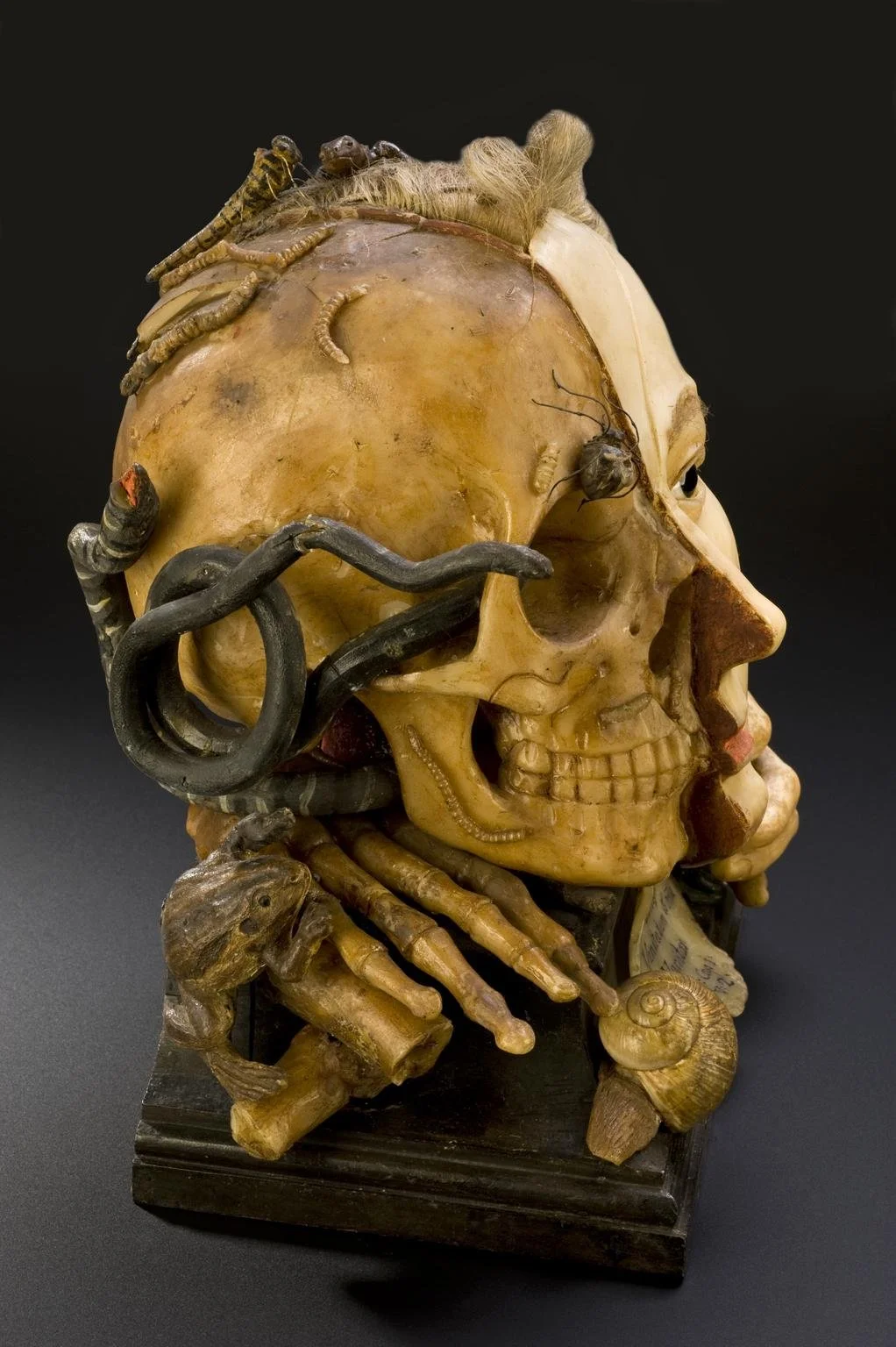
Science Museum Group, Wax vanitas (wax model of a female head depicting life and death), Europe, 1701–1800. Science Museum Group Collection, © The Board of Trustees of the Science Museum, A99821. Shared under a Creative Commons Attribution-NonCommercial-ShareAlike 4.0 International (cc by-nc-sa 4.0) license.

Wax’s ephemerality is most poignant when it is used to replicate the human body. From a technical point of view, it is an ideal material for the purpose: again, easily manipulable, and like marble, slightly translucent, like our flesh. Marble, however, is all but impervious to time, while wax must be handled carefully. It is vulnerable, just as we are. Any nineteenth-century child fortunate enough to be given a precious wax doll would have received that message. It is also the tacit logic of ex votos – essentially, prayers in object form – which were made in hopes of divine intercession, often in the shape of body parts relating to a particular malady or injury, but sometimes depicting the whole supplicant. When all else failed, the death mask waited, sometimes taken in plaster but often in wax

With the modern era, such techniques were put to the purposes of science. Anatomists had unnervingly lifelike models made in wax for study and teaching; skin and muscle peeled away, and pigments were injected to enhance verisimilitude. This is how a Swiss doctor called Philippe Curtius got his start as a wax modeler. After he moved to Paris in 1765, he began making likenesses of public figures, the most accurate in existence in an age before photography, and shared his secrets with a talented young sculptor called Marie Tussaud.

In the late eighteenth century, displays of waxworks began to proliferate, initially as traveling shows, which also featured other entertainments like organ music and live animals. Historian Peter Benes estimates that by 1825, more than 1,500 wax figures and groups had been exhibited in North America—"enough to fill the main floor pews and two tiers of galleries in one of New England’s largest meetinghouses.” Fast forward a century and a half, and that sense of profusion had only increased. Umberto Eco, in his 1975 essay “Travels in Hyperreality,” writes of the many roadside museums filled with replica masterworks he encountered on a road trip across America: “we have been lucky enough to see at least ten Davids, plus several Pietas and a complete set of Medici Tombs.”

True to its acquiescent nature, wax keeps finding new uses: as a lubricant for bicycle chains and machine tools; as an ingredient in polish and paint, shampoo and chewing gum; in coatings for greaseproof paper and weatherproof jackets, supermarket apples and bowling alleys. Carnauba wax, made from a type of palm, is particularly hard and glossy, good for keeping a shine on your shoes or your car. Then there is depilation, or hair removal. The practice, too, dates all the way back to ancient Egypt, both as a means of beautification and a way to prevent lice infection. While it is highly unlikely, as our friends on the internet claim, that Queen Nefertiti personally invented the first wax-based hair removal paste, her famous portrait bust, circa 1340 BCE, does sport suspiciously perfect eyebrows. 

It was only much more recently, however – in the period between 1915 and 1945 – that depilation became widely practiced, and many people preferred to do this by waxing. It is preferable to shaving (though significantly more painful) because the hair is pulled out at the root, instead of sliced through at the surface. This leaves the skin smooth for a longer time, and the hair regrows in its natural shape, rather than blunt and bristly. From this simple mechanical fact has arisen a global industry of vast scale. These days, about 80% of women regularly remove at least some of their body hair. Feminists have long argued that this is ridiculous. As Australian writer Mimi Spencer has memorably put it, “not only is it a humbling and hideous experience during which you proffer your undercarriage to an unknown shop girl, but it also hurts like the bayjesus.” Hard to argue with that, but nonetheless over $10 million worth of wax-based depilation products are sold annually, according to one estimate.

That’s a lot of people saying “ouch.” As a purely economic consideration, though, hair removal pales in comparison to another modern technology that began with wax: the recording of sound. The earliest commercial recordings, developed by a team of engineers including Alexander Graham Bell and Thomas Edison, were cylinders and discs sheathed in a thick layer of brown mineral wax mixed with metallic soap, which was inscribed with a stylus. The cylinders wore out quickly – usually after only a few dozen plays – but they could be smoothed and reused, just like the tablets of ancient Greece. They were also sold blank, so that consumers could create their own recordings with a home machine. 

First released in 1889, wax-based recordings were soon supplanted by a succession of various plastics (celluloid, acetate, and vinyl) which were much more hard-wearing. The terminology, however, stuck – musicians still speak of “putting it on wax” when they’re ready to lay down a track – and so did all those finely inscribed sound waves. In a curious cross-temporal technological fusion, researchers are now digitizing early wax cylinders, even broken ones, by scanning their surfaces with lasers. In the process they’re recovering all sorts of sounds otherwise lost to history: vernacular music, speeches by Teddy Roosevelt, Prohibition-era protest songs. Some of these recordings have in turn been put online. Right this minute, from the comfort of your own laptop, you can hear ghostly voices ringing in new year’s day: January 1, 1900.  Plato had it right, all those centuries ago: whatever is imprinted in wax is known. At least, until it’s gone.

Brilliant Move

Brilliant Move is the Brooklyn-based creative studio of Marci Hunt LeBrun specializing in building websites on the Squarespace platform – among many other things.

I love working with small businesses, nonprofits, and other creatives to help them organize their ideas, hone their vision, and make their web presence the best it can be. And I'm committed to keeping the process as simple, transparent, and affordable as possible.

https://brilliantmove.nyc
Next
Next

Gallery