Infinity on our fingertips
Chenoa Baker
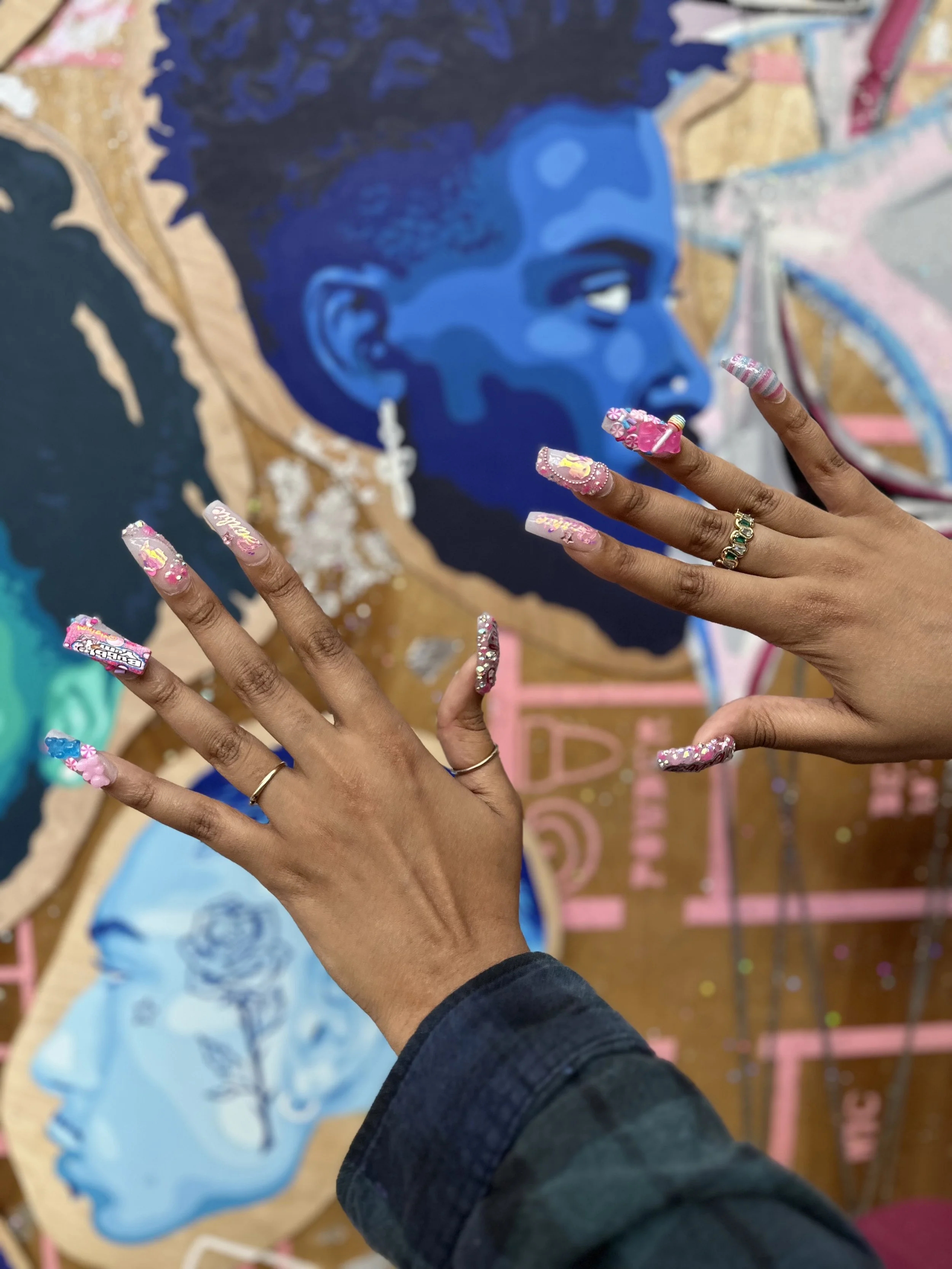
Acrylics worn by the artist Wavy Wednesday in her studio. Nails by Kamela Gissendanner.
When nail extensions first appeared in Africa, as early as 3,000 BCE, they were worn by royalty, and made from ivory, gold, or bone. They are still status symbols today but are typically made of methacrylate. This “hardy and scratch-resistant” polymer also has other applications: in dental contexts, ophthalmological prosthetics, and some household items. In the hands of diasporic communities, though, the material becomes couture: coveted, colorful, curlicue, and cuticle-extending.
Jillian Hernandez, author of Aesthetics of Excess: The Art and Politics of Black and Latina Embodiment, writes of “the improvisational nature necessary for building Black creative traditions.” Nail art, a true form of wearable sculpture, exemplifies this idea. Beginning in the 1970s, acrylics bloomed in Black and Latine glam as a mode of self-expression and a bottom-up beauty standard. As we do: nail art suggests a luxurious life for the wearer, the manicured look serving as a daily denial of manual labor and its occupational hazards.
Somewhere along the line, nails went from natural-looking trompe l'oeil to aestheticized departures from reality. Acrylics were celebrated as markers of beauty and subjected to critique based on respectability politics; they were “hoochie mama,” “ghetto fabulous,” “Chola” or “Chonga.” Donyale Luna, a Black model who appeared on the cover of Vogue in 1966, sported light pink, almond-shaped acrylics obscuring most of her face, except for her elegant cat-eye mascara. The style informed the fashion of disco divas Donna Summer and Diana Ross.
A mainstream crossover occurred in 1987, when larger-than-life sartorialist Dolly Parton sang an acapella duet with Patti LaBelle, playing their nails as Zydeco washboards, demonstrating their surprising percussive potential. Acrylics also became a signature of hip hop and gangsta rap; Lil’ Kim’s ’93 “Get Money” music video featured a custom set by Bernadette Thompson known as the “money manicure” (collected by MoMA in 2017). Dollar bills encased in resin and stuck onto the nails; with accented “party nails” of green rhinestones and gold spokes.
Extreme nail art also appeared in other cultural touchstones such as America’s Next Top Model. In one episode, the contestants take beauty shots with spider-like lashes, bling, and live arachnids, showcasing infinite avant-garde potential (Eva Marcelle, season three winner, could be said to have “nailed it”). In 2015, Anna Goswami, a college student in London at the time, designed a couture collection of dresses made entirely of hand-painted nails, giving the garments a durable chain-mail look.
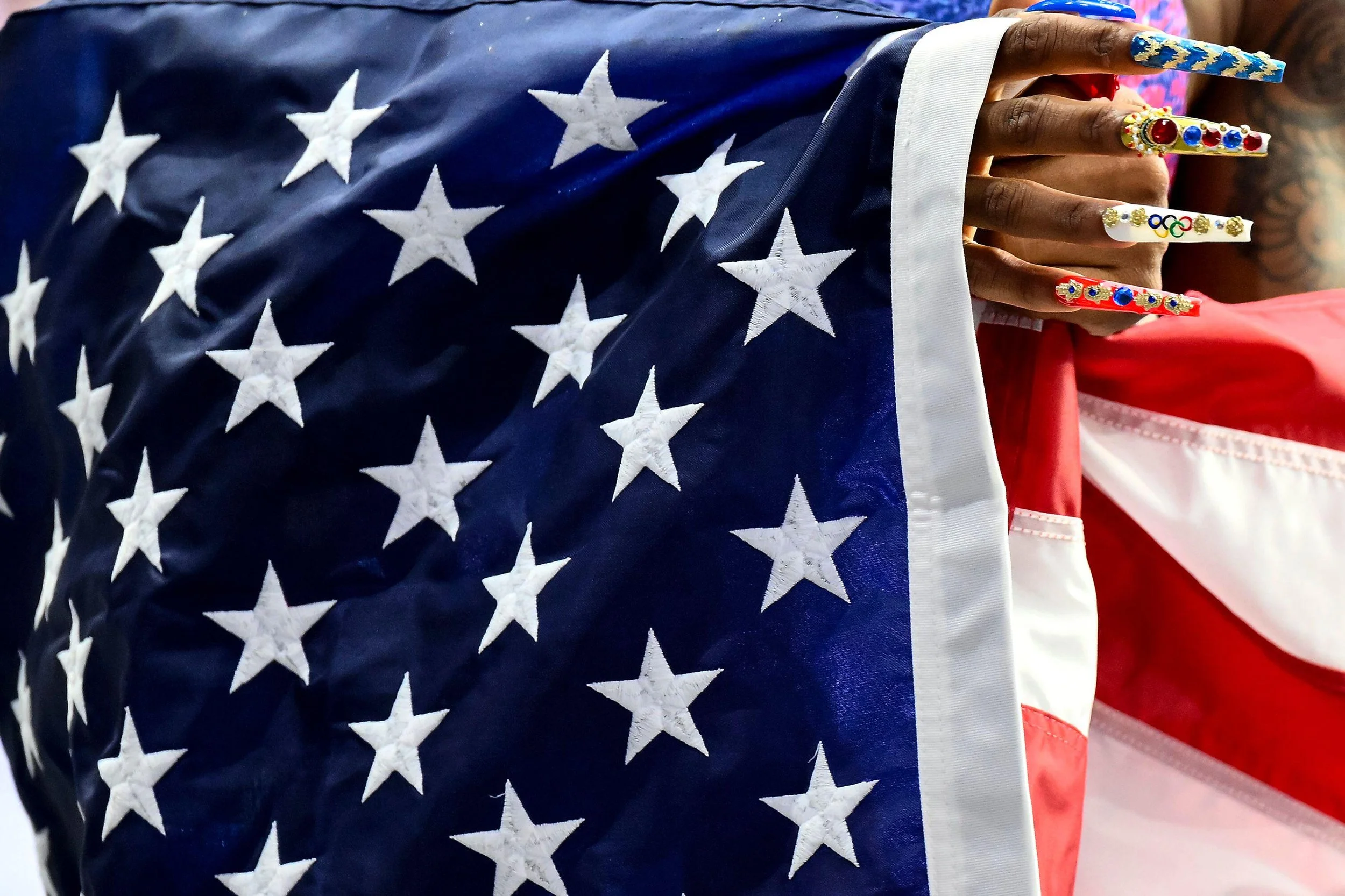
Decorated nails of Sha’carri Richardson are seen after the Women’s 4 x 100m Relay final during the Paris 2024 Olympic Games at Stade de France in Paris (France), August 09, 2024. Team United States placed first, winning the gold medal, 2024. Insidefoto / Alamy.