Privacy control
Caitlin Anklam
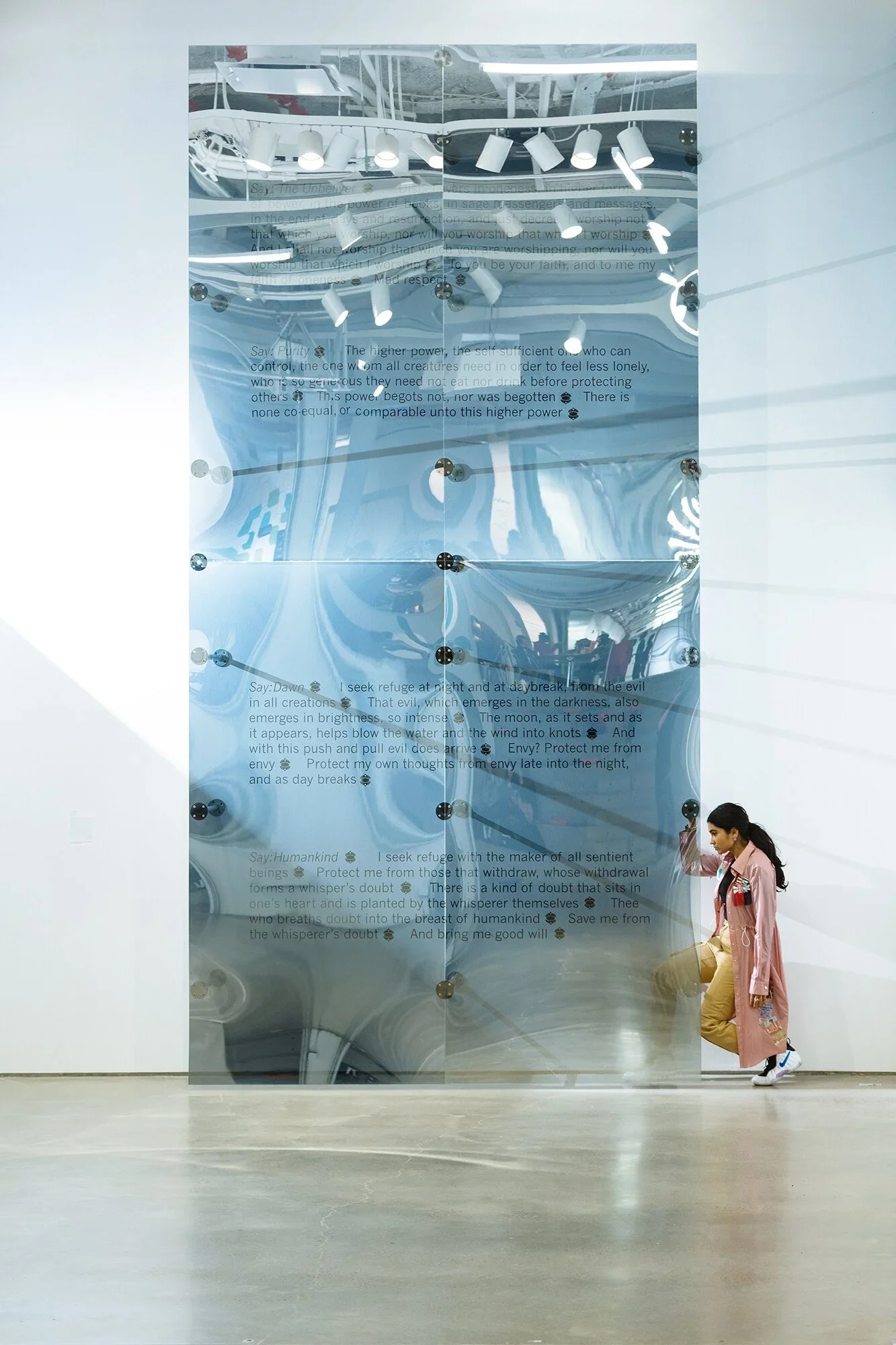
Baseera Khan, Privacy Control, 2019. Installation at bric Arts Media, Brooklyn, ny. Acrylic two-way mirror, steel pipes, vinyl text. 16 x 8 ft. Installation view, bric Arts Media Brooklyn, NY. Curated by Elizabeth Ferrer. Photo: Benny Krwon. Image courtesy the artist.
In 1903, Emil Bloch, an entrepreneur living in Cleveland, was granted a patent for a transparent mirror: opaque on the surface, see-through when lit from behind. This was the first two-way mirror, used by Bloch to advertise objects and photos displayed behind the glass. Popularly known today as an interrogation room fixture on American cop shows, the two-way mirror is now made of acrylic or glass coated in a reflective film. Through Hollywood it has become a symbol of surveillance, of the power differential between observer and observed.
Baseera Khan’s 2018 sculpture Privacy Control is constructed of large sheets of acrylic, coated in two-way mirror film and offset from the wall with steel rods. On the wall behind, the final four chapters of the Quran are written in vinyl, transcribed by Khan in gender neutral language, devoid of the masculine term for God. When the piece is installed in a museum or gallery, Privacy Control functions as a monumental mirror, one that visitors frequently stop and photograph themselves in front of. When standing near to the surface, the work’s metal scaffolding becomes visible, revealing a familiar architecture of support seen constantly while walking around the city. Behind the scaffolding are the vinyl verses, apparent once you are angled so that more light reflects off of the gallery’s wall than the substrate.
Khan’s inspiration for this work came partly from the mosque that their family recently helped to build in their hometown of Denton, Texas, where a two-way mirror partitions women from men during services. (Mosques are often divided by gender, separated by a screen or wall that obscures the “women” from the “men” during prayer.) Women and children sit behind the mirror—where they can see through and out, to the men and the imam—but the men cannot see them.
In my recent conversation with Khan, they described a moment they experienced during prayer. The lighting in the mosque shifted and suddenly, rather than only seeing out through the pane of the mirror, they could see their own reflection and the space behind them, at the same time that they could see through to the front half of the mosque. This was only a momentary glitch; the clouds shifted, the lighting changed, and they could no longer see their reflection. This moment shocked them into self-awareness and the realization that hundreds of thousands of others were experiencing this same way of seeing—of looking out without being seen—during this same ritual, through the same material.
Khan is continuously tracking materials’ uses, points of origin, and complex and contradictory residues of association. In Privacy Control, there is a tension held within the two-way mirror, between the surveillance state that it symbolizes and the moment of privacy and prayer that it enables. Acrylic, the primary material of the work, is a material that Khan returns to again and again. In their 2021 show at the Brooklyn Museum, I Am an Archive, several works displayed alongside Privacy Control used Plexiglas and cast acrylic.
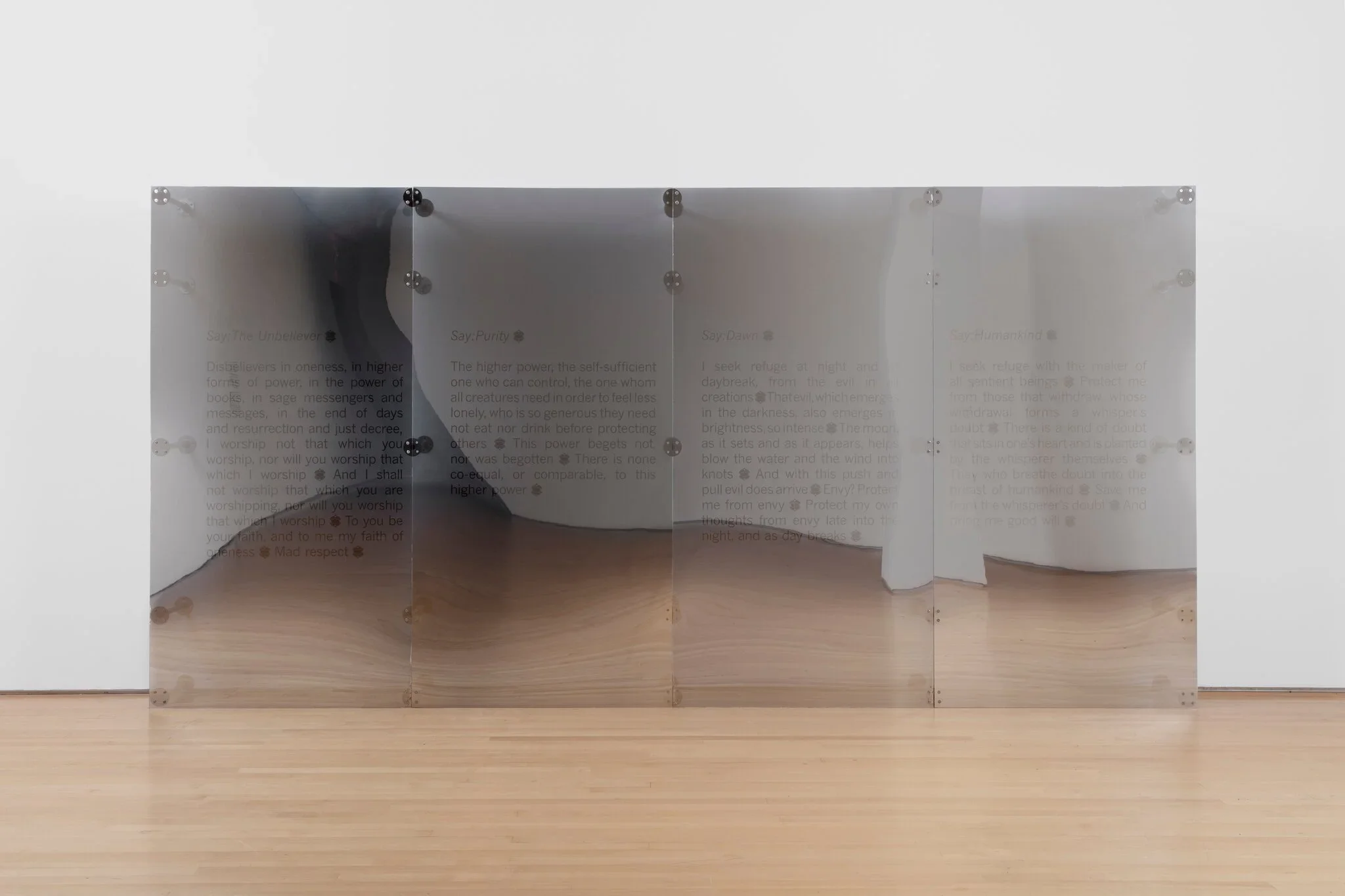
Baseera Khan, Privacy Control, 2019. Installation at bric Arts Media, Brooklyn, ny. Acrylic two-way mirror, steel pipes, vinyl text. 16 x 8 ft. Installation view, bric Arts Media Brooklyn, NY. Curated by Elizabeth Ferrer. Photo: Benny Krwon. Image courtesy the artist.
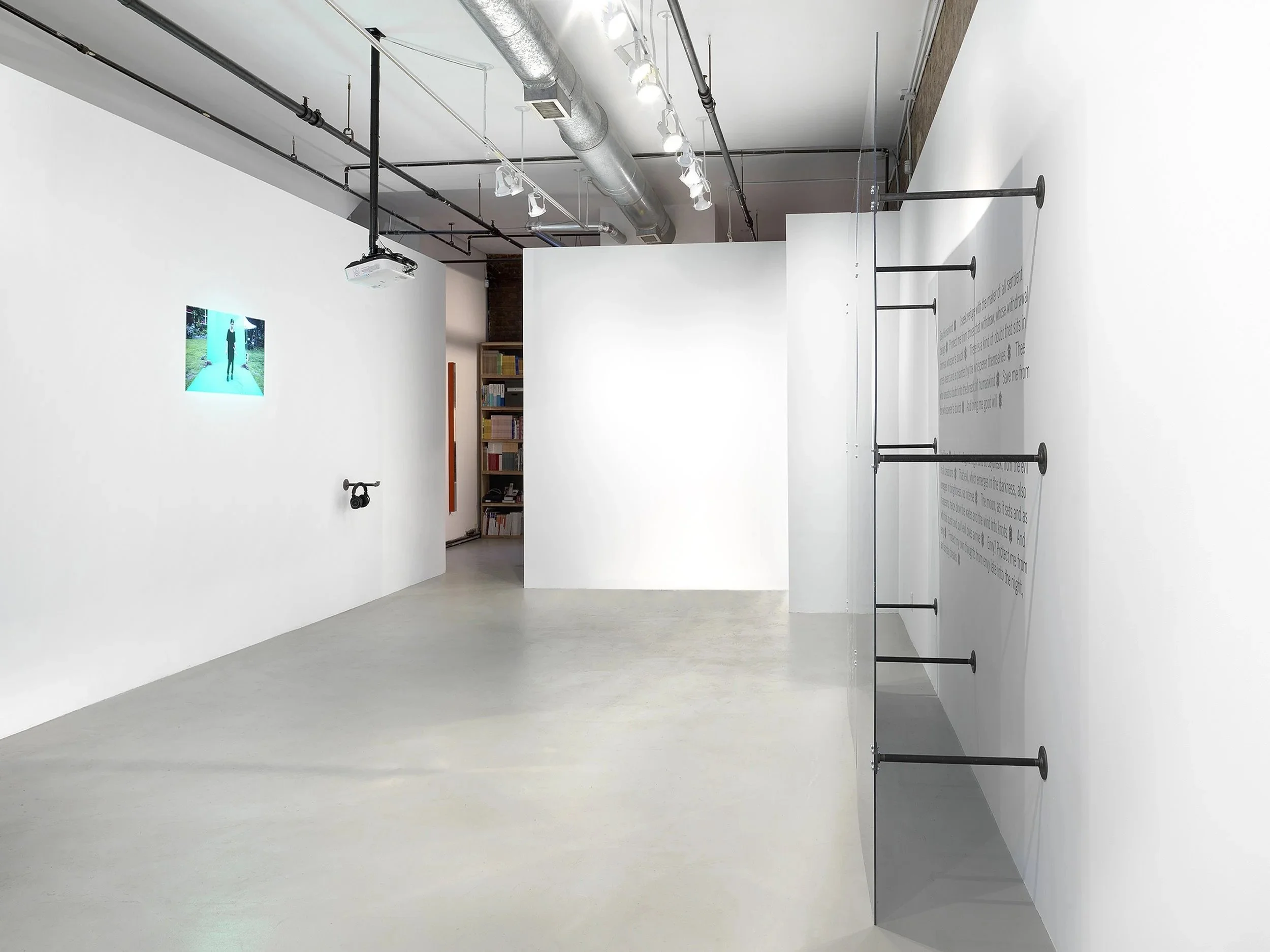
Baseera Khan, Privacy Control, 2018. Acrylic two-way mirror, vinyl wall text, steel scaffolding mounts. 8 x 8 ft. Installation view, Simone Subal Gallery, ny (to the left: Planet Fitness, 2016, 20-minute running performance set to a custom soundtrack). Photo: Dario Lasagni. Image courtesy the artist.
For their 2021 photo series I Arrive in a Place with a High Level of Psychic Distress, Khan constructed a tall clear platform and photographed themself from below. Their face hidden and their limbs visible, their body is obscured behind patterned textiles and large shards of colored Plexiglas layered within the printed photos’ frame. They worked closely with Kashmiri rug makers—a region where they have familial ties—to produce new textiles based on their designs, involving the work within a material network that spans continents. The Plexiglas operates as a shield: the plastic’s hues reference chakra colors, manifesting an energetic protection. The series was created at the beginning of the pandemic, at a time when acrylic barriers proliferated.
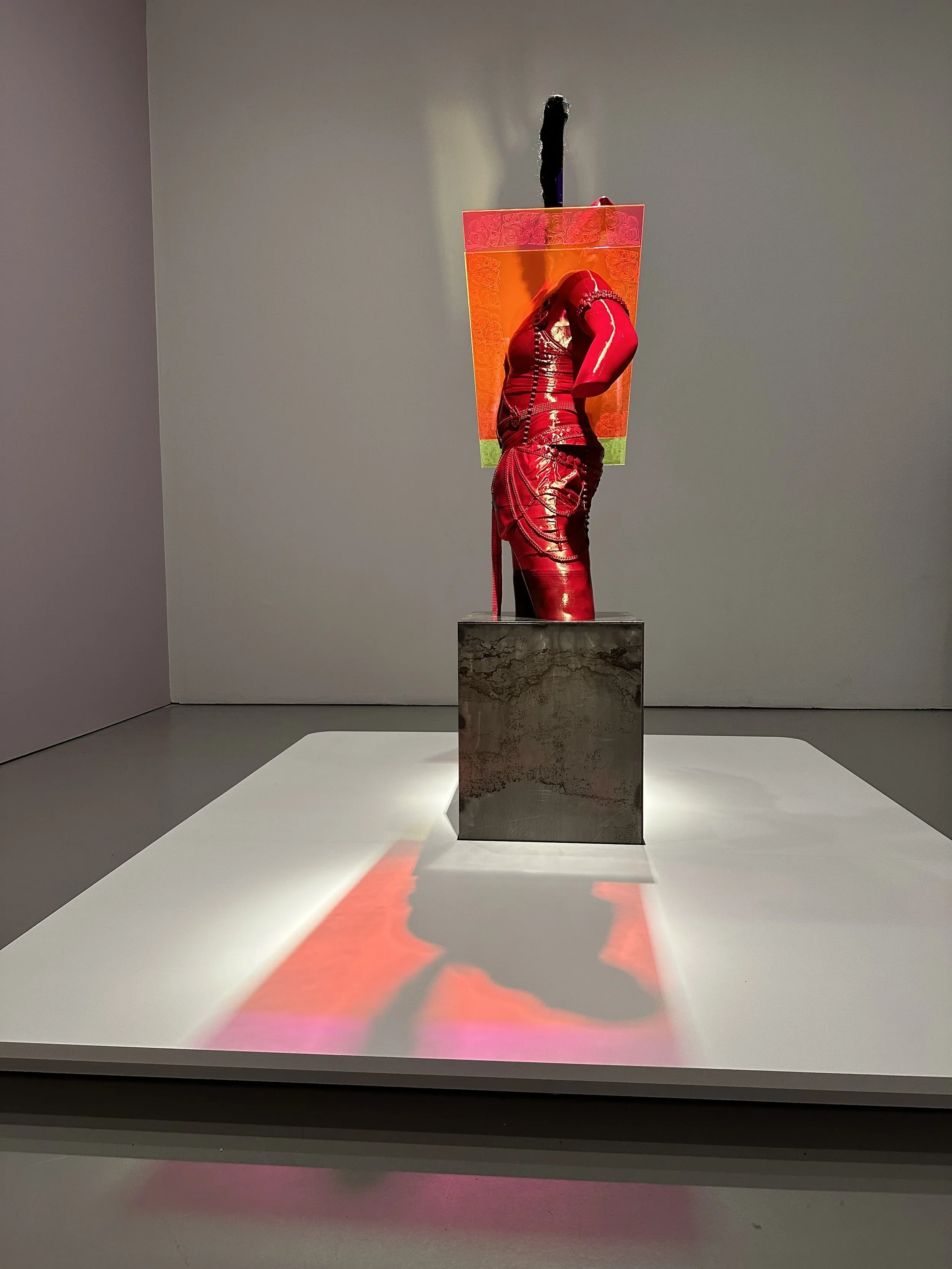
Beseera Khan, The Liberator, from the series Busts of Canons, 2023. fdm (Fused Deposition Modeling), 3d-printed petroleum-based acrylic, artist’s hair, custom steel pedestal. Image courtesy the artist.