Plastic goes pop

Catharine Rossi

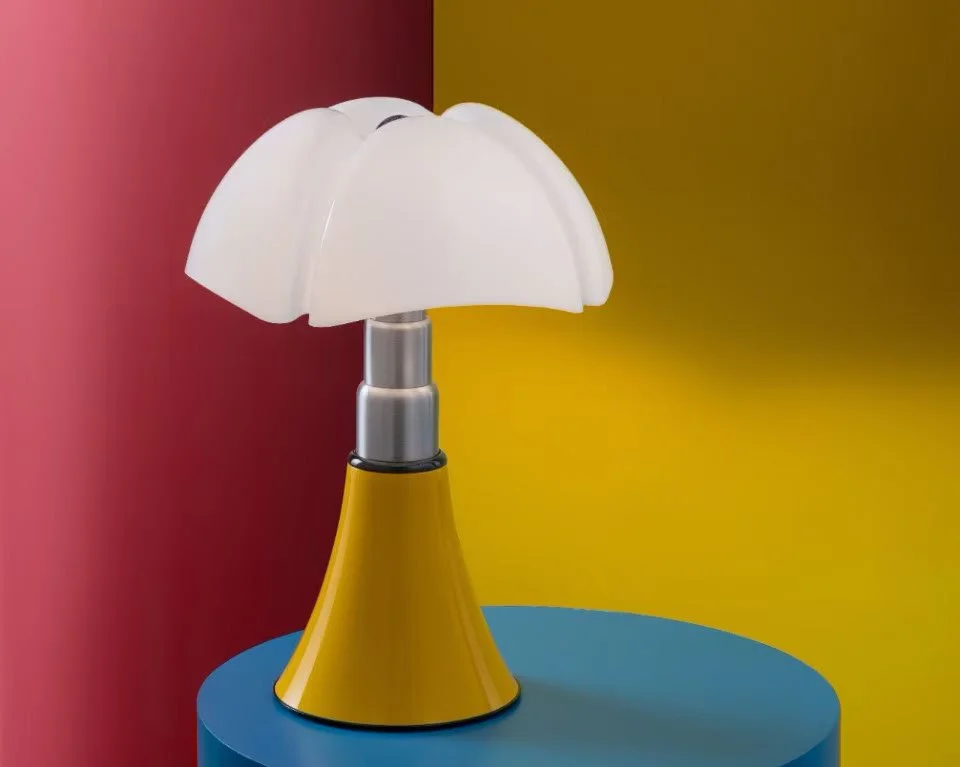
Gae Aulenti, Pipistrello light, (originally produced for Olivetti’s Paris store in the late 1960s): 1965; (yellow-based pop version produced by Martinelli Luce): 2023. Stainless steel and acrylic. Martinelli Luce. Despite The Chipstone Foundation’s efforts to contact Martinelli Luce, the necessary rights for this image have not been obtained.

Passiflora and Pipistrello. These two characters were amongst the acrylic line-up in Italy: The New Domestic Landscape, which opened at New York’s Museum of Modern Art in 1972. Immediately understood as a landmark exhibition, it celebrated Italian design’s growing commercial and critical success in the 1950s and 1960s, with design key to the nation’s postwar rebirth. Curated by Argentinian architect Emilio Ambasz, the exhibition was in two halves: inside were eleven domestic installations commissioned from Italian architects, while out in the sculpture garden were 180 examples of Italian products and furniture from the previous decade.

Plastic was everywhere in the show. Half of the exhibits used synthetic polymers such as ABS, polyurethane, and fibreglass, and, in a dozen cases, acrylic, which had become visible in Italian design from the late 1950s through lighting designs by the likes of Achille and Piergiacomo Castiglioni and Joe Colombo. Exhibition sponsors and partners included plastics manufacturer Kartell (who produced the Castiglionis’ and Colombo’s designs) as well as Italian oil giant ENI, who encouraged architects to explore “the potentialities of the synthetic materials and fibers” in their installations. The exhibition was the culmination of state and private investment in synthetic polymers from the 1920s onwards, and their translation into desirable commodities by Italy’s architects, artisans, and manufacturers.

Unlike craft-based materials associated with Italian design, such as wood, leather and ceramic, plastics are often thought of as unnatural and placeless—even if their amorphous properties ultimately speak of their liquid provenance in subterranean oil reservoirs. Arguably, the success of Italian plastic design was in finding a formal language which acknowledged these geological origins, exploiting the material’s chemically-engineered possibilities and also responding to the postwar Italian context.
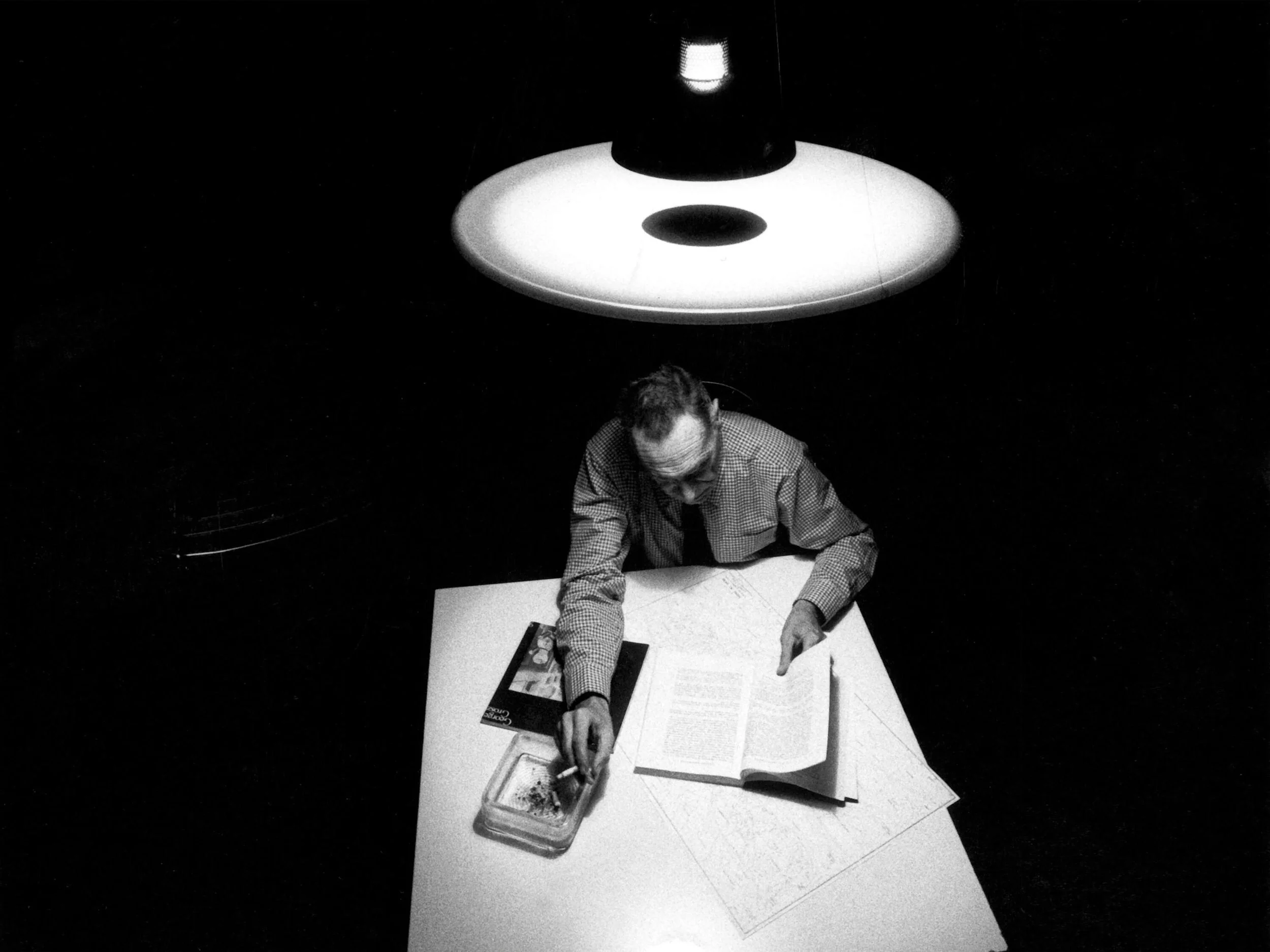
Achille Castiglioni, produced by Flos, Frisbi lamp, 1978. polymethylmethacrylate, steel. Despite The Chipstone Foundation’s best efforts the necessary rights for this image have not been obtained.

This is certainly true of Pipistrello (“Bat”), designed by Gae Aulenti in 1965 for Martinelli-Luce (the only female-designed acrylic product in the exhibition). The lamp’s telescopic stainless-steel base and opal acrylic diffuser exploits the material’s light-transmitting and thermoplastic properties. The diffuser’s batwing-like moulded profile expressed Aulenti’s interest in Art Nouveau, then undergoing a revival through the NeoLiberty movement (named after the London department store), part of a broader critique of Modernism at the time.
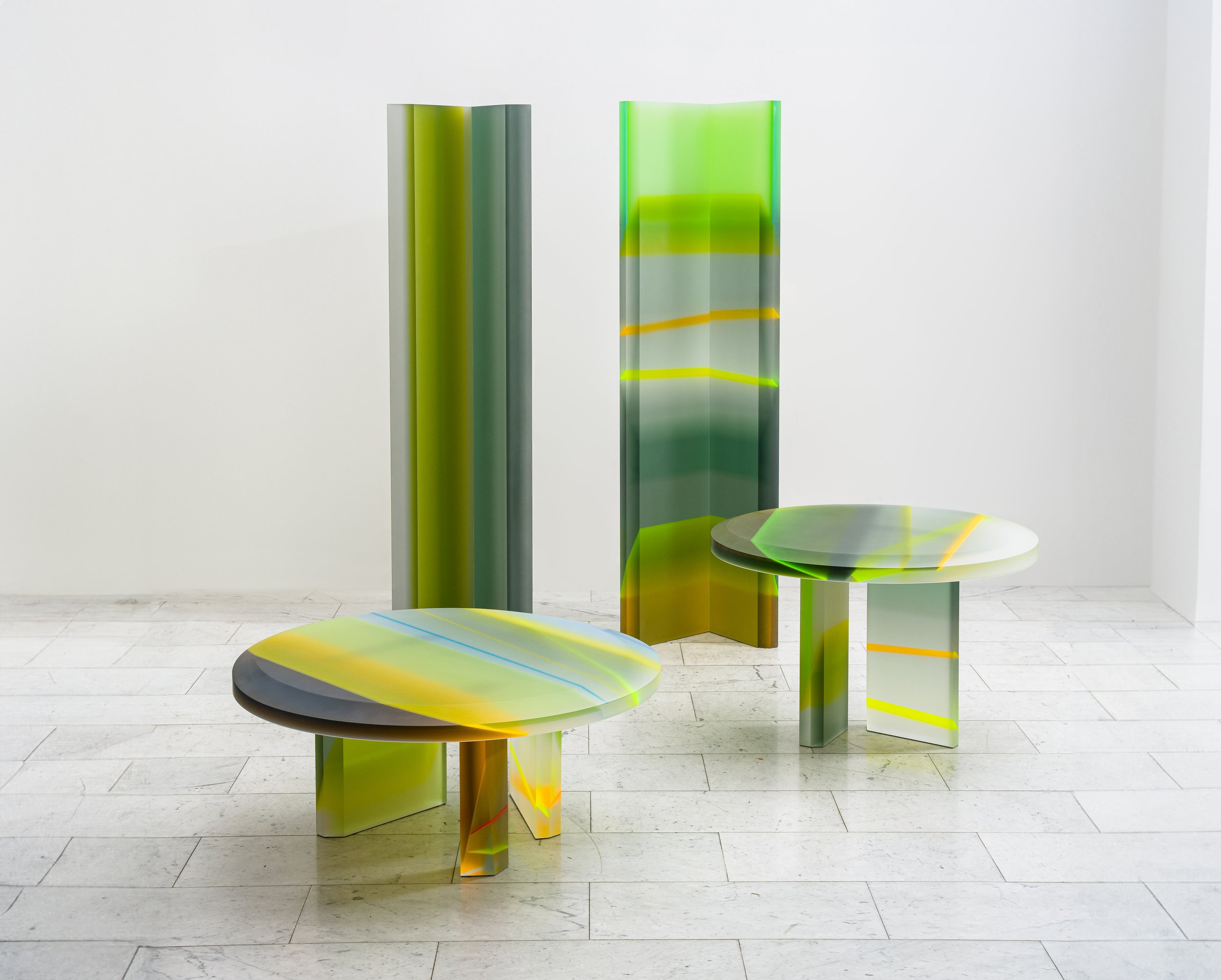
Flare coffee table I, Flare coffee table II, and Flare totems, designed by Draga & Aurel exclusively for Todd Merrill Studio. Photo courtesy of Todd Merrill Studio.

This critique took a more satirical turn in Superstudio’s Passiflora (“Passionflower”), produced by Poltronova. The experimental Tuscan manufacturer produced several works in acrylic, plastic laminate, and polyurethane by Radical architects such as Archizoom, Ettore Sottsass and Superstudio, who used plastic’s pop culture qualities to parodize Italian design’s reputation for desirable, tasteful commodities. Passiflora’s multiple subversions—of the classical column, the natural-artificial binary, and the aesthetics of functionality—are brought to life in translucent white and yellow. The lamp’s sharp profile is composed of five tube-like sections which were hand cut, glued, and filed to produce the smooth polished edge, a reminder that it’s not just ‘natural’ materials that require highly skilled manufacture.

If The New Domestic Landscape expressed plastic’s abilities to express the conceptual, formal, and functional concerns of Italian design, it also seemed to mark the end of this possibility. The 1973 oil crisis made such plastics experiments economically unviable and accelerated a growing disquiet over design’s environmental impact and its societal role more generally. 1973 was also the year that Sottsass, Superstudio, Archizoom and others established Global Tools, an experimental collective focused on workshops and publications rather than market-friendly commodities. As Global Tools member Franco Raggi noted, the oil shock caused a “disorientation” for architects and designers in Europe and the US, as they contemplated a less optimistic era.

However, like plastics, design is multi-faceted and sometimes contradictory. While many designers in Italy gave up on the plastic dream, the industry continued to grow in the late 20th century, with manufacturers such as Kartell producing acrylic and other plastic designs by the likes of Aulenti and Anna Castelli-Ferrieri (Kartell’s co-owner, with her husband Giulio Castelli). Today there are designers continuing to embrace acrylic, such as Italian-based studio Draga & Aurel, whose Heritage furniture collection (2024) features contemporary, jewel-like forms and colours. Marco Campardo, a London-based Italian designer recognized for his material experimentation, is starting to work with acrylic sheets, inspired by American artists Peter Alexander and Donald Judd and Japanese designer Shiro Kuramata. He recognizes the tension between acrylic’s unsustainability and its attractiveness, and the need to use it with care and consideration. Campardo predicts that designers will continue to work with the material in innovative and ecological ways. It looks like acrylic-based experimentation isn’t confined to the history of Italian design, but will be part of its future too.


Catharine Rossi is a design historian and Professor of Architecture at uca Canterbury School of Architecture, Art and Design. A curator, researcher, writer and educator, her interests include Italian design, craft, nightclubs, feminism, environmentalism, and contemporary design and architecture. Publications include Crafting Design in Italy (mup, 2015) and the co-edited The Italian Avant‑Garde (Sternberg, 2013) and Beyond the Dancefloor (Bloomsbury, 2026). She has co/curated exhibitions including Night Fever: Designing Club Culture 1960 –Today (Vitra Design Museum, 2018–2022) and At Home: Panoramas de nos vies domestiques (Saint-Etienne Design Biennale, 2022).