Etching with fire
Lindsey Muscato
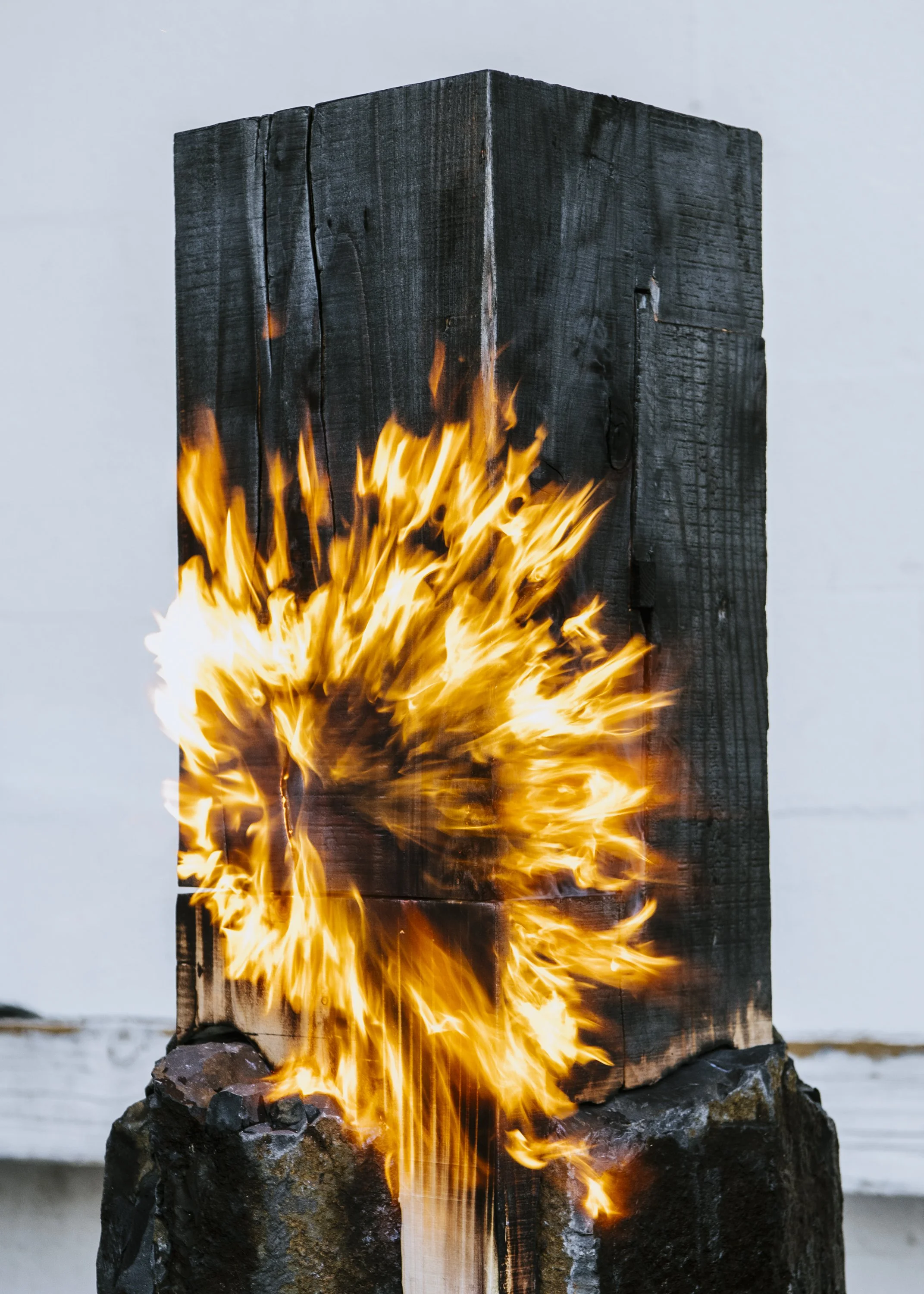
Base 10 (Lindsey Muscato and Joshua Friedman), process photograph. Photo by Brian Guido.
Charcoal-making is rarely paired with the craft of woodworking. But while pulling at the creative thread of our practice in large-scale, sculptural wood furniture, we arrived at this fascination: constructing experimental low-oxygen kilns from recycled metal drums, and pyrolyzing small, jointed-wood maquettes, initially in summer campfires while on our family trips.
My husband and partner, Joshua Friedman, and I met in art school in the San Francisco Bay Area, but the thread that led to explorations of charcoal began after, beginning with Josh’s work in Japanese-style timber framing and carpentry, continuing through the years of his independent woodworking and furniture making, and carrying over to our first trip to Japan and the inspirational impact of the architecture and carpentry we saw there. Those experiences finally led to a body of work in which we employed architectural-scale timbers and joinery techniques, reinterpreting them for interior spaces and furniture forms.
We called the series of works Kodama – the name of a tree-inhabiting spirit – and designed them in simple line drawings, using charcoal and graphite sticks. The monochrome, blackened wood ultimately felt like a three-dimensional articulation of those initial sketches, and a fitting formal resolution for the pieces, which we arrived at in two phases, beginning with an exterior char in the mode of yakisugi (known outside of Japan as shou sugi ban). In the parking lot of our workshop on the east side of Los Angeles, we used a blowtorch to create a controlled burn on the outer layers of the timber: large coastal redwood, aleppo pine, elm and other species. The surfaces were then finished, and further deepened, with natural chemical patination.
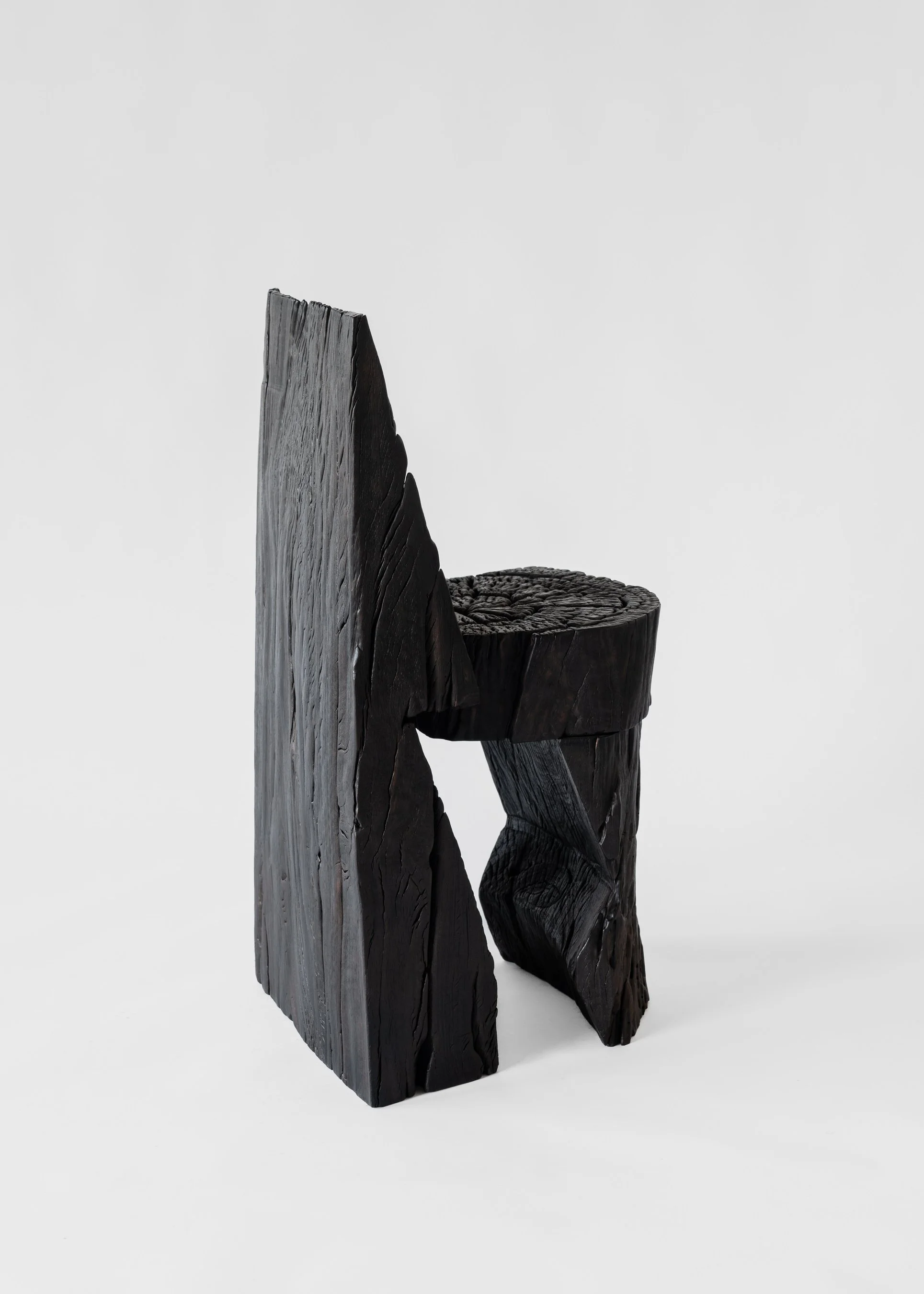
Base 10 (Lindsey Muscato and Joshua Friedman), Soma Chair, from the Offcuts series, 2024. Photo by Erik Benjamins.
In Japan, yakisugi is traditionally applied to thin planks used for exterior cladding. This is done by binding together three boards to form a triangular chimney and igniting the interior. The burned surfaces are then used as the outward-facing layer of architectural surfaces. The char provides protection against microbes, insects, and rot. Intriguingly, it also makes the wood less flammable to further combustion. In other words, the process of burning the outermost layer creates a mitigating face for nearly all of the common vulnerabilities of wood as a building material.
But these protective properties of the charcoaled surface were not our primary aim, and counterintuitively, the blackening of the char was not the primary intention behind our adoption of the process. Rather, we were after specific textures in the wood, unlike other methods of finishing. Because of the distinct seasonal phases of tree growth, wood burns at different rates between the summer and winter growths. Burning emphasizes this distinctive natural grain pattern—like a dimensional etching—visible as soon as the charred surface is brushed away. In technical contexts, charcoal-making is sometimes called ‘destructive distillation,’ which seems to perfectly describe the role that burning played for us as a reductive tool that resulted in the unearthing of the grain qualities we sought.
Our attention next moved from yakisugi to another famous Japanese technique of pyrolysis: binchotan. Instead of a light, shallow burn, this is a kiln carbonization process that takes days, resulting in wood that has expelled up to 95% of its non-carbon elements, leaving an incredibly dense, nearly pure carbon matrix. This process of pyrolysis is achieved by several distinct stages, demarcated by precise temperatures. The technique’s low and slow thermal decomposition ultimately reduces the original mass of the wood by up to three quarters. Because of this carbon purity, binchotan charcoal is prized for use in indoor cooking (long burn times, high temperatures, near smokelessness), as well as water and air filtration. In appearance, binchotan is opaque and dark, rich in its lusterless depth of blackness, the wood’s organic grain and knots preserved in detail as though the original tree branch had been lost-wax cast with all the character from its life intact.
We continue to consider this technique of charcoal-making to be a fascinating space of exploration into the sculptural, yielding a material beguiling in its formal qualities. In the wake of this past winter’s fires here in Los Angeles, where we live and work, however, the concept of ‘destructive distillation’ has taken on entirely new implications. We reflect with humility on our creative investigations into both the paradoxically protective potential of burning with yakisugi, and the exquisite material transformation of binchotan.
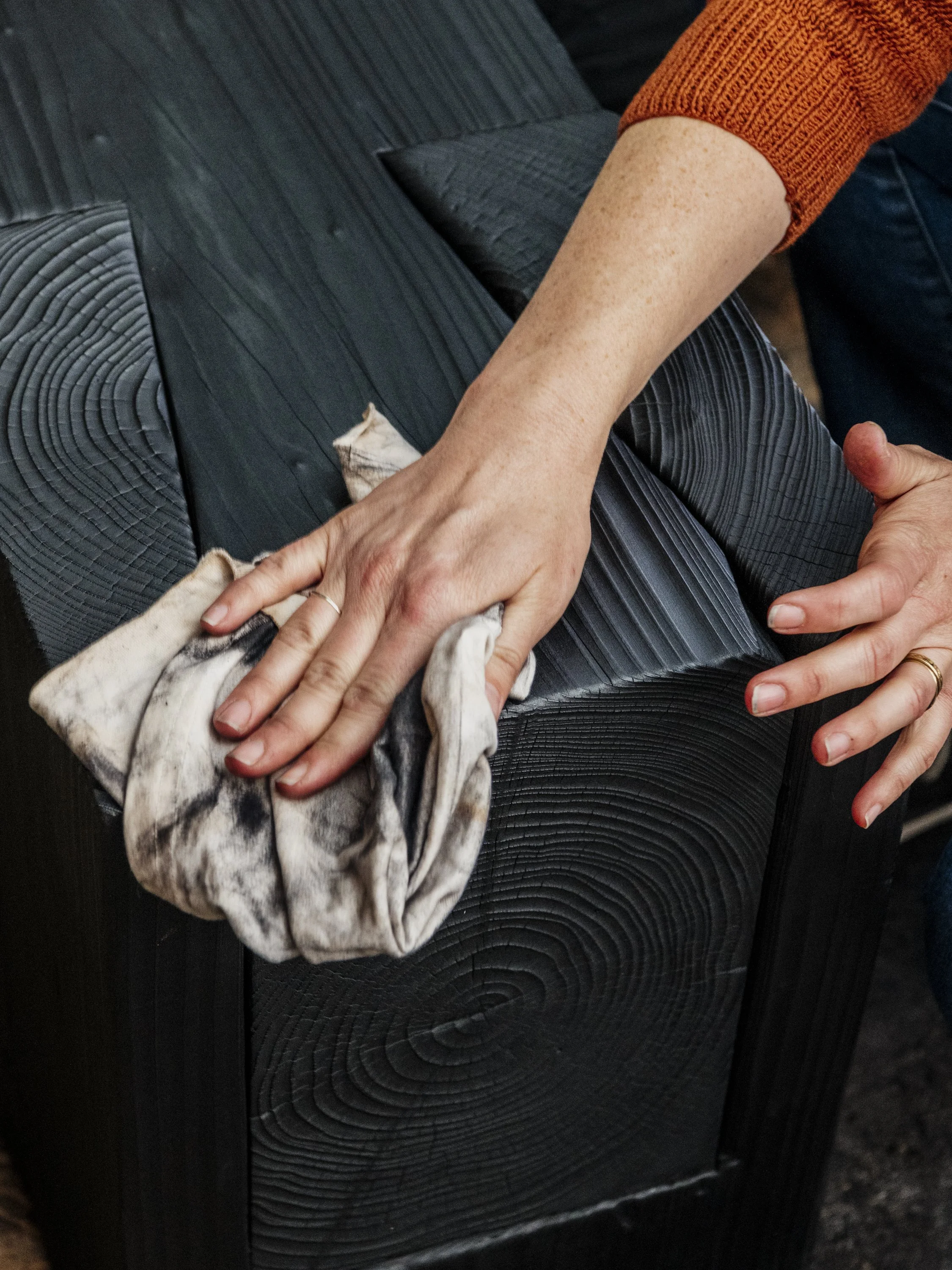
Base 10 (Lindsey Muscato and Joshua Friedman), process photograph. Photo by Brian Guido.
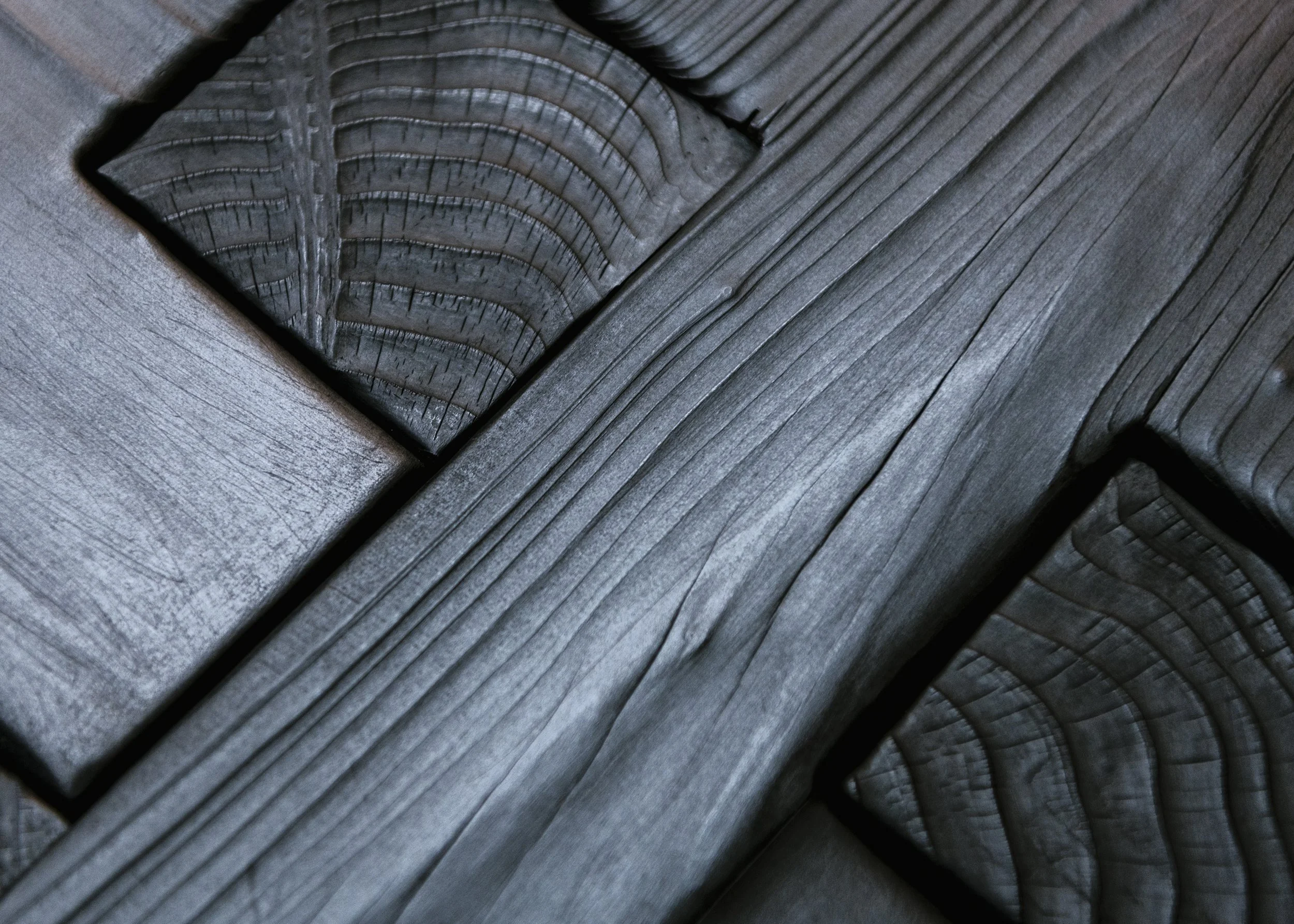
Base 10 (Lindsey Muscato and Joshua Friedman), process photograph. Photo by Brian Guido.