Material intelligence in orbit
Jennifer L. Roberts
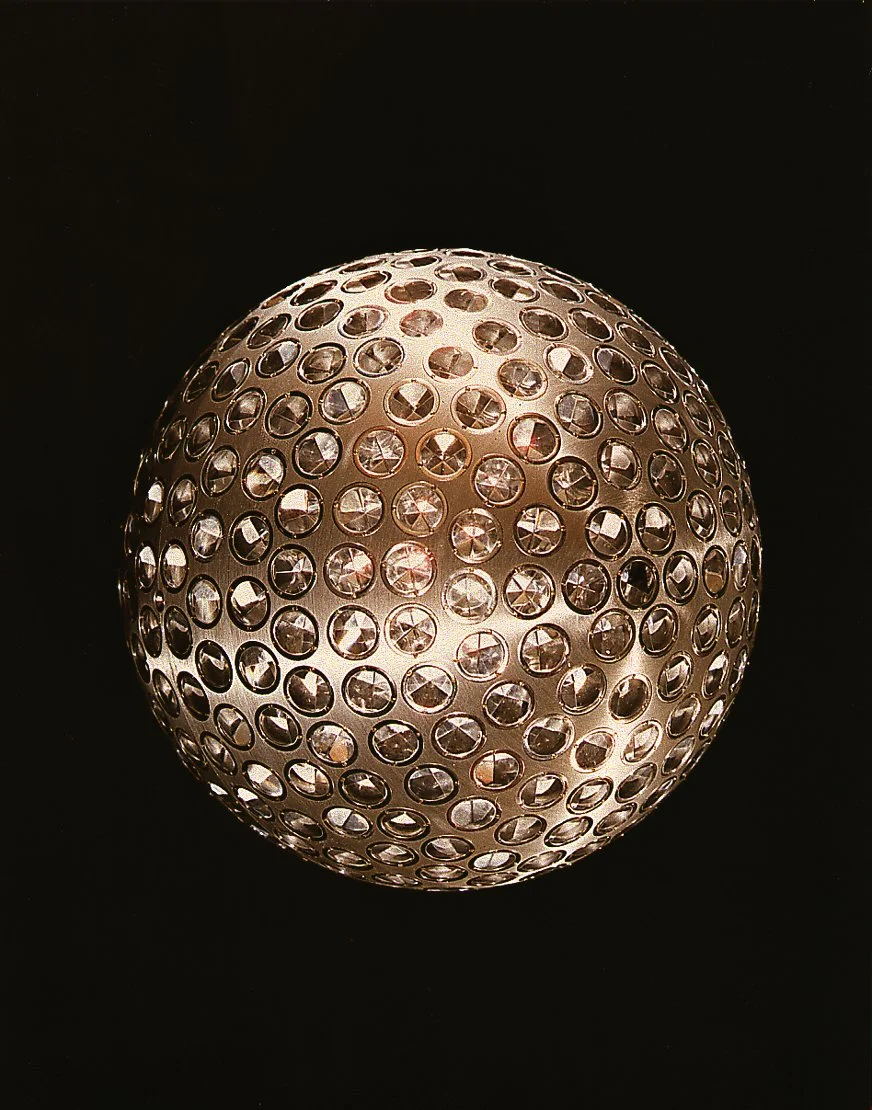
Laser Geodynamics Satellite (lageos). NASA Image and Video Library, 7667283.
The LAGEOS satellite was launched by NASA into an extremely stable Earth orbit on May 4, 1976. It still circles quietly 3,700 miles above us -- and it will continue to do so for something resembling eternity. Its orbit is so secure that, barring some unforeseen catastrophe, it will not fall back to Earth for another 8.4 million years.
It’s pretty spectacular as satellites go, looking like some sort of cosmic disco golf ball. The outer shell is aluminum, studded with 426 retroreflectors made of fused silica and germanium. It looks vaguely menacing, but in fact it is a completely passive object. It has no sensors or electronics on board, no power or propulsion. It is designed for a single purpose: to reflect laser beams in the service of geodetic measurement (LAGEOS is an acronym for Laser Geodynamic Satellite). Ground stations transmit pulsed laser signals to the satellite, which the retroreflectors then return directly back to their source. The round-trip travel time of the laser provides an extremely precise measurement (within 2 cm) of the distance of the satellite from the ground. When combined with readings taken from other stations, this information allows the distances between various points on the Earth’s surface to be determined with exacting precision. It also allows us to take fine measurements of changes in these values, indicating the Earth’s rotation rate and polar wobble, tides and tidal loading, the exact rate of continental drift, and much more.

Still from “Laser Geodynamics Satellite (lageos),” NASA’s Marshall Space Flight Center, YouTube.
If LAGEOS allows us to perceive the otherwise imperceptible dynamism of the planet, it can only do so because of the extreme stability of its own orbit: it provides something like a still point against which these intricate shifts can be measured. And this is where the copper comes in. Inside the aluminum shell is a very heavy cylinder of solid brass, a copper-zinc alloy, which gives the satellite a high mass-to-area ratio. LAGEOS is only 24 inches in diameter, but it weighs 900 pounds. Along with its spherical shape, its high mass keeps it stable by resisting the atmospheric and radiation drag that cause other satellite orbits to decay.
This heavy chunk of metal may seem like an odd topic for a journal about material intelligence: after all, the copper here seems pretty dumb. It’s an inert, inarticulate lump; dead weight. It’s just brass for mass, holding steady. But steadiness is not easy, especially in space, which is anything but constant. Every object “in” it is moving at unfathomable speeds in a flurry of relative and absolute motion. In space, it means a great deal to establish a constant point of reference.
In achieving this, the satellite calls back to the long history of brass in astronomical instrumentation. Think of all those beautiful, finely crafted, early modern armillary spheres, indicating the movement of planets and stars around the earth. In these instruments, as in LAGEOS, brass holds orbits in place. And in the longevity that it bequeaths to the satellite, the brass cylinder also recalls all the great copper and copper-alloy monuments on Earth: massive bronze statues meant to last for generations; copperplate engravings that preserve information through centuries. If humans have recruited copper in the past to hold still against the flow of time, LAGEOS brings this memorial impulse to new orders of magnitude. When it finally drops into the Earth’s atmosphere, the Earth itself will be hardly recognizable, and any remaining members of the human species might as well be aliens. Recognizing this, NASA asked Carl Sagan to design an engraved plaque for the satellite that would serve as “a kind of greeting card” for any future beings who might find it. The plaque is curled around the inner cylinder, and it dates the satellite by indicating its time of origin against a sequence of maps of continental drift. The plaque is made of stainless steel, but it’s the eternity of the adjoining brass that gives it meaning and purpose.
And strangely, it is precisely in its inertness that LAGEOS inherits all the ancient powers of intricacy, workability, and connectivity that have been associated with copper on Earth. When combined with its support network of lasers and tracking stations, this blunt chunk of alloy produces the most exacting and meticulous observational arrays; the most exquisite traceries of global positioning; the finest geodetic filigrees. It helps us draw maps of the earth to centimeter scale, detect slow, miniscule changes in sea levels, coastlines, in the elasticity of the earth’s crust. And because it is impervious to most forms of drag, LAGEOS is also hypersensitive to minute changes in the forces that do affect its orbit. Surfing through the Earth’s gravitational field, it detects minute variations in that field. It is even able to detect phenomena at relativistic levels of subtlety. The Earth, as it spins, pulls spacetime along with it. This is known as the Lense-Thirring Effect, a form of “frame-dragging” that was predicted by general relativity and has now been confirmed by the LAGEOS satellite, which measured a tiny shift in its own orbit in the direction of the Earth’s rotation over the space of a year.
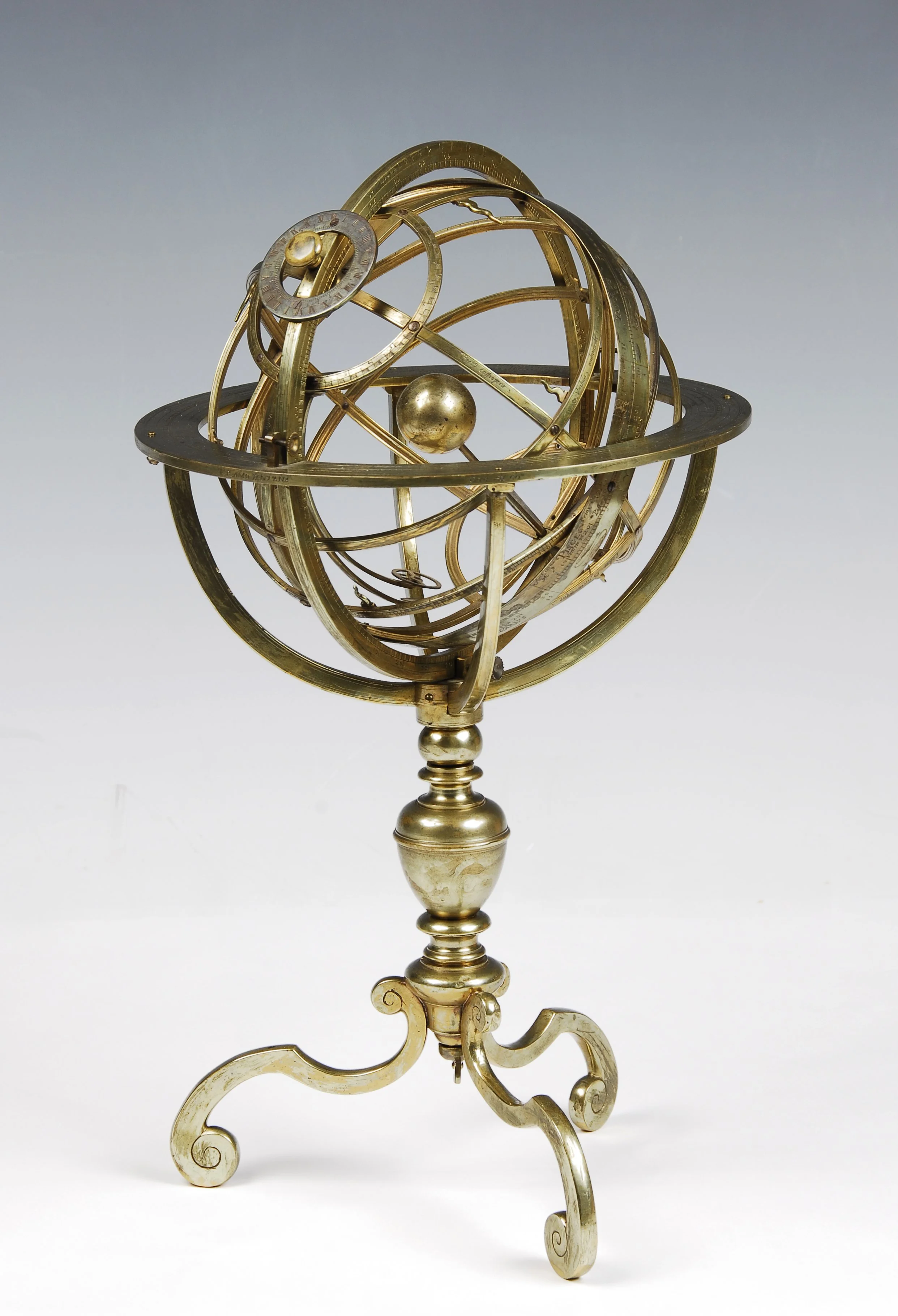
Armillary Sphere by Carlo Plato, 1588. © History of Science Museum, University of Oxford, inv. 45453.

Detail of stainless steel plaque designed by Carl Sagan for lageos. NASA’s Goddard Space Flight Center.