In living color
Ellen Pearlstein
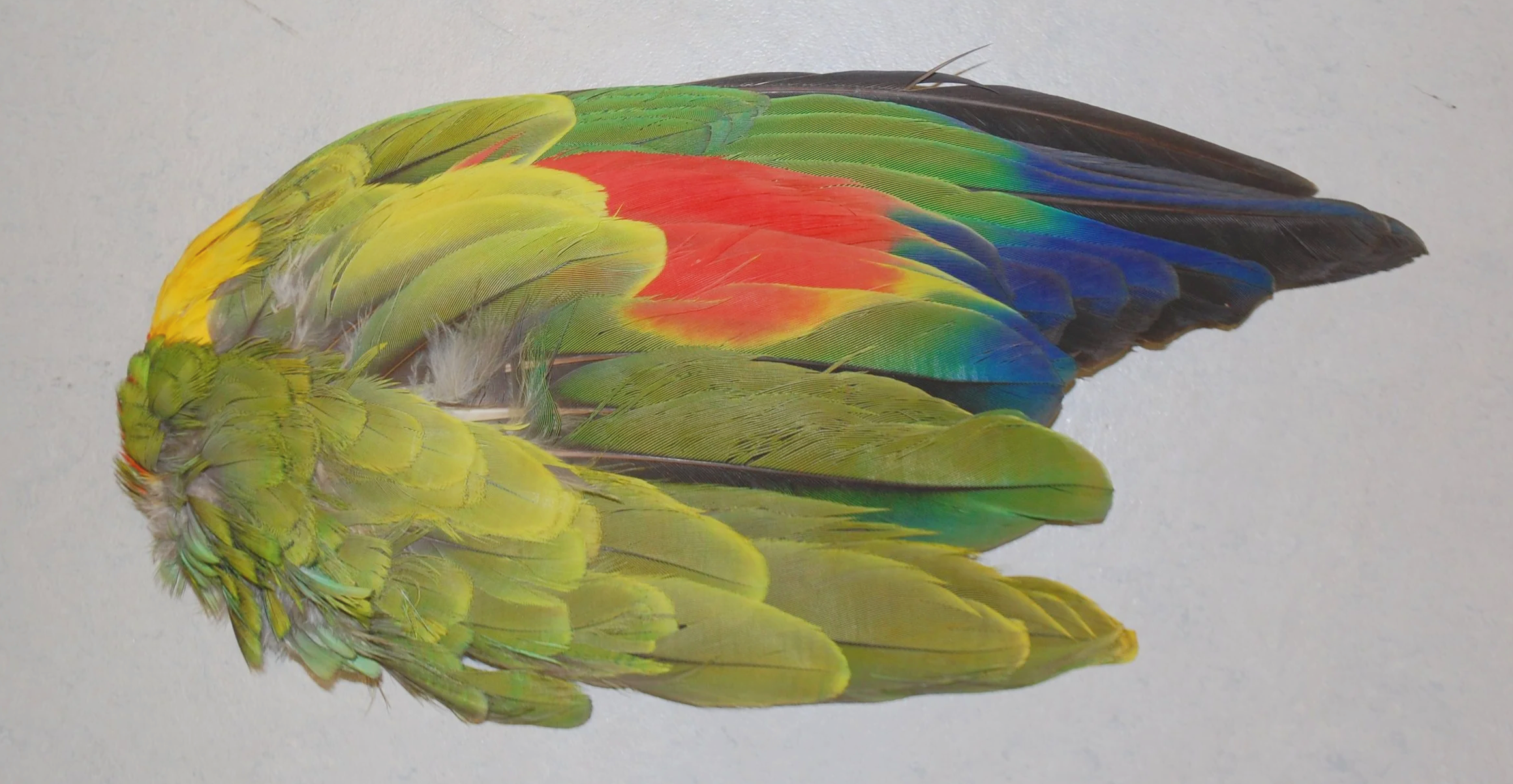
You’d think, looking at the marvelous diversity and beauty of birds, that their polychromatic plumage would be a complicated subject. And you’d be right. Evolutionary biologists have identified no fewer than five major colorant systems produced by birds—as opposed to colors added by dyeing—occurring in hundreds of species. They fall into two big categories: the endogenous and the exogenous. The first are those that are influenced only by biological systems found in the bird, and not by external influences, such as diet. The most prevalent colorant of this type is melanin, a complex chemical component, that also give humans their hair and skin color. Birds use it to produce dark-colored plumage: the black of crows, the grays and browns of ostriches and turkeys, the signature hue of red-tailed hawks. It is present from the modest sparrow to the regal eagle.
Another endogenous colorant—much less widely distributed but far more brilliant—is an organic compound called psittacofulvin, which produces the yellow, red, and orange feathers of parrots, parakeets, and lorikeets, as well as the yellow patches on otherwise white cockatoos and cockatiels. Psittacofulvin-pigmented plumage is among the most spectacular in the avian kingdom, occurring as it does alongside intense blue and green on the same birds.
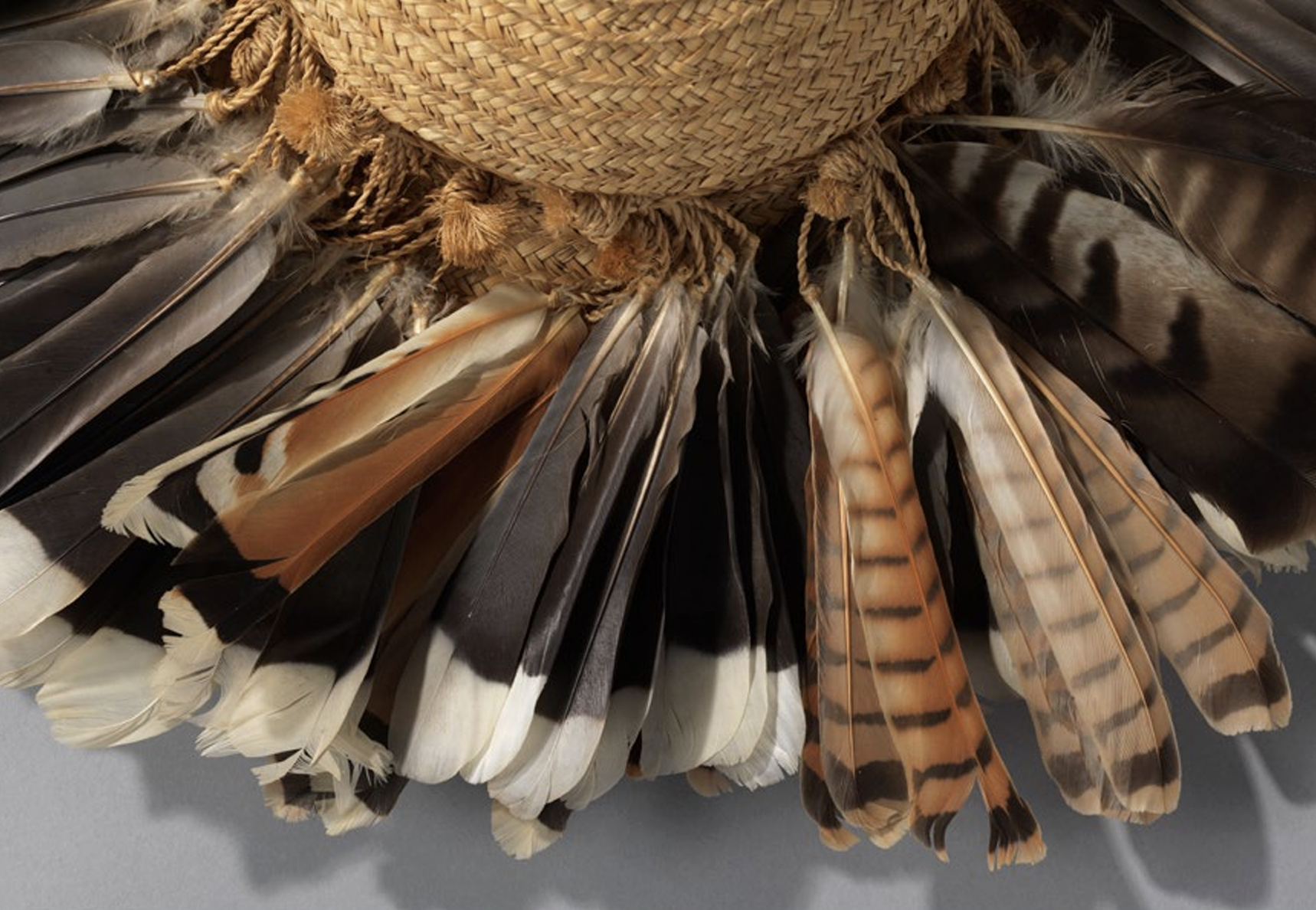
Detail, from Huichol (Wixaritari), Mexico. Hat (top). © Photo courtesy of the Fowler Museum at ucla, x66.2858. Photograph by Don Cole.
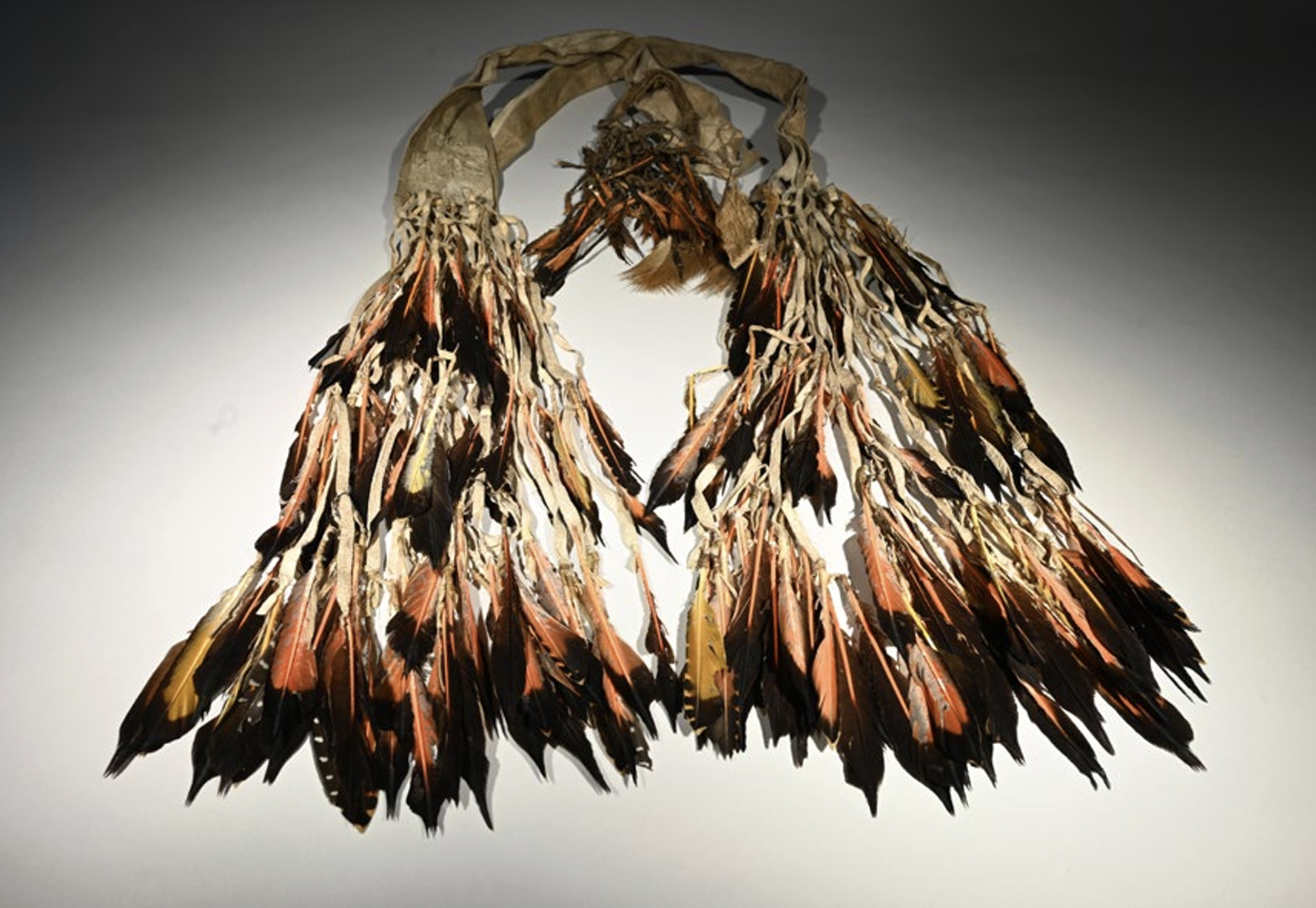
Hupa regalia made from feathers from the Red-shafted Flicker Feather woodpecker. Image courtesy, Bradley Marshall.
The second type of colorants—the exogenous—are those influenced by the diet of the bird. Carotenoid-rich food sources like shrimp shells, red ants and red berries are responsible for reds, oranges, and yellows. These occur in a wider number of species than those colored with psittacofulvin, among them flamingos, cardinals, and red-shafted flickers. There are fascinating studies in which bird biologists have captured birds of the same species and fed them different diets, resulting in starkly different coloration. Similarly, some zoos and aviaries feed pigmented birds a specialized carotenoid-rich diet to keep their plumage showy.
Blue feathers, like those of the blue jay and stellar jay, are a different story: they get their color not through pigment, but rather structure. Tiny melanin granules and air spaces are distributed within the spongy protein that makes up the feather, all on the nanoscale. If you hold a blue feather up to a window, the color disappears, and it looks grey. This is because there is no actual blue colorant there, only the reflection of light.
Iridescence, one of the most spectacular visual effects found in birds, is also produced through structure, with the melanin granules and air spaces reflecting light in a more orderly fashion. The colors appear different as the angle between the viewer and the feather changes. Examples include hummingbird plumage and peacock tail feathers; when these are used in performance regalia, shifting and twisting, the result is a shimmering light show.
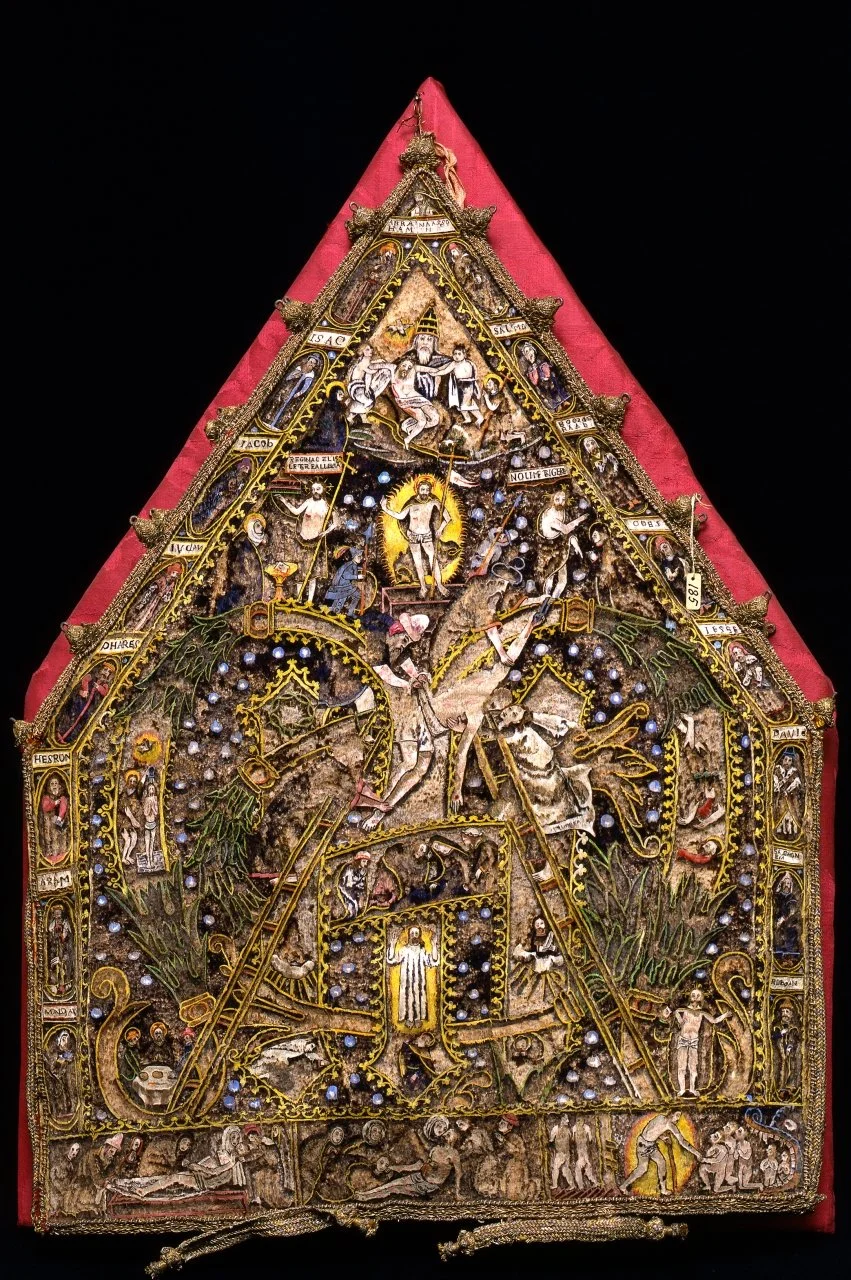
Mexican Manufactory (sec. xvi), Bishop’s miter with feathered mosaic decoration. Fabric and paper support covered with small paper regions with adhered feathers. 15 15/16" x 11 7/16". Museo degli Argenti, Florence, ase 185. Image courtesy, Yosi Pozeilov.
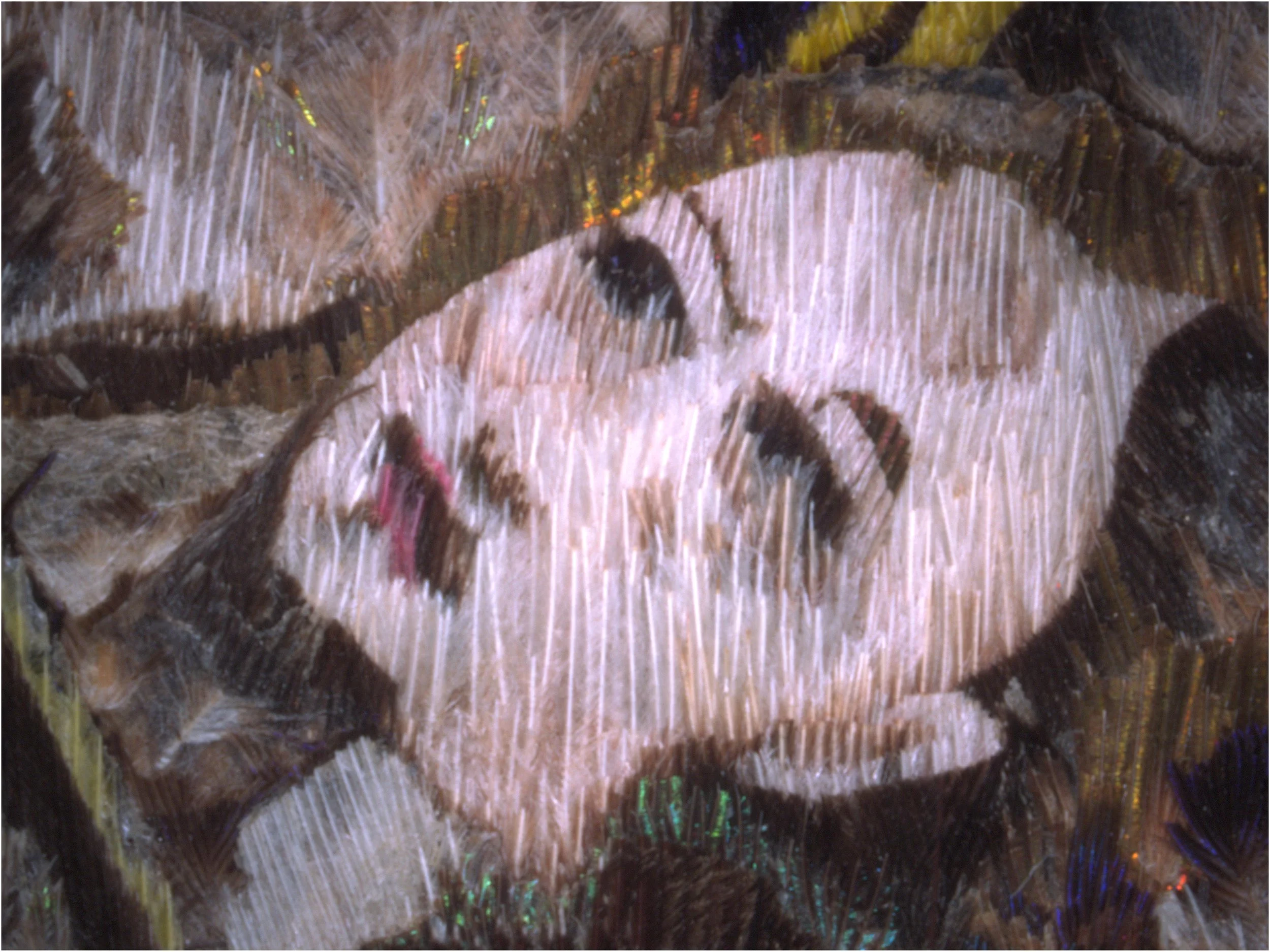
Bishop’s miter with feathered mosaic decoration. Fabric and paper support covered with small paper regions with adhered feathers. Detail at 25x magnification showing design constructed from black and white feathers. Museo dell Argenti, Florence. Image courtesy, Ellen Pearlstein.