In constant motion

Sherrie Smith-Ferri

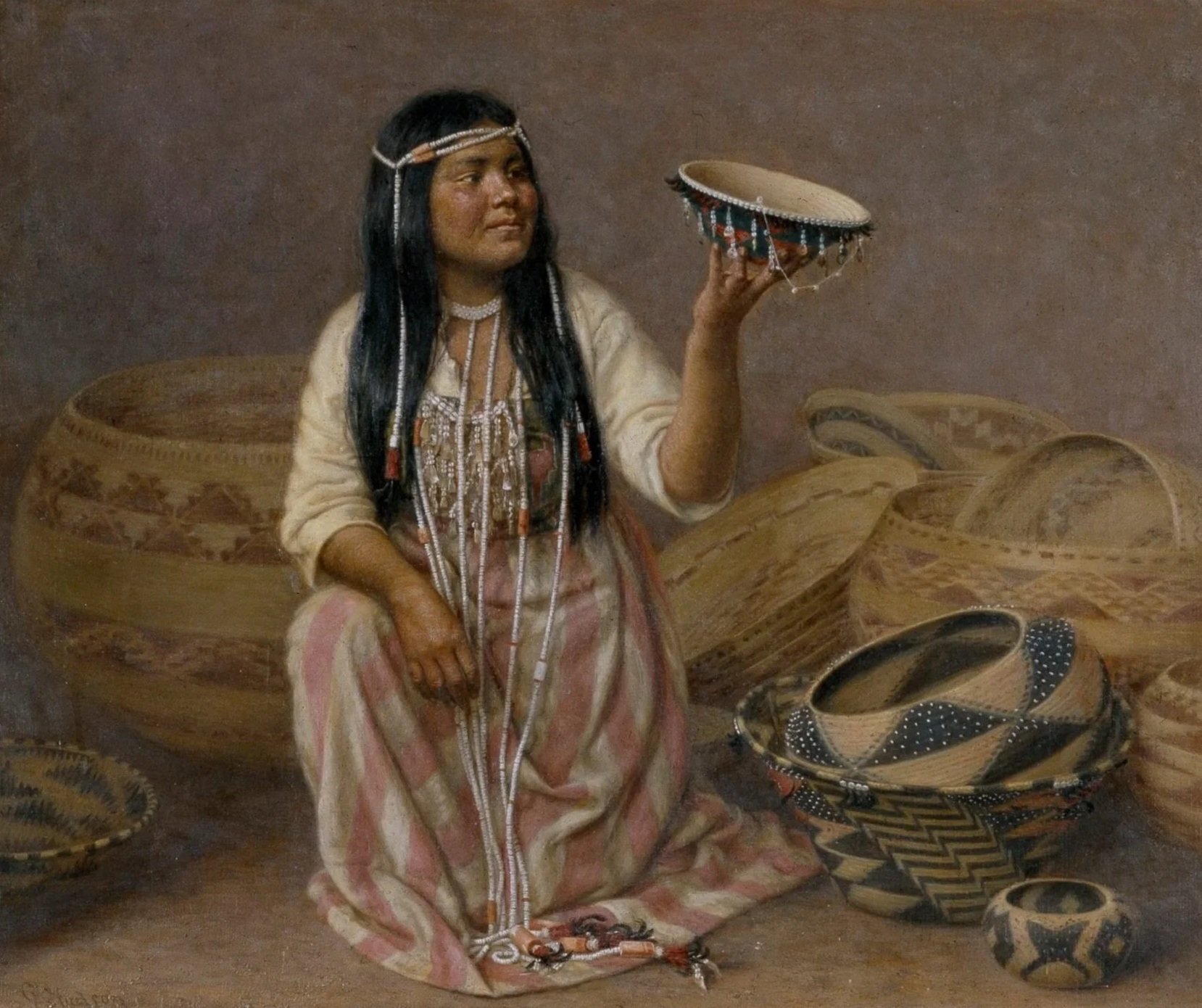
Grace Hudson, The Dowry, 1906. Oil on canvas. Collection of the Grace Hudson Museum & Sun House, Ukiah, CA 2019.11.1. Pictures a young bride holding a feather basket and surrounded by particularly valuable baskets gifted at her marriage.

The homelands of Pomo Indian peoples lie in northern California’s oak woodlands, coastal redwood forests and the tule-covered shores of Clear Lake. We are known worldwide for our superlative basketry, employing a full suite of twining, coiling, and wickerwork techniques. This technical virtuosity is not surprising since, in earlier times, baskets were the main tools of Pomo life. Men used baskets to carry heavy loads and to trap fish. Women used them to harvest seeds and grains from native plants, collect nuts, store food stuffs, winnow the husks of acorns from nut meats, pulverize these nut meats into flour, cook this flour into a porridge, and serve it to their families. 

Similarly, baskets performed many social functions in the Native community. They cradled babies, and were central to gift exchanges between the families of the bride and groom that cemented their marriage. They played roles in young women’s coming-of-age ceremonies, and were burned as a sign of mourning when someone died. Generally such Pomo baskets were coiled, had intricate designs, and were often heavily decorated. These woven pieces of social currency were created to be things of beauty – admired by others, enjoyed as works of art and as symbols of wealth.

One favorite form of ornamentation involved weaving brightly colored feathers from native song birds into the fabric of the basket. Some Pomo feather baskets are best described as “spot feathered.” Weavers meticulously place small tufts of bright feathers across the basket’s straw-colored design background to enliven it with small spots of color and texture and enhance the basket’s dark designs. More famous, though, are the Pomo baskets entirely covered in feathers, called “jewel baskets” by early non-Native basket admirers. 

To make these feathered baskets is a weaving feat demanding skill, patience, and meticulous care. The feathers used are quite small. The weaver takes several of them and spins their quill ends together to form a cluster, so they all lay together at the same angle. This tuft is then tucked under the stitch of the basket, on its outside surface, just before the stitch is cinched down tightly. In making fully feathered baskets, great care is taken to ensure that all of the clusters are aligned and overlapping, so that the feathers lie smoothly, as they do on the body of the bird. Often this involves considerable readjusting and trimming. I remember a weaver, Elenor Stevenson Gonzales, telling me that “if you don’t do the feathers right, the basket will look like an angry cat with its fur sticking out.” A well-made fully feathered basket, on the other hand, has a velvety surface that begs to be stroked. 
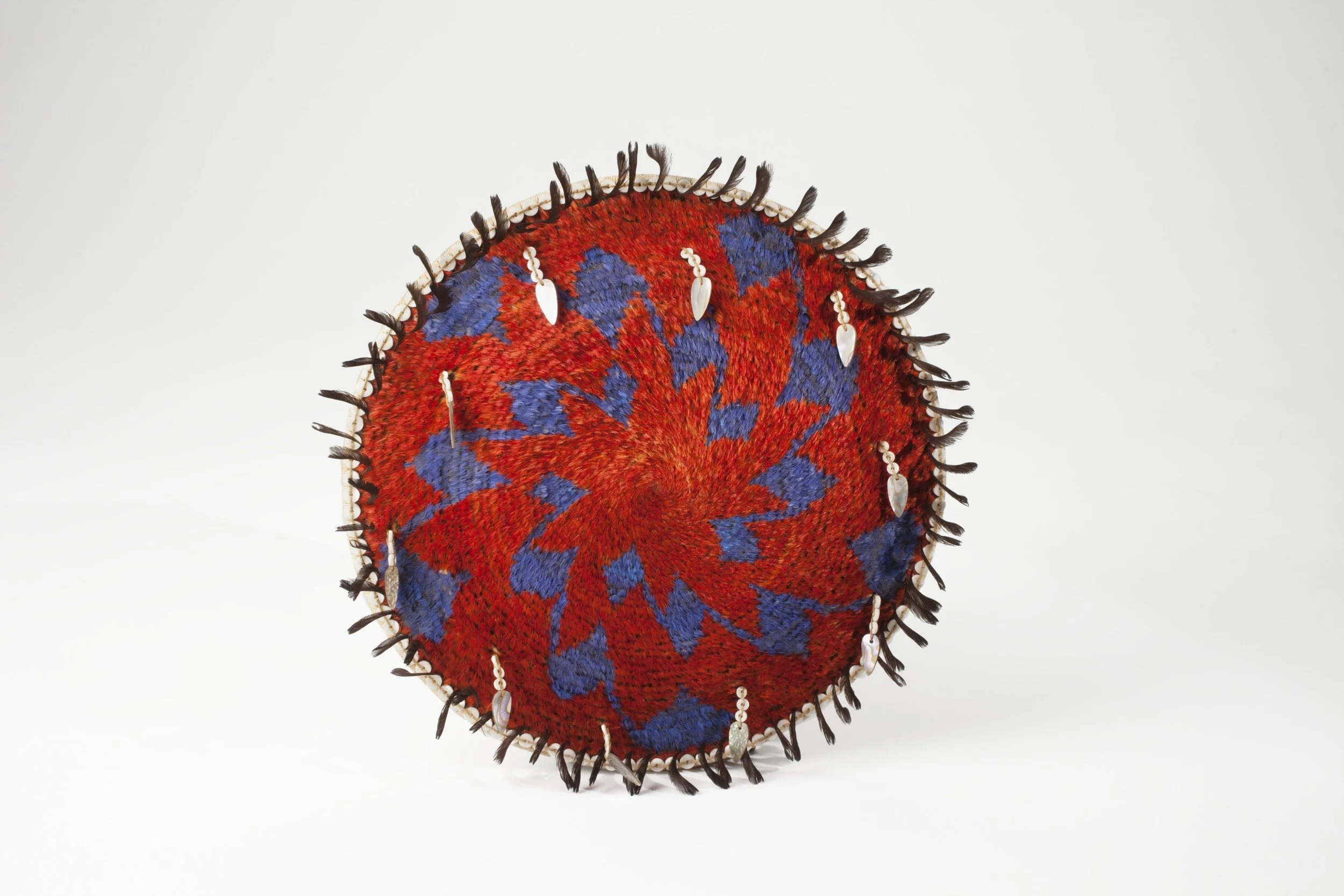
Suzanne Holder, Pomo feathered basket, woven, ca. 1950. Meadowlark and Mallard feathers, Washington clam shell money beads, abalone shell dangles, and quail top knot feathers. Elsie Allen Collection, Santa Rosa Junior College Multicultural Museum.
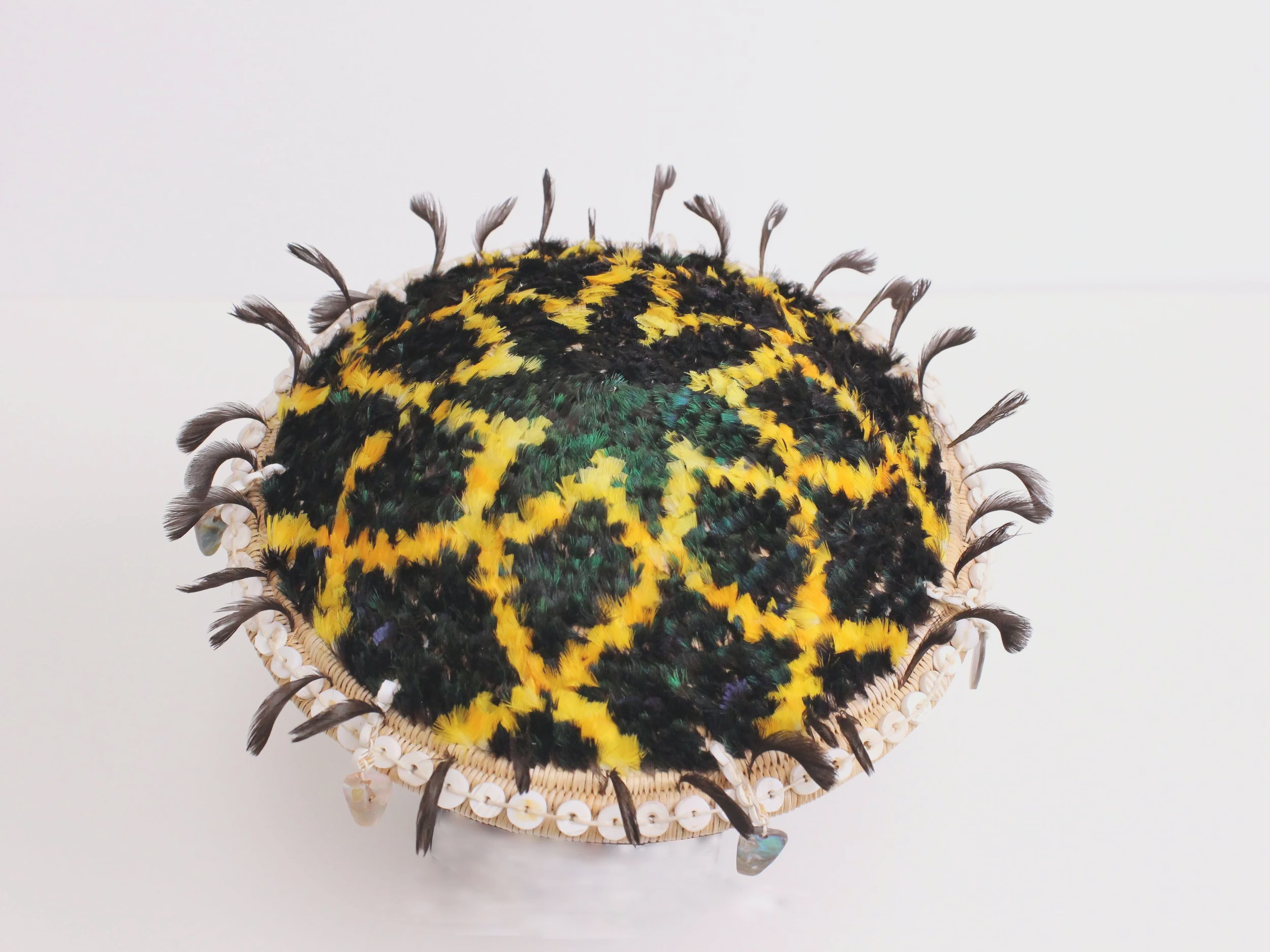
Annie Boone (Pomo), Plaque, early 1900s. Plant fiber, feathers, abalone, and clams shell. 3/4" x 10 5/8" (diam.). Denver Art Museum: Gift of R. B. Bernard, 1942.414. Photograph © Denver Art Museum.
While feathered baskets were generally woven by Pomo women, it was Pomo men who usually captured the birds necessary to their creation and manufactured the clamshell disc beads and abalone pendants used to ornament them. Men knew the behavior of the species they hunted, knowledge essential to fashioning efficient basketry traps. Acorn woodpeckers, for example, sleep at night inside tree cavities. To catch these birds, men wove an openwork tube with a large reinforced mouth tapering down to a closed end. After the birds returned home for the evening, a Pomo hunter used pitch to glue his trap over the nest’s entrance. In the morning, a woodpecker would emerge through this hole, head down, not realizing there was a trap in place until it raised its head, pushing it through one of the trap’s openings. All the hunter had to do then was remove the trap with the ensnared bird, ready to be killed and skinned. Mabel McKay, a well-known Pomo weaver, talked about how every bird used in making feather baskets was eaten: “They do not let it spoil.”

The number of birds required to make such baskets is surprisingly large. Often, the main color field is a bright scarlet, woven from the iridescent crest feathers of the acorn woodpecker. These birds are not big, and the patch of bright red feathers on top of their head is quite small. Weaver Mary Posh notes that she required 223 woodpeckers to create the red-feathered basket pictured on these pages. The black feathers encircling the rim of the basket are the curling plumes of 250 California valley quail. Like many feathered baskets, this one is also embellished with creamy-white round “buttons” sewn around its rim. These are clamshell disc beads, a form of currency used by Pomo peoples. In essence, the basket has a rim of silver dollars. These shell disc beads also provide a handle to hang the basket up, as well as forming “dangles”– strands of beads, terminating in gleaming pieces of abalone shell. 

Such feather baskets are like mobiles, suspended in space, projecting shifting flashes of bright color as they slowly revolve. When looking at a photo of a similar basket, California Indian artist Frank Tuttle said, “I’d like to see it move, with all of those pendants moving. The black feathers would start moving when it swirls, and the pattern. Rather than being static, everything would move. Then it’s doing what it’s supposed to do, which is to remind us that we’re in constant motion.”


Sherrie Smith-Ferri PhD, is an enrolled member of Sonoma County’s Dry Creek Rancheria Band of Pomo Indians and also descended from Bodega Bay Miwok people. She recently retired from a thirty-year career as executive director and curator of Ukiah’s Grace Hudson Museum & Sun House and is currently working for Dry Creek Rancheria as their Tribal Historic Preservation Officer. Smith-Ferri has extensively studied and written about Pomo basketry and Pomo peoples’ history as well as participated in a number of related museum exhibitions.

Brilliant Move

Brilliant Move is the Brooklyn-based creative studio of Marci Hunt LeBrun specializing in building websites on the Squarespace platform – among many other things.

I love working with small businesses, nonprofits, and other creatives to help them organize their ideas, hone their vision, and make their web presence the best it can be. And I'm committed to keeping the process as simple, transparent, and affordable as possible.

https://brilliantmove.nyc
Previous
Previous

In living color

Next
Next

Pen and ink, and . . .