To fall together
Caitlin Anklam

Rebecca Horn, Parrot Circle, 2011. Brass, parrot feathers, motor, electronics. Photographer: Mathias Schormann. Image courtesy of Galerie Thomas Schulte. © 2024 Artists Rights Society (ars), New York / vg Bild-Kunst, Bonn.
While researching the artist Rebecca Horn, I come across a description she provides of a “fairly common” species of migratory birds, which fly every year from West Africa to South America. Only one-tenth of the population survive the journey, she explains. The rest collapse into the sea below, dead from fatigue, at the point where the two continents originally separated. Here the birds begin to “circle frantically,” their preserved instincts “guiding them to their exhausted death.” Only the “most insensitive reach the nether shore.”
I’ve tried and failed to find the species that she describes—I’ve searched online, watched films on bird migration, even reached out to a friend of a friend getting a doctorate in bird ecology. From my basic understanding of migratory patterns, birds fly from the Southern hemisphere to the Northern and back again; transatlantic travel is rare. But it doesn’t really matter whether this bird exists. What matters is the image that Horn conjures of birds falling into the sea, with only the “most insensitive” reaching the shore.
As Armin Zweite points out in his 2006 essay on the artist, it feels surprising that Horn would describe the survivors in this way, rather than celebrating their escape or recognizing their resilience. For her, though, the symbol of the circle represents what is “fragile and earthbound,” and sensitivity equates to bodily constraint. Horn’s sketchbooks are filled with drawings of spiraling circles, often concentric and loosely sketched. Her description of her haptic sculpture Circle Inscriber (1983): “A piece of chalk is attached to an aluminum arm. Gropingly, the arm moves along the floor and draws increasingly smaller circles, marking the location where the birds fell to the earth.” A circling, eventually leading to collapse, repeats across her drawings, sculptures, and machines.
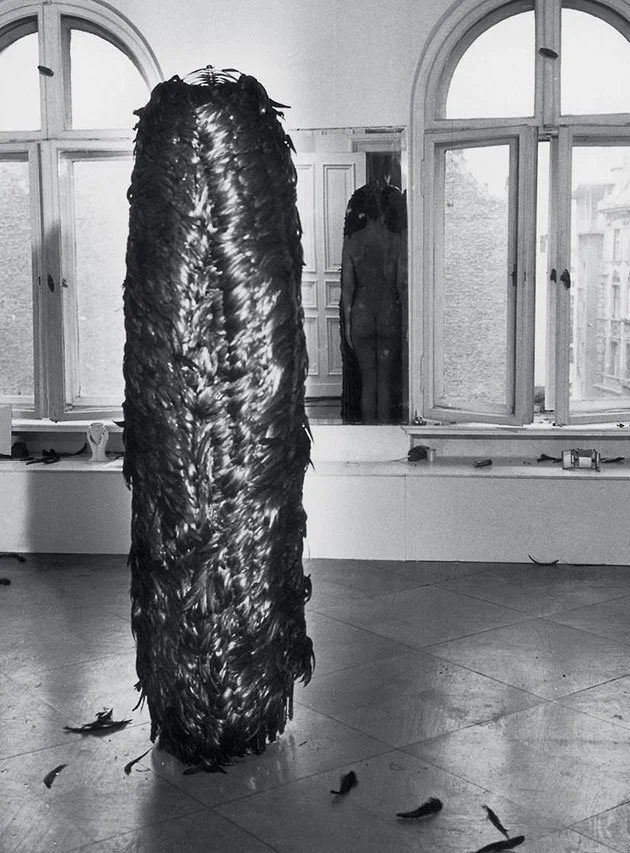
Rebecca Horn, Paradieswitwe (Paradise Widow), 1975. Installation. Photographer: Rebecca Horn. © 2024 Artists Rights Society (ars), New York / vg Bild-Kunst, Bonn.
When Horn first began to make work, as a student in the 1960s, she remade her own body in cast appendages of polyester and fiberglass. Unaware of the risks posed by these materials, she contracted severe lung poisoning; her subsequent hospitalization extended into a yearlong period of institutionalization. The work she made at this time was still concerned with the body—with the practice of creating prosthetics and extending the body outwards—as she turned away from polyester and towards natural materials like cotton, linen, and feathers.
In Cockatoo Mask (1973), one performer wears a headpiece of the bird’s densely layered white feathers. Another performer gently separates the headpiece’s two wings, revealing the face of the wearer, before wrapping the wings around their own head, enclosing both in a clouded intimacy. This feathered enclosure is paralleled on a larger scale in Paradise Widow (1975), wherein two tall wings of black feathers form a body suit fitted to the performer. “The ballerina,” as Horn called her, would stand inside the wings, which would shyly separate to reveal her body, naked, before slowly closing again. In photos, with the wings folded shut, Paradise Widow appears as a tall column of glossy black feathers. Only the mirror positioned behind reveals where the feathers split, the performer inside. For Horn, feathers were not used to attempt real or symbolic flight, but to provide an enclosure that “somebody could be held inside,” transforming them into a “bird-person,” the feathers acting as a second skin.
The mechanized reveal of Paradise Widow was remade iteratively by Horn, in a series of feathered machines and kinetic sculptures that mimic birds in action and form. In The Peacock Machine (1981), the tall white feathers of a male peacock open and close, the machine approximating the bird’s mating rituals. In Parrot Circle (2011), variegated brown and indigo feathers fan outwards, cycling upwards like wings until they complete a circle and return to their resting position. Horn also used parrots’ flight feathers, whose close-knit barbs enable flight by preventing the passage of air.
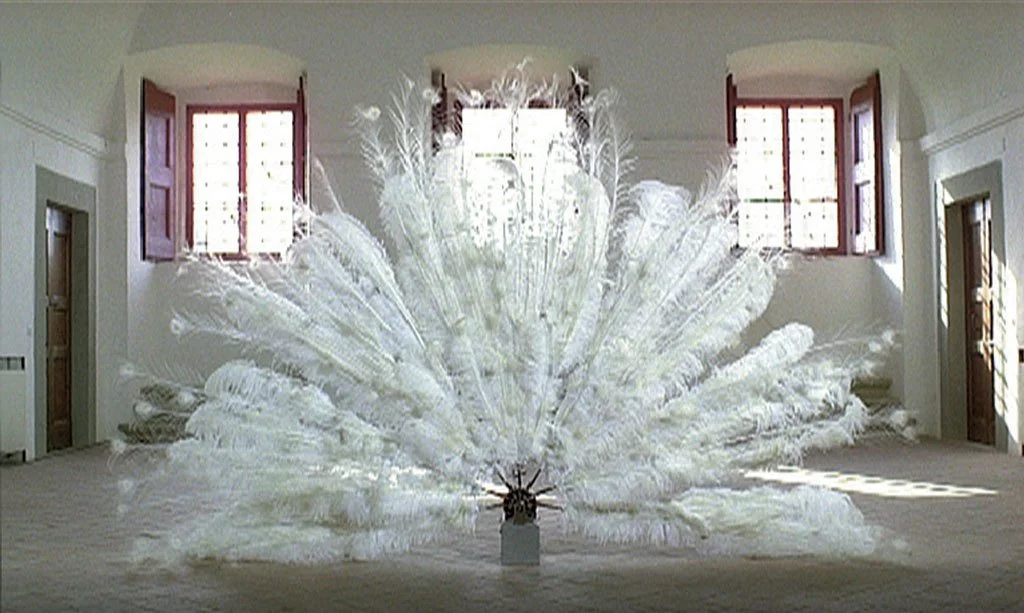
Rebecca Horn / Germany 1944–2024 / La Ferdinanda: Sonate für eine Medici-Villa (from ‘Rebecca Horn Films’ 2003) 1981 / 35mm transferred to dvd: 85 minutes, colour, sound / Purchased 2012. Queensland Art Gallery / Collection: Queensland Art Gallery | Gallery of Modern Art. © 2024 Artists Rights Society (ars), New York / vg Bild-Kunst, Bonn.