First-class curlers
Alison Kowalski
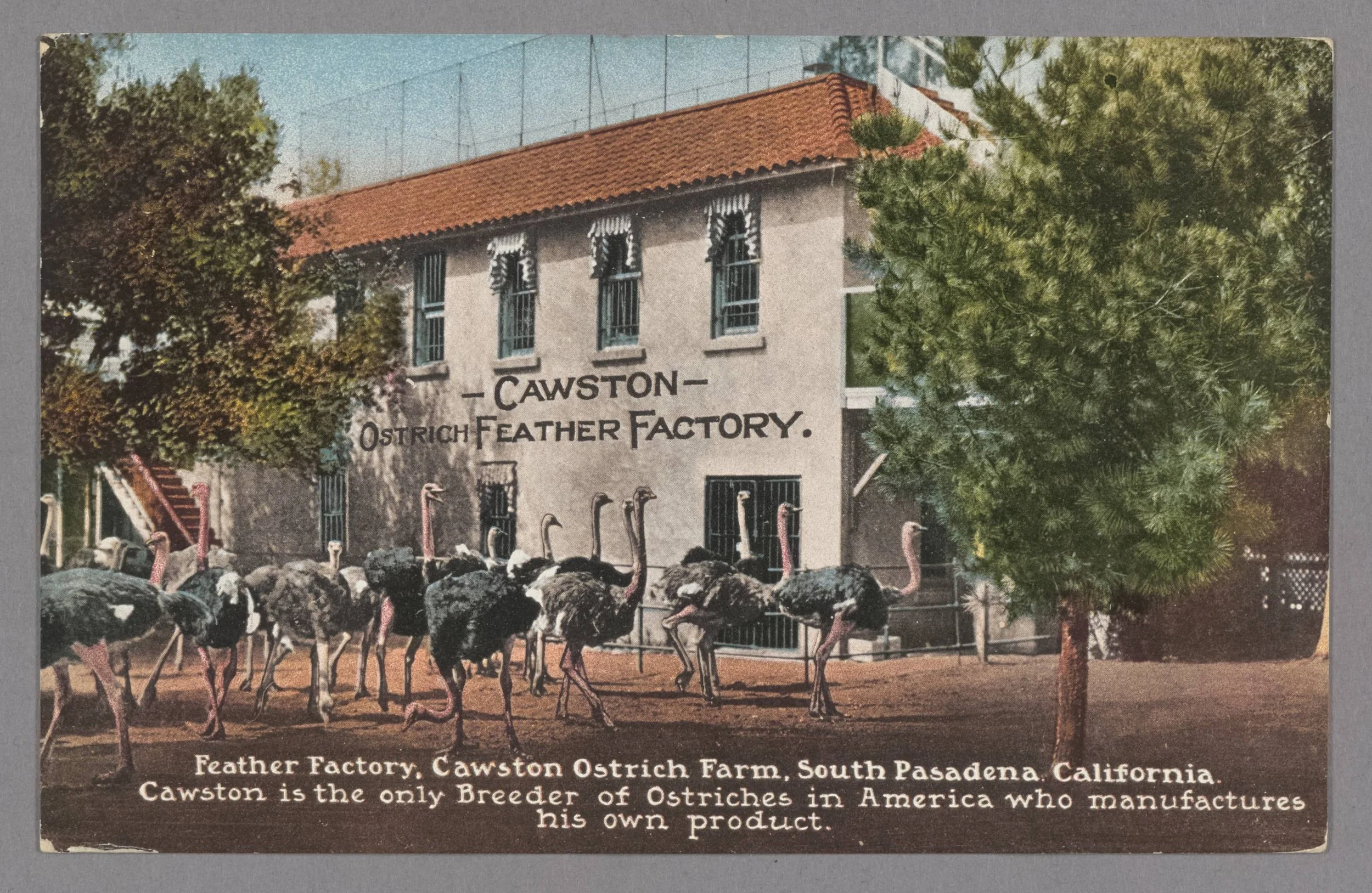
Edward H. Mitchell (Publisher), Feather Factory, Cawston Ostrich Farm, South Pasadena, California. Cawston is the only Breeder of Ostriches in America who manufactures his own product, published 1910-1915. Postcard. banc pic 2017.021: dh3-s:nn (carton 3, box 2). The Bancroft Library, The Berkeley Library University of California Digital Collections, University of California, Berkeley.
In early 1905, Edwin Cawston set out to start manufacturing fashionable fans, boas, hair ornaments, and hat plumes in South Pasadena, California. His factory would be an offshoot of the ostrich farm he had established about twenty years earlier, importing eighteen of the birds from South Africa and beginning to breed them. He had since turned the Cawston Ostrich Farm into a tourist attraction: visitors could ride the ostriches, pose for photographs with them, or even feed them whole California oranges. From his stock, he had also been cultivating raw feathers and selling them to New York factories where they were turned into women’s accessories. With his newest venture, Cawston hoped to challenge the monopoly New York had long held on the US ostrich feather market. East coast factories ran largely on female labor, and because women typically held low-skill positions, Cawston may have assumed it would be easy to assemble his own outfit. But this was not the case. It turned out that feather work, particularly the specialization of feather curling, required so much skill that Cawston was forced to recruit across the country and pluck employees from his intended competitors.
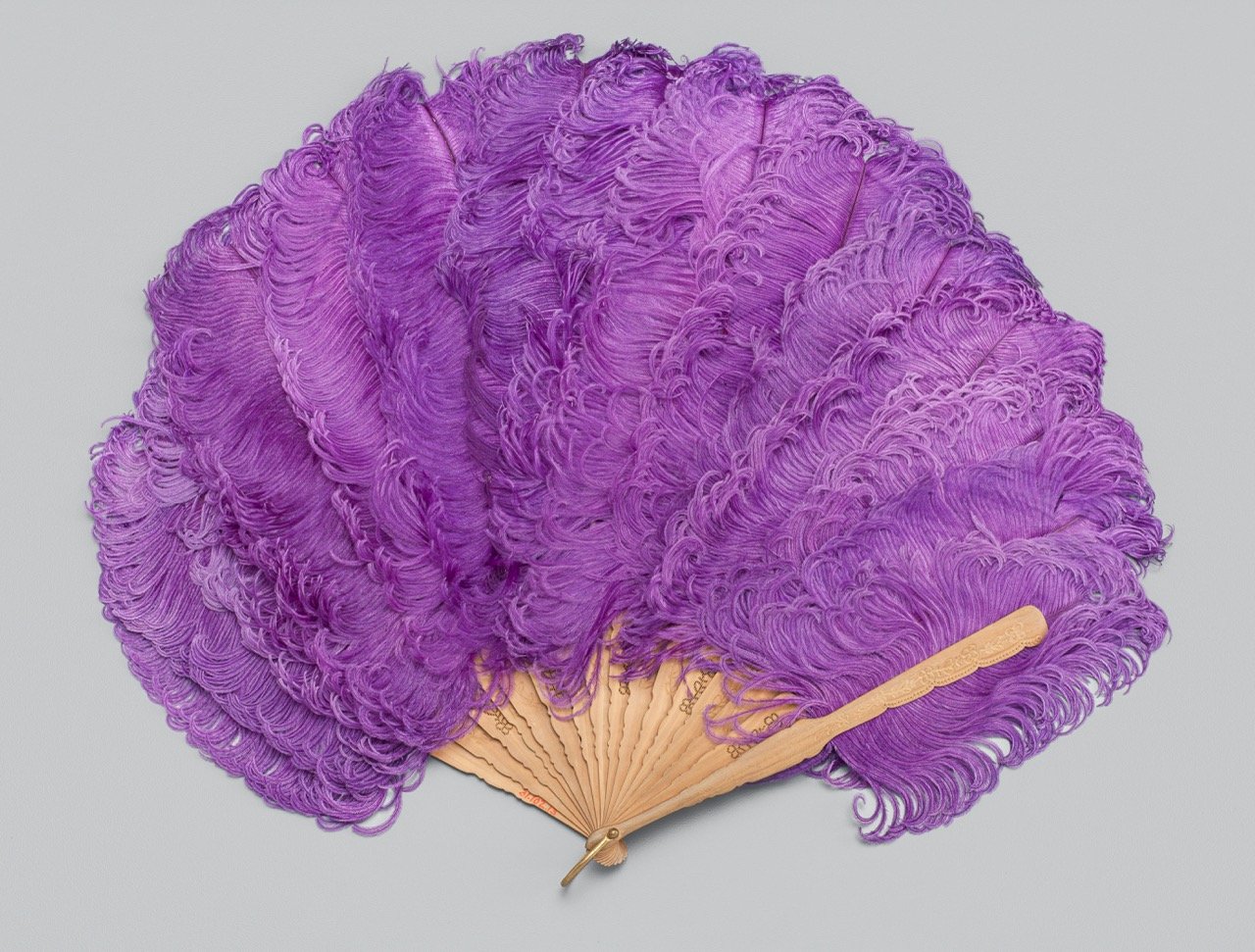
One New York feather worker he courted was Lulu Willis, who had at least six years’ experience and was by her own estimation an “expert curler.” Such an expert could transform a natural ostrich feather into any number of refined forms. The feathers on fans, for example, often had their flues—the straight, frond-like, fuzzy barbs projecting from the central shaft—curled into sleek stacks of stretched-out S’s, the ends whipped into tight hooks. The feathers on a popular style of boa had long flues whirled in all directions to create a wild and woolly look. Whatever the desired effect, a curler began her work by holding a feather over a steam jet for a few seconds, which relaxed any errant flues into alignment and made them more pliant. Then out came the curling knife, a specialized tool with a short, curved blade. Working a few flues at a time, the curler drew them between the inside edge and her thumb; the angle of the knife and the pressure of her thumb determined the style of the curl.
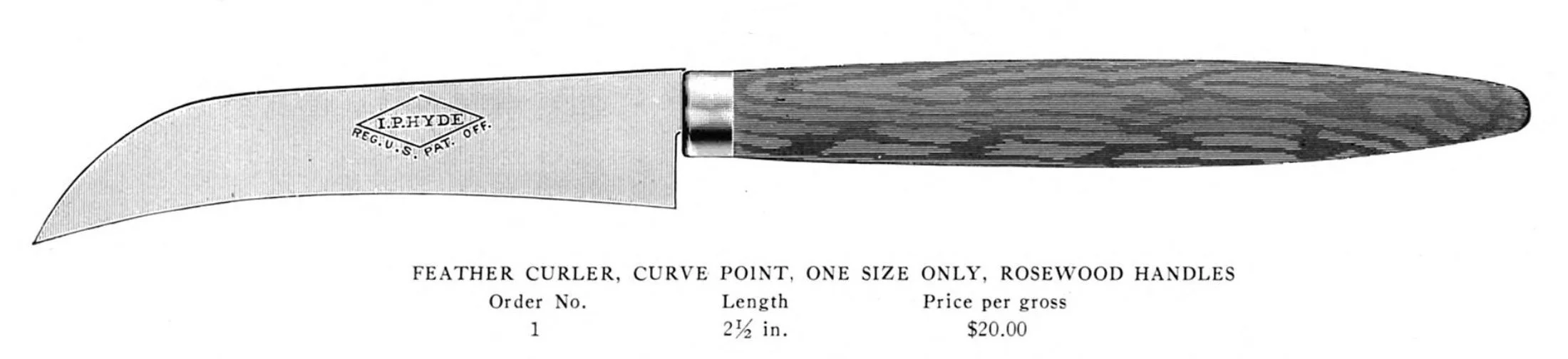
Feather curling knife, Hyde Manufacturing Co.: Cutlery (Southbridge, ma: Hyde Manufacturing, 1914), 19.
Curling was the most skill-intensive step in the manufacturing process, so difficult that it took anywhere between three months and two years to become proficient. Because of this, one writer explained, a “first-class curler is a prize in any factory.” Cawston needed women like Willis to have any hope of competing with New York. And he was going to have to pay up, because curlers were known to make high wages, at least relative to other working-class women.
According to Willis, Cawston guaranteed one year’s employment at New York wages for her as well as her daughter Florence, who was also a seasoned curler. Annually, this would amount to each woman earning at least $1,300 (about $46,000 today). Willis’s husband George secured an offer from Cawston to work as a dyer, one of the only roles in a feather factory performed by men. While we don’t know how much money George was offered, generally dyers could earn up to four times what the best curlers made, even though it was curling that required the real skill. George doesn’t appear to have needed much, if any, experience; just the year before, he had been working as an insurance broker.
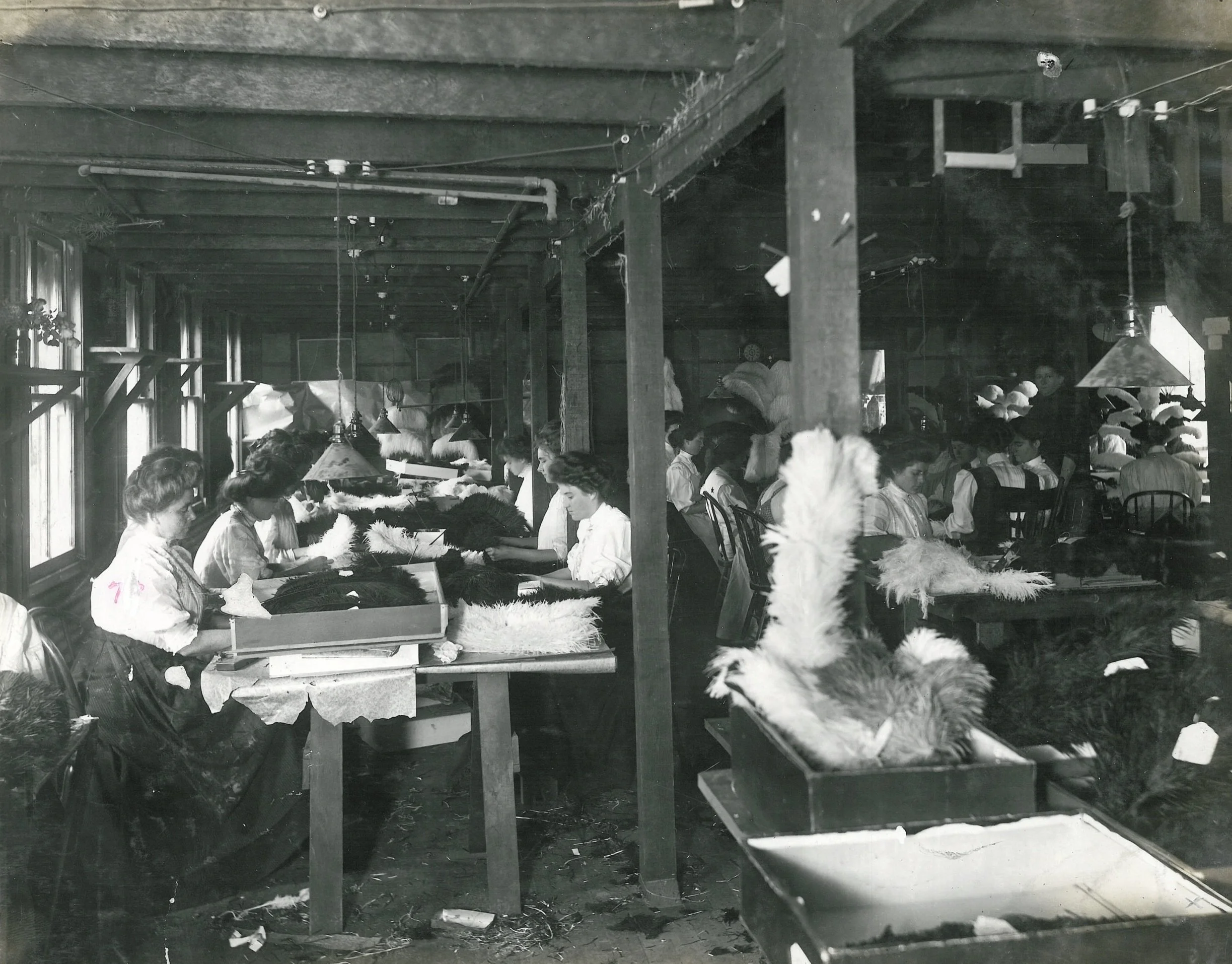
Feather workers in the Cawston Ostrich Farm factory, ca. 1905, Courtesy of the South Pasadena Public Library.