The plume boom
Claire Allen-Johnstone
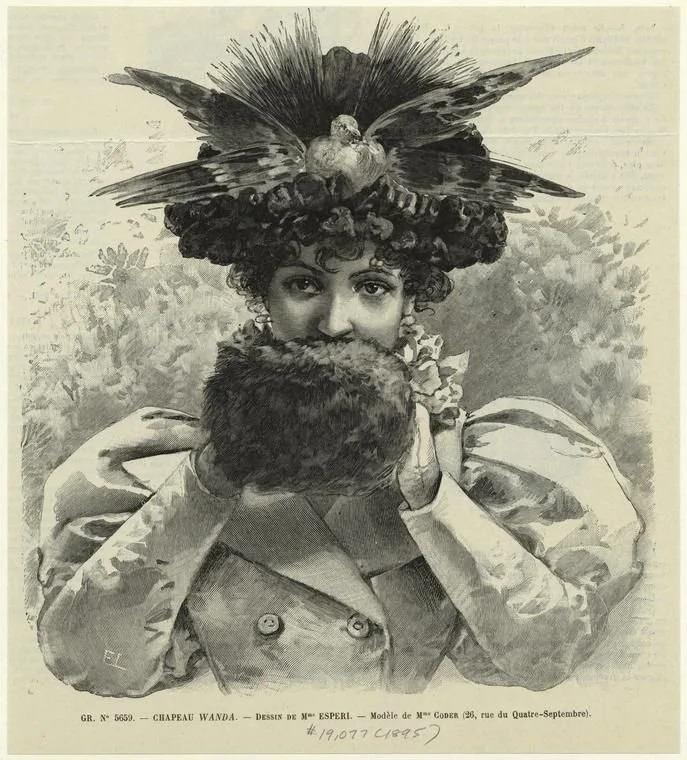
Mme. Esperi, “Chapeau Wanda.,” in Le Moniteur de la Mode: Journal du Grande Monde (Paris: Imprimeries Réunies, 1895). The Miriam and Ira D. Wallach Division of Art, Prints and Photographs: Picture Collection, The New York Public Library, b17215479. The hat is identified as “Modèle de Mme. Coder (26, rue du Quatre-Septembre).” Colorized.
“Feathers are universal,” announced the English periodical La Belle Assemblée in 1814. Yet a trend was just getting started. It would be difficult to overstate the centrality of birds to fashion in and around the late nineteenth century, in places such as Britain, France, and the US. During this Plume Boom, feathers, wings, and whole birds – both local and imported, the latter often from colonized areas – were everywhere, from women’s hats to their hemlines. In 1886, one bird-spotter-turned-people-watcher surveyed 700 passing hats in New York, and noticed feathers on over three-quarters of them.
Millinery was the main locus of this phenomenon. Hats offered a convenient perch for plumes and were in great demand because women were expected to cover their heads outside. A bonnet with a bird mounted on a floral spray, worn by Empress Eugénie in 1859, is thought to have played a part in instigating the fashion. She was probably sporting an Empress Brilliant hummingbird, a species recently named in dedication to her by the English ornithologist John Gould. (The males have a patch of lilac on their throats, a color Eugénie loved.)
Women who could afford to wear fine feathers made their selections from the numerous options that milliners supplied, drawing inspiration from a thriving fashion press. They were affixed to all manner of late nineteenth-century headpieces, from toques to sailor-style hats. Where a whole bird was featured it could be manipulated into a range of positions, having been stuffed, wired, treated (hazardous substances are known to have been used), and given false eyes. Parts of different birds were sometimes brought together; dyes made fantastical color combinations possible. Wings were especially sought after: “Mercury wing” hats had one on either side, referencing the Roman god’s helmet.
At the start of the twentieth century, as the fun-loving Edward VII ascended the throne in the UK, the size of fashionable women’s hats grew considerably, as did a dominance of ostrich feathers, whether natural (white, gray, or black) or dyed. Already large and airy, because their barbules are not attached to one another, they were often artificially supersized through techniques like sewing feathers together along their shafts and using knotting to extend the barbs. Swirling ostrich plumes were also regularly used for fans, another accessory which had been made using many kinds of feathers, and sometimes whole birds, in the previous century.
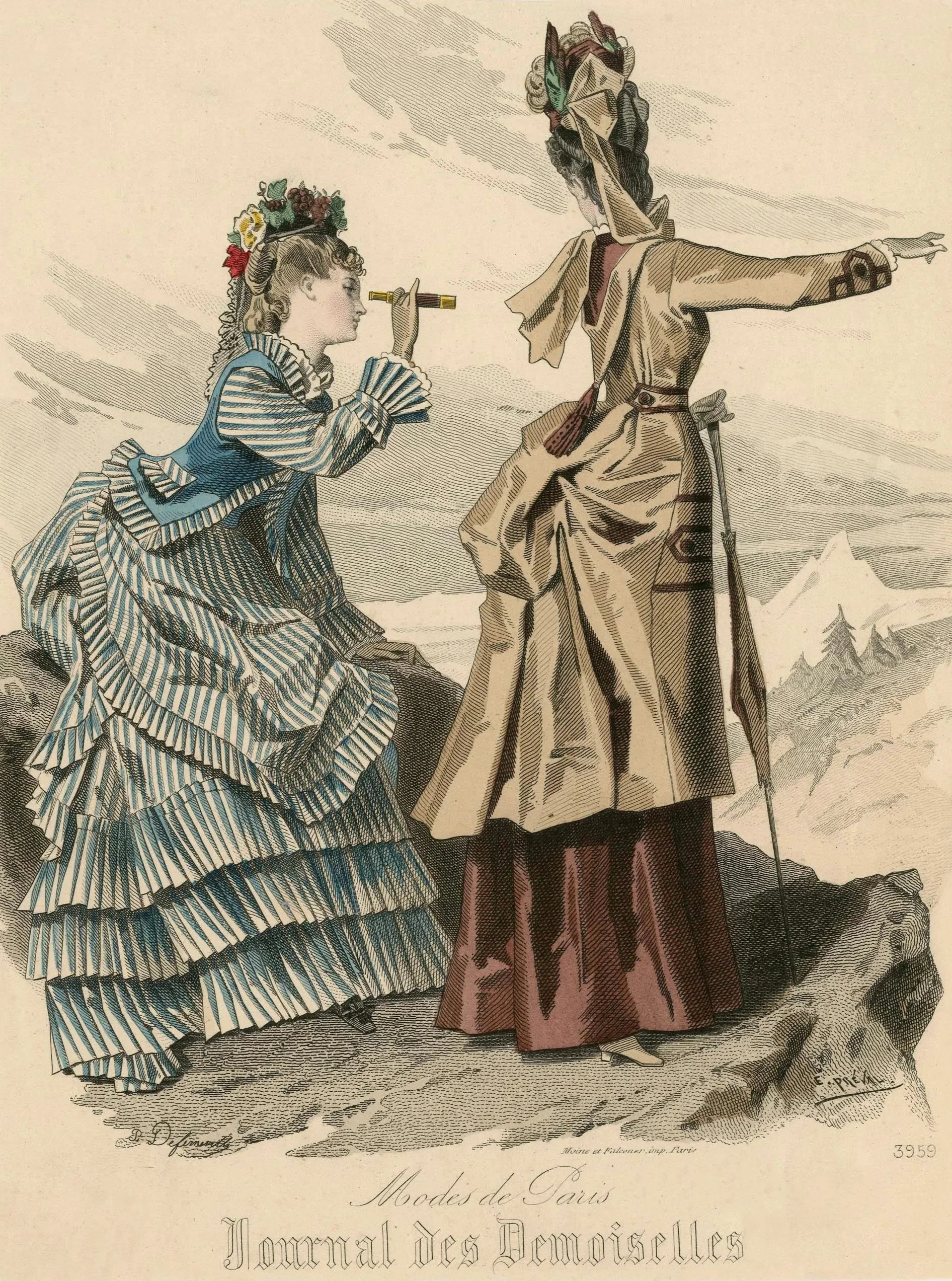
Mme. Esperi, “Chapeau Wanda.,” in Le Moniteur de la Mode: Journal du Grande Monde (Paris: Imprimeries Réunies, 1895). The Miriam and Ira D. Wallach Division of Art, Prints and Photographs: Picture Collection, The New York Public Library, b17215479. The hat is identified as “Modèle de Mme. Coder (26, rue du Quatre-Septembre).” Colorized.
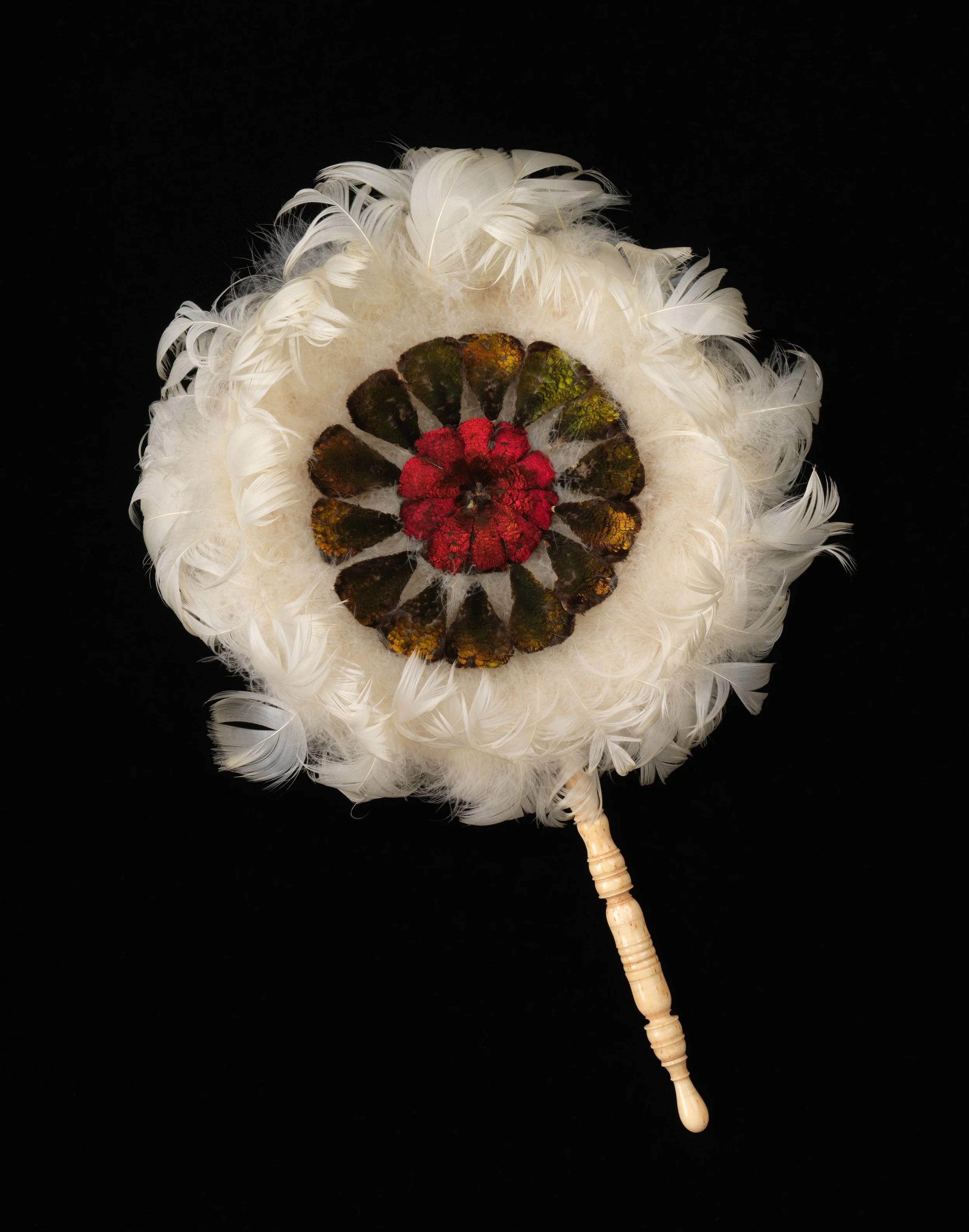
Brazilian, Fixed Fan, 1865–1875. Ivory, feathers, and beetles. Brooklyn Museum Costume Collection at The Metropolitan Museum of Art, New York, Gift of the Brooklyn Museum, 2009; Gift of Lucie and Mary Stevenson, 1948, 2009.300.3087.
Despite the popularity of ostrich feathers, a desire for variety in avian fashion had by no means disappeared. 1908 issues of the US periodical The Illustrated Milliner feature plenty of exuberant ostrich plumes, but also everything from arrangements of stiff wings to owls. That same year Vogue US reported: “The craze for feather novelties asserts itself in a multitude of styles, the latest being [the] teigne papillon.” This experimental design brought together bird and insect parts, including “two pair of vulture wings of extreme expanse,” a “slender body… with a small, beakless head,” “the head ornament of the lyre bird – long, flexible feelers,” and iridescent “wings of petrified African beetles,” to create an enormous moth-like hat.
The journalist describing the teigne papillion thought it exquisite, but not everybody would have agreed. Concerns about cruelty and conservation gathered pace from the 1880s. In A Dedication: To all those who love the beautiful and mourn over the senseless and cruel destruction of bird life and beauty (1898–1899), George Frederic Watts depicted a winged angel’s sorrow at the sight of a group of slaughtered birds. He was involved with the Society for the Protection of Birds, established in the UK by Emily Williamson in 1889. In 1906, two years after they acquired royal patronage (now becoming the RSPB), Queen Alexandra promised the organization she would “do all in her power to discourage the cruelty practiced on these beautiful birds.” She was referring specifically to egrets, a focal point for the campaign because adults were killed during the mating and nesting season when their white plumes were deemed most impressive. Their chicks were left to starve. As a consequence, egrets were known to be facing extinction. Even some fashion magazines expressed approval of the Queen’s stance.
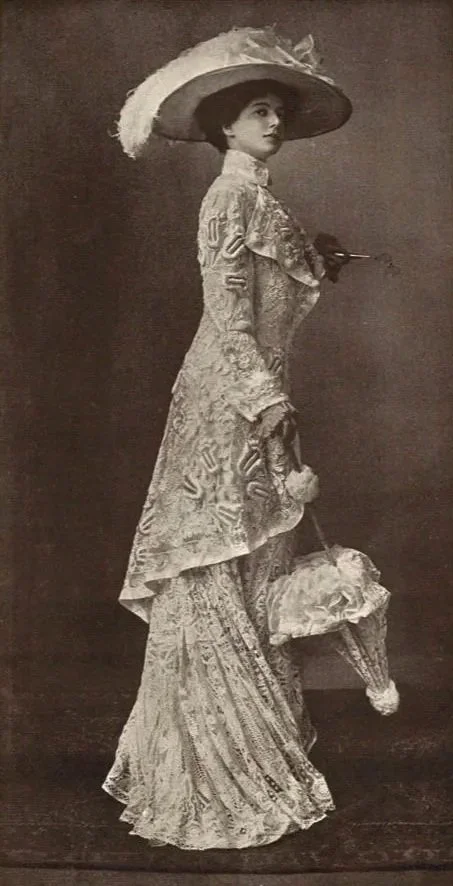
“Silk Hand Embroidered Lace Coat and Princess Lace Robe,” in The Lace and Embroidery Review (New York: Clifford Lawton, January 1909). Wallach Division Picture Collection, The New York Public Library, b17122176. The coat and robe are identified as “Imported by Cobden & Co., 7 West Twenty-second Street.”
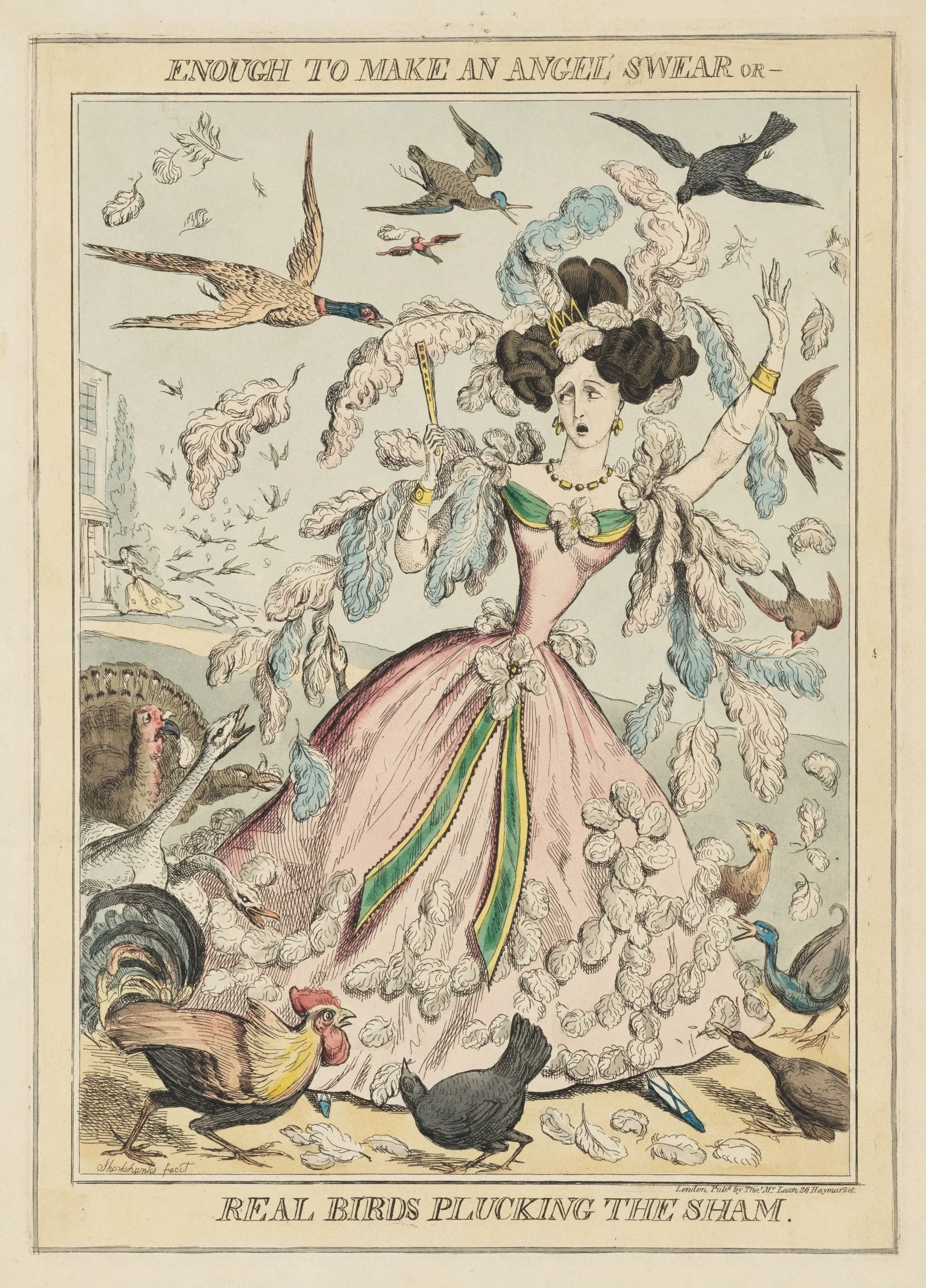
Robert Seymour (British, 1798–1836), “Enough to Make an Angel Swear or—Real Birds Plucking the Sham.” Hand-colored etching signed “Shortshanks fecit” (London: Thomas McLean, ca. 1828). The Metropolitan Museum of Art, New York, Gift of Jill Spalding, 2022, 2022.309.29.