Hair, art, care
Sarah Mesle

Emilia Clark, Game of Thrones, 2011. Cinematic Collection / Alamy.
Hair takes care. What kind? Time, attention, treatments; rinses, washes, hair masks, hot rollers. As any tour through Instagram shows – the ads that appear on my feed, anyway – hair care drives a huge market for products and services. But more importantly, it can also be a practice of intimacy and respect, a means of retaining cultural memory. In hair care, material and emotional cultures intertwine.

Emilia Clarke, Kit Harington, “Game of Thrones” Season 8 (2019) Episode 6. Photo , Helen Sloan hbo / The Hollywood Archive / Alamy.
For all its importance in daily life, though, hair care can be quickly erased. Very often, art and media project fantastical visions of hair — women’s especially — that are detached from tangible realities. In such aesthetic fantasies, women’s hair appears to be beautiful or stylish due to some “natural” or inevitable force, rather than because they (or someone else) carefully tended it. These representations may be seductive, but they are also impoverished. Omitting hair care, such media also casts aside honest representations of embodiment — and the opportunities for connection and transformation that come with it.
To explain what I mean, I want to consider the depiction of a woman who is definitely a fantasy: Daenerys Targaryen, a central character on Game of Thrones. The hit HBO show made space for female characters to have material power – and often, extravagantly-styled hair. How might a critic read these fantasies against each other, to better understand the ideology this show put on offer?
Game of Thrones has an infamously elaborate plot: over ten seasons, it marched its characters through an imaginary world called Westeros, towards a climactic final war featuring dragons, ice zombies, and several competing armies. At the helm of one of these forces was Daenerys Targaryan. As the stakes of the plot got higher, Targaryen’s hair got more and more elaborate. On the one hand, she was engaged in a life-or-death battle for supremacy. On the other she had a new glossy hairstyle every episode. Who, I wondered, was styling it?
In its early seasons, Game of Thrones seemed surprisingly interested in hair care as a material part of experience. Many episodes featured scenes of men shaving with rough tools, showing how clean-shavenness would be a sign of luxury in a world without running hot water or safety razors. It admitted that characters with elaborate hair might need help styling it. It acknowledged if you were out in the desert for days on end, you might end up with some flyaways.
In its final season, though, Targaryen appeared with escalatingly complex braids, even though there was no one in view to braid them, no time to braid them, and no evident means of holding them in place. (What might she have used as hair product? Tallow? Dragon drool?) The show gave this woman a lot of screen time, and nominally, a lot of power. But the attention she got came at the expense of realism: she seemed no longer to sweat or get dirty. Only the scruffy male characters still gave the appearance of bodily participation in a world of struggle.
At the very moment when Game of Thrones seemed to want to turn itself into the narrative of a strong woman, then, it increasingly displayed its own dangerous beliefs about embodiment. This example shows how even within a nominally progressive television show, characters might be granted different levels of verisimilitude based on their gender. As a result, viewers are unconsciously trained to hold women leaders to truly fantastical physical standards of appearance.
Consider, in contrast, the work of Shani Crowe, which elevates the caretaking skill of specifically Black hair care and braiding. Her craft has a fantastical element: it links braids to divine power. But unlike the makers of Game of Thrones, Crowe uses fantasy to celebrate, rather than erase, women’s embodied experience. The photograph Fingerweave Saint, for instance, depicts one of Crowe’s own friends, whose hair Crowe has carefully braided into a halo, a sign of transcendent worth. The Breadth We All Share depicts three women whose hair Crowe has braided together into a zig-zagging cord, like an EKG. In Crowe’s visual metaphor, hair care’s connections become a kind of lifeline.

Shani Crowe, FINGERWAVE SAINT, 2016. Archival Ink on Hahn- emuhle German Etching Paper. 44 x 44 in. Photo credit: Shani Crowe.
There’s nothing inherently wrong with fantasy, hair-based or otherwise. We may need fantasies, in fact, to help lead us to more feminist realities. But any responsible representation of hair must incorporate caretaking into its aesthetic vision, rather than (as too often happens, even in art that evinces a feminist position) allowing that caretaking to remain invisible. What I call “Critical Hair Studies” proposes this theory: by attending to how hair and its care is represented, we better understand the real textures of women’s lives. As Crowe’s work shows, beautifully coiffed hair doesn’t need to elevate women to some imaginary height, as if they were riding on dragon-back. It can also eloquently explore their position within the world as it really is, connecting them to others with whom they will work for change.
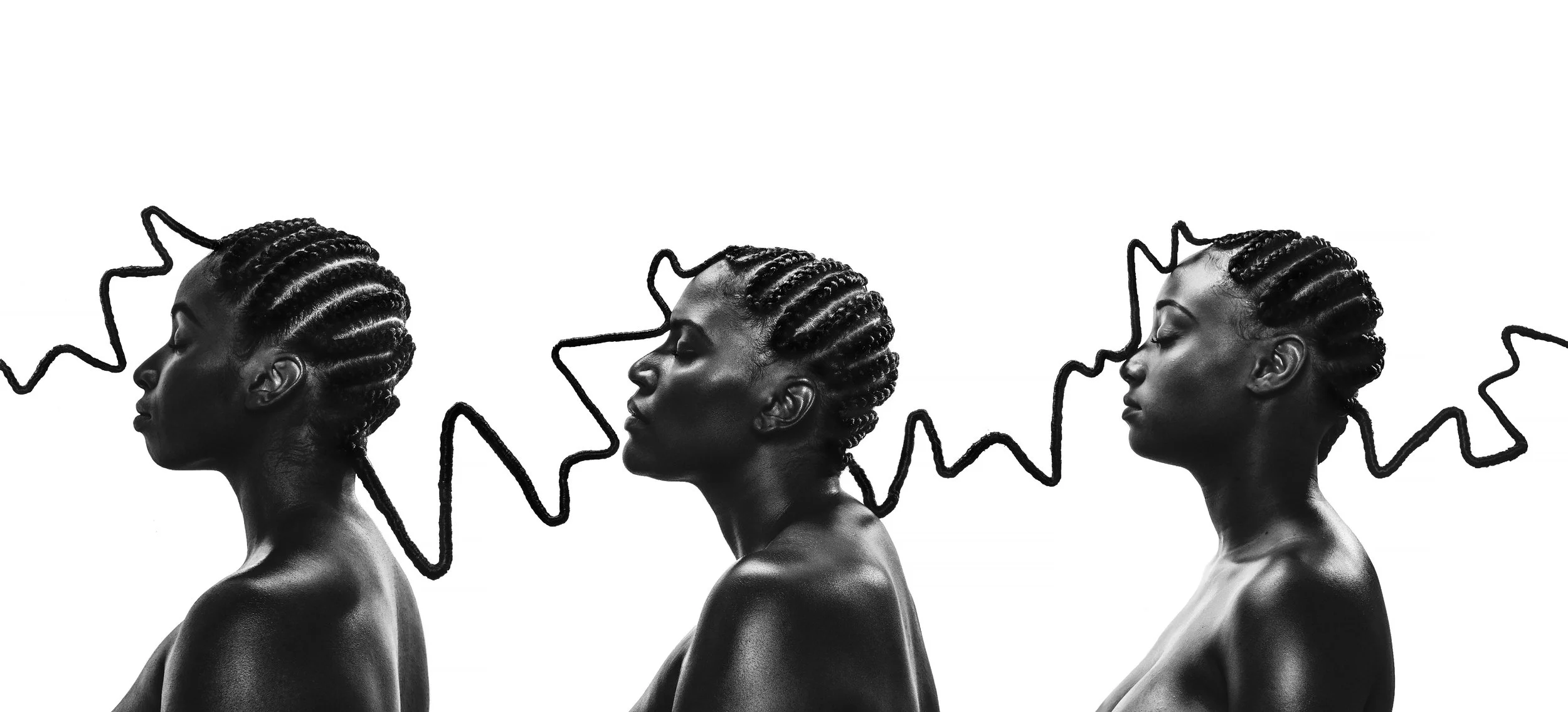
Shani Crow, THE BREADTH WE ALL SHARE, 2016. Archival Ink on Hahnemuhle German Etching Paper. 44 x 96 in. Photo credit: Shani Crowe.