Keeper of secrets
Faisal Abdu’Allah

Faisal Abdu’Allah and Eric Baillies, The Buzzer, from the series In the Hands of the Duppy, 2020-2022. Tintype. 30 x 20 in. © Faisal Abdu’Allah and Eric Baillies. Photograph courtesy of Eric Baillies.
As a child growing up in northwest London, I accompanied my father on weekly visits to the local barber, tucked into the back room of Mr. Wright’s home. Before entering, he would remind us, “Children are seen and not heard.” My brother and I sat in silence, reading comics, sketching, and half-listening to the conversations of the Afro-Caribbean elders waiting their turn. Dominoes clattered across tables. The stereo played Morning of My Life by John Holt, Mr. Wright’s favorite reggae artist. The sultry tones fill the room. Sunset drinks were poured and sold. The air was heavy with the sharp scent of Pashana Hair Tonic and baby powder. Words of wisdom, tall tales, and stories of saucy exploits spilled into every corner. It was familiar, it was homey—and I knew that come Monday morning, I would walk into school looking sharp, transformed by Mr. Wright’s skilled hands.
The enforced quiet, demanded by my parents, honed my imagination. I learned to watch, to listen between the lines, to invent characters for each elder as they spoke. The barber’s space became my first institute of learning—or unlearning. It was a place where intimacy and renewal were enacted, where skilled hands cut away the old to reveal the new. Only later did I understand that this seemingly ordinary space was a site of performance, ritual, and civic imagination.
That early training in observation would serve me well as I pursued my love for the arts. But it collided with a formative encounter: my first visit to the National Portrait Gallery. Walking through those hallowed halls, I noticed that whenever a body like mine appeared in the paintings, it was framed in roles of servitude. I asked my art teacher why. His response—and the weight of that distortion—left me restless. How does a young mind navigate the tension between perception and representation? Before leaving, I made a silent promise to myself: I would pursue a career in the arts, reflecting the Black experience as a kaleidoscope of joy, beauty, magic, and possibility rather than a narrow archive of trauma and subjugation.
Immersing myself at Central Saint Martins at nineteen felt like medicine—as though I had been cured of ignorance. But the remedy came with a side effect: I was thrown into another lion’s den, this time among the bigoted intelligentsia. My research was met with confusion, dismissed by professors who could not—or would not—understand it. For a time, I adopted abstraction as a way to buy myself space. It wasn’t until I traveled to Boston and encountered histories of barbering in the Antebellum period that the threads connected. My Pashana-scented childhood folded naturally into my studio practice, weaving memory, tradition, and identity into my art.
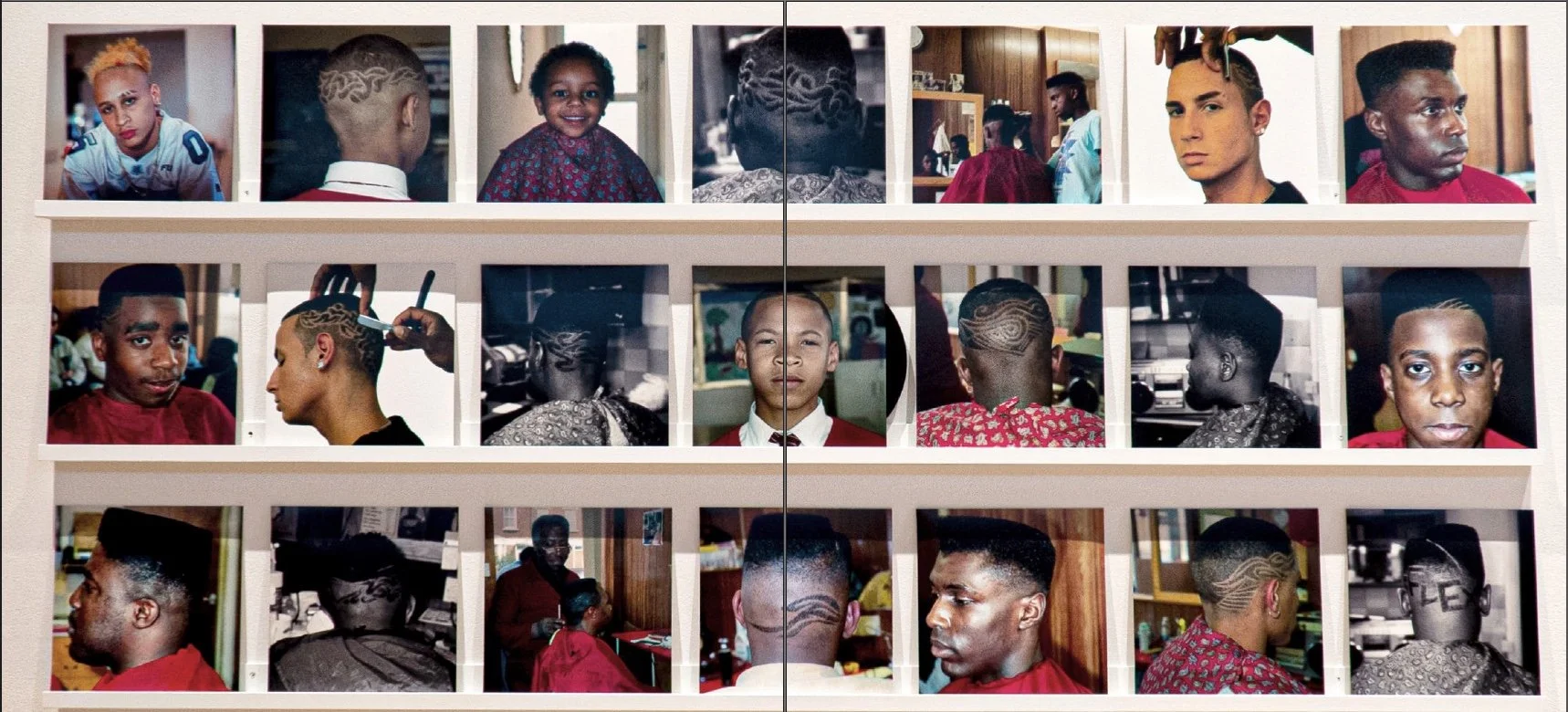
Faisal Abdu’Allah, Def Cuts, 1990/2022. Installation of 21 acrylic on cardboard album covers. Dimensions variable. © Faisal Abdu’Allah. Co- published by the Artist and Magnolia Editions. Photograph by mmoca.
Quincy T. Mills, in Cutting Along the Color Line, reminds us that the Black barbershop has always been more than a grooming space. From the transition out of slavery to the rise of Black consumerism, it has been a site of entrepreneurship, civic resistance, and community formation. Working in a local shop, and later owning one, I witnessed firsthand the barbershop as both sanctuary and stage, where respectability is negotiated and memory preserved. In my own work, this has been embodied most explicitly in the ongoing performance Live Salon, first staged at the British Art Show. Here, grooming—one of the most intimate human gestures—becomes public, political. Legacy and lineage surface. The salon is a forum to speak freely, nurture activism, and imagine opportunity, even when the surrounding world offers little support.
For me as a child, the barber’s space was a sanctuary, a space of narrative escape. Waiting my turn, I devoured comics that opened portals to other worlds, each page sparking the conviction that I could shape a world of my own. In my exhibition Dark Matter, these comics line the walls alongside a gold-plated Koken barber’s chair: opulent, futuristic, and deeply personal. It is at once a self-portrait and a portal, a reminder of those early years reading, waiting, and being transformed. That barber chair carries symbolic weight, resonating with the Afrofuturist vision of Sun Ra, who offered a liberated future for Black people through cosmic music and philosophy. The future must always embrace innovation.
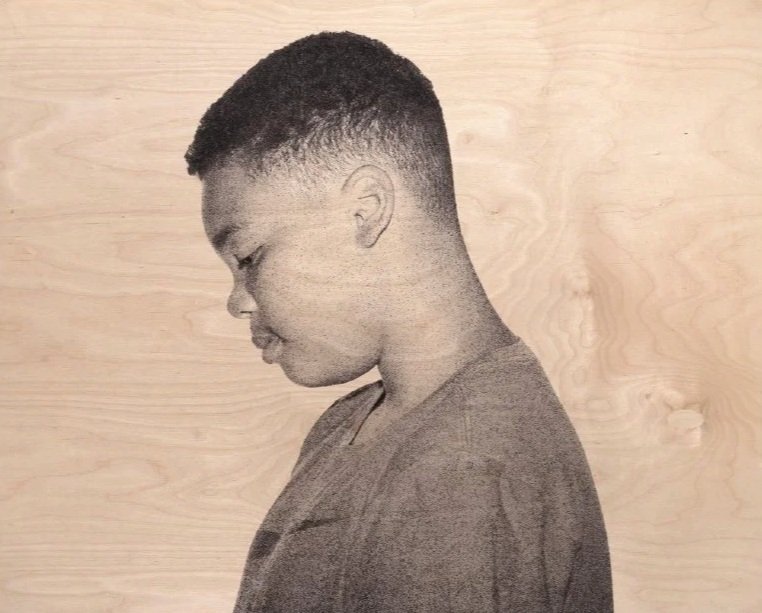
Faisal Abdu’Allah, Hairtrait Jamarion, from the series Hairtraits, 2022. Hair and acrylic on birch veneer plywood. 40 x 50 in. © Faisal Abdu’Allah. Co-published by the Artist and Magnolia Editions. Photograph courtesy of Magnolia Editions.