Urban fabric
Sanne Visser

Sana Badri, [Hair cutting at one of the donating hair salons in Earls Court, London, UK, as part of Sanne’s [Visser] residency at the Design Museum in 2022], 2022. Photography credit: Sana Badri.
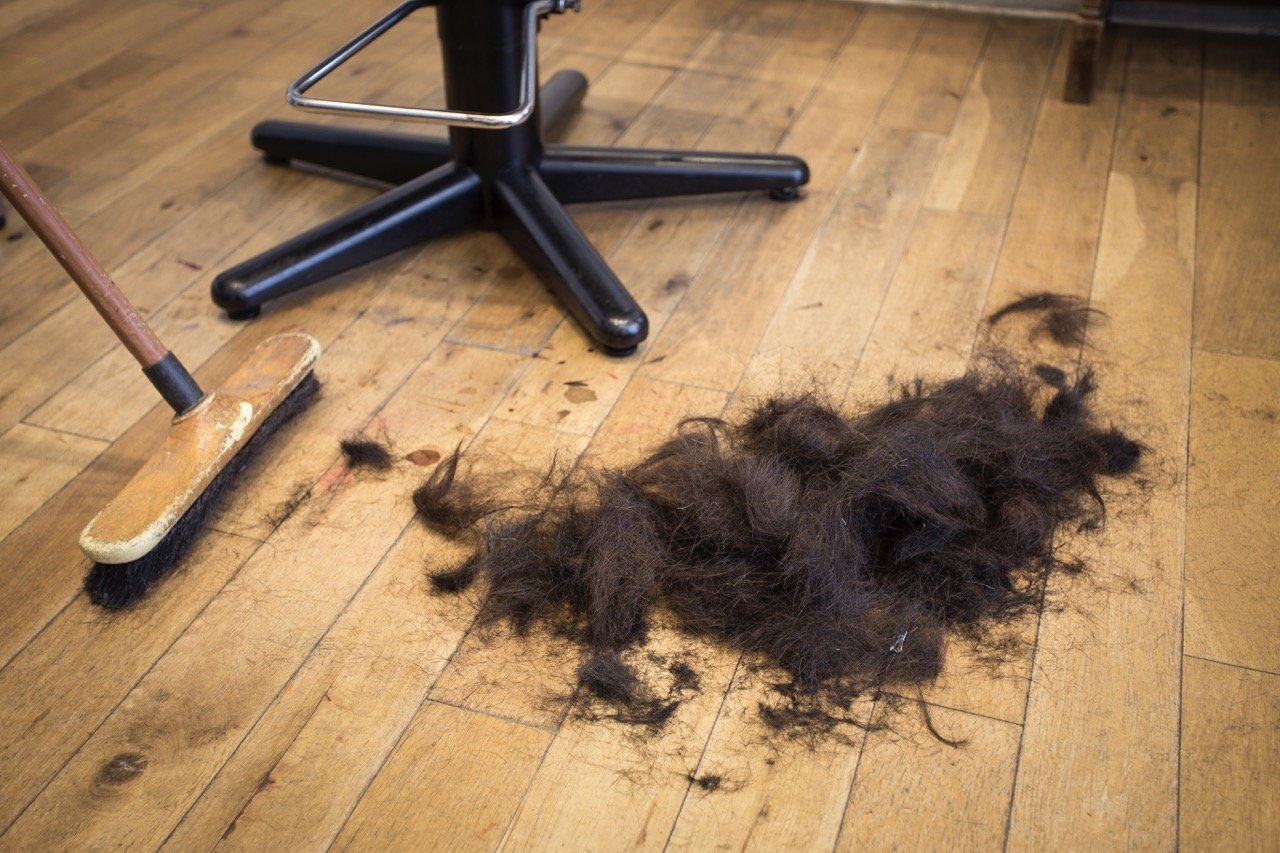
Sanne Visser, from The New Age of Trichology. Photography credit: Sanne Visser. Human hair waste at salon floor captured during Sanne’s earliest hair collections in 2015.
We all grow it, in many forms, shapes and sizes. Many of us care for it meticulously. Yet when it’s cut from our heads, we rarely think about where it might end up. Over the last decade, I have been deeply fascinated by the potential of human hair. As a material designer and researcher, I have been exploring how it can be seen as a regenerative material resource, and trying to uncover its complex pathway through social, ecological and technical domains.
Hair first really caught my attention in 2016, when I began my Master’s degree in Material Futures at Central Saint Martins in London. I was attracted to its sheer quantity as a material, as well as its properties. It’s lightweight, flexible, highly oil-absorbent, strong in tensile strength, biodegradable yet extremely durable (it can degrade in as little as six weeks in an industrial composting machine, yet remain intact for 6,000 years if protected from light and air). At the same time, I was motivated by the idea that we are living through a climate crisis, and still mining materials from the other side of the world, all while abundant natural resources are growing out of our own heads.
The UK alone, where I live, currently generates an estimated 6.8 million kilograms of human hair each year. Most of this is classified as general waste, ending up incinerated, releasing harmful gases, or in landfill, taking up large amounts of space. Interestingly, this figure used to be 6.5 million kilograms, back when I began this research. It’s only an estimate, but still highlights that human hair is one of the few natural resources that increases in direct proportion to global population growth.
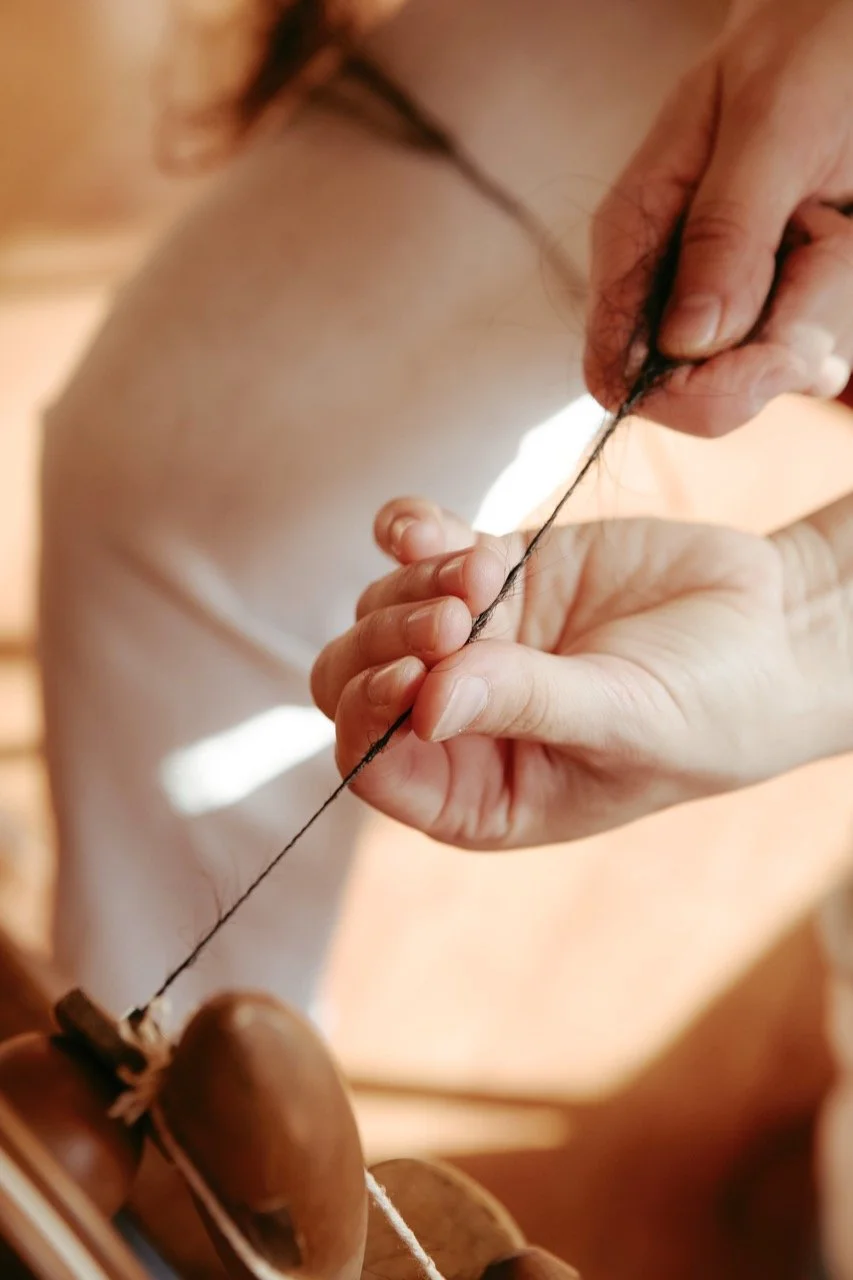
Rocio Chacon, [A close up image of the spinning process of human hair using a traditional spinning wheel. Once the hair is carded, the hair is spun into a 2-ply yarn], 2024. Photography credit: Rocio Chacon.

Sanne Visser, from The New Age of Trichology. Photography credit: Tom Mannion. The black netted bag—made from 100% human hair—was one of the first products made as part of Sanne’s final year Masters project The New Age of Trichology, using hand spinning, ropemaking and knotting techniques.
I approached the challenge with pragmatism, perhaps because of my Dutch heritage. First, I was eager to explore hair’s tensile strength. This led me quite quickly to ropemaking, which is greatly undervalued as a craft today, yet from a materials development perspective was one of the most groundbreaking technologies of all time. Today most rope is made industrially from materials like metal or carbon, but prehistoric humans - as long as 25,000 years ago - made rope from plant-based fibres such as hemp and flax. From a circular economy perspective, ropemaking appeared especially promising to me: it allows the fiber to remain unmixed with other materials, what is called mono-materiality, which is highly valued within circular and sustainable design strategies as the product can be easily dismantled or composted at the end of its useful life.
I knew little about ropemaking, but this was an advantage in a way, because it forced me to work with others. By collaborating with experts from all backgrounds, professions, and ages, I achieved outcomes I never could have alone. After collecting hair from several local hairdressers in Central London, I worked with a master spinner and ropemaker. Haircuts longer than three centimetres were ideal, as this yielded fibers that could be neatly twisted into delicate yarns and ropes using ancient tools such as spinning wheels and rope machines. The process felt almost magical. My first products included a series of utilitarian objects, like dog leashes, netted bags, belts, and cords.
Already, I felt that I had proven hair’s potential for practical applications. But I wanted the products to really come to life, creating impact beyond ‘just’ well-crafted objects and diverting matter from landfill. My goal was to regenerate whole human environments, increasing biodiversity while also enabling communities to thrive with conviviality and prosperity.

Angela Tozzi, [Young community members taking part in a ‘tug-ofwar’ with a rope made from 100% human hair, following a day of hairbased felt making in the R-Urban community garden during a HairCycle workshop], 2024. Photography credit: Angela Tozzi.