The ties that bind
Timon Screech
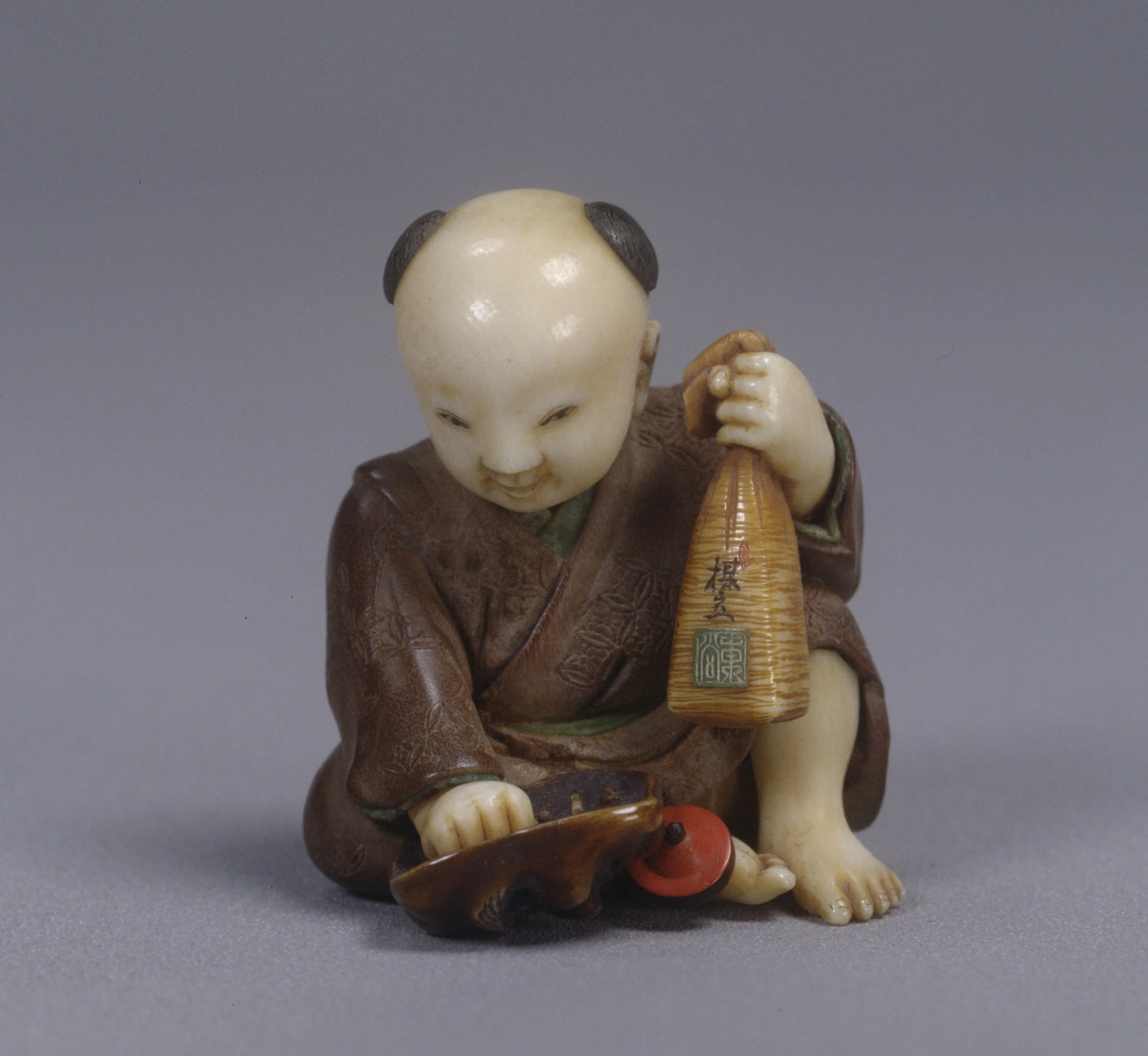
Tarudate Higashitani (square seal), Edo period, 19th century. Ivory, mulberry, and ebony. Tokyo National Museum, Donation by Mr. Senosuke Go, h-4183. National Agency for Cultural Properties Integrated Search System, ColBase.
Comparisons are odious, especially when they refer to people’s bodies. However, it is a physiological fact that East Asian hair is the thickest human type. One strand of Afro-textured or Caucasian hair is about 0.05mm; Asian hair is twice as much, at 0.1mm. This has given rise to a certain culture of hair care and styling. In Japan – at least until the advent of mousses and perms – there were but two options: let it grow, or cut it off. The history of Japanese hairstyles might, in fact, be better characterised as a series of changes in systems of hair-management.
The processing began early, as infants’ heads were generally shaved, leaving two tufts tied in little buns. This was called the ‘Tang child’s haircut’ (karako-mage), a reminder that the ancient Chinese dynasty served the Japanese much as Greek and Roman antiquity did for Europeans, as a lofty classical past. Those not yet come to full personhood were positioned, as ‘trailing clouds of glory’, as it were, free from the decline of latter-day epochs. From about the age of five, the hair would be allowed to grow, intermittently shorn, and from about eight years old, the top of the head would be shaved, with the forelock left in place.
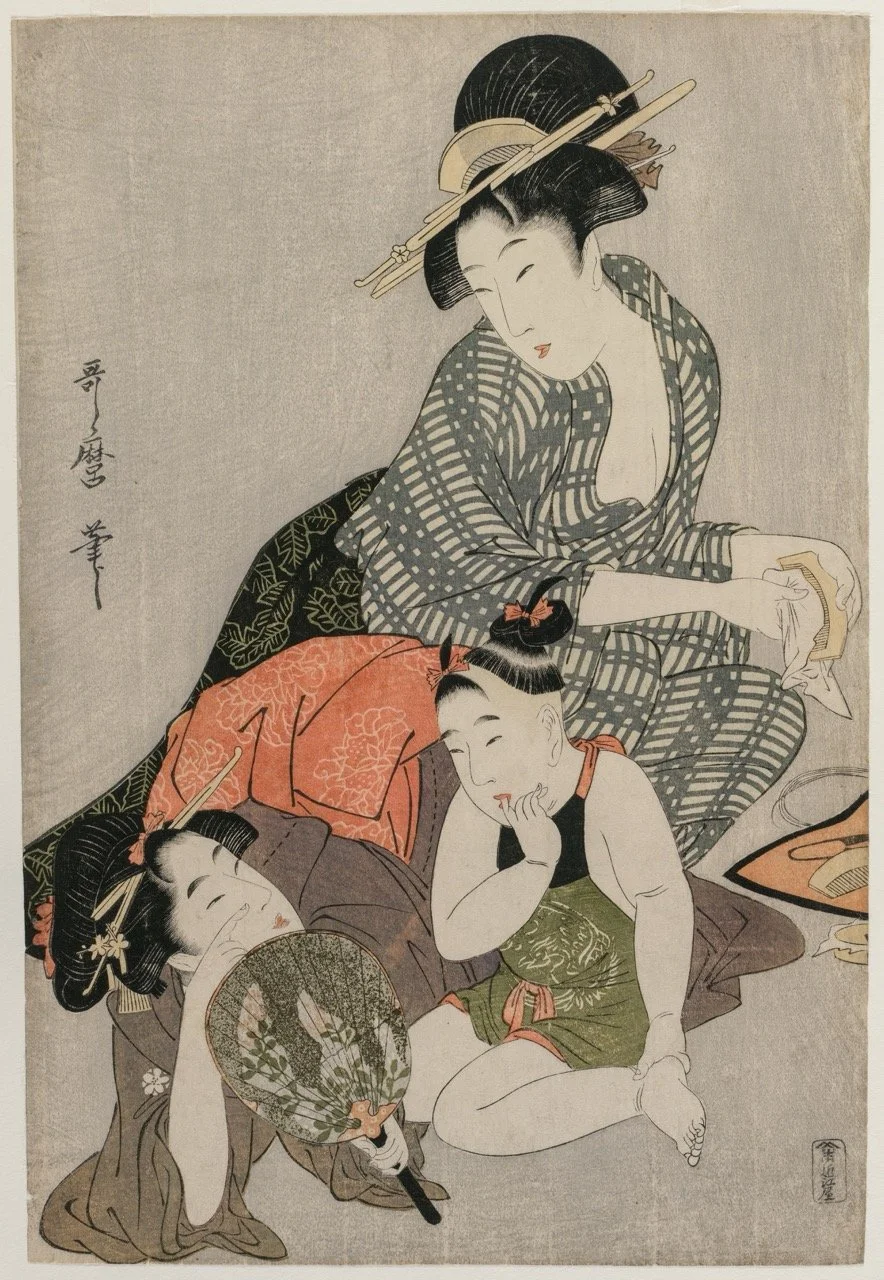
Cleaning Combs, color woodblock print, c. late 1790s. Kitagawa Utamaro, (Japanese, c. 1754–1806). Courtesy, Clevland Museum of Art. 1930.216.
The great step was adulthood, when men removed their forelock. For those of senior rank, the status was denoted by an eboshi hat, which would not fit over a forelock; donning this headgear was a moment of great pageant, overseen by a ‘cap parent’ (kanmuri-oya). One incident occurred in the case of Ashikaga Yoshinori, who unexpectedly succeeded as shogun in 1429, having previously been a monk. This meant he had no hair at all. Yoshinori’s investiture was delayed for several months until he had grown enough to render his eboshi wearable.
As this anecdote suggests, hair – where and how much – was a definitional matter in Japan. Growing it took time, while removal could be instantaneous. Elite women never cut their hair, and it grew to be longer than they were tall. As widows, they were expected to take the tonsure, that is, have their hair shaved off. Once cut, a lady’s hair formed an enormous bundle, and many temples have ropes or extended items made from donated hair.
Both men and women took the tonsure when taking religious vows and entering a cloister, which could be done at any time in life. History is full of examples of this rite of passage, and it is also a recurrent trope in literature. Great grief made Yoshimune no Munesada, grandson of the emperor, leave the secular world in 850, while in his thirties. He commemorated the event in verse:
Did my mother
Ever run her fingers through my hair
Hoping that I would one day be
What I now am?
There is subtext alongside the pathos, here: Munesada’s mother would have had high hopes for an illustrious career at court, which was impossible now that he had a bald pate. In the event, he lived on for another forty years, and under the clerical name of Henjo emerged as one Japan’s most famous poets. His verse was picked up in the great novel Tale of Genji (c. 1020), in which a princess called Ukifune becomes a nun out of despair. She imagined that her sufferings would already have thinned her thin, but it had not; as she is shorn, she whispers Munesada’s couplet, ‘Hoping that I would one day be / What I now am’.
Taking the tonsure meant shedding social classification; for women, it also meant a willing renunciation of their beauty. Length and lustre of hair were regarded as among a woman’s treasures, but this very allure was thought to be dangerous. As the fourth-century Sutra of Verses on the ‘Five Tribulations’ (Gokushōku-gyō) put it, “a women’s hair can constrain even an elephant” – a line quoted (and hence rescued from obscurity) by Yoshida Kenkō in his celebrated Essays in Idleness of c. 1330. Kenkō noted how easily men could be led astray in love: ‘So it is that we have those tales of how a woman’s hair can snare and hold even an elephant.’ It was, he said, a trap to be avoided. In the popular imagination, this was often less a fear than an aspirational titillation.
In older years, as air went thin and then fell out, elderly ladies might become nuns and shave their heads before baldness set in, while commoner women had to arrange their locks to cover deficiencies as they could. Gentlemen wore retirement caps (hōroku-zukin, literally “baking-pan headcloth”). In a painting by Miyagawa Chōshun, now in the Chester Beatty Colleciton in Dublin, one can be seen on the head of a wealthy person celebrating his happy retirement. A blind masseur, whose quasi-medical work has required him to shave his whole head, is behind, while a musician strums in front. The sword indicates he is of samurai rank, while the full moon painted on the screen, rising behind long grass, is a sign of autumn. Now oxidized dark, it would originally have been a luminous silver, perhaps symbolizing the late season of this man’s life – and in its plenitude, some measure of satisfaction.

Detail. Handscroll painting, Leisurely activities by the waterside, painted in ink and colours on silk by Miyagawa Cho¯ shun in the early 18th century, Japan. Nihon-e Miyagawa Cho¯ shun zu. 13 x 108 in. Courtesy, Chester Beatty