Splitting hairs
Yuhang Li
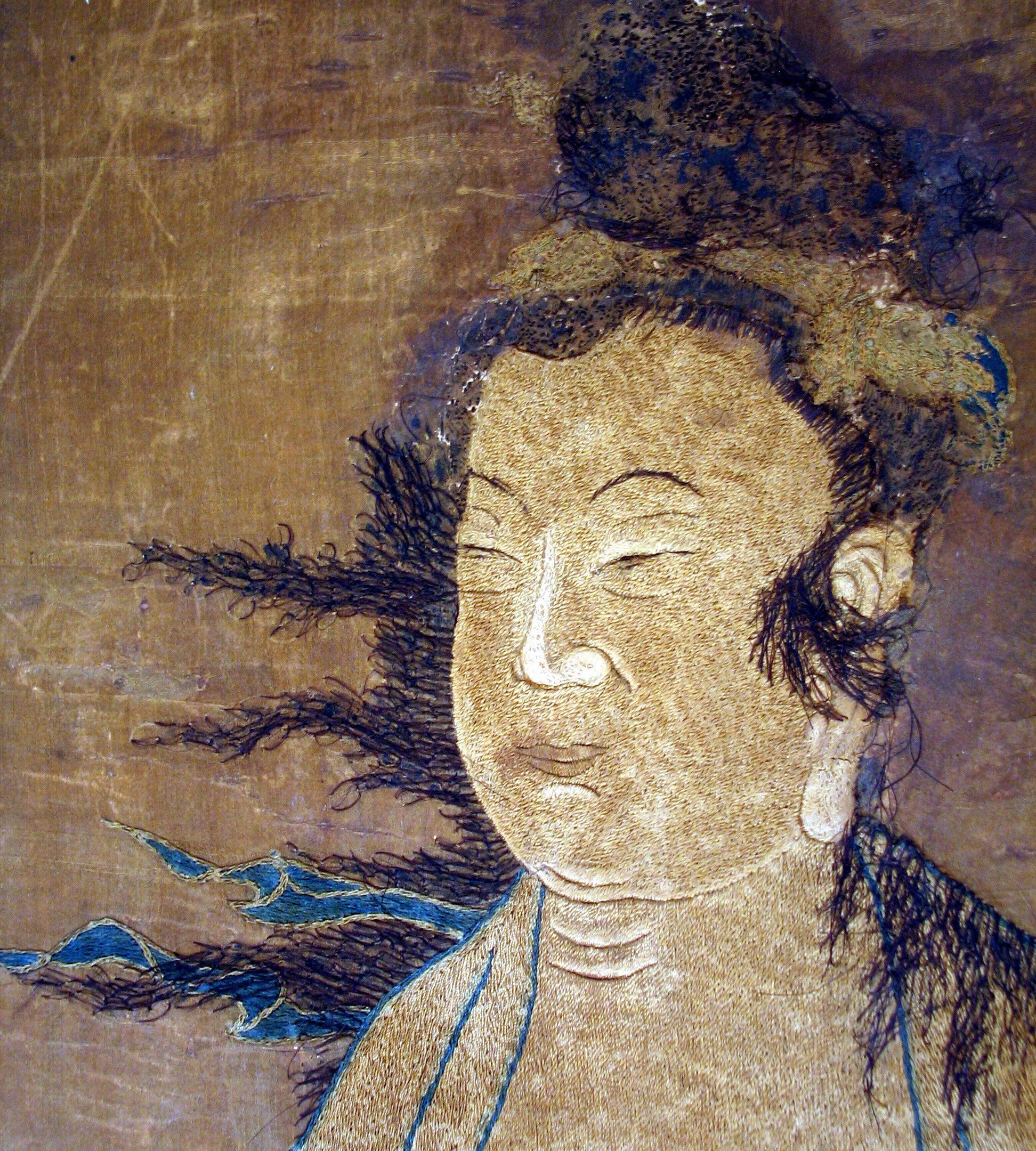
Detail, Guan Daosheng, Guanyin, 1309. Hair and silk embroidery. 41 5/16 x 19 11/16 in. Nanjing Museum Collection. Photo, Yuhang Li.
Hair used as thread, stitched on to white silk: this is the refined and remarkable materiality of Chinese hair embroidery. During the Yuan, Ming and Qing Dynasties, this practice was primarily the domain of pious women, for whom it was an extreme form of Buddhist devotion—a means of communicating with the Bodhisattva Guanyin, the most popular female deity in late imperial China. Through sacrificing their hair, lay women asked this divinity to intercede in their everyday lives.
In some examples of this embroidery, human hair is combined with silk thread to create the image. A portrait of Guanyin, attributed to the renowned Yuan dynasty woman painter Guan Daosheng (1262-1319), represents an early form of this practice: only the Bodhisattva’s hair, eyebrows, and eyelashes are embroidered with hair, while her robe, face, and other parts of her body are rendered in silk thread. The direct transplantation of hair onto that of the icon was an act of vital regeneration—a term that, in this context, can be understood as a kind of spiritual rebirth. Three or four strands of hair are twisted together to form each single thread. To achieve the effect of hair dancing in the wind, the stitches are oriented in various directions, vividly conveying a sense of materiality.
A second, more representative type of Chinese embroidery is executed entirely in human hair. This form of hair embroidery is often considered an imitation of the baimiao painting technique, or fine-line drawing. The seventeenth-century artist Li Feng provides one of its finest examples. A seated Guanyin, here manifested as an enlightened Buddha, is centered within the scroll. Two different techniques are used. In some passages, a single hair is used to delineate the deity’s hair and robe; elsewhere, hairs are split into multiple, finer strands to create skin texture. In contrast to embroideries like Guan Daosheng’s, in which hair is used to represent itself, here it effaces its own materiality, mimicking the appearance of painting. The extreme difficulty of splitting the hairs significantly enhanced the value of the devotional object.
We know from surviving objects and textual sources that hair for embroidery was painfully plucked from the root, rather than cut with scissors. Religiously sanctified suffering is a phenomenon found across cultures, often serving to increase proximity to the divine. In the Chinese context, when a devotee intentionally inflicts pain upon herself, she transcends her human state and approaches Guanyin—becoming a recipient of divine sympathy, generally understood by believers to be universal. The particularity of self-inflicted pain, however, serves to individuate the practitioner, allowing her to construct a unique personal relationship with the divine.

Guan Daosheng, Guanyin, 1309. Hair and silk embroidery. 41 5/16 x 19 11/16 in. Nanjing Museum Collection.

Detail, Li Feng, Guanyin, 1691. Hair embroidery on silk. 26 3/4 x 13 3/4 in. Beijing Palace Museum Collection. Image courtesy of Shan Guoqiang, Zhixiu shuhua, Shanghai: Shanghai kexue jishu chubanshe; Xianggang: Shangwu yinshuguan, 2005, P.71.
The Buddhist tradition cherishes stories of Bodhisattvas relinquishing their bodies for the Dharma. In one key narrative paradigm, Vairocana Buddha uses his own skin as paper, his bones as a pen, and his blood as ink to transcribe the Dharma into material scripture. Vairocana is a model for both laymen and laywomen, but in practice, the act of bodily sacrifice has been heavily gendered, with blood scripture primarily the domain of male Buddhist priests, and hair embroidery practiced by lay Buddhist women.
While recognizing this division, the two practices do share fundamental commonalities. First, as explained, both hair and blood were considered vital, self-regenerating parts of the body. Second, practitioners must endure pain when collecting these “raw” materials before creating their devotional objects. Third, both practices require immense technical skill. Fourth, in both cases, the bodily substance is transplanted from the practitioners onto a new medium (paper or silk); it is in this act of transference that the calligraphy or images are transformed into devotional objects.
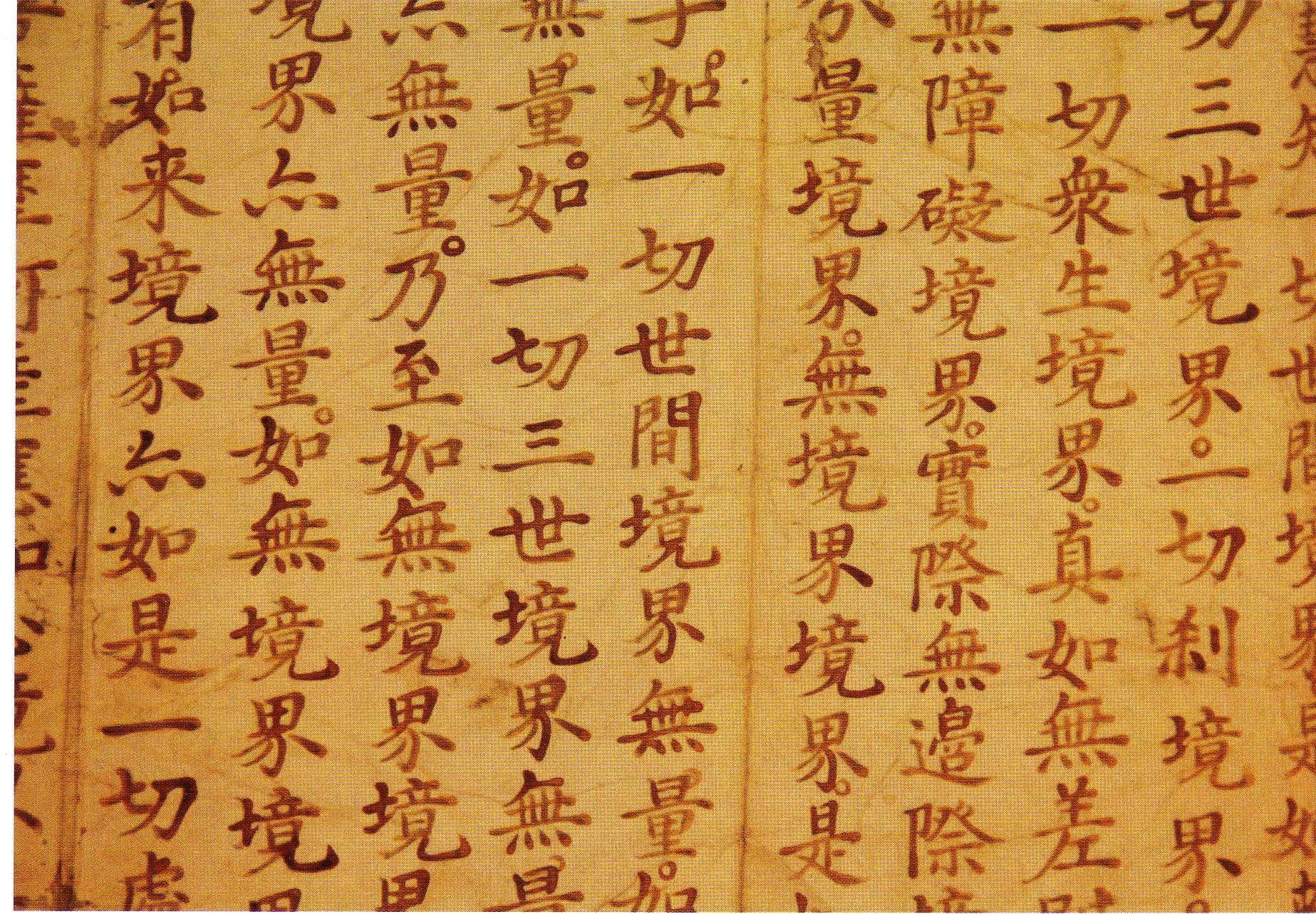
Buddhist Priest Zongxian, Huayan jing (Avatamsaka Sutra), Qing dynasty, (1644-1911). Human blood on paper. 13 3/8 x 5 1/8 in. Wenshu Monastery Collection. Image courtesy of Zongxing and et al., eds., Zhongguo Chengdu fojiao wenhua zhencang shiji dazhan, zhanpin xuanji, Publisher unknown. 2005, P. 44.