A living trace
Vaishnavi Patil
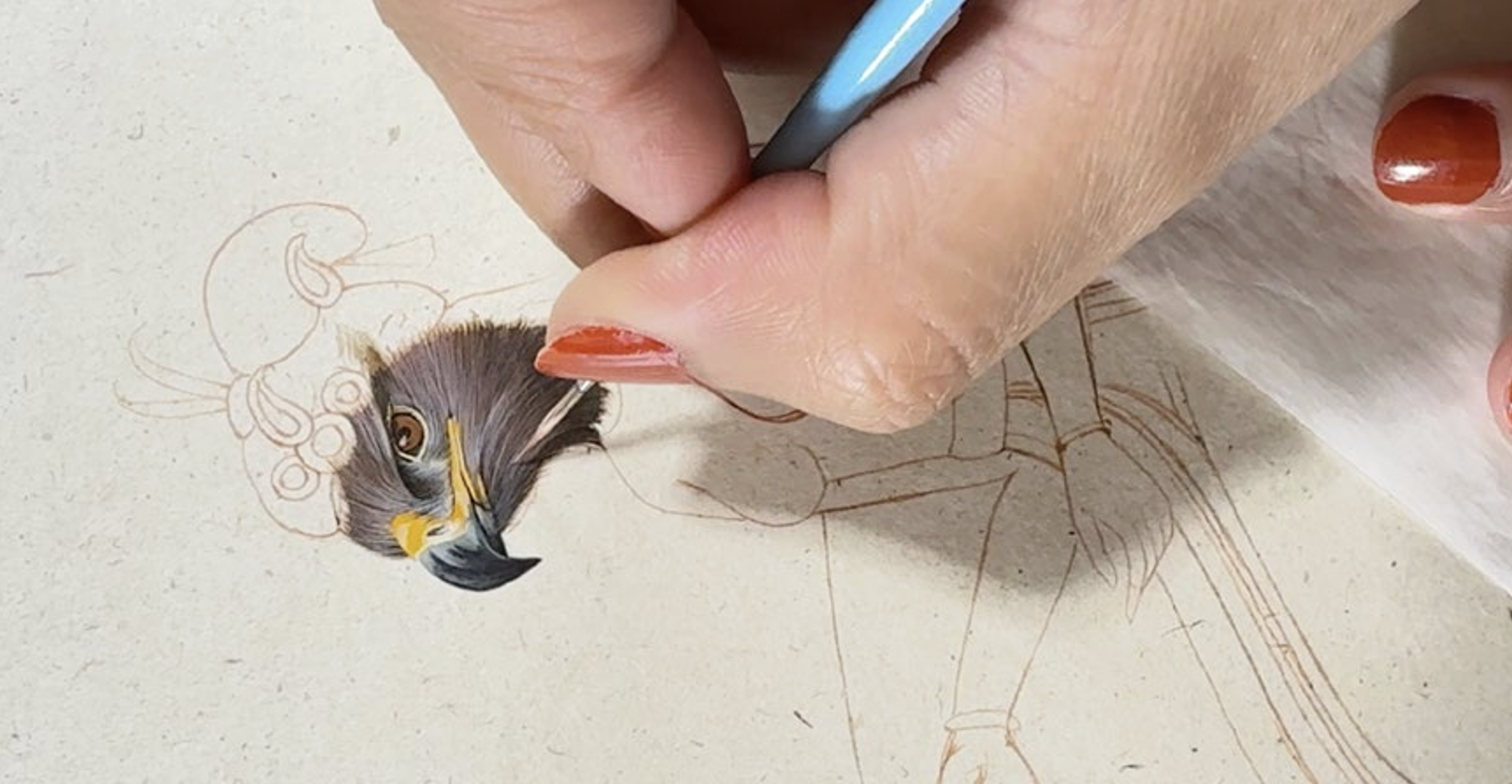
Manjot Kaur, [artist drawing], undated. Photo by Manjot Kaur. Image courtesy the artist.
South Asian painting is often defined by exquisite control, each image rendered with remarkable precision. We immediately admire the vibrancy of pigment, the delicate outlines, the layered color. But look closer—at a single eyelash, a strand of hair, or the flow of a robe—and the mastery reveals itself as deeply material, not only technical.
The brush, though often overlooked, is vital to the tradition. Artists use specialized brushes crafted from natural materials, each chosen for its unique feel and expression. Squirrel tail hair, valued for its curve and fine point, is ideal for delicate outlines. Mongoose hair gives firmer, springier strokes, its “snap” perfect for expressive linework. Goat hair or fine cow ear strands hold water well, creating smooth, even fills. Each brush is more than just a tool. It is an extension of the artist’s body, responsive and intuitive.
But what does it mean to paint with a living trace? What relationships are embedded in each gesture—between artist, animal, and surface? Perhaps we should think of animal hair not just as a material, but an active collaborator. This reframes painting as a dialogue with the more-than-human. The tense stroke made with a mongoose-hair brush, for example, not only reflects the artist’s control, but also holds the memory of the animal’s body. The brushstroke, in this sense, is co-authored.
Each brush made with animal hair behaves uniquely. Manjot Kaur, a contemporary Indian artist, says that her favorite squirrel-hair brush has a natural curl that allows for uninterrupted strokes—ideal for rendering feathers in birds’ faces, a recurring motif in her paintings. The base holds a small reservoir of color, releasing it gradually in a controlled flow. Length and softness determine the pressure possible, not only from the hand, but through the brush’s own structure.
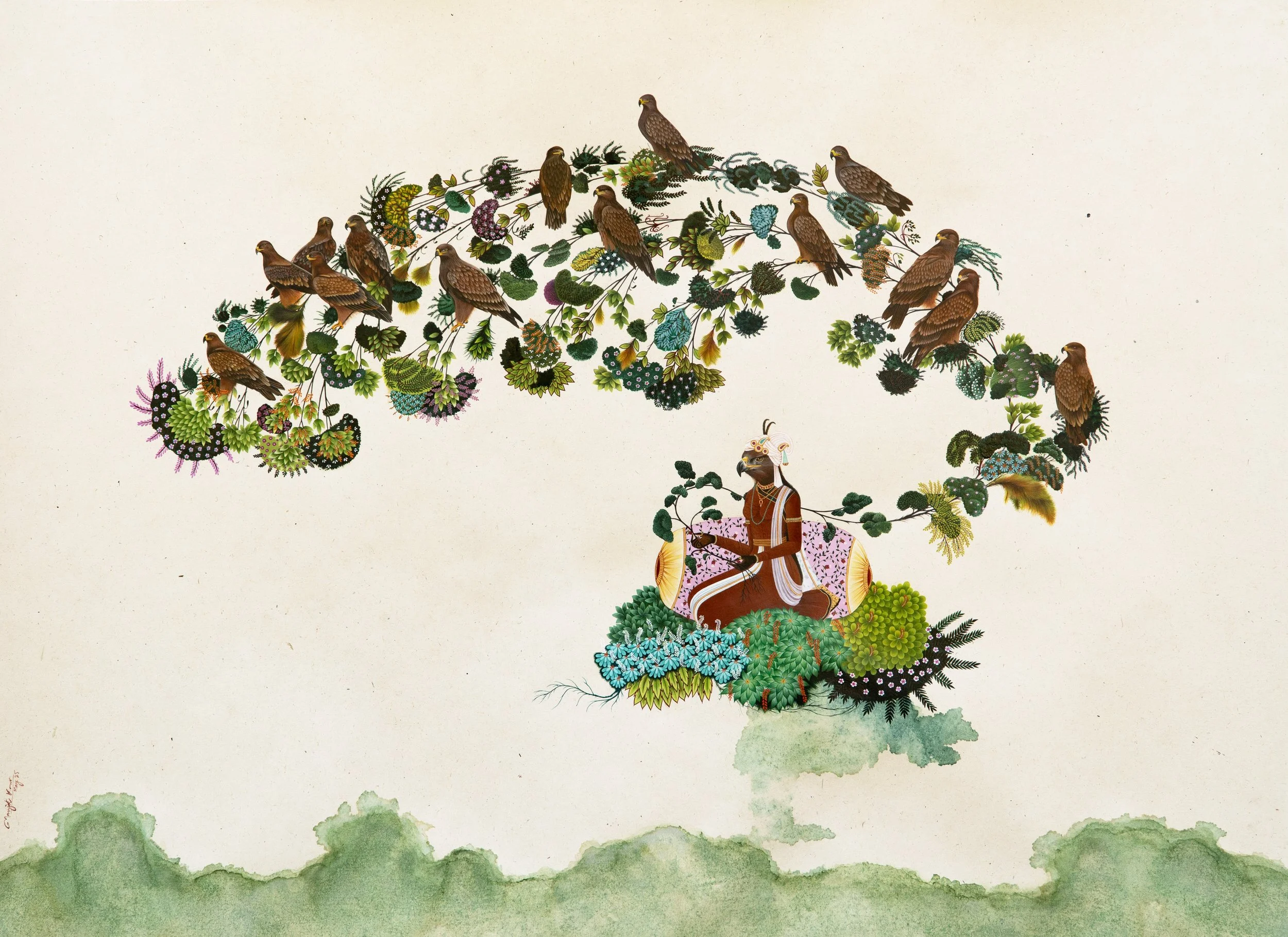
Manjot Kaur, The Convocation of Eagles, from the series Chthonic Beings, 2025. Gouache and watercolor on paper. 22 13/16 x 31 1/2 inches. Courtesy of the artist Manjot Kaur and mor charpentier.
Kaur doesn’t merely wield the brush, then—she listens to it. Knowledge arises through touch: the paper’s drag, the bristles’ tension, the pigment’s wetness. This is the embodied knowledge anthropologist Tim Ingold describes when he writes, “making is thinking.” Knowledge flows through repetition and gesture—through hand as much as mind.
Traditionally, brushes were not store-bought but handmade, sometimes by artists themselves, sometimes by specialist artisans with generations of skill. The craft of making a squirrel-hair brush involves separating, aligning, and binding each strand by hand. It is a tactile choreography, a quiet intimacy that transforms raw material into a living extension of the maker’s body.
This tactile knowing resonates across cultures. Orhan Pamuk, in his novel My Name Is Red, portrays Ottoman brushes as objects of discipline and devotion—personal, symbolic, and spiritual. In South Asian painting, where the mastery of the line carries immense weight, the brush is central. Art historian Molly Aitken, similarly, notes how Rajput lines carry emotional agency. A line can pulse, hesitate, shiver, or sing. To achieve this nuance, artists cultivate an intimate, haptic relationship with their brushes. Gestures have a physicality that is beyond illustration—they materialize, turning the page into a textured, expressive field. The painting is not just visual but “visceral.” We feel it even when only looking.
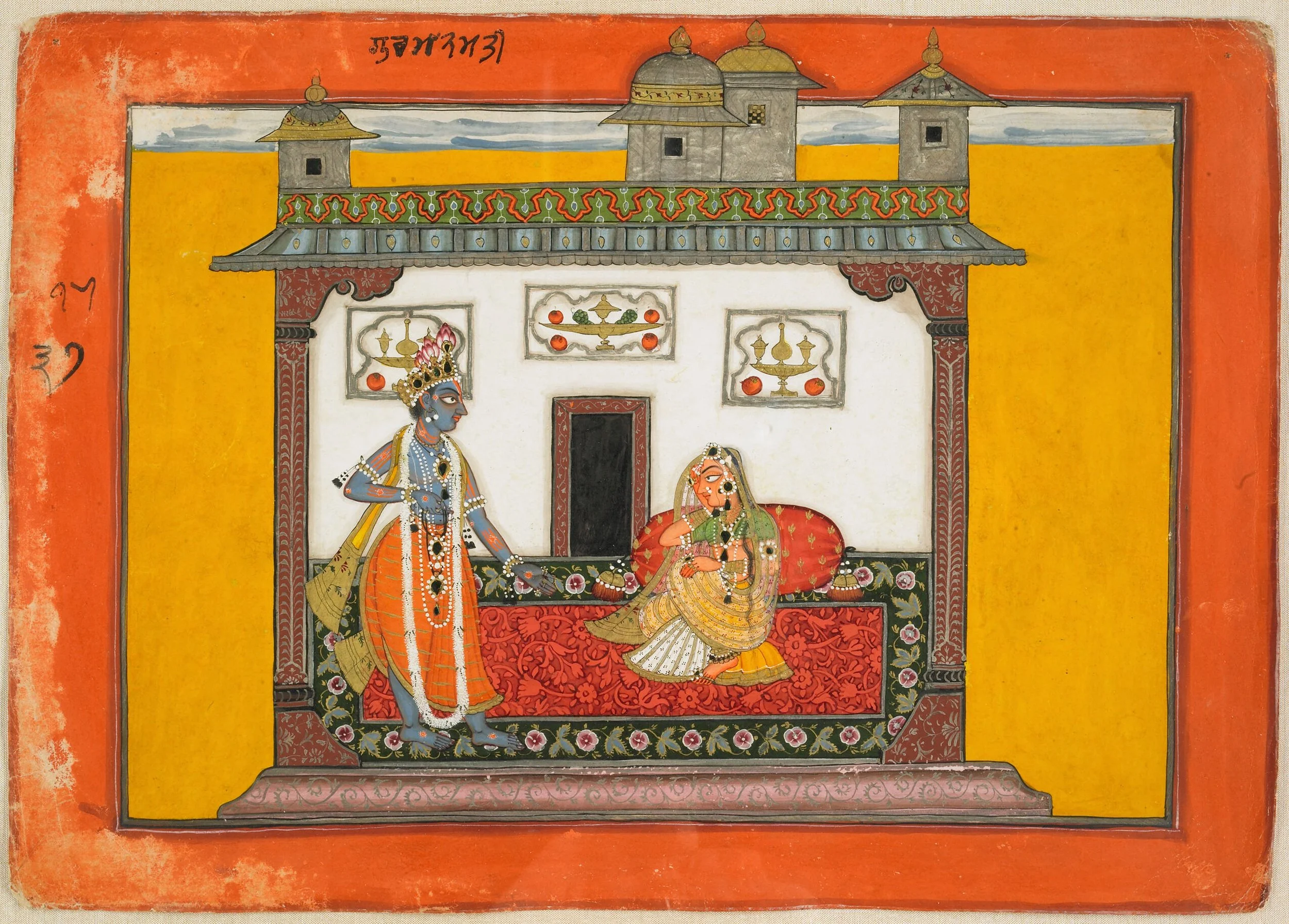
Indian, “A Nayika and Her Lover: Page from a Dispersed Rasamanjari Series (Blossom Cluster of Delight),” ca. 1660-1670. Manuscript folio. Harvard Art Museums/Arthur M. Sackler Museum, Gift of John Kenneth Galbraith, 1972.74. Photo © President and Fellows of Harvard College. Harvard Art Museums collections online, Nov 03, 2025.