Horse tales
Peter M. Kenny
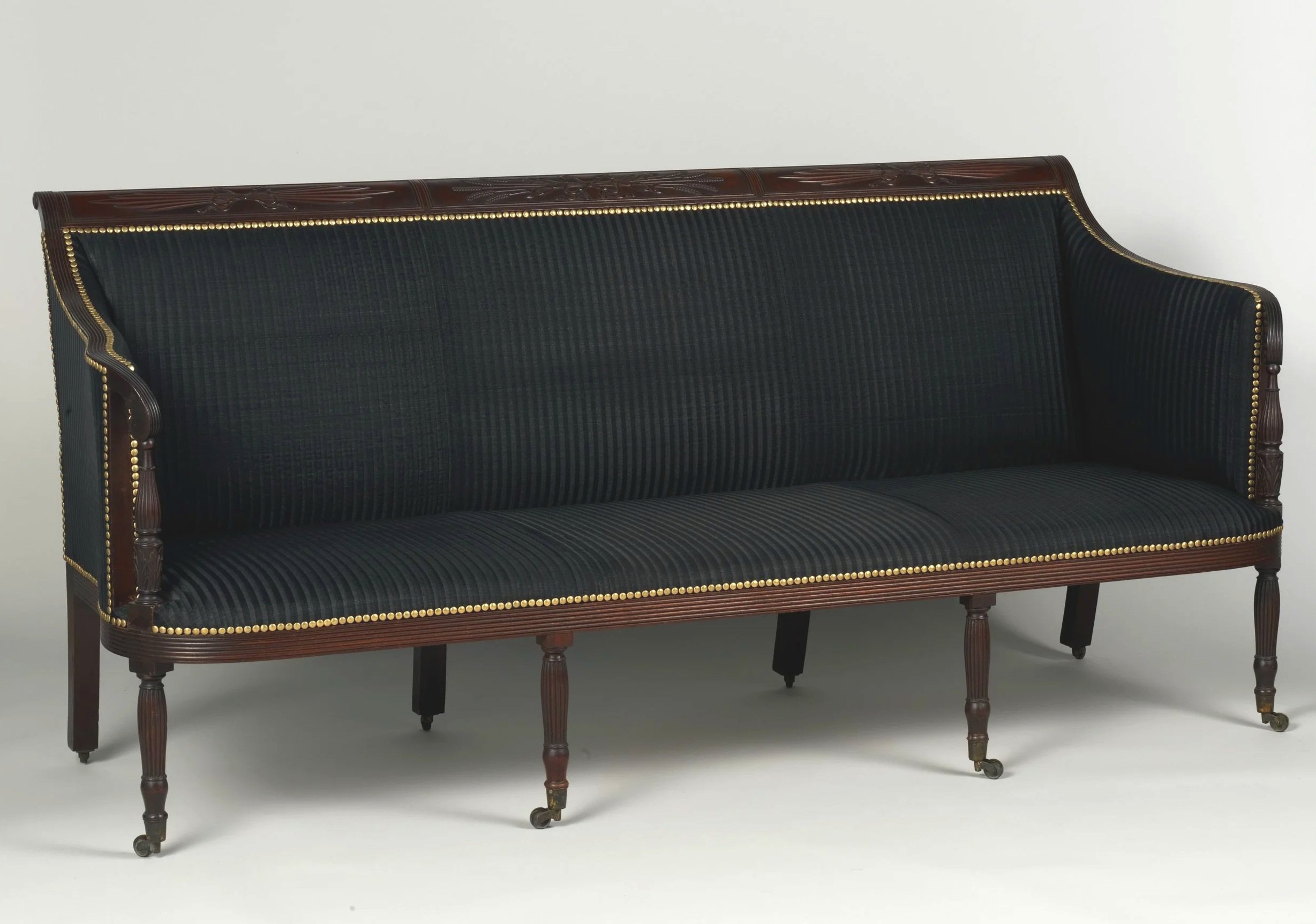
Attributed to the workshop of Duncan Phyfe, Sofa, New York, 180515. Mahogany with modern striped horsehair upholstery. Metropolitan Museum of Art, New York. Gift of Mrs. Harry Horton Benkard, 1942, 42.16.
Humans and horses have been in a cultural partnership for about five thousand years now, ever since the animals were first domesticated on the grasslands of Central Asia. In addition to their crucial roles in transport and warfare, horses have been a material resource. The coarse long hairs from their tails are used in the manufacture of bows for violins, violas, and cellos, the scaly surface ideal for grabbing and releasing strings to produce a distinctive, resonant sound. Softer hairs from horses’ manes were fashioned by eighteenth-century peruke makers into powdered wigs, which no self-respecting gentleman or London barrister would be seen without.
Later, in the nineteenth century, horsehair was woven into linen or cotton to make stiff crinolines (crin being French for horsehair) that held women’s skirts away from their bodies in a conical shape. It is in the realm of domestic furniture, however - epitomized by the elegant and commodious fauteuils (upholstered armchairs), canapés (sofas), and chaises longues (daybeds or couches) of pre-revolutionary France - that this versatile and resilient natural material was put to one of its best uses.
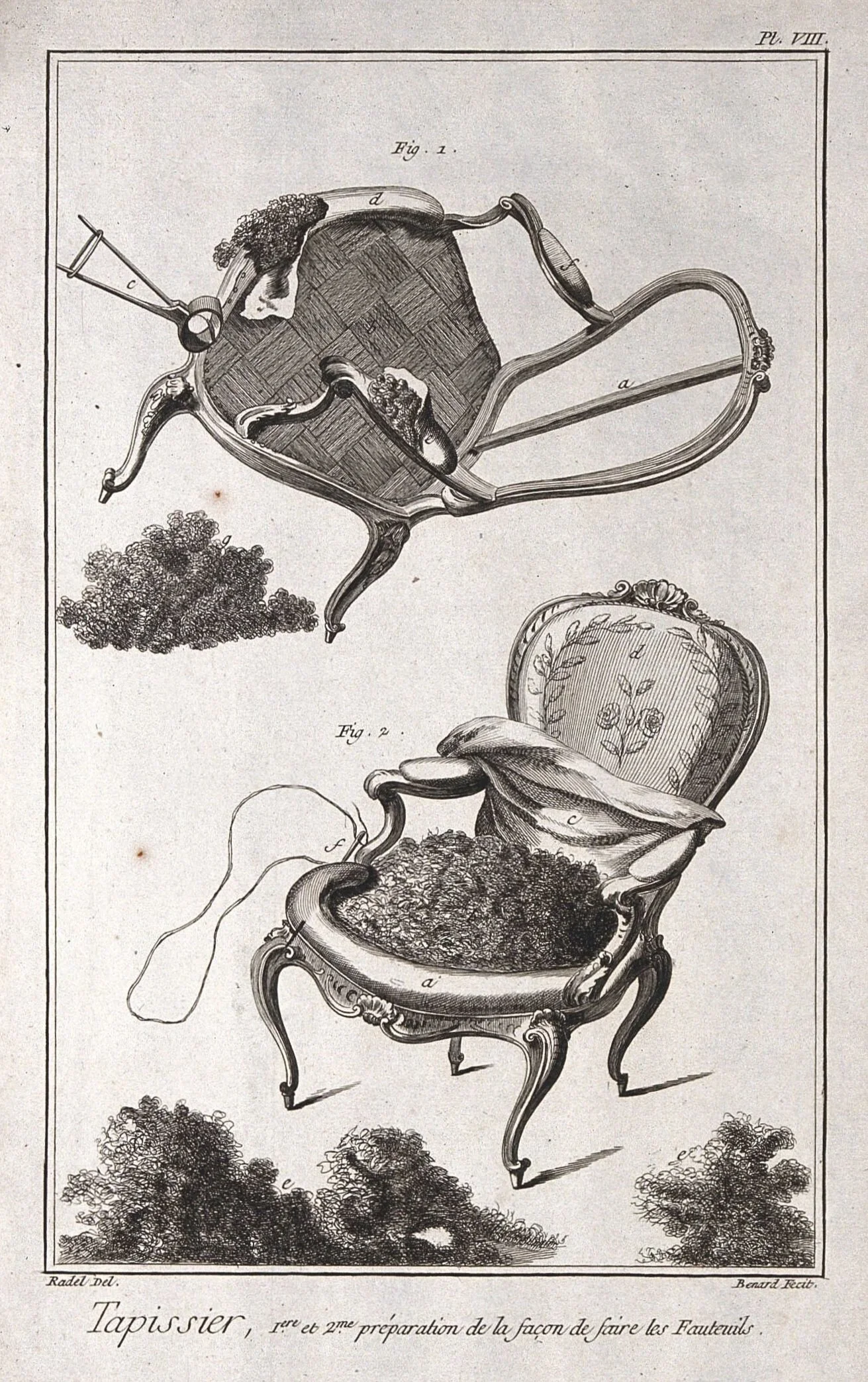
Engraving by R. Benard after Radel. Plate VIII: Tapestry work: First and second preparation [stages] in the making of armchairs, from “Tapissier,” Encyclopédie ou Dictionnaire raisonné des sciences, des arts et des métiers, vol. 9 (plates) (Paris, 1765). Wellcome Collection. Source: Wellcome Collection.
Horsehair was expensive, and throughout the eighteenth and most of the nineteenth centuries was principally harvested from living animals. One reliable source was carriage horses, whose manes and tails were cropped not only for healthful grooming but also to keep the tails from getting tangled up in the working parts of a vehicle. Horsehair is hollow and highly elastic, and could be curled by washing, rinsing, heating and drying it, rendering it light and springy. So treated, it had a remarkable ability to recover its shape even after long use as an upholstery foundation or as a filling for cushions and mattresses.
A plate in Diderot’s Encylopedie shows the material and techniques used by an eighteenth-century French tapissier (upholsterer) to create the foundations for a fauteuil. Copious amounts of curled horsehair are shown close at hand for layering into the seat well and stuffing, sausage-like, into linen sleeves to form arm pads and an edge roll for the front seat rail. This not only helped to contain the horsehair in the seat well, but also provided padding for the wooden seat rail, so its edge would not press into a sitter’s thighs.
Curled horsehair’s qualities made it ne plus ultra in upholstered seating furniture. More often, for economic reasons – and occasionally unbeknownst to clients – it was mixed with sheep wool, the hair of other domesticated animals, flax, cotton, scraps of fabric, and in the American South, Spanish moss. By the mid-eighteenth century, horsehair was also being woven in Europe into a durable, lustrous fabric for use as show coverings on upholstered furniture. It was hand-loomed with a warp made from tail hairs, carefully selected, washed and combed, and cotton or silk for the weft. The resulting textile is uncomfortable by contemporary standards, being rather unyielding and scratchy. Because tail hairs measure, at most, only about 28 inches long, the fabric also had a limited width, making it best suited for the relatively narrow seats and backs of chairs, though pieces could also be sewn together for use on sofas.
What people admired in horsehair fabric, then, was not its comfort but its look: a formal, burnished appearance. It was most often produced in natural dark brown and black, but vibrant colors could be achieved through dyeing, and fancy woven patterns were also available. In 1767, Thomas Chippendale supplied a customer with “10 Mahogany Chairs with neat Open Carv’d Backs and and seats stuff’d over the rails, cover’d with Crimson Haircloth and Brass nail’d.” George Hepplewhite, in his Cabinet-Maker and Upholsterer’s Guide (1788), wrote that “Mahogany chairs should have the seats of horsehair, plain, striped, checquered, &c. at pleasure.”

J.M. Szymanski, Horsehair Chair No. 1, Production ongoing. Blackened steel, wax finish, and horsehair textile. 29 x 20 x 28 in.