
Kohle, kunst, kulter
Doris Wicki
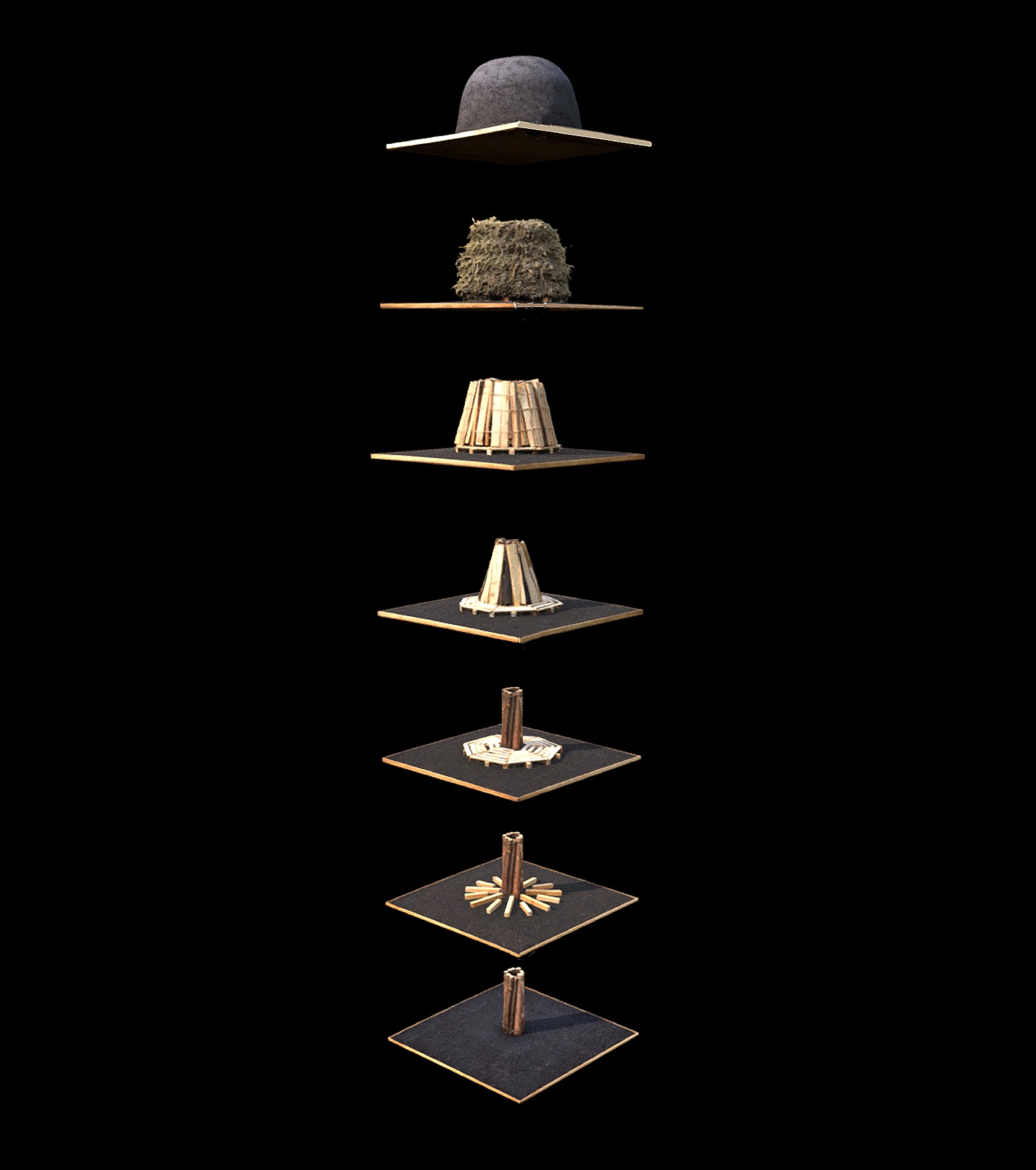
Diagram of a charcoal burning pile. Image courtesy of Doris Wicki.
It’s a phenomenon every single time. Naturally, after all the many charcoal kilns I've set up, I know how to perfectly execute every movement. Nevertheless, each charcoal kiln has its own life. There's the type of wood—how old it is, how long it's been stored—and there’s the care with which each log and splint is fitted together. Every charcoal burner knows this too: the denser and more compact the pile is stacked, the better the carbonization process of the wood in the pile. The goal of is to add only as much oxygen as necessary to keep the process going, leaving pure carbon.
Admittedly, a charcoal burner doesn't necessarily need to know all the physical laws and chemical processes. What's more important is presence, attention, and awareness of what's going on beneath the pile. Two major advantages helped me to develop this instinct. First, I grew up in a charcoal-burning family myself, in an environment - a rather harsh region of Switzerland - where practically all mountain farmers relied on this practice to survive. My great-grandfather was a charcoal burner, as were my grandfather, my father, and my brothers. Girls were only allowed to help, mostly in taking apart the charcoal kilns and packing the charcoal into sacks.
The second advantage: I am a woman. For many, many years, I was the only woman in Switzerland and beyond who made charcoal. "A female charcoal burner?! Can’t be." – This, or something similar, was the firm opinion of those around me, with the exception of my own family.
At some point, one of my brothers was commissioned to build a charcoal kiln outside our region. By that time, it was no longer a regular day job. But UNESCO had added charcoal burning and related tar distillation to its World Heritage List as important intangible cultural assets, and so there has been a revival of the craft – at least in Europe.
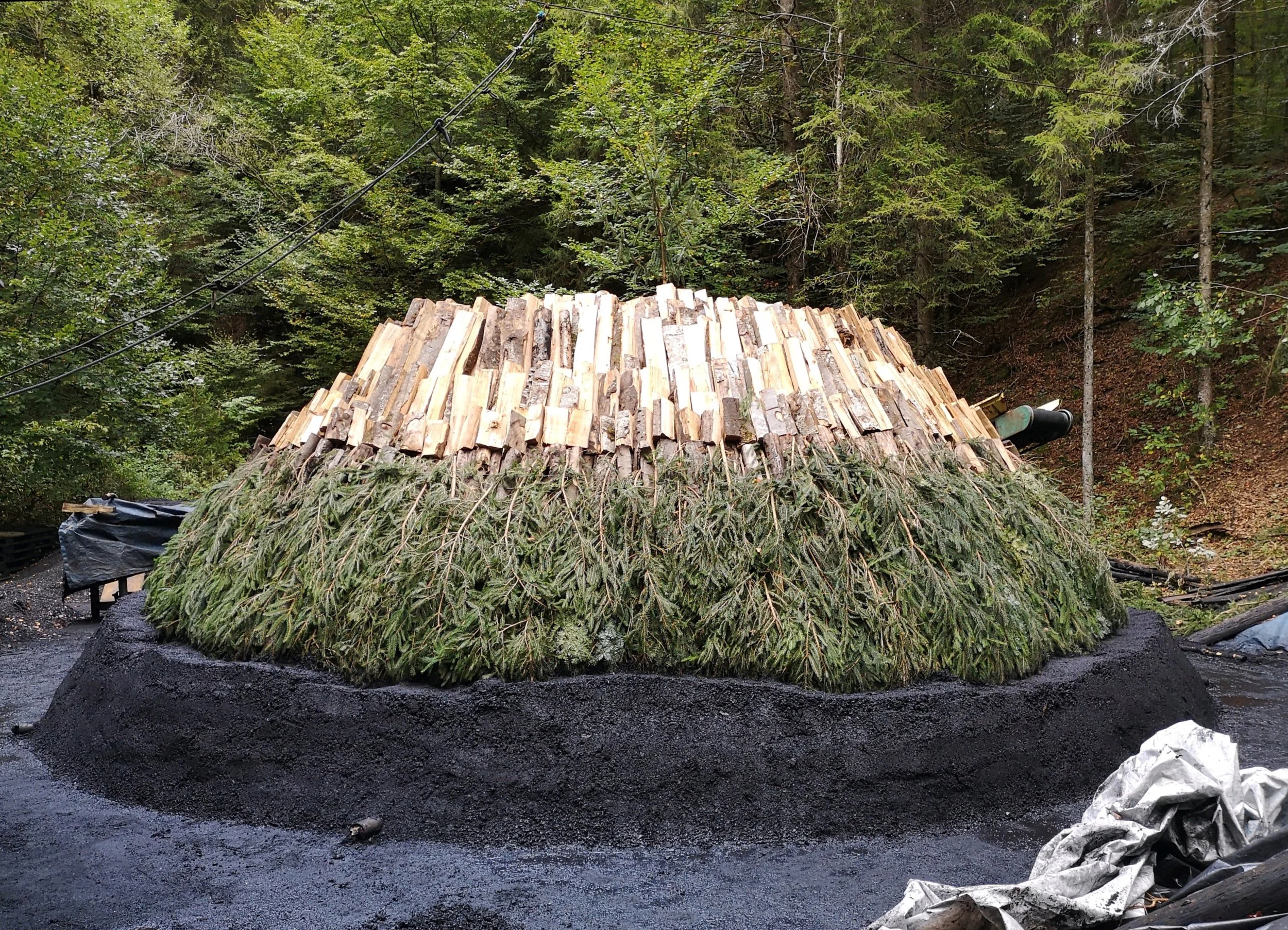
Image courtesy of Doris Wicki.
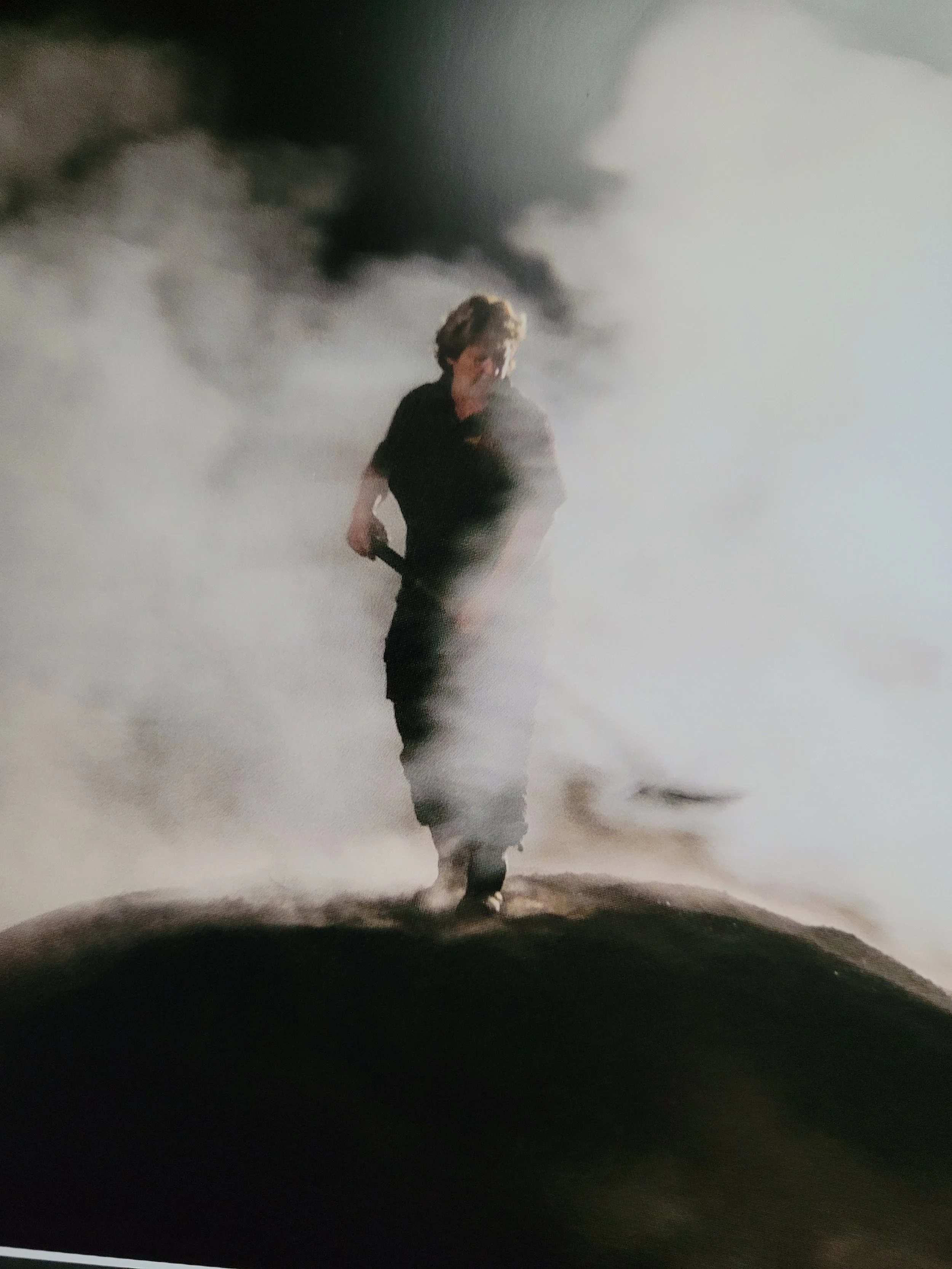
Image courtesy of Doris Wicki.
Anyway, my brother had the job, but didn't have the time. The question came spontaneously: "Doris, why don't you do it? You've helped with so many charcoal kilns, you know what you’re doing." Thanks to my brother's good advice, delivered by mobile phone, everything worked out pretty well. That was my first step into independent work as a charcoal burner. And that was a long time ago.
I'm now Vice President of the European Charcoal Burners Association (Europäischen Köhlerverbandes) and have probably supervised well over a hundred charcoal kilns, and slept right next to them as they burned. The nights – yes – they are very special. I always enjoy the atmosphere, though I understand that in the history of charcoal burning, there have been dozens of legends and stories about devils and demons. On the other hand, in Catholic regions, charcoal burners even have our patron saint: Alexander of Comana.
A charcoal burner has to develop a feel for all the interacting factors: wind, humidity, wood quality, the size of the charcoal pile, prevailing temperature, etc. It seems to me that every pile has its own character, and its own changing moods. This is partly a matter of location. If the kiln is completely sheltered, it's different than if a gusty, irregular wind is whistling through the forest.
A shift in weather can turn a peaceful creature into a fury. There are descriptions of flames shooting up if the firefighters aren't constantly monitored, which can lead to worse – a forest fire. To be on the safe side, charcoal piles are typically stacked right at the edge of the woodland. Fortunately, I've never experienced any serious damage.
Image courtesy of Doris Wicki.