
The ecological medium
Maggie M. Cao
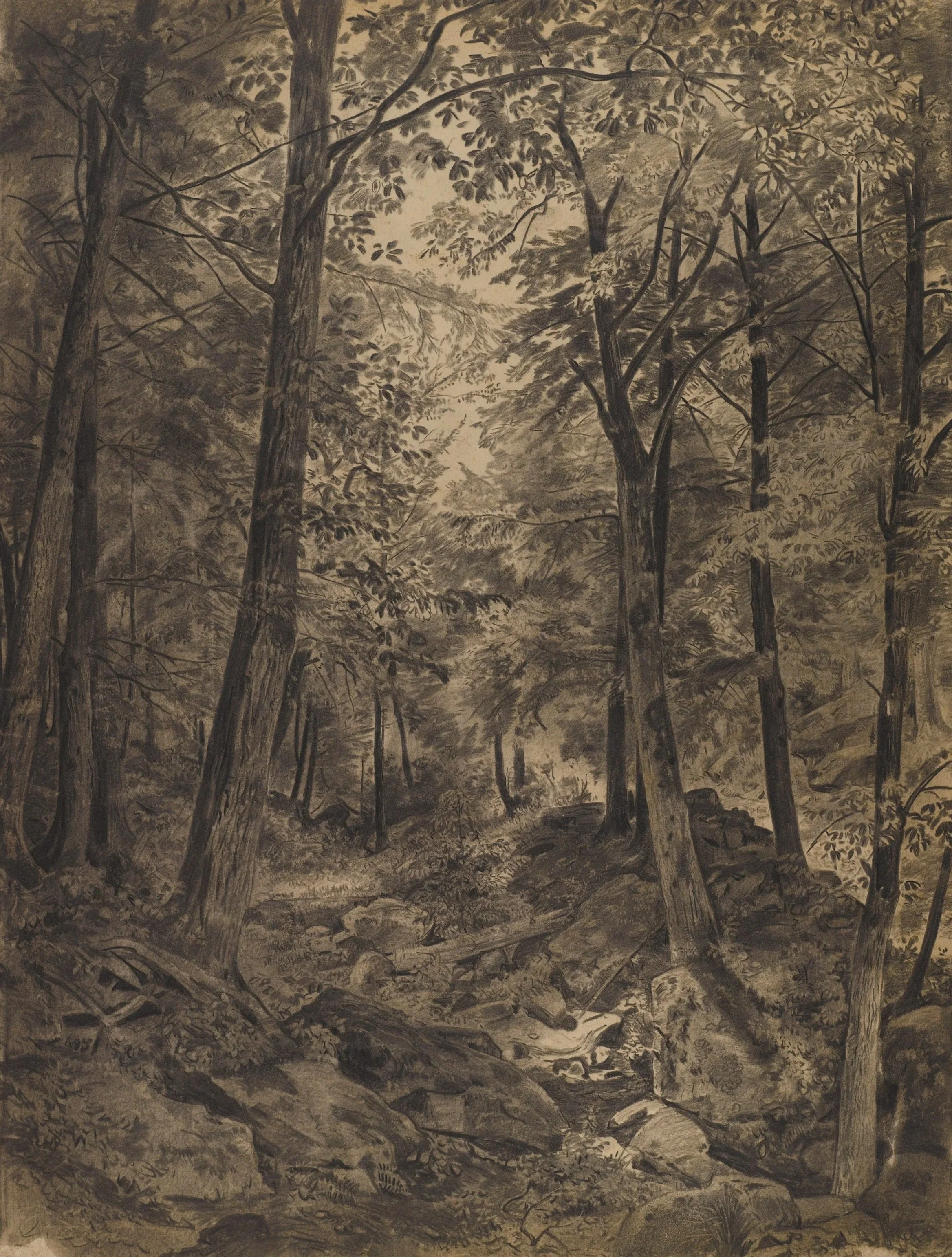
William Trost Richards (American, 1833-1905), Forest Scene with Rocky Brook, ca. 1864-67. Charcoal on cream, moderately thick, slightly textured wove paper mounted to paper. (Sheet): 22 13/16 x 17 13/16 in. (57.9 x 45.2 cm). Brooklyn Museum, Gift of Edith Ballinger Price, 72.32.2.
As charcoal crumbles and splinters in an artist’s hands, it serves as a reminder of its past life as a tree. Perhaps no one was more aware of this than the artists who led a brief renaissance in charcoal drawing in the middle decades of the nineteenth century. These artists called themselves fusainists, after the tree from which the best artists’ charcoal was made. The fusain or spindle tree (genus Euonymus) is a fast-growing shrub whose soft wood was also valued for making spindles used for spinning yarns. A slow firing in the absence of oxygen breaks down the plant’s lignin to transform twigs and branches into nearly pure carbon—a refined version of the process used to create the wood charcoal that had powered steam engines and fueled smelting furnaces.
Although artists’ charcoal had long been manufactured in the form of thick crayons or willowy sticks, it was brittle and soft, depositing a dry, soot-like powder which could be swept away with a brush of the hand. Given these limitations, it was employed only for sketching and cartooning, where erasing and editing were valued. It was the consummate ephemeral medium: charcoal images quickly disappeared, returning to dust. Finishing a charcoal drawing was impossible before the invention of chemical fixatives in the 1840s, which inspired artists in Europe and the United States to use it for impressive, large-scale drawings.
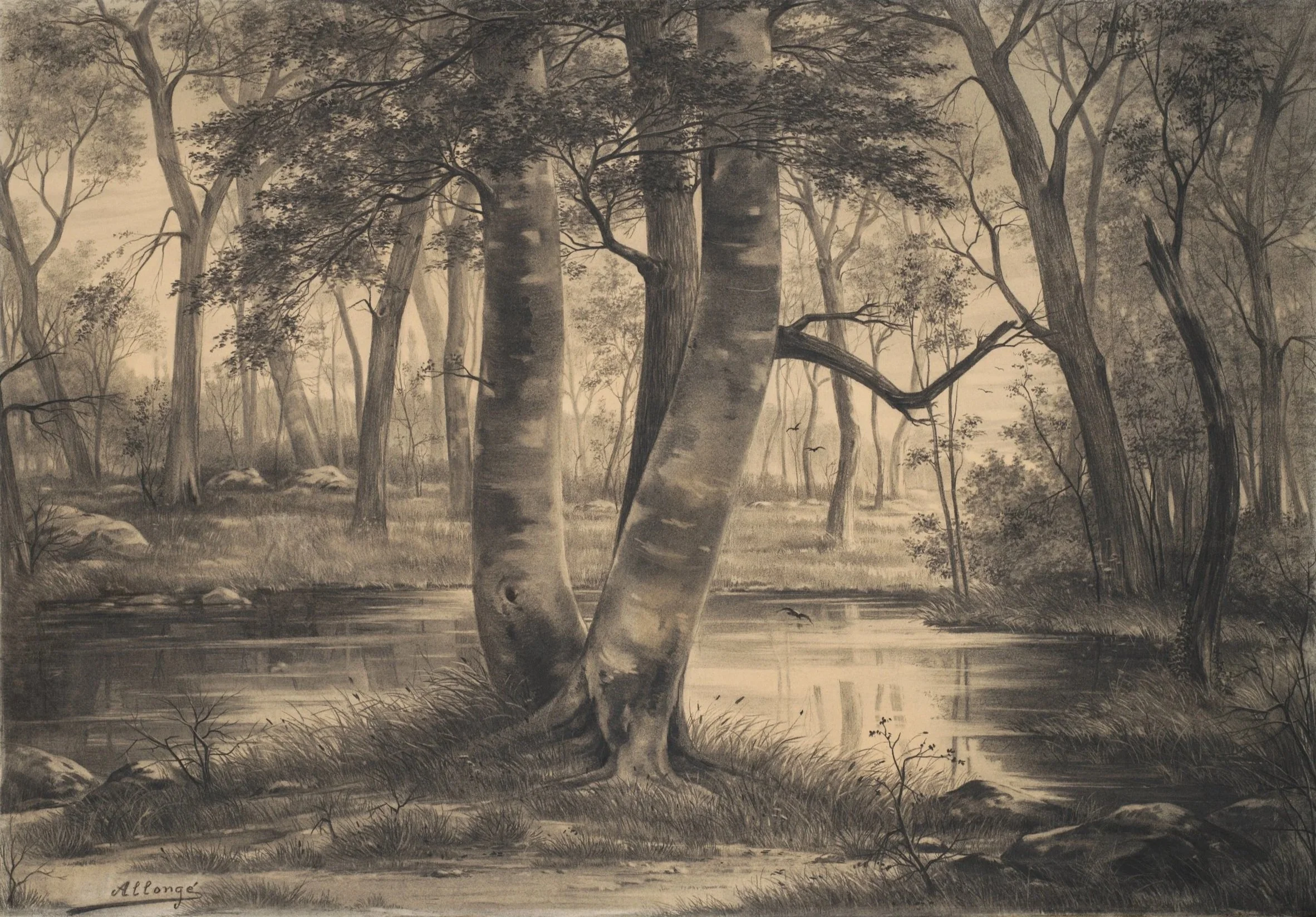
Auguste Allongé (French, 1833-1898), A Pond in the Forest of Fontainebleau, 1870-98. Charcoal. (sheet): 27 9/16 x 39 3/8 in. The Metropolitan Museum of Art, Purchase, Friends of Drawings and Prints Gifts, 2023, 2023.381.
As early adopters, the fusainists had to fight the public perception that their medium only facilitated artistic imagination and experiment. Offering the novel argument that their so-called “natural pencil” was best suited for rendering “the immediate likeness of nature,” they celebrated the infinite tonal scale that charcoal made possible, using poetic prose to describe their ability to “quickly and easily” capture “a ray of sunlight…when it illuminates in spots the rough bark of the oak,” or the deepening shadows of coming night. In treatises, they instructed fellow artists on how best to coax such tonal nuances out of the meeting of black carbon and white paper.
For the fusainists, material intelligence went hand in hand with master draftsmanship, but I see it deeper still in the ecologies of their methodical drawings. In woodland scenes set at Fontainebleau or along Pennsylvania’s river valleys, they carefully observed mature trees, young saplings, fallen branches and logs, showcasing the full life cycle of forest environments. This much is obvious. What goes unnoticed is the material kinship in such charcoal drawings: the images are constructed from the charred remains of the woodland itself. The same places frequented by the fusainists, today the site of nature preserves, were once adjacent to much vaster forests clear cut to fuel the industrial revolution, perhaps even transformed into charcoal destined for railroads and mines.
The fusainists’ tools also included a whole suite of unusual natural materials. To say that they “drew” with charcoal is somewhat misleading, for the process is more tonal than linear, often involving more smudging and erasing than mark making. To lighten or remove the carbon from the paper required special tools. One was stale homemade bread: a period observer described a charcoal artist starting with a full loaf and constantly “breaking off little lumps of bread and assiduously mopping up the fog.” Another dependable (and longer lasting) eraser was the soft pith of tinder mushrooms, a common fungus sourced from downed logs, another product of the pictured woodland. Their images were pictorial microbiomes that mimicked the ecological forces at work in the natural worlds they rendered.
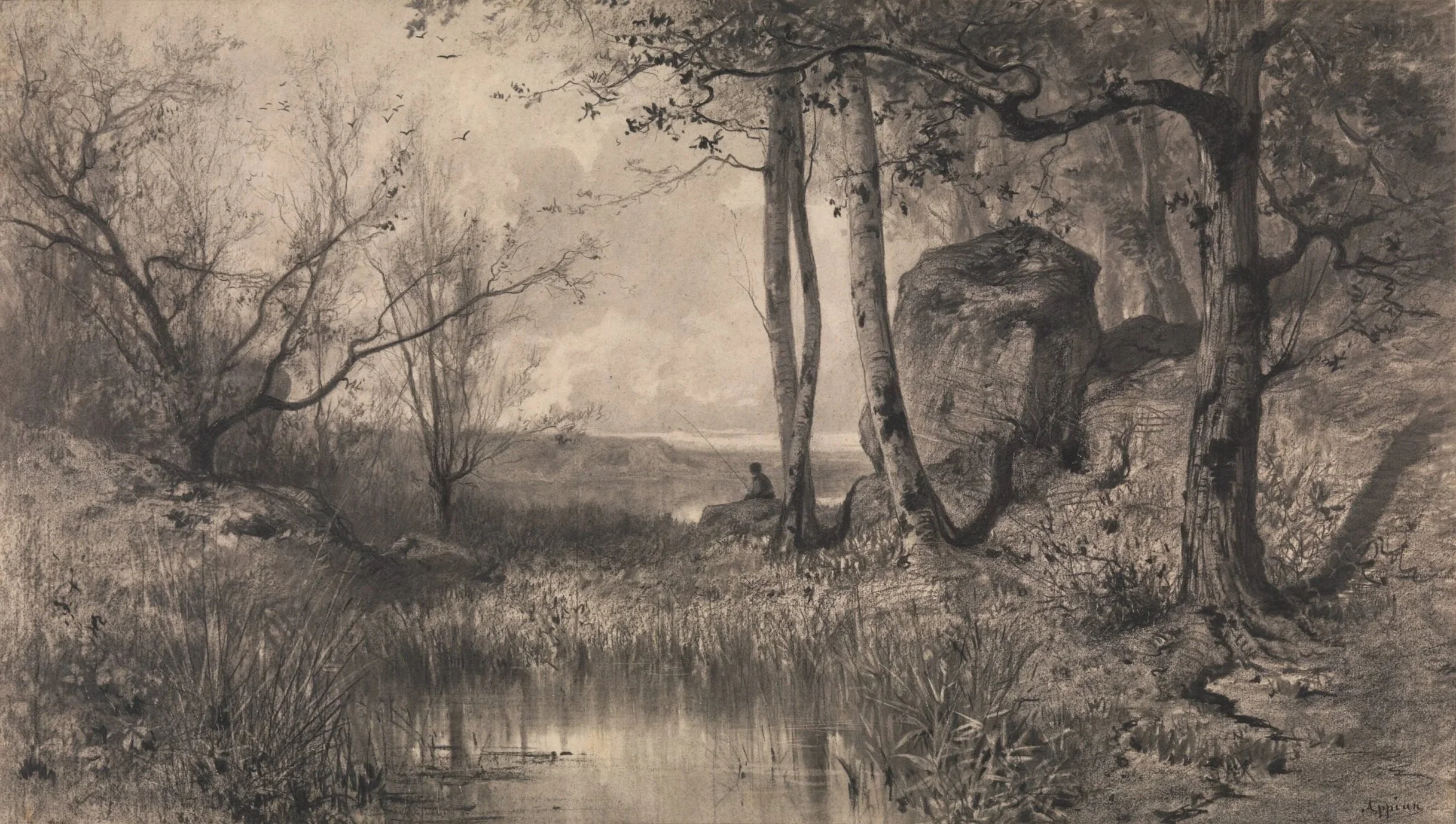
Adolphe Appian (French, 1818-1898), A Pond with a Fisherman along the River Ain, 1868-70. Charcoal with stumping and scratching out. 21 5/8 x 38 1/4 in. The Metropolitan Museum of Art, Purchase, Gift of Mrs. Gardner Cassatt, by exchange, 1998, 1998.359.