Agnes Martin’s Fields of Flax
Kerr Houston
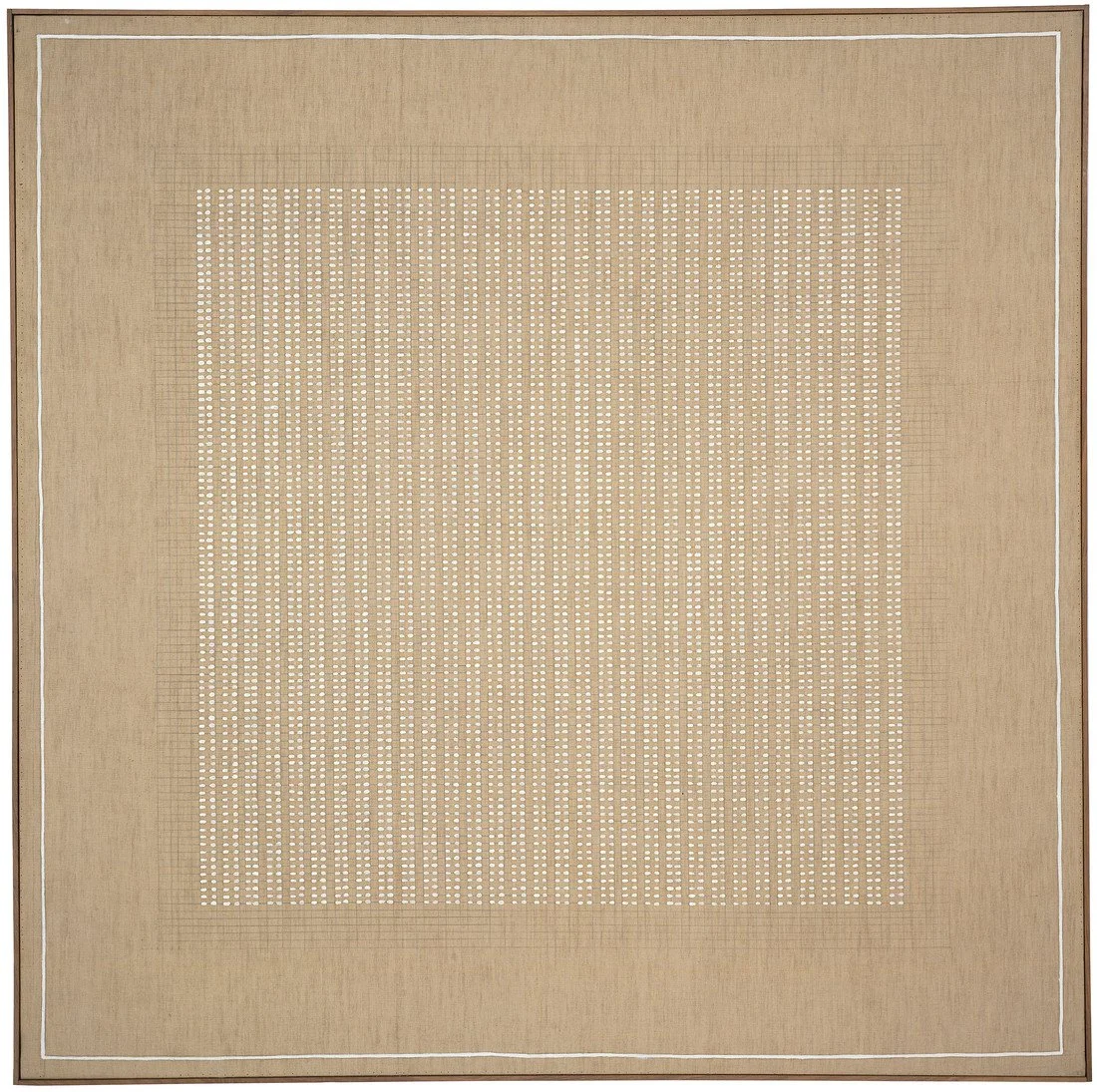
Agnes Martin, The Islands, 1961. Oil and graphite on linen canvas. Private collection, New York. © Agnes Martin Foundation, New York / Artists Rights Society (ARS), New York.
What can we make of the largely overlooked fact that Agnes Martin, the famed modernist painter, suddenly began to work on linen in 1960?
It was a consequential moment in a consequential career. After spending most of a decade in New Mexico, where she had experimented in a range of modes (encaustic portraits, biomorphic watercolors, abstractions in oil), Martin moved to New York City in 1957. Working in a warehouse in Coenties Slip over the next few years, she began to create gridded patterns on six-foot-square canvases: subtle exercises in geometry and restrained mark-making that soon attracted notice, and which are now widely admired. Understandably, this has frequently been seen as a critical period for Martin. Indeed, the artist herself saw it that way; years later, she remarked that “It wasn’t till I found the grid, in New York in 1960, that I felt satisfied with what I was doing.”
Significantly, at that very moment Martin began to work with a new material. As Christina Rosenberger has noted, Martin had previously used various supports, including Masonite, paperboard, composition board, and cotton duck. But in 1960, she started to paint consistently on raw linen—and even left her support provocatively bare in places. In a work such as The Islands (c. 1961), for example, pairs of daubs executed in acrylic hover against a spectral grid of graphite, on a field of unprimed beige linen.
This choice carried multiple connotations—and to understand them, some material intelligence can help. Linen, which is made from flax fibers, is one of the oldest textiles in the world; it was already worn by the ancient Sumerians, and Egyptian mummies were commonly wrapped in linen funerary shrouds, which were associated with purity and sometimes painted. Many centuries later, linen became the preferred support of many European painters, who valued its durability and its feel.
In the years after World War II, however, linen was in short supply and grew pricier, leading some artists to explore cheaper and more readily available alternatives. Jackson Pollock, for example, began to work on unprimed cotton duck, a sailcloth that was more absorbent and more easily stretched than linen. Frankenthaler and Louis soon took notice, and also began to paint on cotton. Where linen embodied tradition, affordable cotton offered unpretentious convenience—and so appealed to many mid-century American artists, some of whom were also setting aside their oil paints in favor of quick-drying enamels and acrylics.
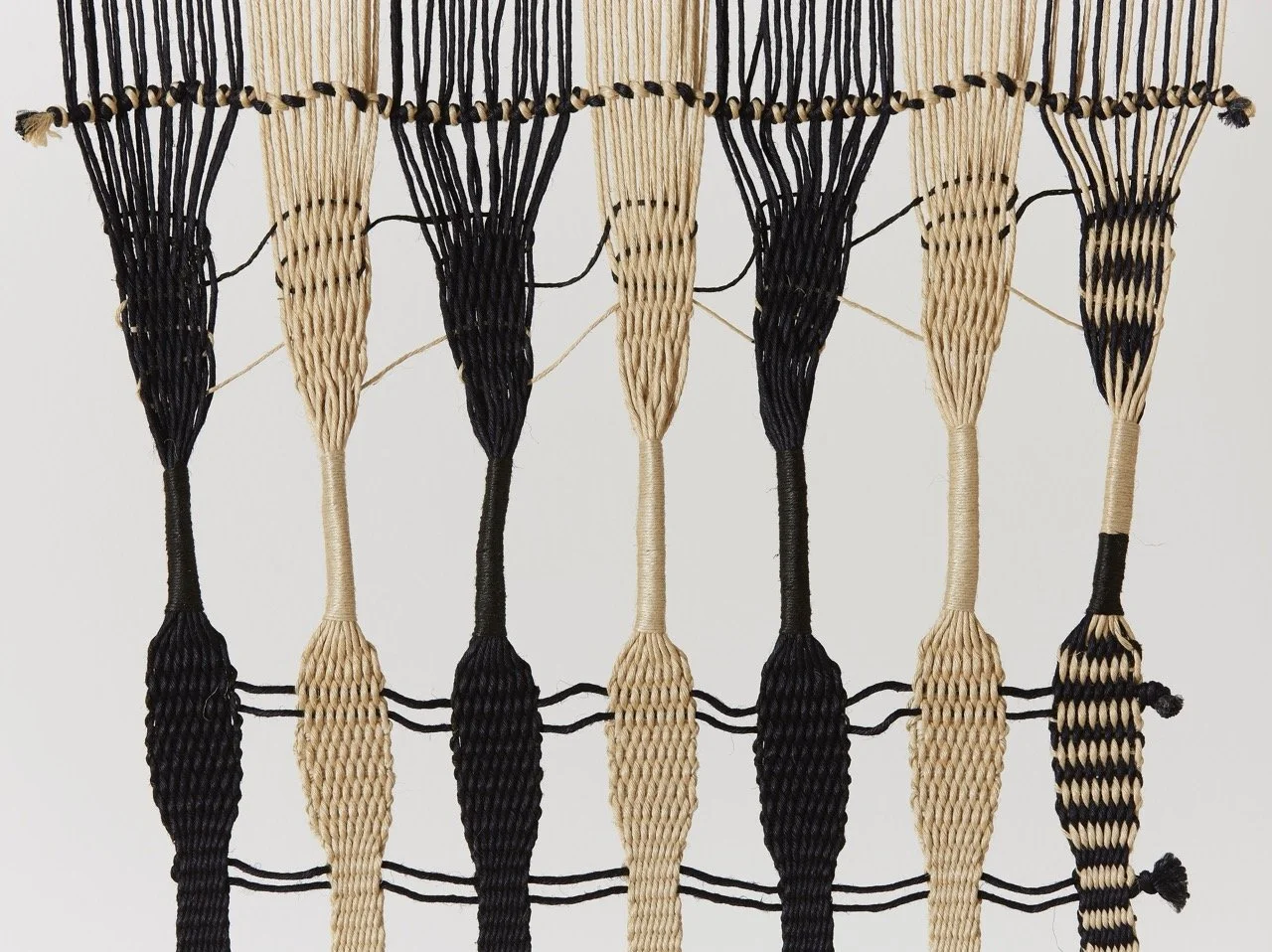
Lenore Tawney, Inquisition (detail), 1961; linen; 138 x 28 in. Collection of the Lenore G. Tawney Foundation, New York. Photo: Rich Maciejewski, 2018, courtesy of John Michael Kohler Arts Center.
But linen still had its adherents, including most of the artists closest to Martin, in Coenties Slip. Ellsworth Kelly and Jack Youngerman, who lived in the same building as Martin, had both consistently painted on linen since spending time in France. Barnet Newman, who lived nearby and befriended Martin in the late 1950s, usually worked on linen. And the innovative fiber artist Lenore Tawney—with whom Martin was “intimately entwined,” as Prudence Peiffer has put it—often used linen in her remarkable open-weave compositions. Working within a few hundred feet of each other, these artists maintained a creative conversation in which linen was a common thread.
While Martin never recorded her explicit thoughts on working with linen, it likely appealed to her for more specific reasons. In executing her grids, she typically placed a straight-edge against her canvas and then ran a pencil along its edge. As she did, the canvas yielded, especially in areas far from the stabilizing strainer, resulting in slightly bowed lines. Linen, a tauter fabric than cotton duck, facilitated this work, permitting more precise grids. At the same time, though, the rougher texture of linen inevitably affected the quality of her drawn lines, which responded to the variegated weave of the fabric. But this, too, could be a desirable trait. Indeed, the subtly irregular aspect of Martin’s lines plays a key role in fostering the human tone of her works, which read as handmade rather than industrial, thanks to her choice of substrate.
Finally, it’s also worth noting that linen may have carried a personal significance to Martin, who had spent her childhood in the flax-growing belt of Saskatchewan, near the town of Flaxcombe. Admittedly, she tended to resist suggestions that her paintings represented fields or farms; they were, she said, “not about the world, or nature or things like that.” But even if her paintings weren’t about nature, they were made of natural materials. And so the tremulous lines in a work such as White Flower (1960), shaped by the toothiness of the canvas, hint at origins in coarse stalks of flax. (fig. 3)
Martin’s turn to linen, then, can be read in several ways at once: as a response to practical considerations, a faint echo of her childhood, an engagement with a venerable tradition, and a reflection of her artistic community. In 1966, her friend Ann Wilson noted that “Martin makes great use of the fabric of her canvas.” An attention to the material qualities of that fabric, and all the things that linen meant, can help us to understand the quiet power of her work.
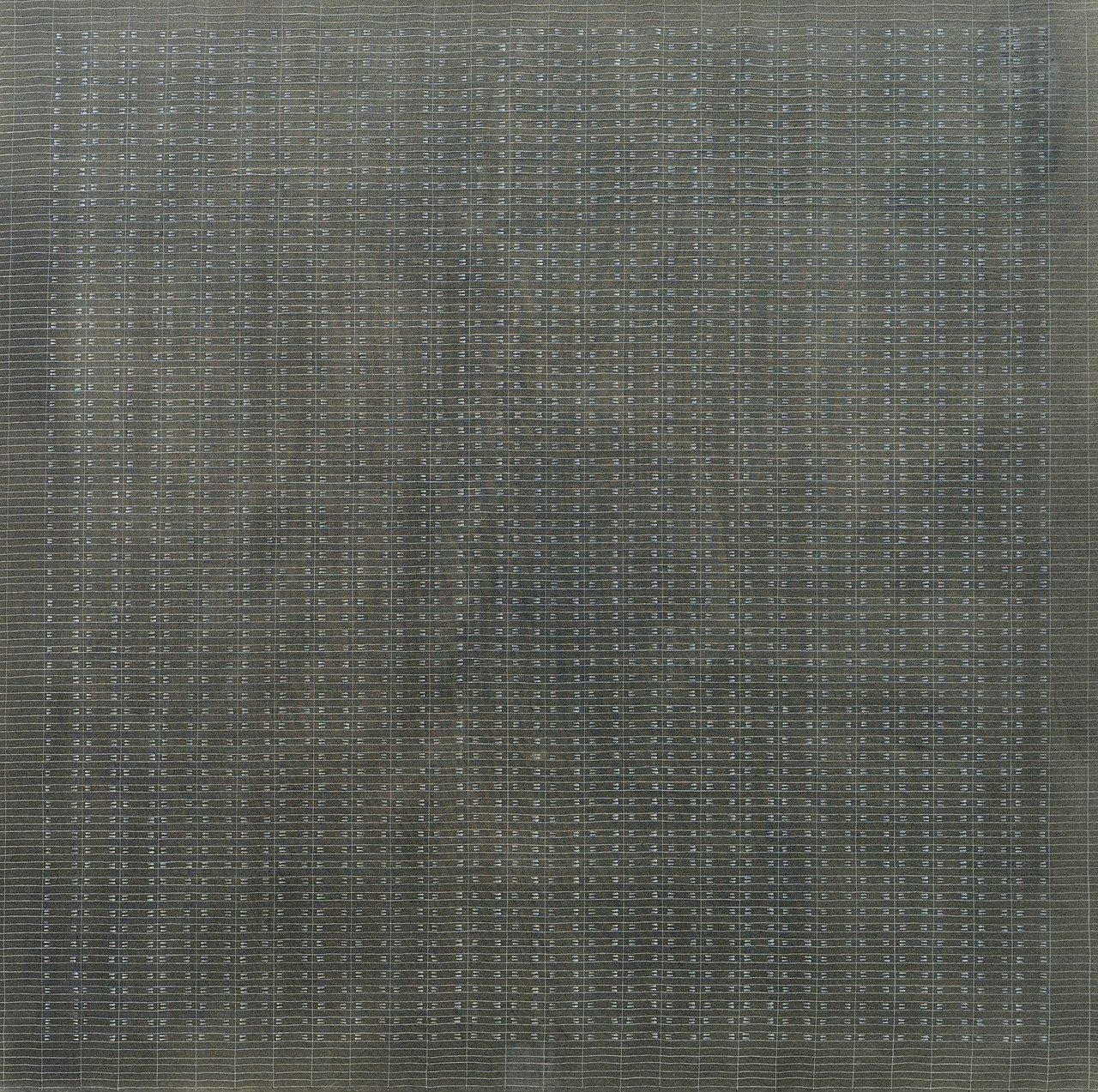
Agnes Martin, White Flower, 1960. Oil on linen canvas. Solomon R. Guggenheim Museum, New York, Gift of Lenore Tawney, 1963, 63.1653. © Agnes Martin Foundation, New York / Artists Rights Society (ARS), New York.
Kerr Houston has taught at the Maryland Institute College of Art since 2002. He regularly teaches courses on Italian Renaissance visual culture and Islamic art, and for the past four years has taught a seminar on materials and materiality in the history of art. He is the author of two books (An Introduction to Art Criticism and The Place of the Viewer), and of several dozen articles and book chapters on Italian Renaissance art and modern and contemporary art and art criticism. He lives in Baltimore, and regularly writes art criticism for BmoreArt.
Published April, 2026