Leaving the fold
Elaine Reichek
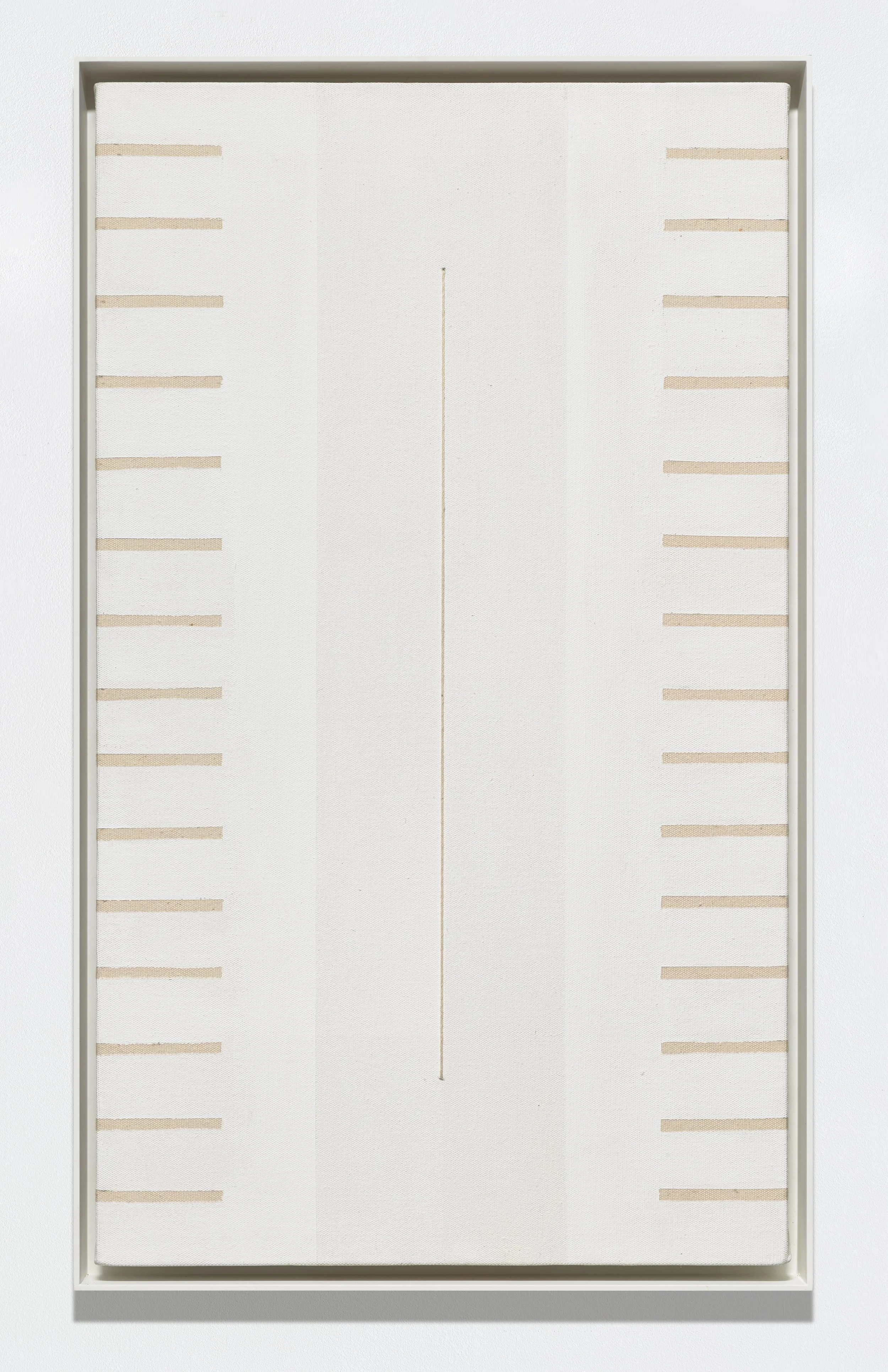
Elaine Reichek, Untitled #12. 1973. Gesso, acrylic, thread and graphite on canvas. 24 x 14". Photograph by Tom DuBrock. Private Collection.
I am old enough to have been taught how to stretch and prime a canvas in the traditional way. You began by selecting the fabric. Cotton duck was cheaper, but linen was the gold standard because that’s what the Old Masters used. We were told it was more resistant to wear than cotton duck, and it came in a variety of weaves, graded by weight and refinement, and a choice of shades from pale flax to dark tan. Once you pulled the linen taut over a set of four squared-off stretcher bars—no wrinkles, please—you applied a thin coat of rabbit-skin glue. This foul concoction was heated and stirred over a small burner and carefully applied with a wide flat brush. Now the linen was sized and ready to be primed. You brushed on one thin coat of oil-based gesso and sanded it in preparation for the second coat. And then, after completing this daunting amount of labor, you were expected to cover it all up with paint. I always wondered why the discussion of “painting as object” took so long to come into vogue. By the time your canvas was prepared for paint, you had certainly constructed an object.
I based my first solo exhibition, in 1975, on an exploration of these basic ingredients for preparing a canvas. No surprise that I settled on such minimal means, since my painting teacher in college in the early 1960s was Ad Reinhardt, nicknamed the “Black Monk” for his limited, dark-hued palette and stringent geometric compositions. In critiques, Reinhardt always asked you to account for your choices; if anything was extraneous, you had to take it out. So, by the early 1970s I found myself, to quote Reinhardt, “starting over at the beginning.”
To canvas and acrylic gesso I added graphite, tape, and thread as drawing materials. After the exhibition was installed I looked at my work in the gallery and thought, “Who made this? What am I looking at?” What I noticed first was the thread, which I had used to draw lines that pierced the canvas support, looped around the back, and came through the surface again to make other lines. I thought I was inching my way out of the narrow mode of formalism that viewed painting as entirely self-referential, anti-illusionistic, and only concerned with the material aspects of its own making. But what I saw, standing in the gallery, was embroidery on linen. Believe me, the idea that I was sewing was terrifying! And this was an OMG moment that I could either bury or embrace. What’s funny to me now is that this eureka happened only after I had made twenty-six paintings and hung them in a show.
From that time on, thread became a basic element in my work, though for several years I segued into knitting and photography, among other materials. Eventually I came back to embroidery on linen. And because so much of my interest centers on a dialogue between painting and other art forms that are often excluded from the high art canon, linen seemed ideal because it literally crosses the artificial boundaries between painting and embroidery, high art and low craft. Even the Greeks used woven linen to symbolize mutual accord. Statues were draped with linen when a peace treaty was announced. Warp and woof had come together to weave a new fabric out of opposing points of view.
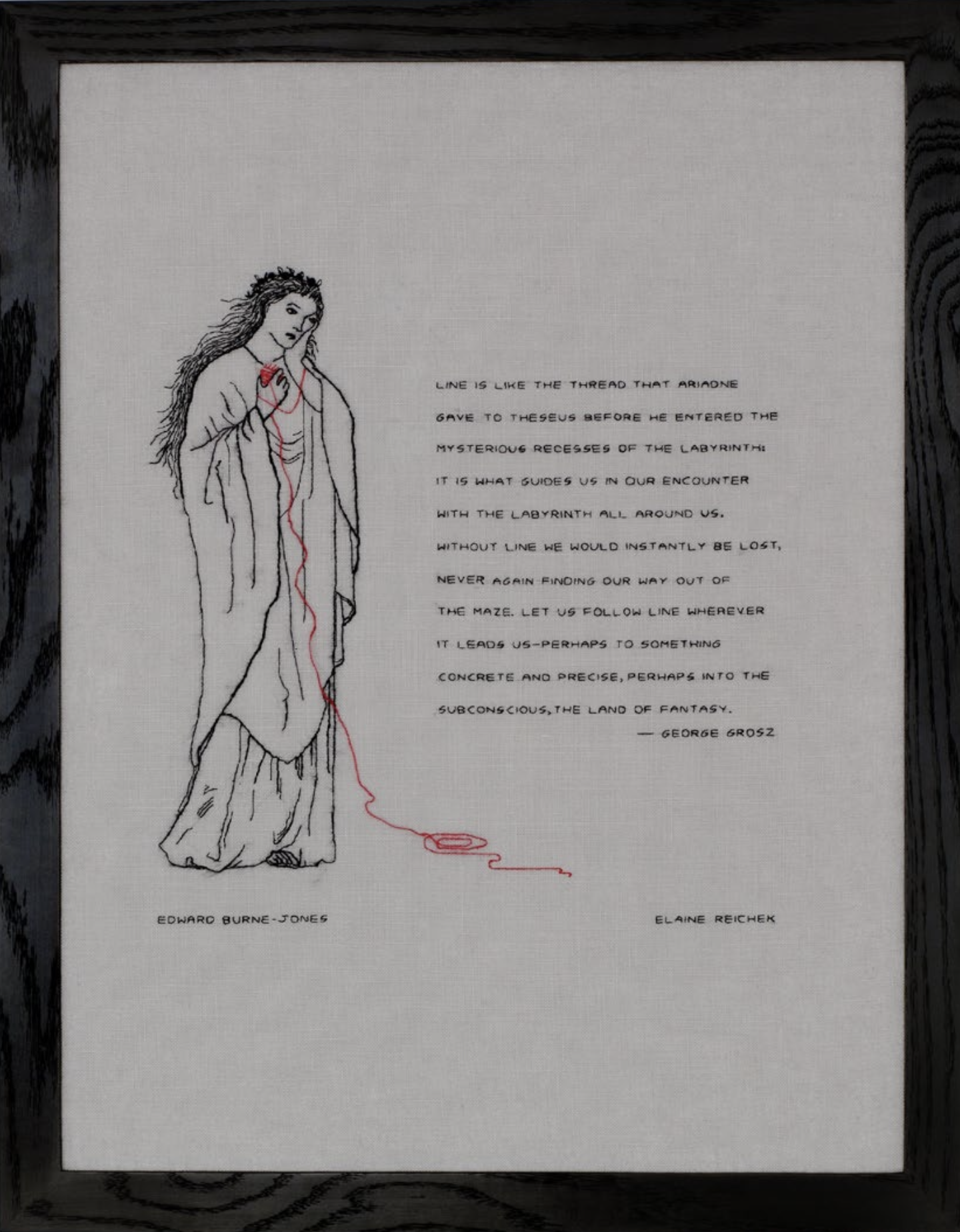
Elaine Reichek, Line Is Like the Thread, 2008, Hand embroidery on linen, 24.5 x 19". Photograph by Paul Kennedy, Collection of Ellen Susman, Houston, TX.
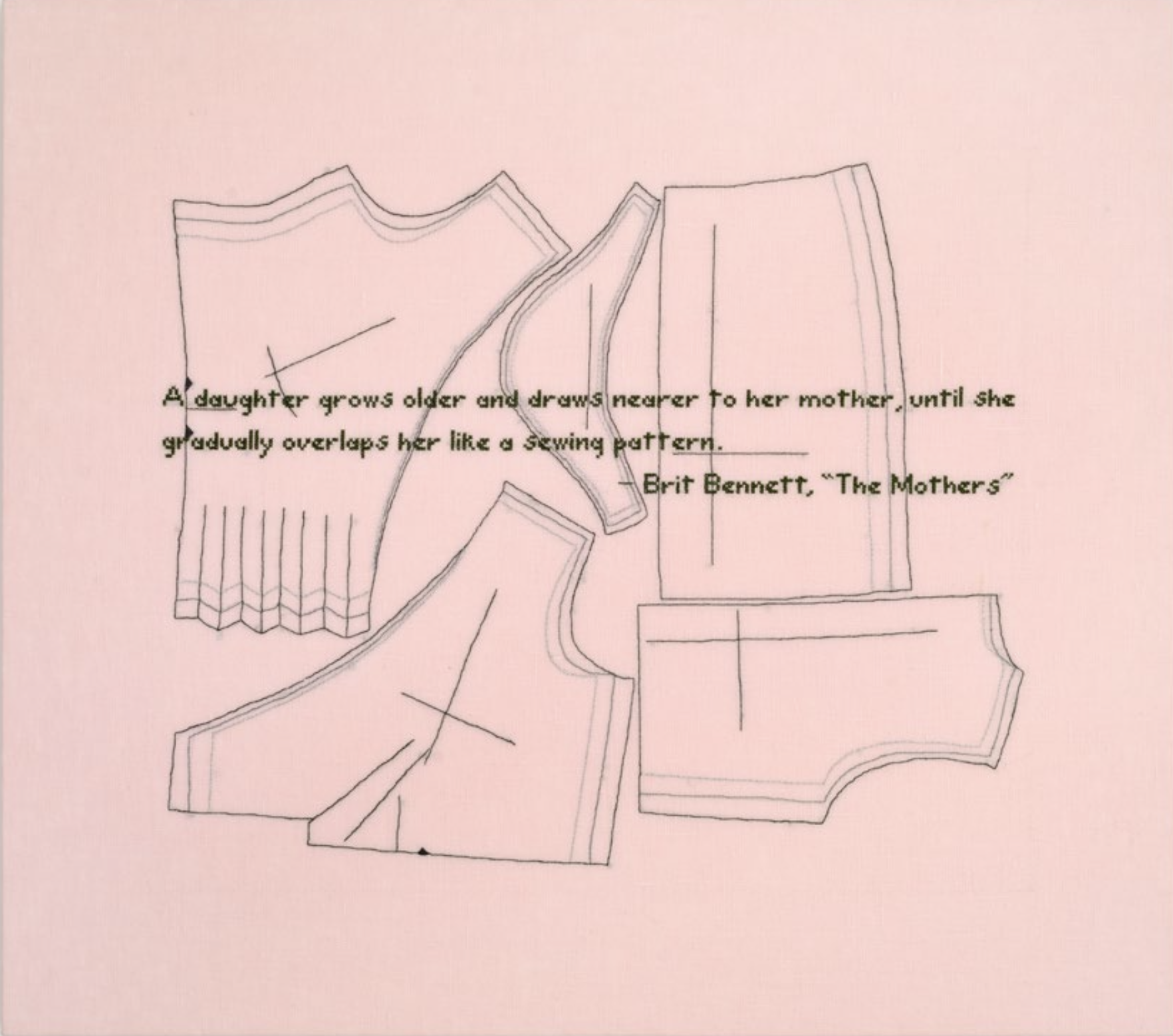
Elaine Reichek, A Daughter (Brit Bennett), 2019, Hand embroidery on linen, 23 x 26". Photograph by Paul Kennedy, Private collection.
Of course the ancients wove their linen by hand—the warp-and-woof construction is prominent even behind vitrine glass in a museum. The linen I use, on the other hand, is manufactured to have an even weave. As a product it’s much closer to the linens used for embroidered samplers in the seventeenth to nineteenth centuries in Europe and the US, despite the fact that much of this cloth was also hand-woven. The tightness of the weave is referred to as the count, and the warp and woof form an even grid that allows you to map out the composition and regulate the stitches as you go. Even here I must give the nod to Reinhardt. After all, the cruciform structure of his late compositions is like a deconstruction of the grid, an examination of its most fundamental components, which in turn directly invokes the woven fabric on which he painted.

Elaine Reichek, Sampler (Starting Over). 1996. Hand embroidery on linen. 8.75 x 67.5". Photograph by Adam Reich. Collection of the Museum of Modern Art, New York.
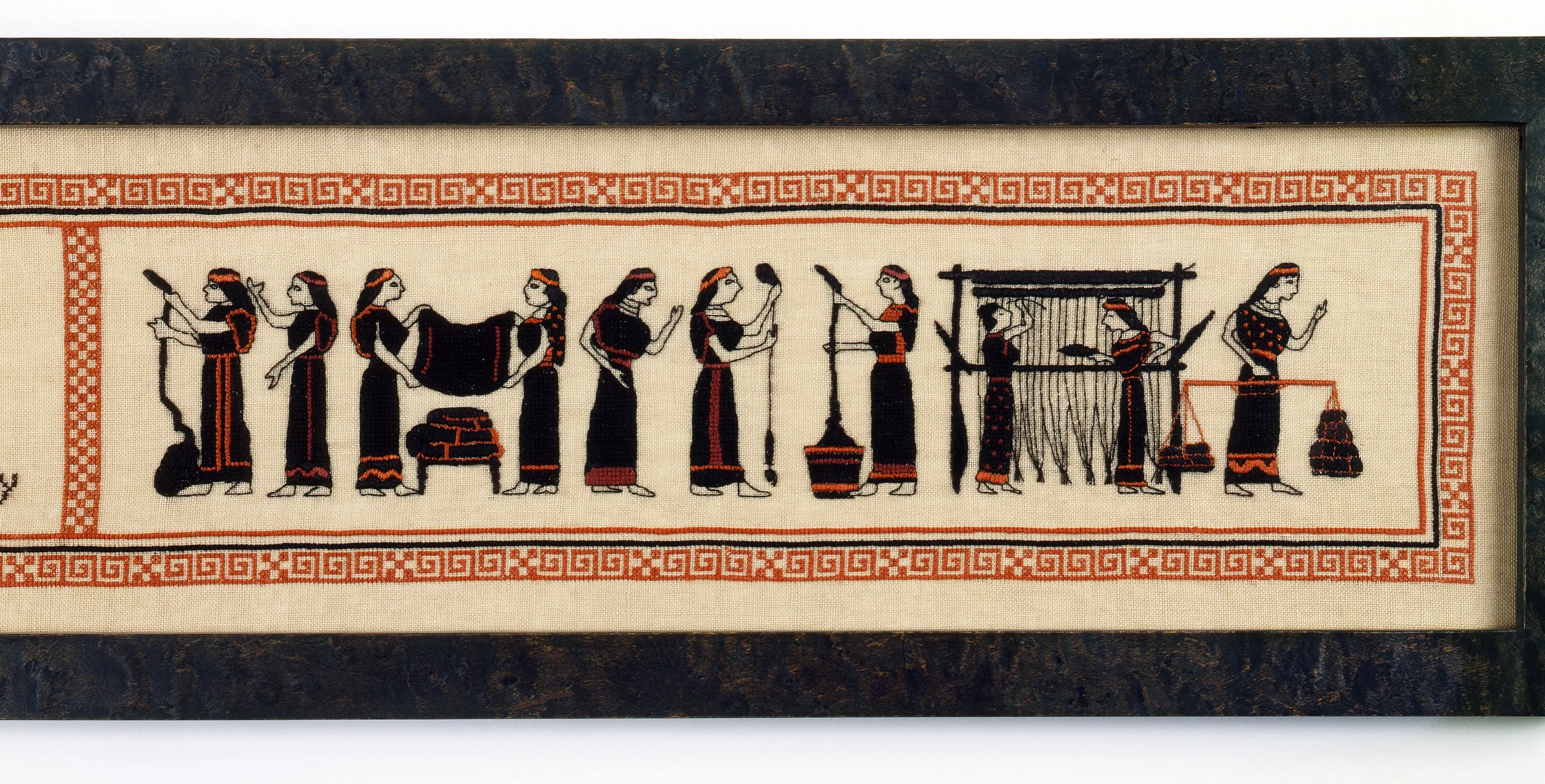
Elaine Reichek, Detail of Sampler (Starting Over). 1996. Hand embroidery on linen. 8.75 x 67.5". Photograph by Adam Reich. Collection of the Museum of Modern Art, New York.
The choice of linen for my work is also based on a love for the fabric itself. I love the way it takes a dye. The natural fibers absorb color in a way that synthetics can’t match. I’m also attached to its haptic qualities. Refined linen has a dry “hand,” and it’s a pleasure to work with, unlike many synthetic or blended fabrics, which can feel slimy or scratchy. It’s also strong and wears well, which is very important to me because I’ve never used an embroidery hoop, which keeps the textile in tension—I hold the fabric in my hands as I sew, and I can work on the same embroidery for a very long time. I’ve also used thread made from linen. It has a smooth, flat finish and is especially nice for embroidering text. And as an added conceptual bonus, several scholars have pointed out that the etymological roots for the words textile and text are the same, as are the roots for linen and line.
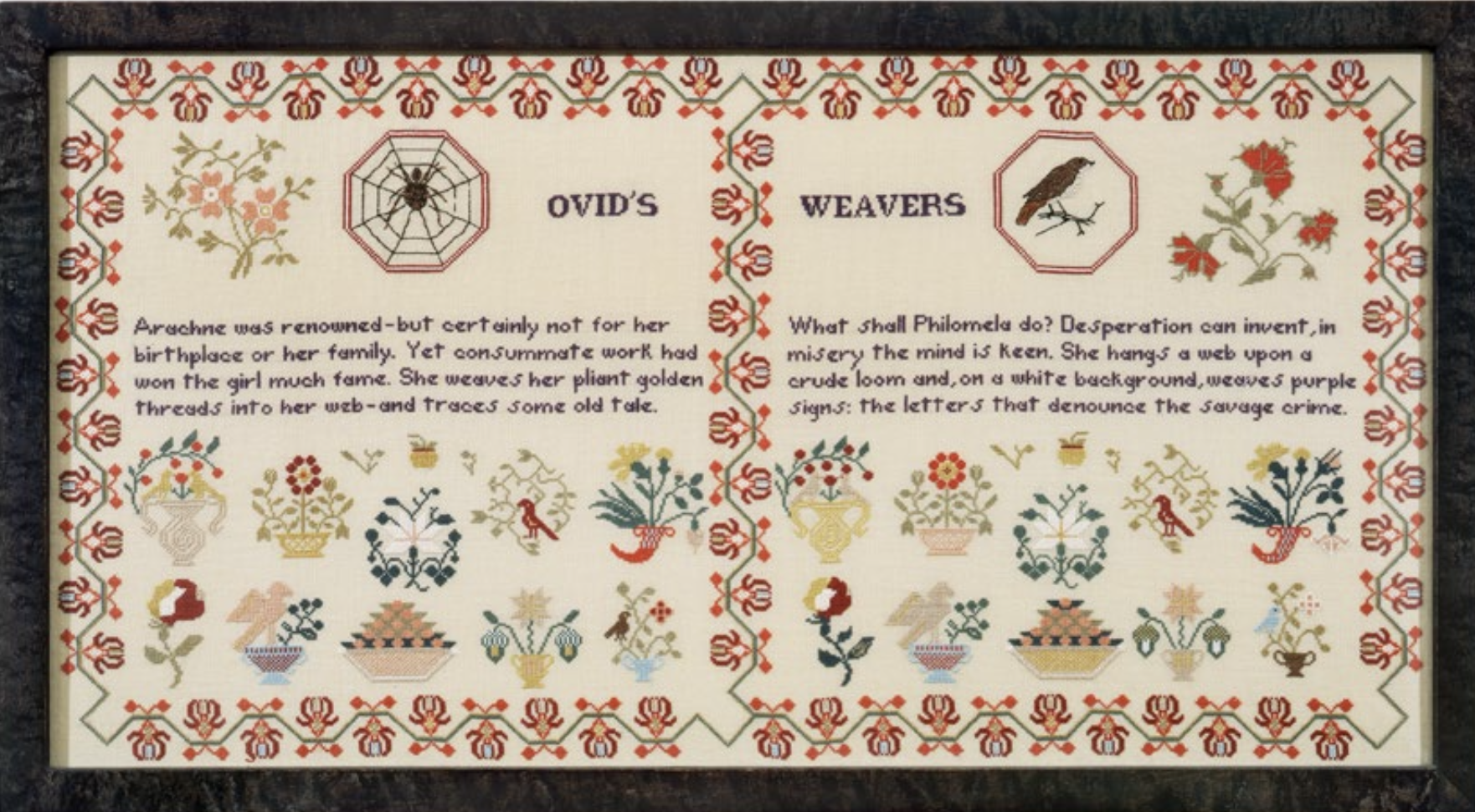
Elaine Reichek, Sampler (Ovid’s Weavers), 1996, Hand embroidery on linen, 19.25 x 35". Photograph by Adam Reich, Whitney Museum of American Art, New York; gift of the Estate of Melva Bucksbaum.
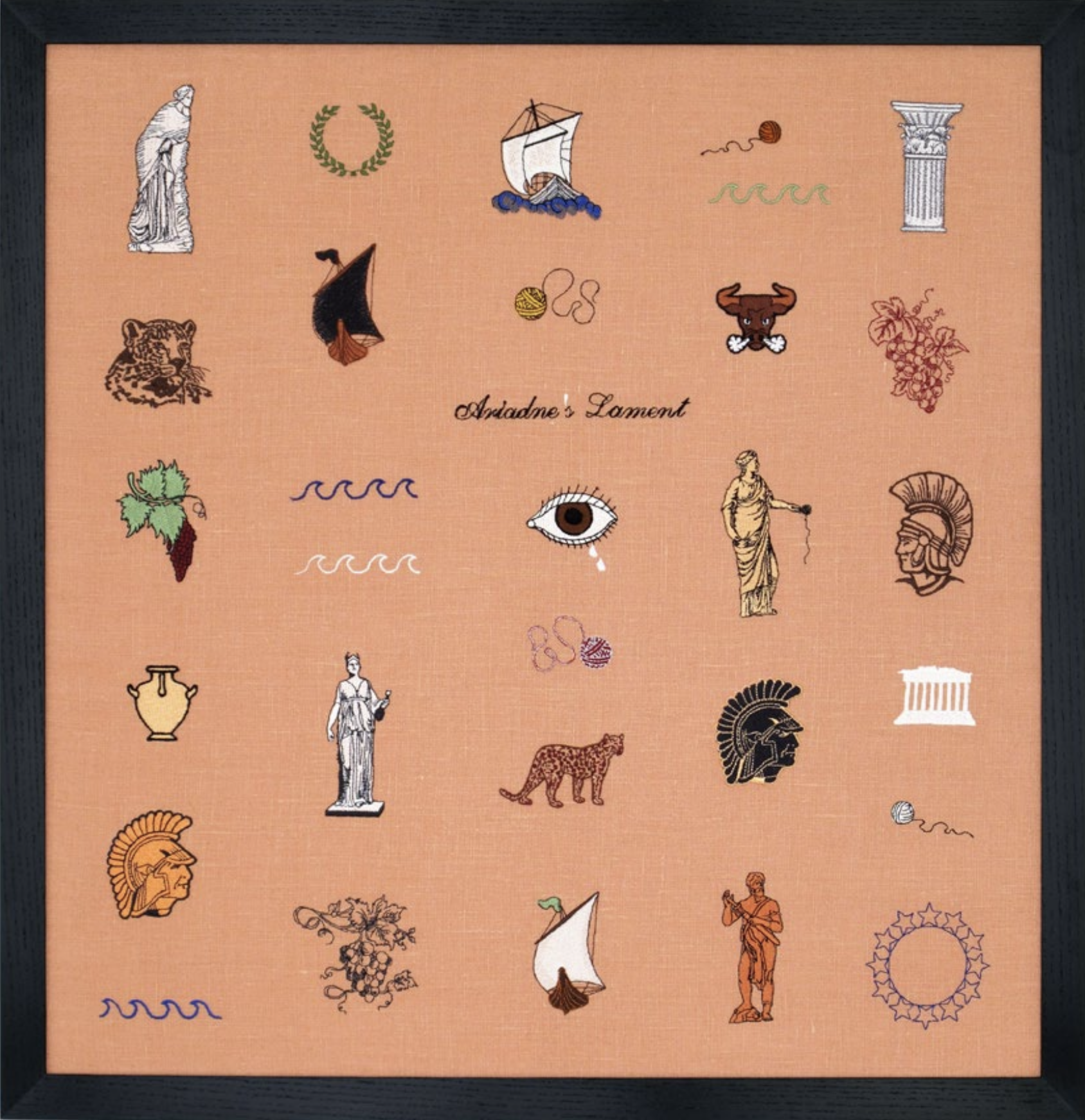
Elaine Reichek, Ariadne’s Lament, 2009. Digital embroidery on linen, 27.5 x 26.5".
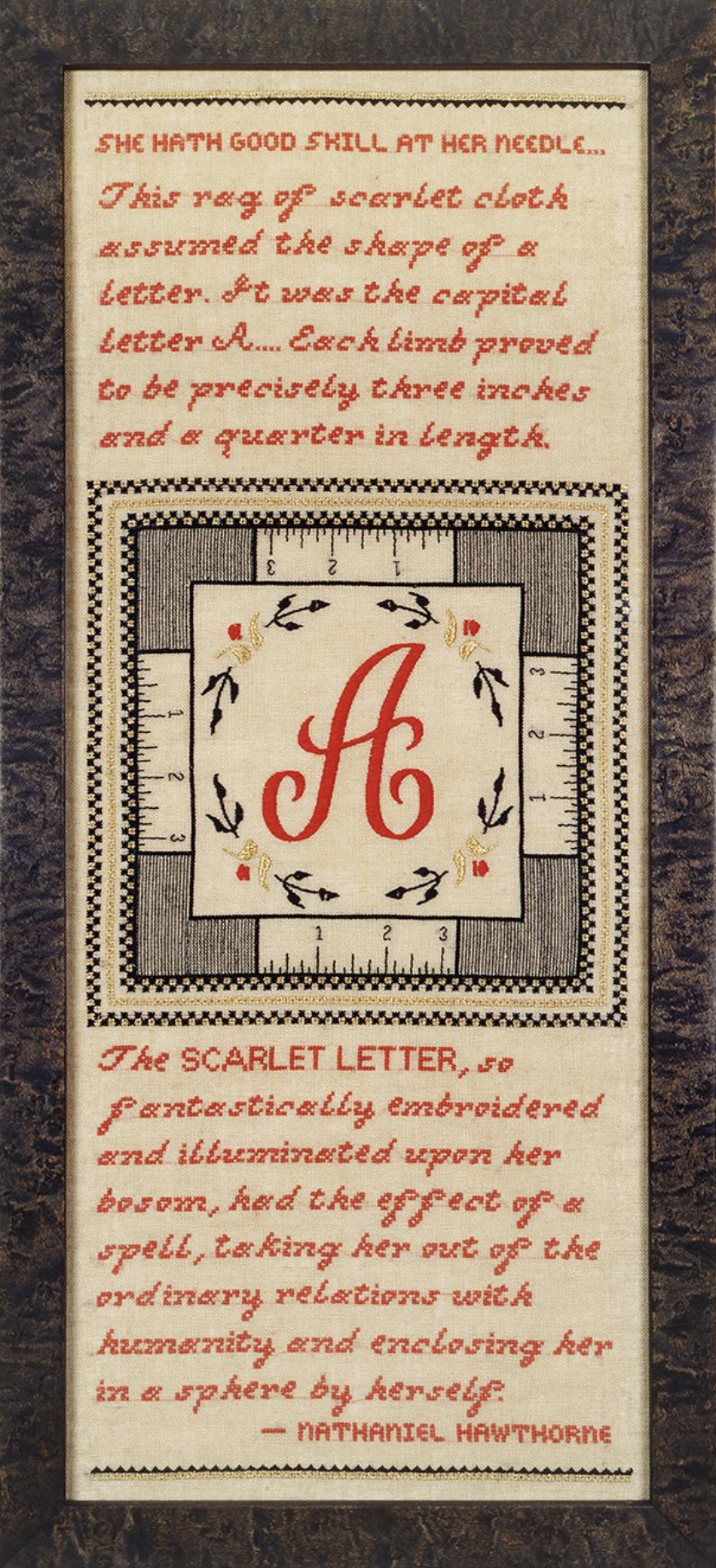
Elaine Reichek, Sampler, (Scarlet Letter), 1996, Hand embroidery on linen 26.5 x 12". Photograph by Paul Kennedy. Museum of Fine Arts, Boston; The Hayden Collection—Charles Henry Hayden Fund.