Armor made of linen and glue
Greg Aldrete
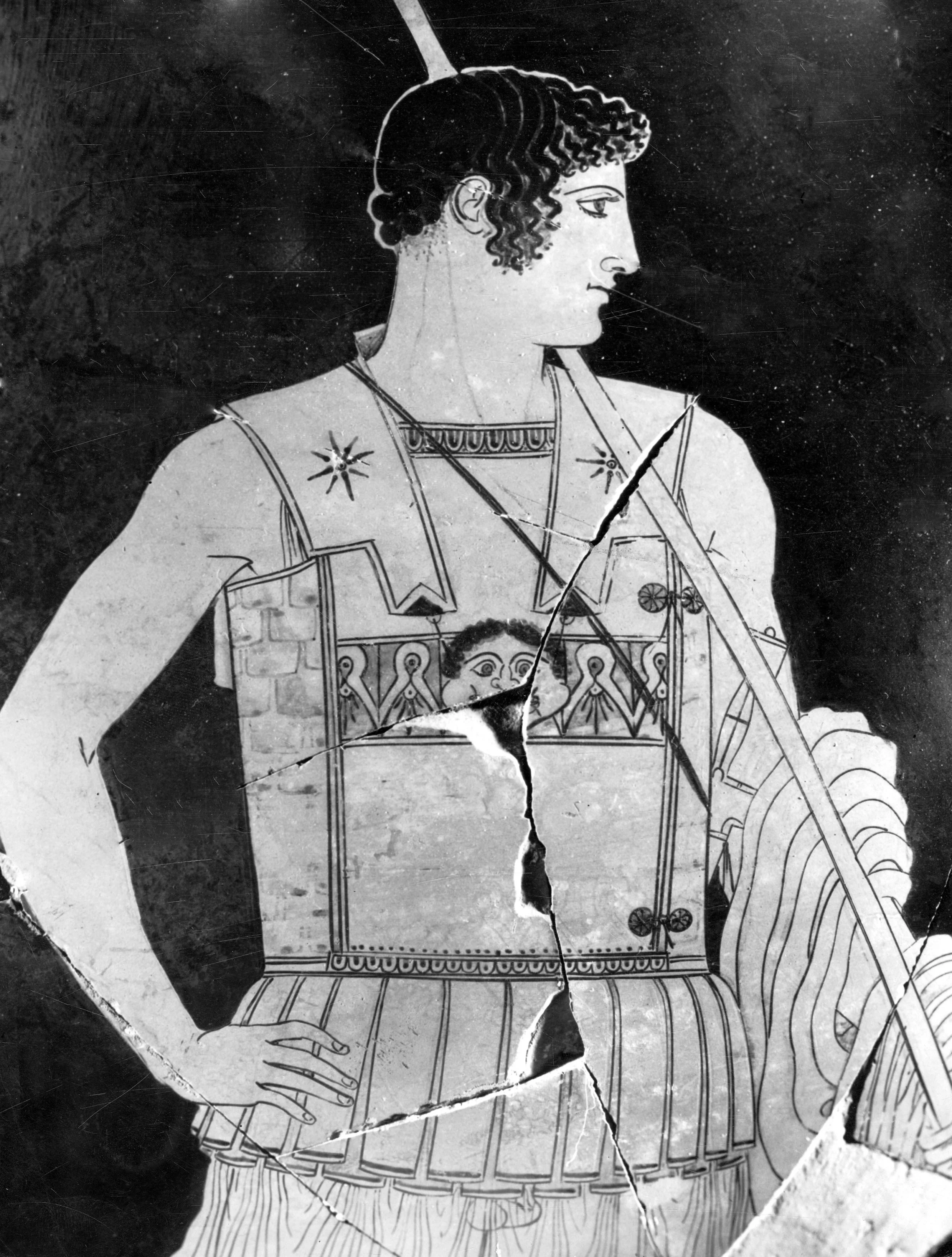
Detail of Achilles on the Eponymous Attic Amphora of the Achilles Painter, copyright, Smith Archive / Alamy Stock Photo.
15 years ago, Scott Bartell, one of my undergraduate students at the University of Wisconsin-Green Bay, decided to make himself a replica of the armor that Alexander the Great is shown wearing in a famous mosaic from the city of Pompeii. Known as a linothorax, this armor was apparently made just out of linen. Little did I realize that much of the next decade would be dominated by the quest to reconstruct and test that armor. When Scott asked me for advice, I confidently assumed I could dig up a few scholarly articles for him, but to my surprise, I discovered that there was no agreement on what the armor was made of, how it was constructed, or how effectively it protected its wearer. Thus was born the UWGB Linothorax Project, which would eventually grow into a multi-year investigation involving professors in several fields and dozens of students, as well as community members ranging from traditional weavers to bowhunters.
The linothorax had been afforded relatively little attention by scholars, due to the highly perishable organic materials of which it was constructed; no specimens have survived. This contrasts with the many fine examples of ancient metal armor that can still be seen in museums around the world. If we wanted to understand the linothorax and assess its characteristics, we were left with no choice but to apply the methods of experimental archaeology and reconstruct full-size replicas using only materials that would have been available in the ancient Mediterranean world. In tackling this mystery, we had two main sources to draw upon: ancient authors who mention linen armor, and depictions of it in ancient art. We identified references from 40 different ancient authors, and my wife Alicia amassed a database of close to 1,000 images in ancient art, such as vase paintings and sculpture. This body of evidence attested that the armor was used by many civilizations, including the Egyptians, Persians, Romans, Carthaginians, Greeks, and Macedonians, and that it was employed from at least the 6th through the 2nd centuries BC.

Gregory S. Aldrete.
Based on these sources, we “backwards-engineered” our own linothorax. The greatest challenge was locating historically authentic flax. As most linen these days is machine-made, we couldn’t just go to the local fabric store. We required linen made from flax that had been grown, harvested, and processed by hand, using traditional methods. Eventually we found a weaver in Wisconsin who grew and harvested her own flax, and then spun and wove it into linen. Later, two fellow UW Green Bay professors - Heidi Sherman, a specialist in Medieval History including textiles, and Alison Gates, a textile artist in the Art Department - began a project to plant, harvest, rett, dry, break, scutch, and hackle flax by traditional methods, spin the resultant fibers into thread, and weave them into linen.
One standard construction method for linothorakes seems to have been to laminate together multiple layers of linen. We chose to work primarily with rabbit glue, an adhesive that would have been both cheap and widely available throughout the ancient Mediterranean. Our first full-scale replica linothorax, which had 17 layers and a thickness of 12 mm, required a bolt of linen 16 meters long and 1 meter wide, and the lamination process consumed roughly 7.5 liters of glue.
Our hands-on reconstructive methods revealed some interesting practical aspects of manufacturing the armor, such as the fact that it is vital to let each laminated layer dry thoroughly before adding the next, to prevent the armor from growing a nasty mold. It also showed that the most time-consuming phase of construction would have been spinning the flax into thread, which would have accounted for about 575 of the estimated 715 total hours of labor needed to make one corselet (that is nearly 18 modern work weeks!). However, linen armor would still have been much cheaper than comparable bronze armor, which demanded expensive materials and a highly-paid specialist, a blacksmith. In contrast, almost any woman or girl in the ancient world (who typically spent much of their time engaged in textile production) would have possessed the essential craft skills to make this armor.
Next, to evaluate its battlefield utility, we made a number of test patches using various types of linens, glues, and weaves, and then subjected them to penetration tests by shooting them with replica arrows under controlled conditions. The arrow tests revealed that the linothorax would have provided excellent protection to its wearer. Our experiments showed that the linothorax was an extremely viable form of protection, and one that even offered some advantages over contemporary bronze armor. Compared to metal armor, a linothorax would have been cooler, lighter, cheaper, and more comfortable, while offering a similar level of protection, at least during the Classical and Hellenistic eras.
Scott, Alicia, and I ultimately co-authored a scholarly book describing our research. Several documentaries were even filmed about us. This led to another memorable experience. Since the filmmakers wanted a more dramatic visual than merely shooting at test patches, Scott agreed to don the armor while I shot him at point-blank range with an arrow. This was less hazardous than it sounds, because we had done over a thousand test shots, and knew exactly how the armor would perform. But it was certainly a compelling demonstration of the armor's effectiveness.
Our project not only brought attention to an underappreciated aspect of ancient military and textile history, but also illustrated the sorts of knowledge and insights that can only be gained by moving beyond books, crafting a physical object with your own hands, and then actually using it.
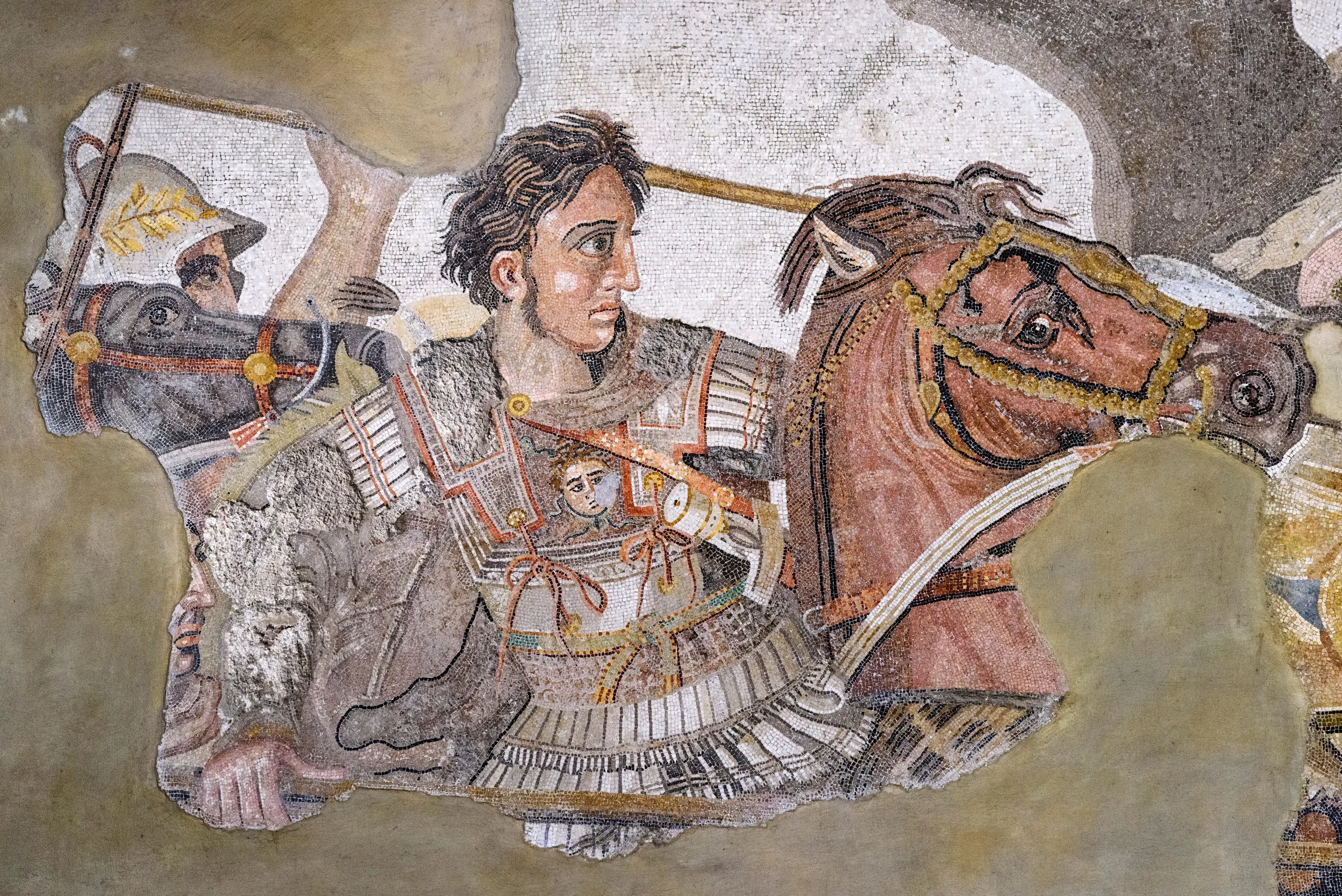
Detail of Alexander Mosaic, Museo Archeologico Nazionale di Napoli, photo copyright Adam Eastland / Alamy Stock Photo.