Ghost nets
Richard Lombard
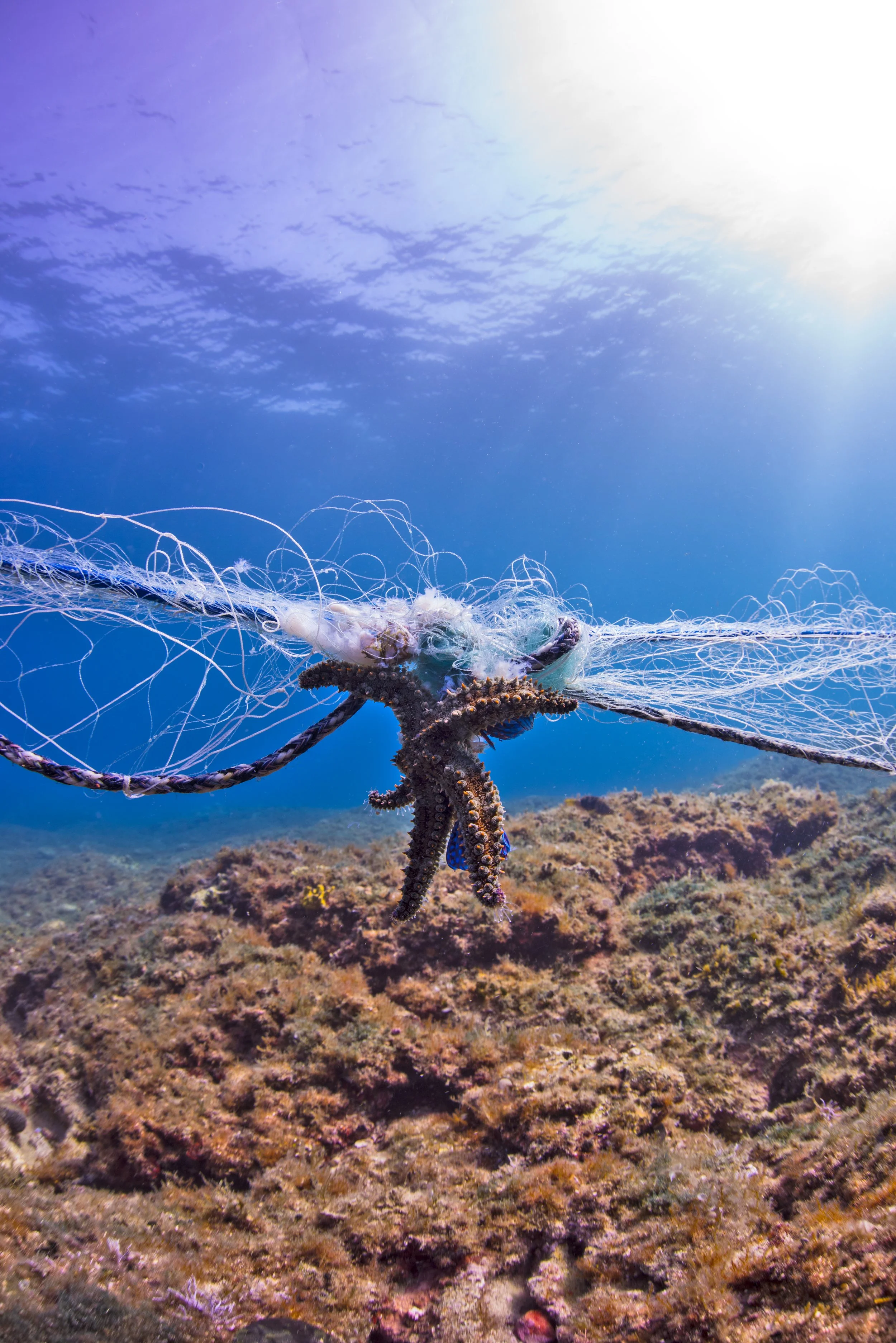
Case Kassenberg (Dutch), Ghost Fishing, ca. 2017.
Humans have been fishing with nets for millennia. The earliest evidence for this consists not of fibers, but rather stone and ceramic weights that were used to keep them below the surface. The nets themselves are long gone. Even a well-made one might have lasted only a year before breaking down, its organic matter returning to the nutrient cycle from whence it came.
One of the oldest discovered nets, from Antrea, was fashioned from willow bark. Found in 1913, it dates to 8540 BCE and was preserved in the clay of an ancient freshwater lake that became the modern Baltic Sea. Other ancient nets have survived in this way, too, entombed in the soft banks of a body of water. The majority of our knowledge of ropes and nets from antiquity, however, is based on images and writings. We know that fishing nets were fabricated from many natural fibers: barks, grasses, and hemp.
In the last 150 years, industrialization changed everything. A quest for lighter, stronger, more durable materials led first to mass-produced cotton nets, which dominated the fishing industry in the latter part of the nineteenth century, and into the twentieth. Then came Nylon. Apart from its slippery surface, this synthetic fiber had every property needed for a good fishing net: it was strong, it was light, but it did not float. And it was durable. Nylon did not weaken in water, and was not impacted by salt, sun, or sand. It was forever.
This brings us to ghost nets. Nylon’s permanence means that equipment made from it will survive for decades, and this makes for a big problem. In a recent study, it was estimated that fishing gear makes up about 10% of all ocean plastics, and nets are far more problematic than the much-maligned straws, bottles, and other flotsam that make up the other 90%. They continue to trap and kill marine life, transport species far into foreign ecosystems, and present a hazard for maritime navigation.
There is debate about the scale of the problem and the culpability of the bad actors involved, but there is no doubt that removing ghost nets from waterways and oceans is a good idea, as it removes a clear and present danger. Salvaging this material can also provide manufacturers with a novel supply of valuable material. A single trawling net – large enough to ensnare a commercial airliner – can contain thousands of pounds of Nylon.
Nylon has a greater value in the market than other polymers. To reclaim it from a net, however, other substances must be removed, especially the lead weights often attached to them, so that what re-enters the system is a mono-material. Once past these critical sorting measures, these former terrors of the deep become a benign commodity. But they are then cast into a sea of another sort: market forces weigh heavily on the reclamation process.
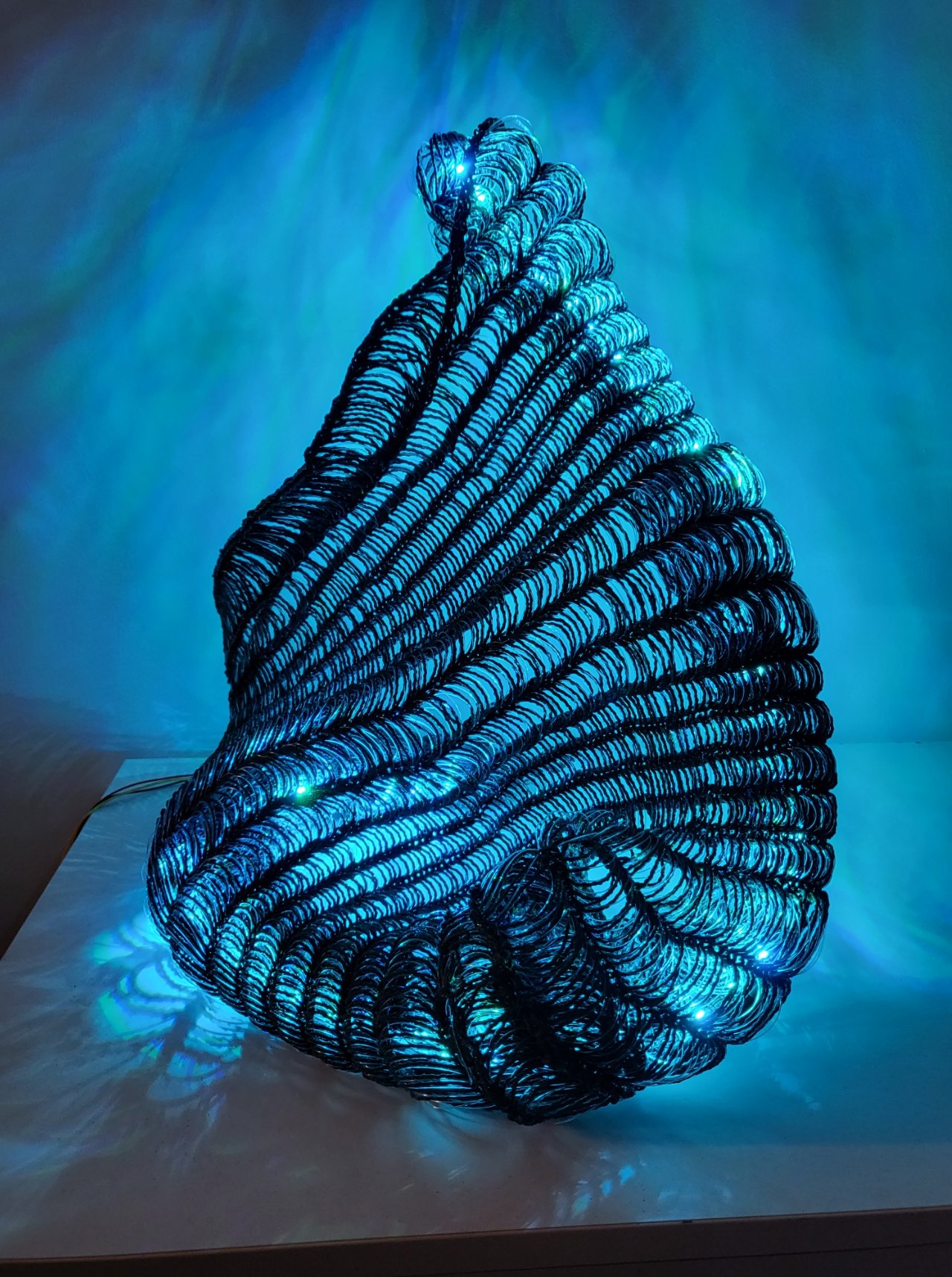
Hannah Kim, Lighting Product, 2021, econyl® fiber, leds, infrared sensors.