What women want

Regina Lee Blaszczyk

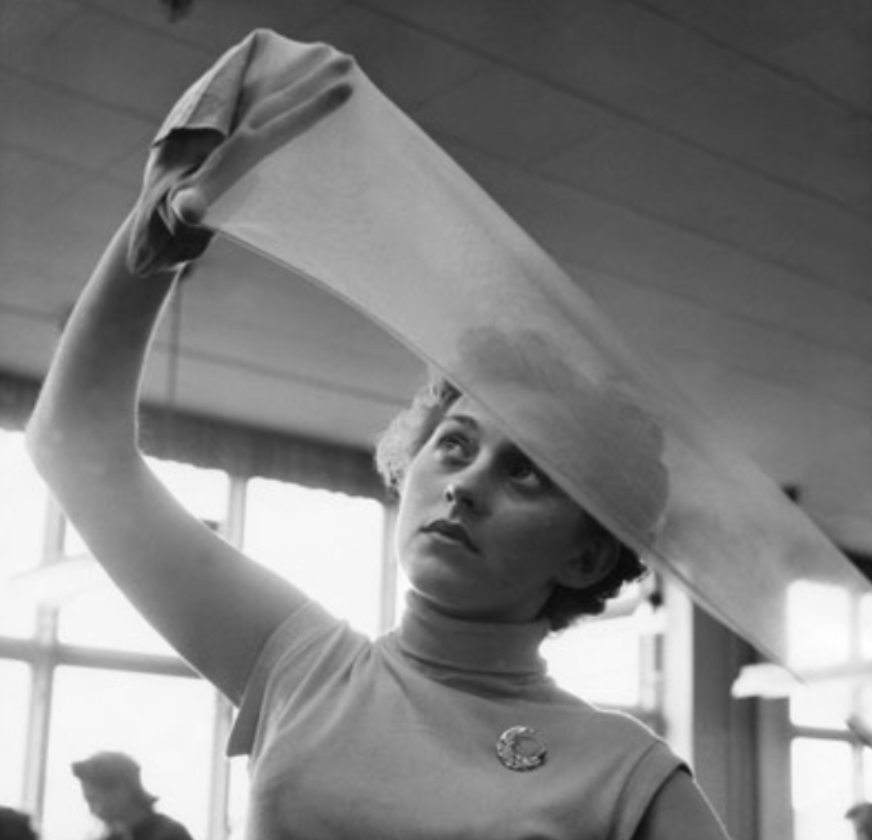
Erik Liljeroth (Swedish 1920–2009), A woman holds a stocking against the light to examine the quality, 1954, Nordiska Museet, nma.0028271.

On January 3, 1938, a California bookkeeper named Mary F. Wandercheck wrote to the president of E. I. du Pont de Nemours and Company with a brainstorm. Like countless other pink-collar workers, she had to look respectable from nine to five. Her job in a Los Angeles office mandated a lady-like appearance. She likely wore a dress or a suit, leather shoes with heels, color-coordinated accessories, and sheer silk hosiery five or six days per week. Much to her ire, though, those expensive stockings developed runs after just a few gentle washings in the sink.

Wandercheck wasn’t the only woman frustrated by that problem. Fed up with the replacement costs, some Los Angeles consumers took advantage of the warm southern California climate to ditch silk hose in favor of bare legs. “I know of many, many women,” said Wandercheck, “who wear absolutely no hosiery because the prices are too high and the merchandise is not satisfactory or dependable.” A proud conservative and registered Republican voter, she believed American enterprise could help preserve the culture of respectability and spare her such a disgrace.
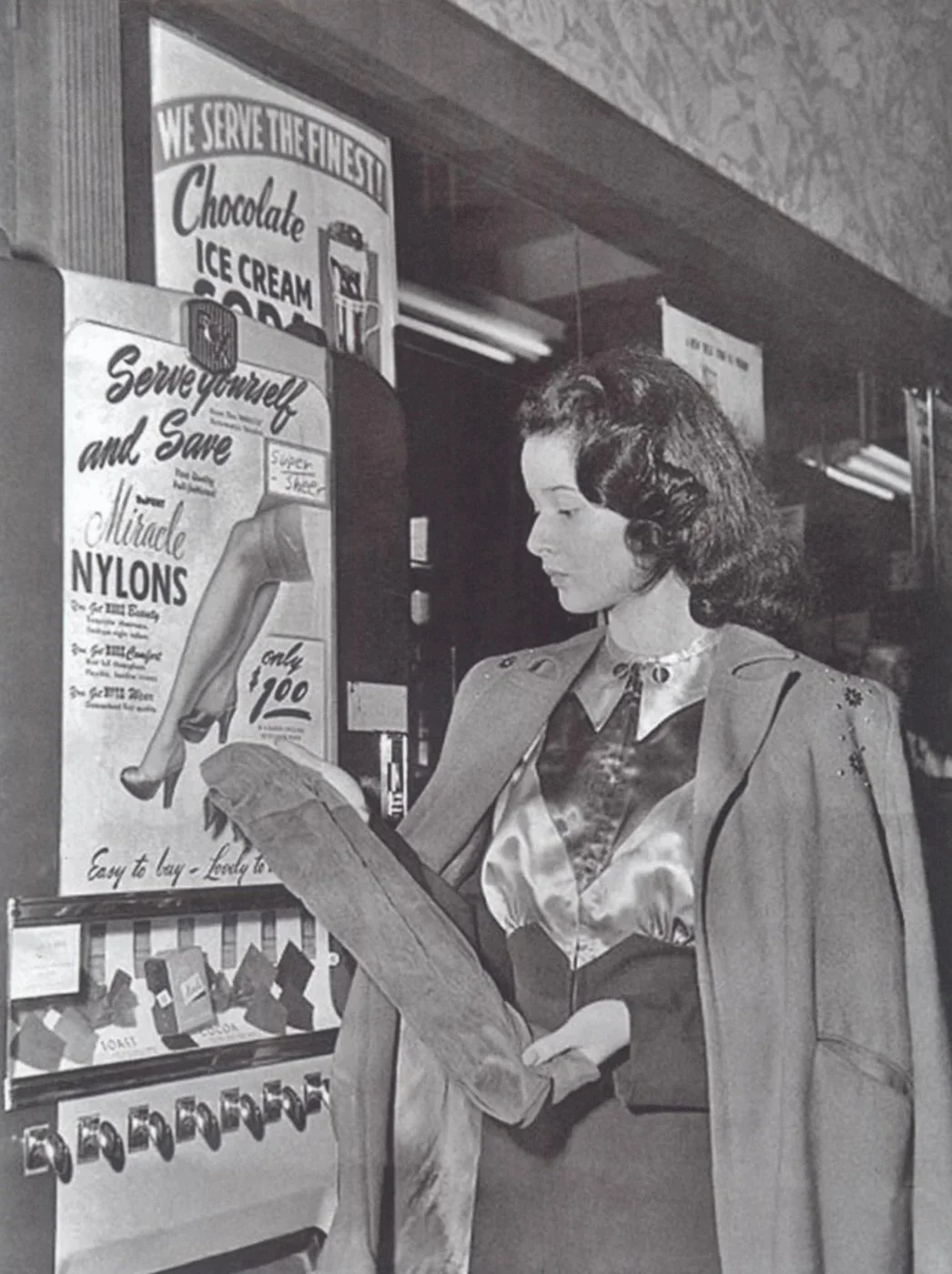
A woman buying a pair of nylons from a street vending machine, ca. 1950.

Wandercheck often listened to the Cavalcade of America, a weekly radio broadcast that promoted DuPont’s ambition to deliver “Better Things for Better Living . . . Through Chemistry.”  Such advertisements would have taught her that DuPont was a leading producer of viscose and acetate rayon for ladies’ lingerie and dresses. Commercialized in the Anglo-American context in the early twentieth century, viscose rayon was a silk substitute made by chemically treating wood pulp, and then spinning the goop into yarn for knitting and weaving; acetate rayon was a refinement based on a slightly different process.

As a modern woman, Wandercheck likely owned some lingerie and a few drapey dresses made from some type of DuPont rayon. She also had some inkling that DuPont scientists working at the Experimental Station, a R&D lab, had created novel products like synthetic rubber. And this led to her brainstorm: “in the name of every working girl,” Wandercheck implored president Lammot du Pont, “I ask your organization to consider our problem and to provide the solution by preparing a material for hosiery which will look like real silk and will have the wearing quality of your rayon materials but will not be too expensive for the purse of the average woman.” 

Wandercheck’s entreaty was remarkably prescient. Over the past few years, DuPont had indeed been secretly laboring over Fiber 66, a new polymeric material that rivaled rayon and natural silk in terms of durability, elasticity, and strength. It would soon be renamed and commercialized as nylon. Rayon had been produced by treating pine pulp with familiar chemicals; nylon was synthesized under heat and pressure by manipulating a mixture of coal, air, and water. Throughout 1937, DuPont had tried to determine if the new material could replace imported Asian silk in ladies’ hose. The first experimental stockings were knit by a Maryland hosiery mill, and in early 1938, DuPont’s top managers would approve funds to build a pilot plant at the Experimental Station.
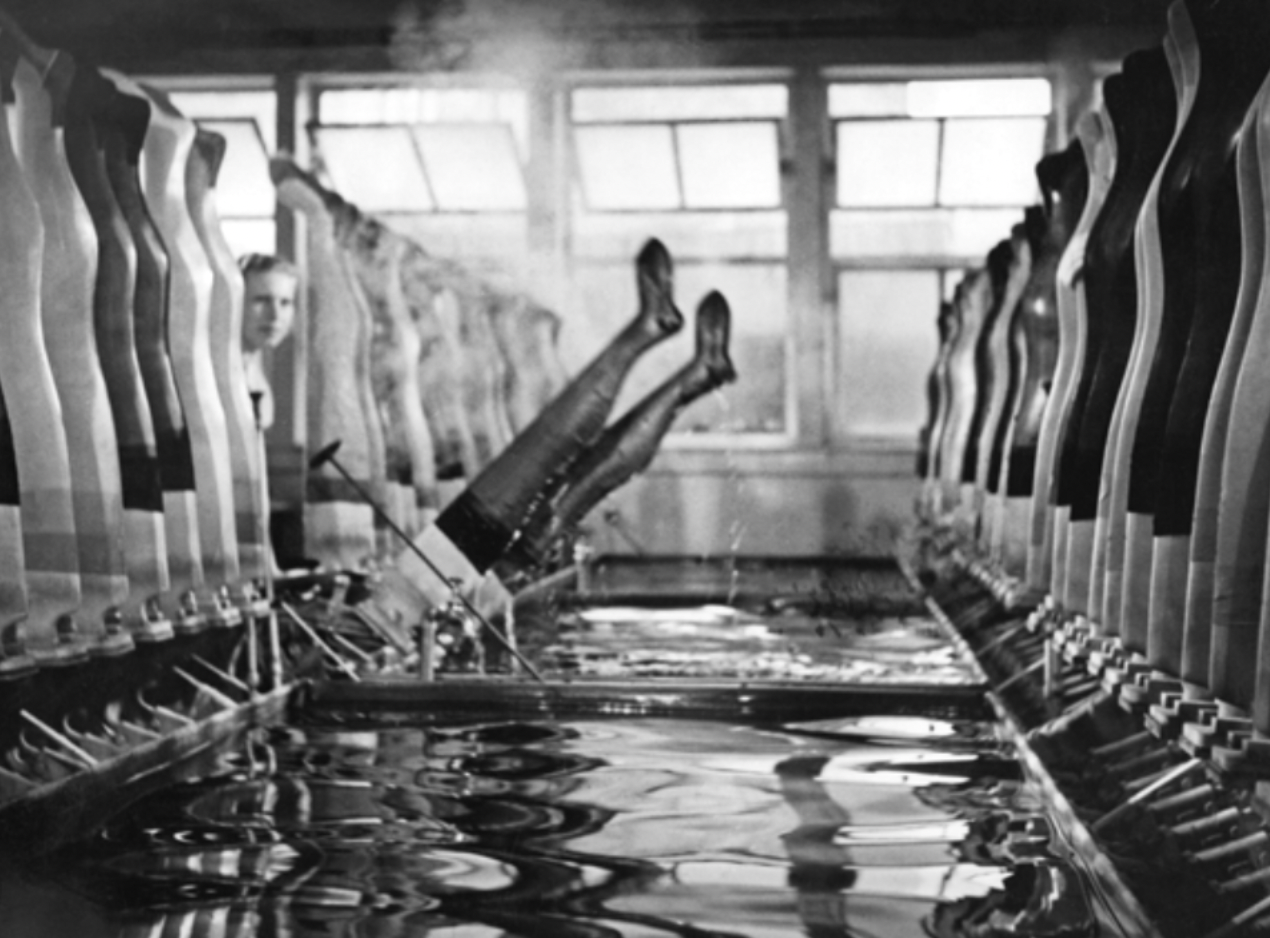
Manufacturing women’s stockings, 1938.

Nylon was an entirely new product, an invention born of a test tube.  It had no history, no ancestry, no proven applications… and no customers.  Historians have described nylon as a breakthrough technology that launched a dual revolution in chemistry and clothing. In reality, though, the story of DuPont’s entry into nylon hosiery did not follow a straight arrow. Their product developers, who had knowledge of the rayon trade, worked behind the scenes to get a handle on what women wanted. With careful deliberation, the firm’s rayon experts undertook some of the first corporate studies of consumer preferences in textiles and clothing.

Their Jazz Age collaboration with the National Retail Dry Goods Association, a trade group for fabric shops and department stores, generated data on women’s tastes that led to softer rayon yarns and more sensuous rayon apparel. In the mid-1930s, DuPont specialists consulted with the Psychological Corporation, an early market research group, to determine how women responded to the touch, sound, and even smell of different textiles. These modest studies paled next to DuPont’s subsequent investment in motivational research and market surveys after World War II, but they did force the firm to grapple with consumers like Mary Wandercheck.

Polymer chemistry and consumer studies went hand-in-hand with translational research conducted for DuPont by contacts in the rayon business. The knitwear industry—the mills who made women’s lingerie and hosiery, and the retailers who sold them—played a crucial role in bringing nylon to market.  Lingerie brands like Van Raalte, a well-respected manufacturer of ladies’ intimate apparel, and mass-market retailers like R. H. Macy & Company, the store that lorded over the Herald Square shopping district in New York, were among those in DuPont’s network who contributed fashion expertise.  Back at company headquarters in Wilmington, the nylon team circulated samples of experimental nylon hosiery to executives and their wives, running in-house market tests on comfort, aesthetics, and wearability. 

Nylon thus followed a long and winding road from the test tube to the hosiery shop. Mary Wandercheck’s seemingly clairvoyant suggestion for synthetic silk, written from across the continent, might have frightened a superstitious man. We’ll never know what Lammot du Pont may have thought about it, however. All we have is a polite reply, sent by his personal assistant: “This is a problem which has already been brought to our attention, and is being given consideration by our research organization. . . . [We] hope that some day we may have solved the problem which you describe.”


Regina Lee Blaszczyk is Professor of Business History and Leadership Chair in the History of Business and Society at the University of Leeds in the UK. Her work focuses on capitalism, material life, and consumer culture. She is the author or editor of thirteen books, most recently Capitalism and the Senses (Philadelphia: University of Pennsylvania Press, 2023). This article is based on her research in the DuPont corporate archive at the Hagley Museum and Library, Wilmington, Delaware, for her next book, The Synthetics Revolution.

Brilliant Move

Brilliant Move is the Brooklyn-based creative studio of Marci Hunt LeBrun specializing in building websites on the Squarespace platform – among many other things.

I love working with small businesses, nonprofits, and other creatives to help them organize their ideas, hone their vision, and make their web presence the best it can be. And I'm committed to keeping the process as simple, transparent, and affordable as possible.

https://brilliantmove.nyc
Previous
Previous

Ghost nets

Next
Next

Luxury underfoot