Luxury underfoot
Sarah Archer
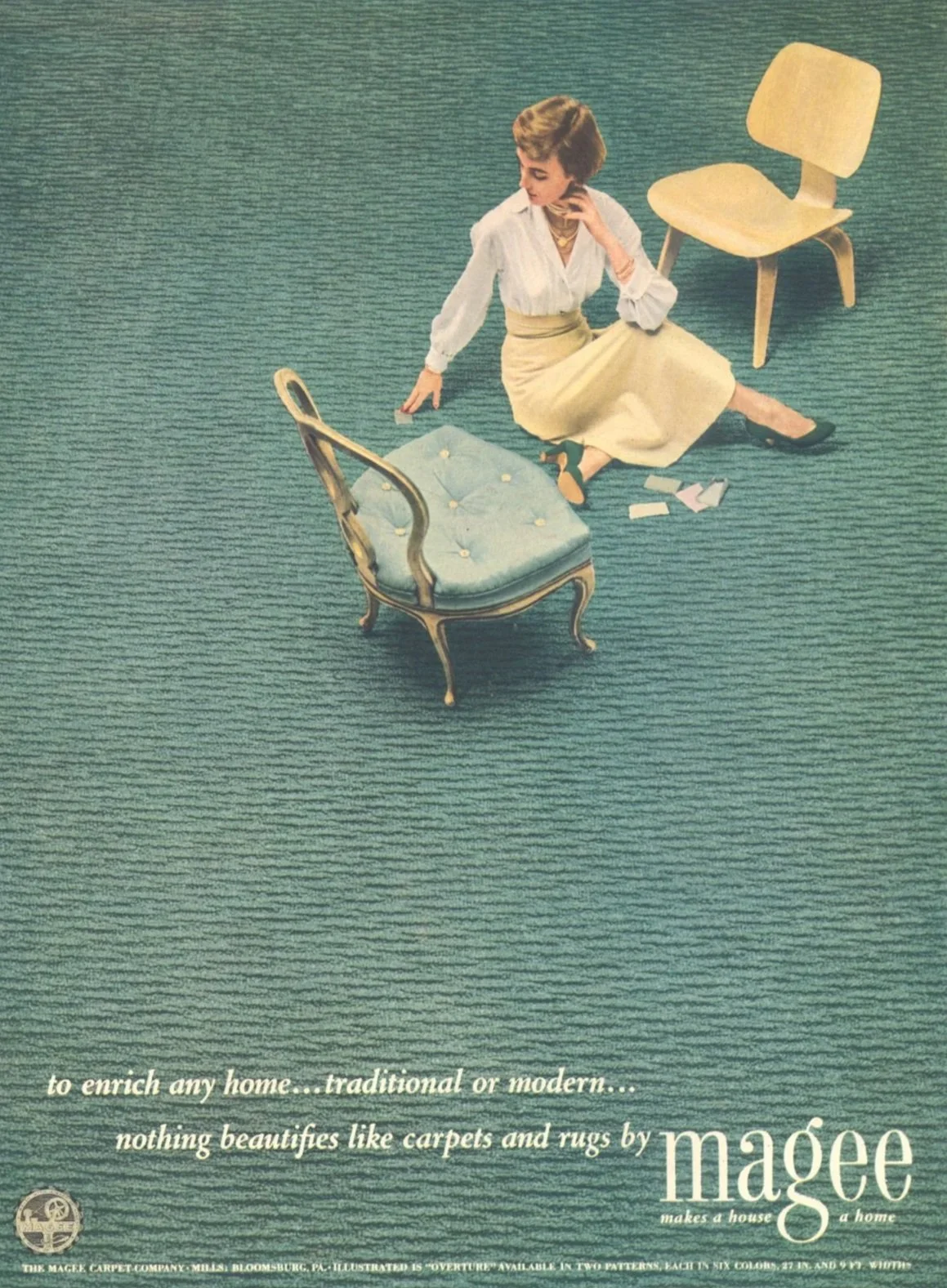
Magee Carpet Company (Bloomsburg, Pennsylvania, founded 1901), To enrich any home … traditional or modern … nothing beautifies like carpets and rugs by Magee, 1949.
It’s difficult to imagine a group of Gilded Age women reading a magazine, or listening to music on a phonograph, while reclining on a rug. Their foundation garments wouldn't have permitted it. The wool wouldn’t have been comfortable to laze on, even if it had been acceptably ladylike to do so. But this is exactly the posture in which we find women in the 1950s, at least in innumerable editorials and print ads. They lie sideways, wearing pants or leotards, doing their thing, almost as though there were a new, secret room in the house hovering just below the horizon line of the coffee table.
Nylon made it possible. Resilient, plush, colorful, stain-resistant and stylish, this novel material helped domesticate a new zone in the great American interior: the floor. Children had always played down there, but that grown women would take to the floor, and get comfortable, was a new and provocative phenomenon in domestic life. A Nylon carpet could turn a staid living room into an almost avant garde space. The plane ordinarily devoted to vacuum cleaners, and the searching eyes of critical houseguests, was now a place to spend time. The room was familiar, but the elevation was new.
In her 2012 study “Curtains and the Soft Architecture of the American Postwar Domestic Environment,” scholar Margaret Maile Petty describes the steely formalism that characterized American Modernism in the immediate postwar years, and its (literally) no-frills rejection of textiles. Though they didn’t have it in for carpet specifically, George Nelson and Henry Wright wrote in their 1945 book Tomorrow’s House: How to Plan Your Postwar Home Now that “shades, curtains, and draperies” should be banished as outmoded “clutter.” Whatever formal splendor the Nelson worldview brought into existence, though, few people can live, relax, or entertain without the creature comforts of soft furnishings.
No one was happier to ignore the scolds than the executives at DuPont. The company introduced a Nylon carpet product called Splendante in 1948, describing it as “luxurious,” and noting that its contrasting pile height gave a sophisticated “bas-relief effect.” DuPont carpeting entered its plush era in 1959 when the company introduced BCF (bulk continuous filament), which streamlined the manufacturing process and made carpeting even more affordable. By the time the company introduced its Antron brand in 1965, it was firmly established as an industry leader.
The printed advertising campaign for Antron comprises a rich fabric in its own right. This Nylon carpet could be by turns modern and traditional—even stuffy—but it was always soft, and was typically portrayed as a comfortable surface for the whole body, not just the feet. The people we see in Antron's advertising landscape are nearly all female. A 1967 print ad for Antron, which shows a mother and daughter playing on an immaculate pale green carpeted floor, invites readers to consider “underfoot luxury that lasts.” The promise of high-tech durability paired with stylish elegance appears in a similar DuPont print ad, this one for carpets made from the company’s 501 fiber, from 1966. A woman in a green dress presses her stockinged feet and bare hands across the blue carpet’s fibers. As in Nylon hosiery ads from this period, she’s partially disembodied. Mostly what we can ascertain is her sensual pleasure; we can see that the carpet is soft, but we’re assured that it’s also “tough.”
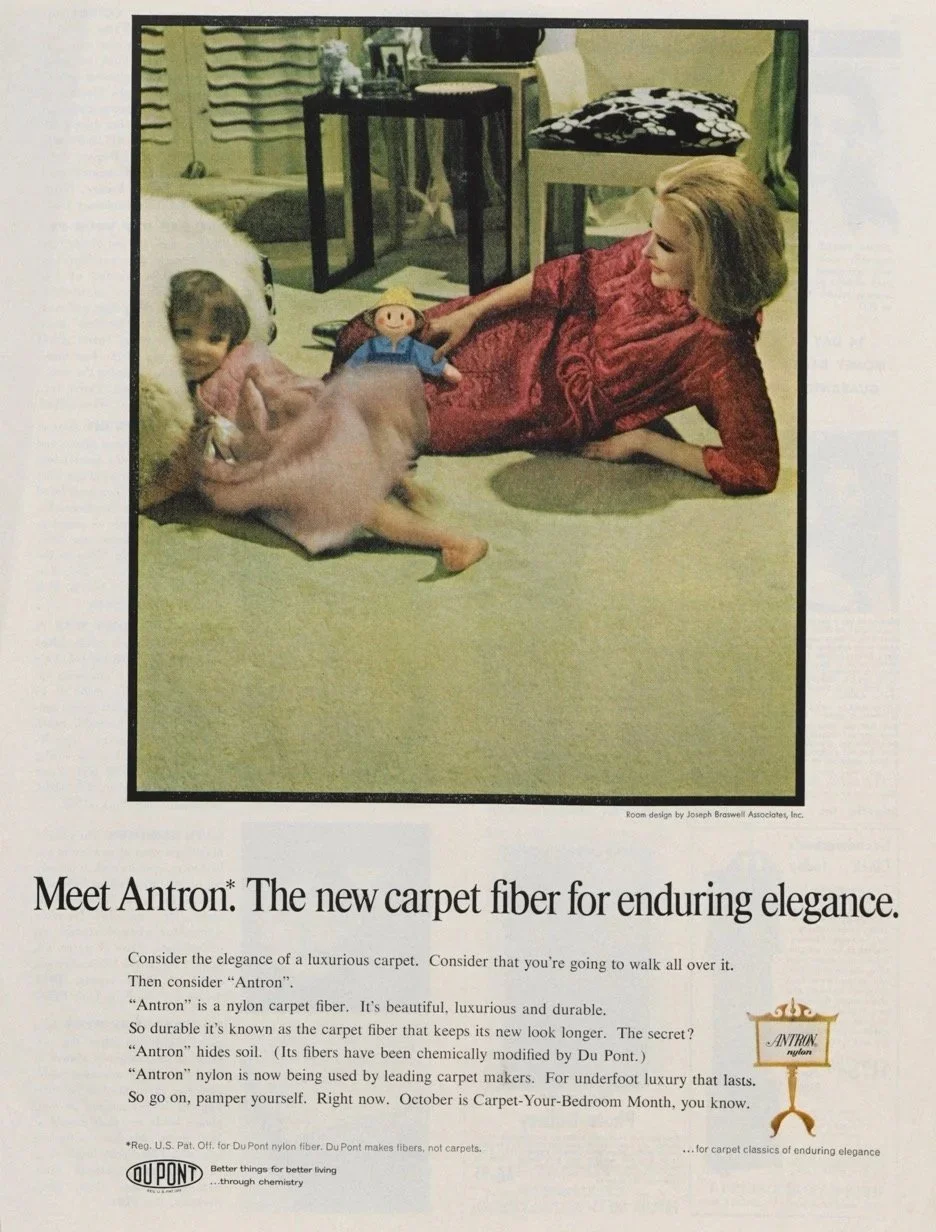
E.I. du Pont de Nemours & Company (Wilmington, Delaware, founded 1802), Meet Antron: The New Carpet Fiber for Enduring Elegance, 1967, dpads_1803_00680, Series I, Box 43, Folder 42, E.I. du Pont de Nemours & Company Advertising Department records (Accession 1803), Manuscripts and Archives Department, Hagley Museum and Library, Wilmington, DE 19807.
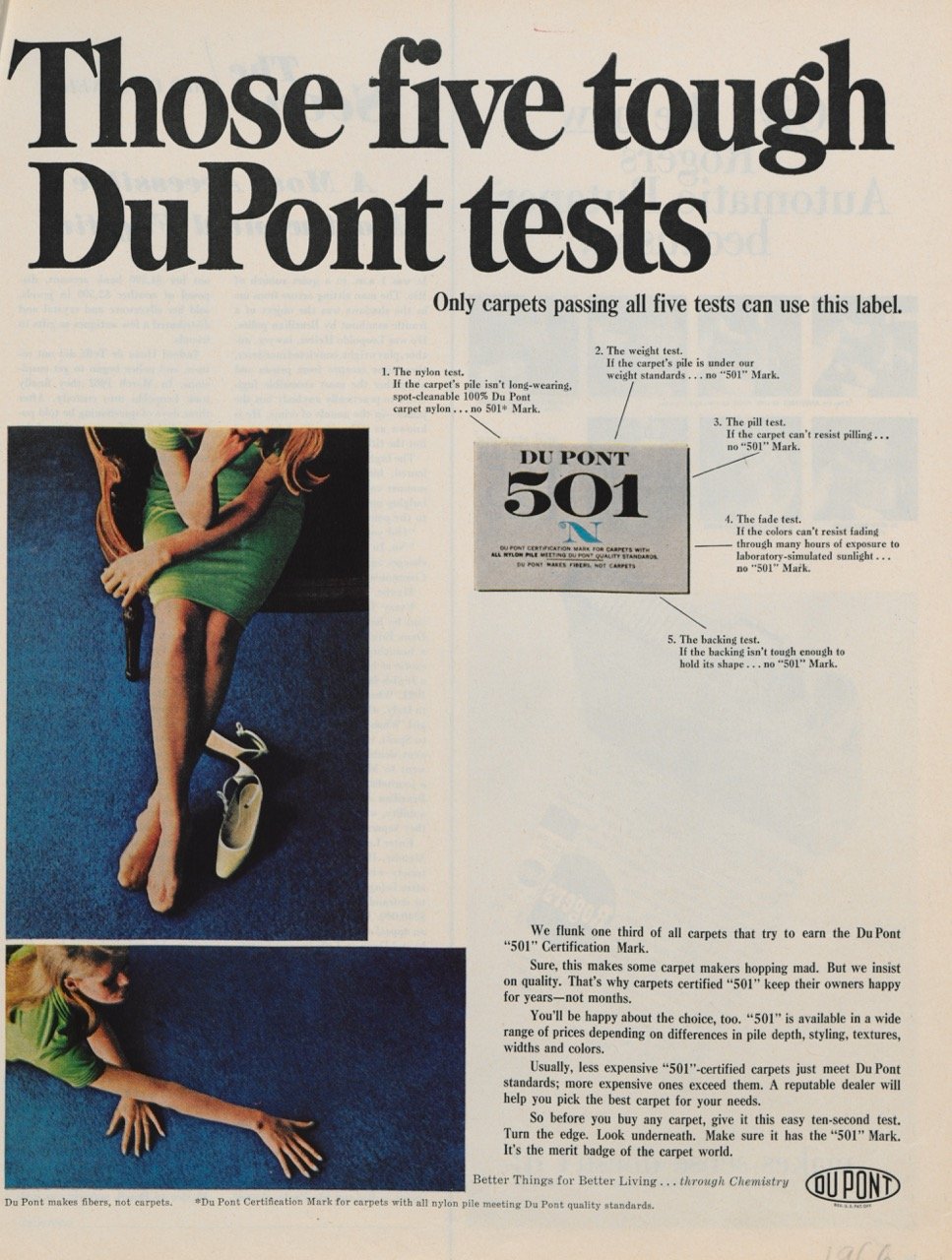
E.I. du Pont de Nemours & Company (Wilmington, Delaware, founded 1802), Those Five Tough DuPont Tests: DuPont 501, 1966, dpads_1803_00650, Series I, Box 43, Folder 41, E.I. du Pont de Nemours & Company Advertising Department records (Accession 1803), Manuscripts and Archives Department, Hagley Museum and Library, Wilmington, de 19807.