The many and the one
Andrew James Hamilton
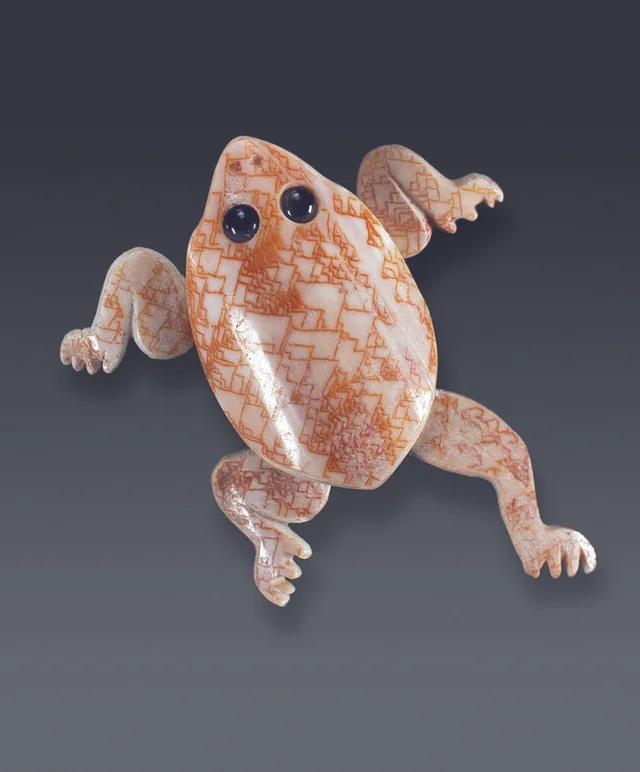
Mayan frog scultpure. Image courtesy the author.
There are plenty of fish in the sea, as the adage goes. But there are actually far more mollusks. While there are around 35,000 species of fish, over 85,000 mollusks have been identified—making it the second-largest animal phylum after arthropods—and malacologists believe many species have yet to be discovered. Aside from cephalopods (octopuses and squids) and gastropods (slugs), the majority grow protective coverings made mostly of calcium carbonate, which we call shell. Artists in the Americas have worked this material for millennia.
The diverse shapes and colors of seashells—culled from separate rich populations in the Atlantic and Pacific Oceans—have inspired Indigenous artists to produce a huge array of works. For example, in northeastern North America, communities including the Haudenosaunee have used quahog clams (Mercenaria mercenaria) from the Eastern Seaboard, prized for their purple colors, to make tubular beads called wampum, which they often strung as belts. To the west and south, inland artists of the Hopewell Tradition and later Mississippian peoples sought lightning whelks (Busycon perversum) from the distant Caribbean; their , whose rare lefthand spiral likely held symbolic importance. These massive shells allowed artists to cut large circular ornaments from their outer whorls, which scholars call gorgets.
Across the Great Plains, multiple species of tusk shells from the Pacific Coast—collectively referred to as Dentalium—have been used to make items of regalia. Their long and skinny forms allow them to be threaded as necklaces and breastplates and couched to garments. Artists of the Northwest Coast employ still other types of shells, including the opercula of red turban snails (Pomaulax gibberosus), which they embed in wooden bowls and bentwood boxes. They also have long used local northern abalone shells (Haliotis kamtschatkana) for iridescent inlays, and have traded for more colorful red abalone shells (Haliotis rufescens) from southern waters off California.
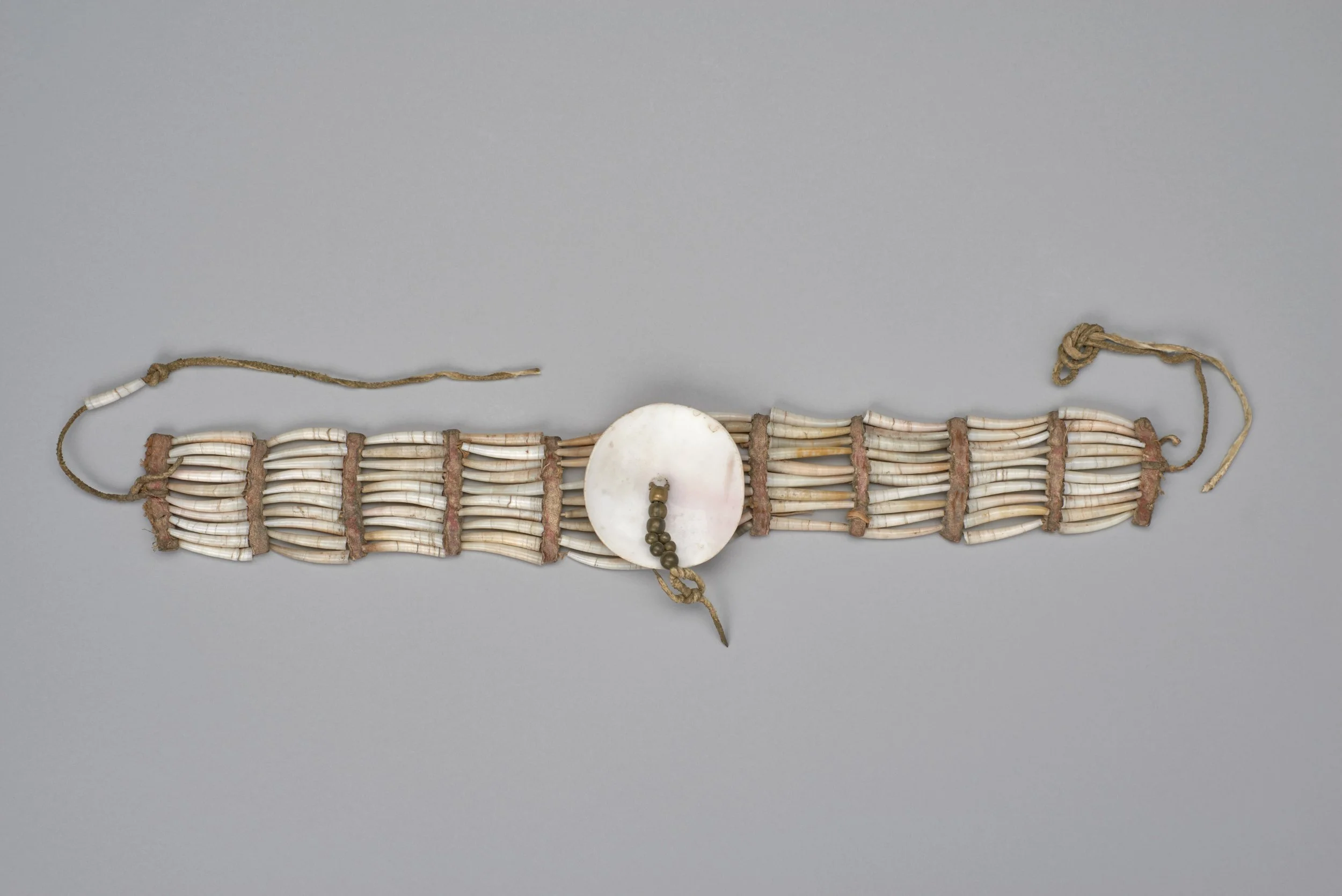
Plains artist, Choker, before 1915. Dentalia shell and cord; 28½ x 2½ x 1 in. Denver Art Museum: Gift of W.B. "Dub" and Maxine Blankenship, 2015.298. Photography courtesy Denver Art Museum.
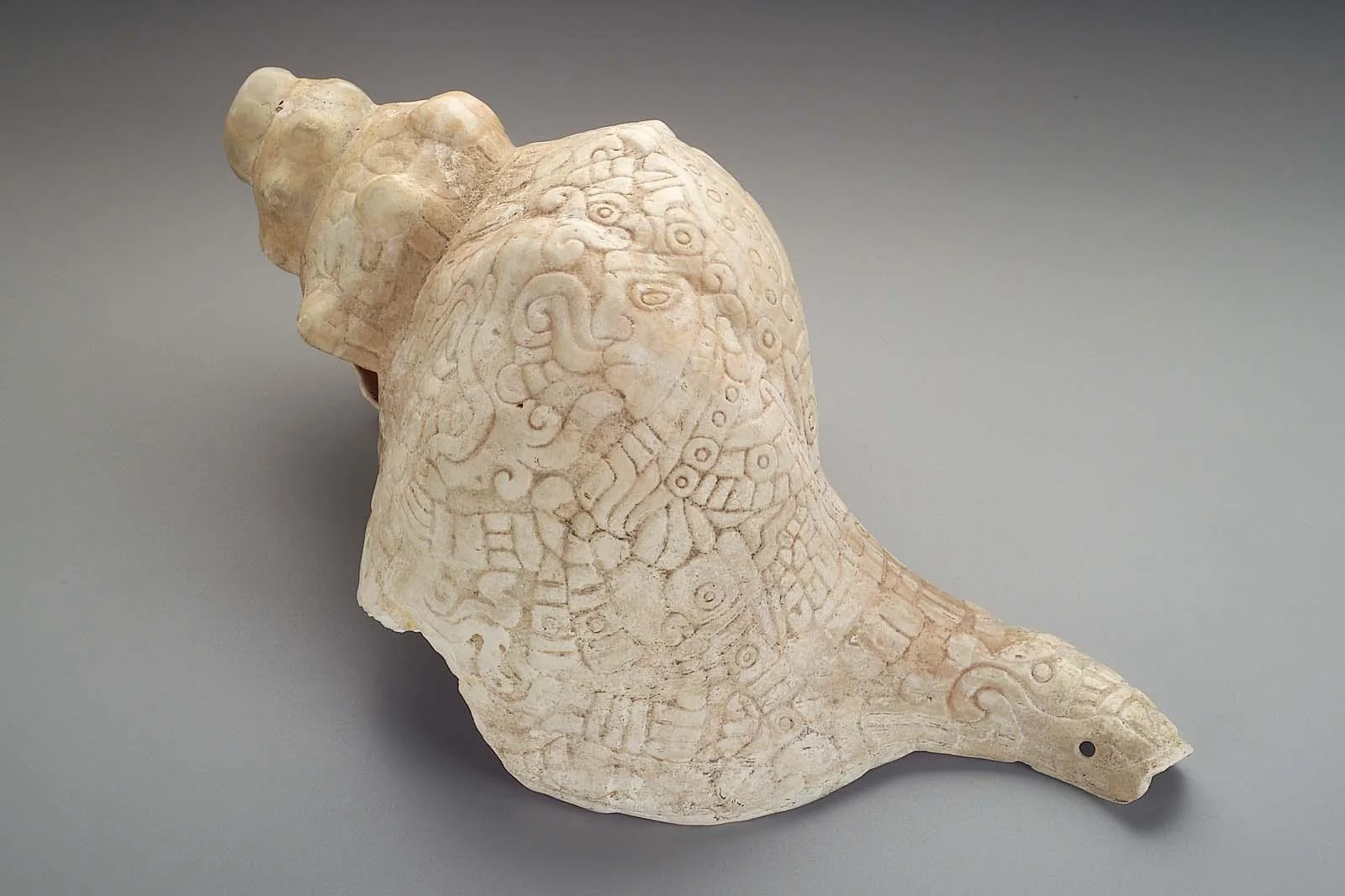
Aztec or Mixtec, Conch shell trumpet, AD 1425–1520. Conch shell. Museum of Fine Arts Boston, Gift of Landon T. Clay, 1988.1214.
In Ancestral Puebloan communities, artists crafted beads from dwarf olive shells (Olivella dama) hailing from the Gulf of California. The gulf was also the source of the largest inland shell deposits ever found in the Americas—at Casas Grandes in the middle of the Chihuahua Desert in what is now Mexico—amounting to nearly 4 million pieces of shell, largely composed of mud snails (Nassarius spp.). Across Mesoamerica, artists used the large shells of the horse conchs (Triplofusus giganteus) for making trumpets, especially at Teotihuacan and in ancient Maya sites, as well as for paint palettespigments. Still other types of shell were used further south; for example, at the ancient pilgrimage center of Chavín de Huántar high in the central Andes, artists used the Eastern Pacific giant conch (Titanostrombus galeatus) to create trumpets, called pututos, many of which were incised with elaborate designs.
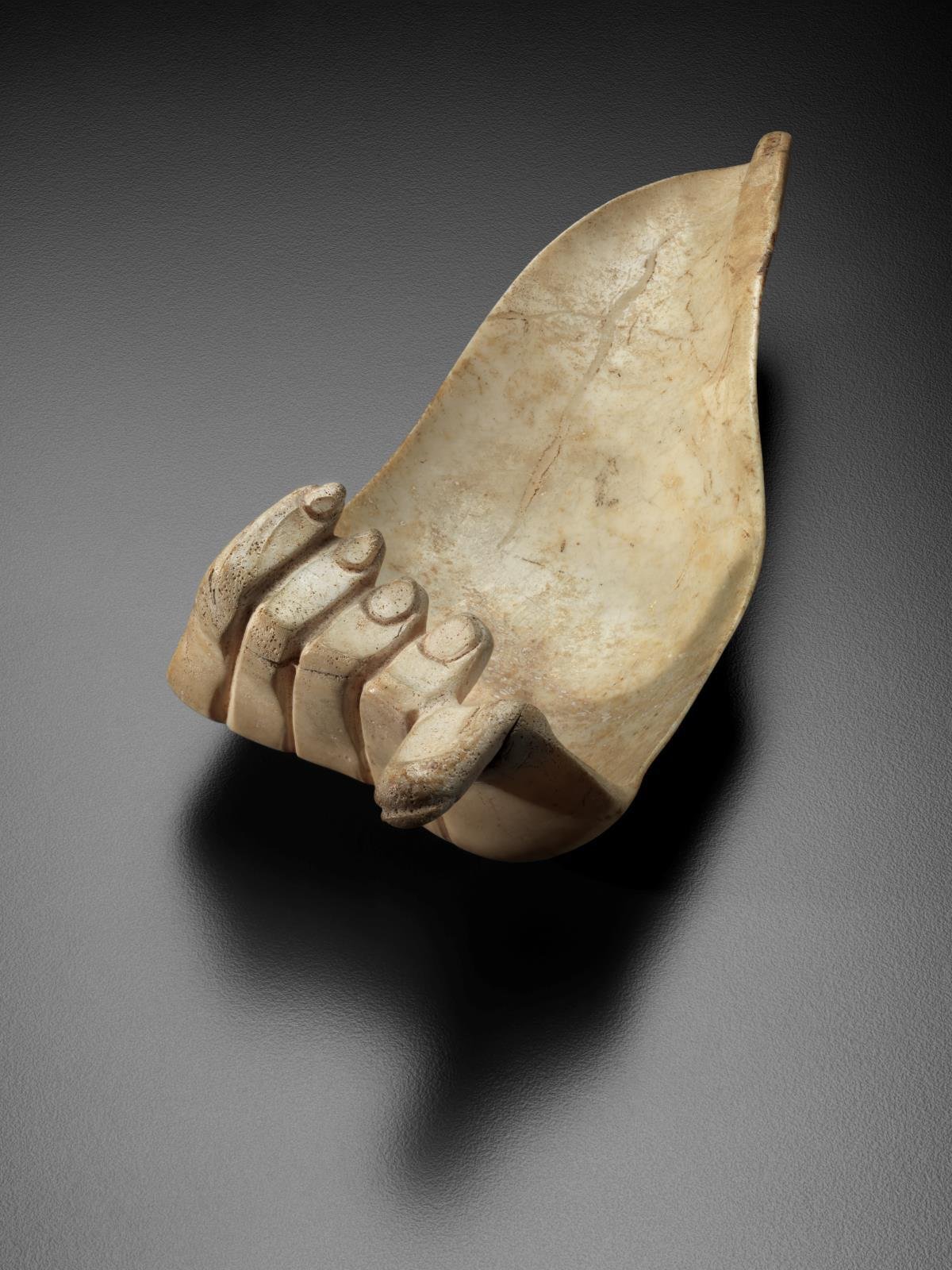
Mayan, Shell paint palette, AD 550–850. Conch shell. Museum of Fine Arts Boston, Elizabeth M. and John F. Paramino Fund in memory of John F. Paramino, Boston Sculptor, John H. and Ernestine A. Payne Fund, Helen and Alice Colburn Fund, William Francis Warden Fund, Seth K. Sweetser Fund, Helen B. Sweeney Fund, and Harriet Otis Cruft Fund, 2017.849.
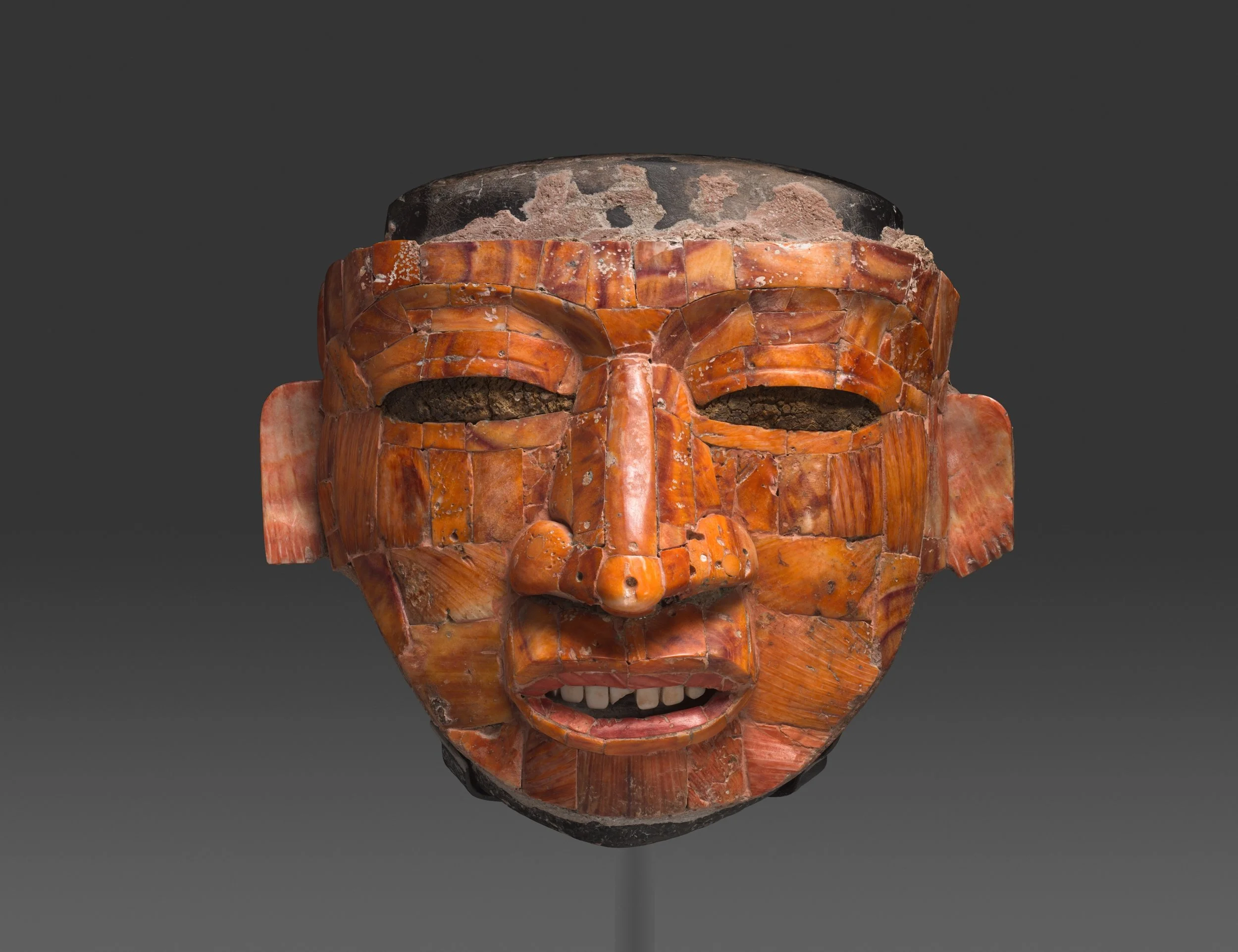
Mexican (Teotihuacan), Face, 300 CE–600 CE. Stone, spondylus shell, and stucco. The Art Institute of Chicago, Through prior gifts of Mr. and Mrs. Arthur M. Wood and Mr. and Mrs. William E. Hartmann; Robert Allerton Trust Fund; through prior gifts of Ethel and Julian R. Goldsmith and Mr. and Mrs. Samuel A. Marx; Morris L. Parker Fund; purchased with funds provided by Cynthia and Terry Perucca and Bill and Stephanie Sick; Wirt D. Walker Trust, Bessie Bennett, and Elizabeth R. Vaughn funds; purchased with funds provided by Rita and Jim Knox and Susan and Stuart Handler; Edward E. Ayer Fund in memory of Charles L. Hutchinson and Gladys N. Anderson Fund; purchased with funds provided by Terry McGuire; Samuel P. Avery Endowment Fund; Charles U. Harris Endowed Acquisition Fund, 2012.2.
But dDespite this incredible diversity of shells and the myriad ways Indigenous artists have used them, one specimen has enjoyed a kind of pre-eminence; it shell was came to be sought after by many different communities far across the Americas and well beyond the mollusk’s natural habitat. The is the spiny or thorny oyster (Spondylus crassisquama), which is native to the warm waters of the Pacific Ocean from Baja California to Ecuador, but has long been traded north into the American Southwest and south into the central Andes. Spondylus objects have been found at archaeological sites almost contiguously throughout this vast range — including Chaco Canyon, Teotihuacan, at the Aztec capital of Tenochtitlan, in West Mexican burials, at Maya sites in the Yucatan, Gran Coclé in Panama, at Malagana in Colombia, throughout coastal and highland Peru, at Tiwanaku in Bolivia, and Inca sites in Argentina — arguably making it the most culturally significant shell in the history of the Americas.
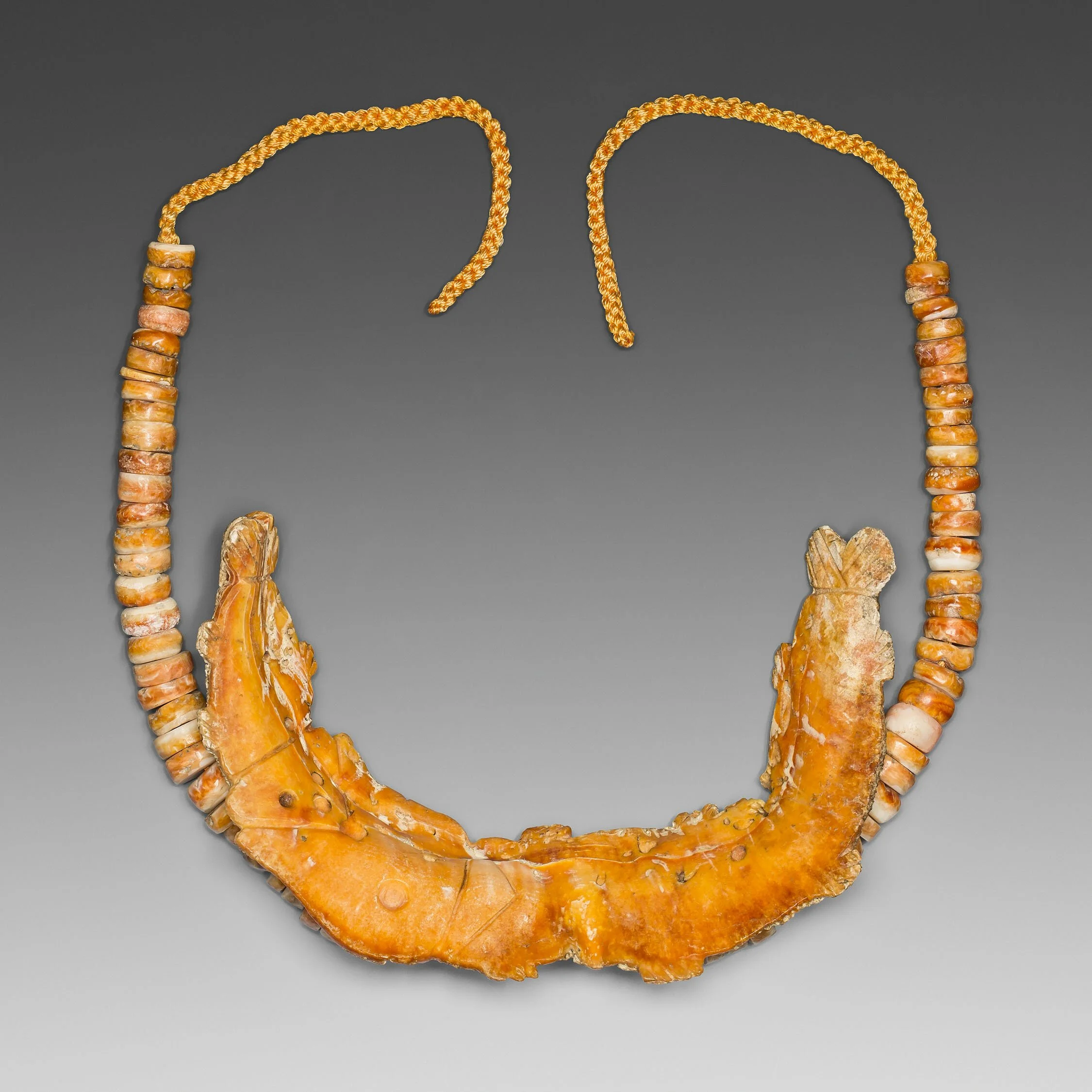
Mexican (Colima), Necklace with pendant depicting a large fish eating a smaller fish, 200 BCE–200 CE. Spondylus shell. The Art Institute of Chicago, Maurice D. Galleher Endowment, 2001.152.8.

Mexican (Colima), Pendant in the form of a mythical double-headed creature, 200 BCE–200 CE. Spondylus shell. The Art Institute of Chicago, Maurice D. Galleher Endowment, 2001.152.9.
Although the modern common names of the mollusk refer toence its striking spiked form, artists usually removed the spines and polished the shells to draw out their colors, which can range from pink to deep saturated reds and oranges. Called mullu in the Inca Empire, it was valued far more than gold.

Panama (Coclé), Nose Ornament in the Form of an Long-Nosed Saurian with C-shaped Body, 750 CE–1250. Spondylus shell. The Art Institute of Chicago, Wirt D. Walker Fund, 1969.794.
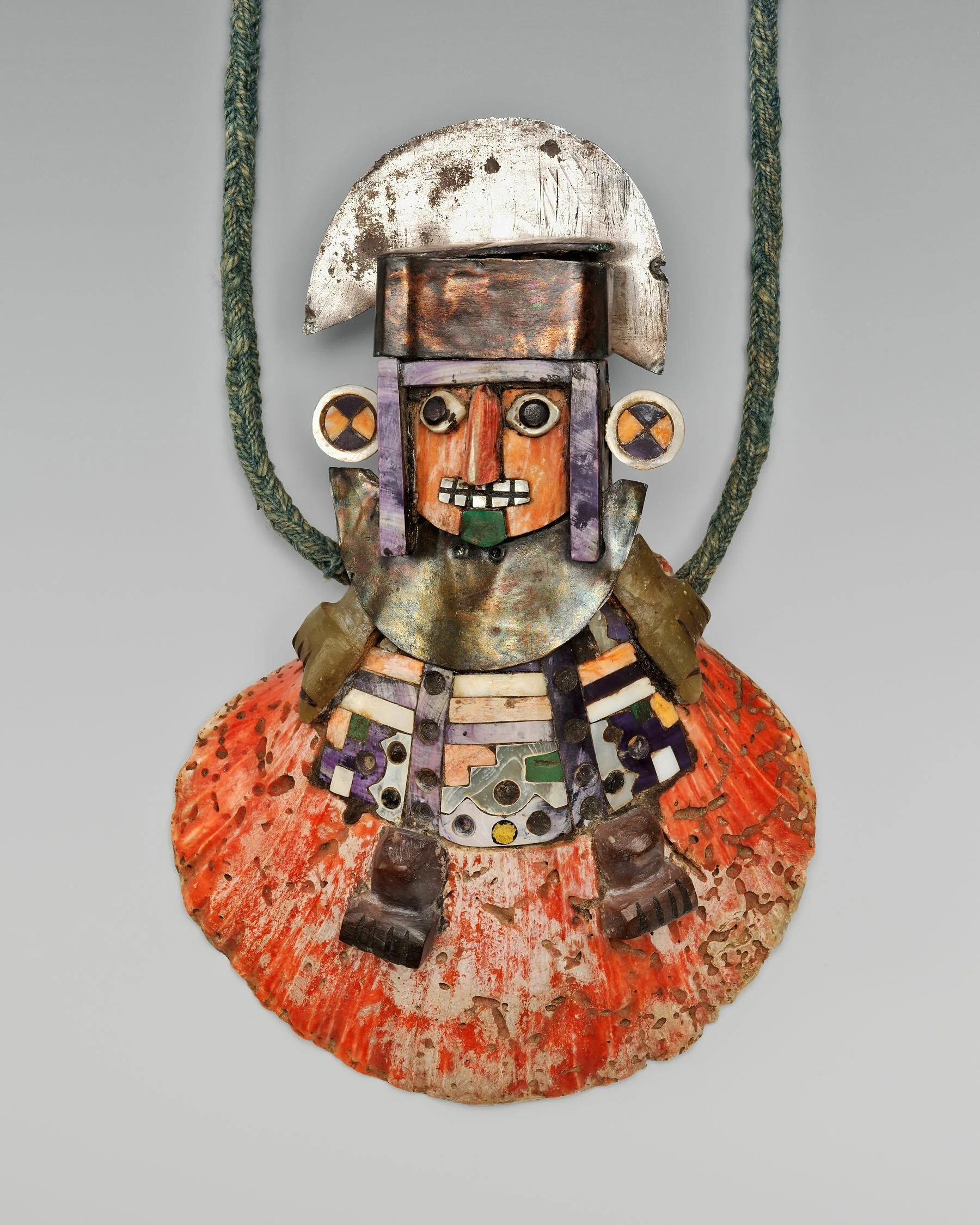
Peruvian (Tiwanaku), Pendant in the form of a figure, 400 CE–800 CE. Shell, stone, silver, copper, and cotton. The Art Institute of Chicago, Kate S. Buckingham Endowment, 1955.2542.