A language of ornament
Christine Guth
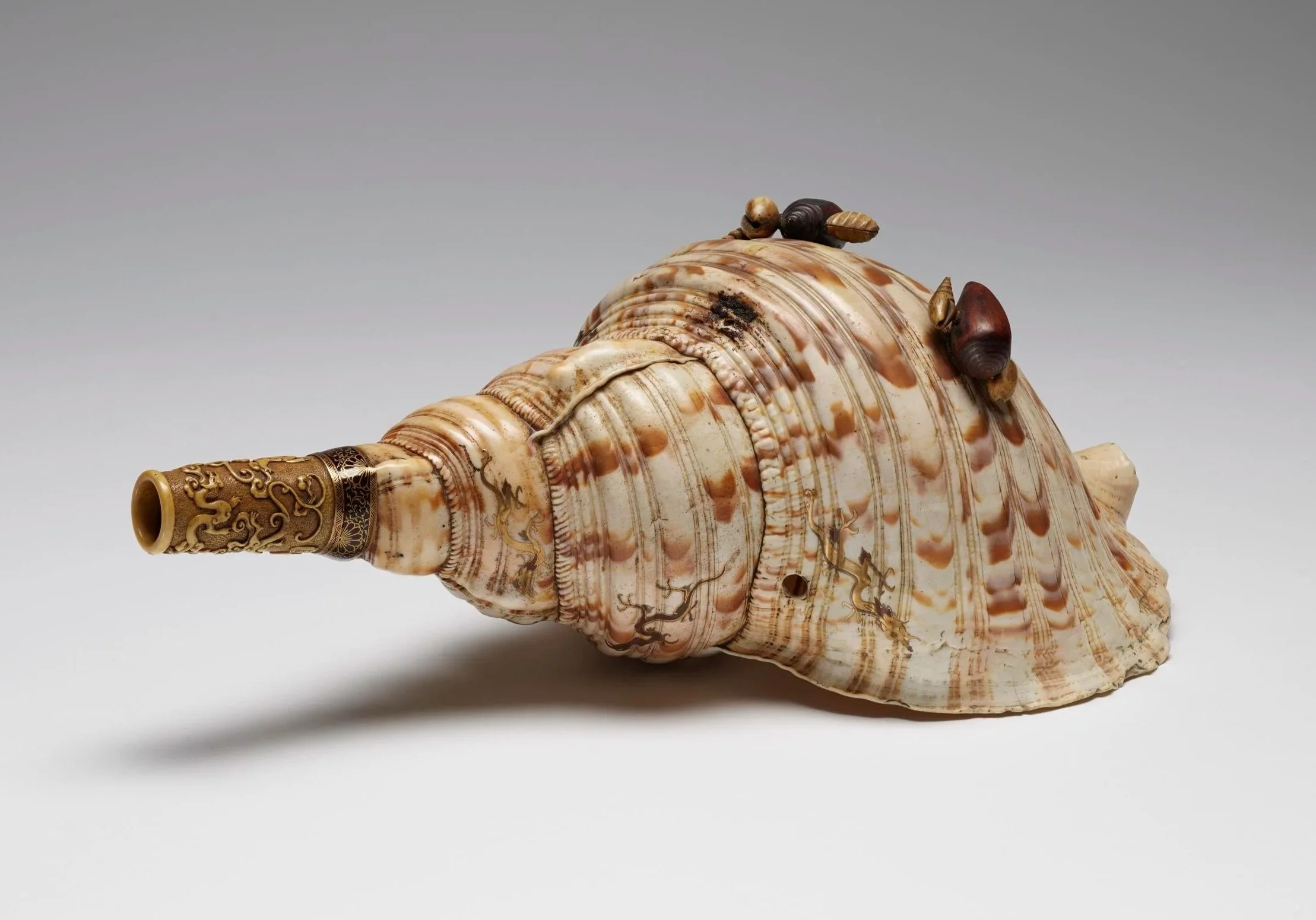
Japanese, Musical horn (gungai), Conch shell with wood, lacquer, and ivory handle, 19th C. The British Museum, OA+.7252. © The Trustees of the British Museum. Shared under a Creative Commons Attribution-NonCommercial-ShareAlike 4.0 International (CC BY-NC-SA 4.0) licence.
A Japanese language dictionary may seem a strange place to begin a consideration of shell. But the many words formed with the character for shell speak to this material’s global economic, cultural, and religious importance in premodern times. “Shell” exists as an independent character 貝, typically pronounced kai or gai, but it also figures in a host of compounds. These include: 財 money, wealth; 貿 exchange, trade; 賀 congratulations; 賛 praise; and 質 substance, matter, quality. These characters, which are Chinese in origin, also have variants in Vietnam and Korea, everywhere forming information-dense entities, conveying meaning on multiple levels. They are not phonetic, but logographic, with each one representing an entire idea. Together they testify to the material and symbolic place that shell has assumed since ancient times in East Asia and beyond.
Sometimes, these compounds speak to the cultural significance of a particular species. An example is the cowrie, 宝貝 (Takaragai), meaning “treasure shell.” Though most abundant in the Indian Ocean, cowries have been used worldwide as a form of currency. Those from the Maldives were especially important in the trade between South Asia and Africa – in fact, the English word for this mollusk derives from the Hindi kaudi. When Chinese porcelain was first introduced to Europe, it was believed to be made from ground cowrie shell, and the word for porcelain, first used in 1298 in Marco Polo’s accounts of his travels in Asia.
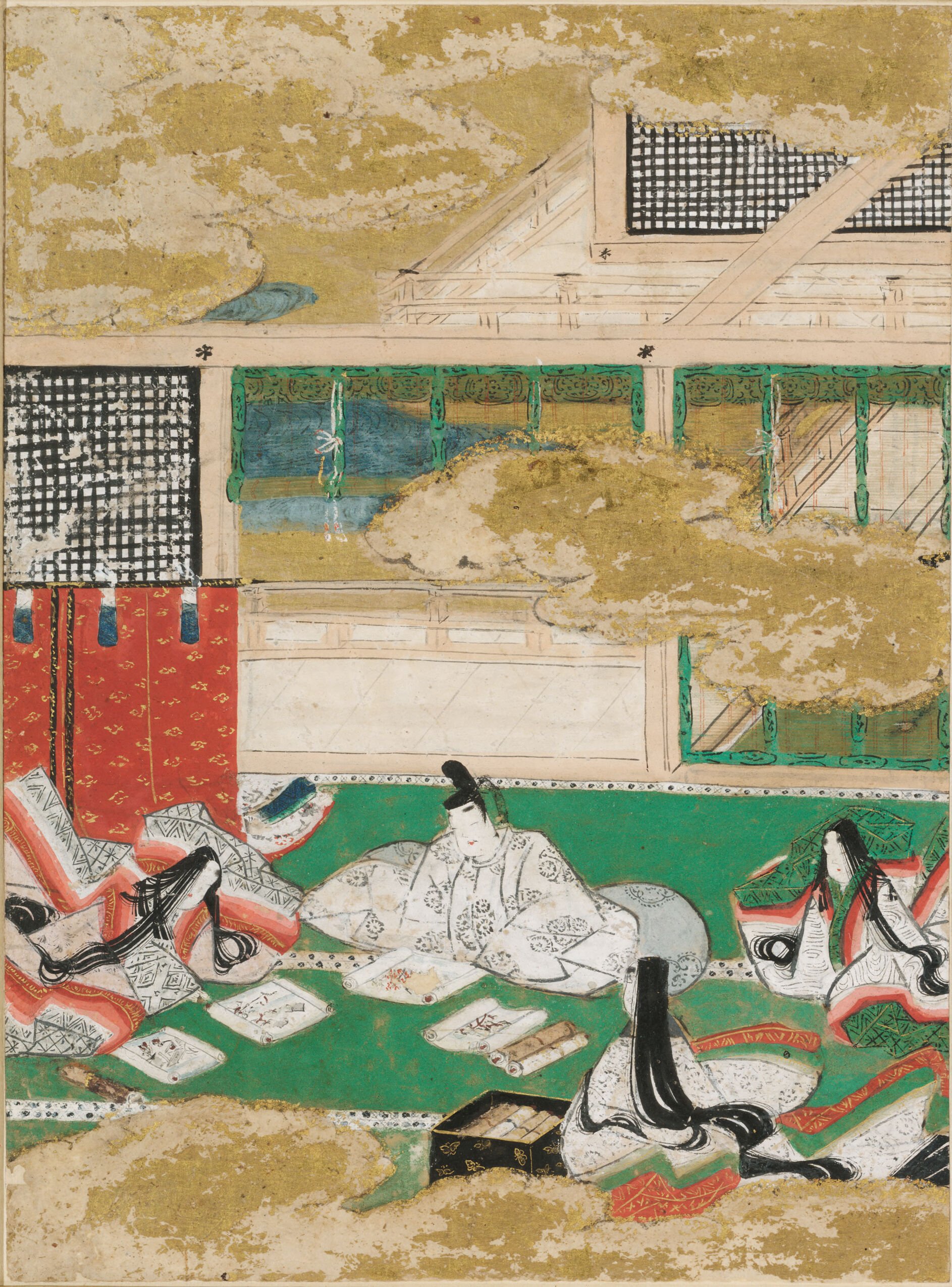
Tosa Mitsunobu (Japanese, active c. 1469-1522), The Picture Contest (Eawase), Illustration to Chapter 17 of the Tale of Genji (Genji monogatari), Muromachi period, datable to 1509-1510. The seventeenth of a series of 54 painted album leaves mounted in an album with calligraphic excerpts; ink, color, and gold on paper. Harvard Art Museums/Arthur M. Sackler Museum, Bequest of the Hofer Collection of the Arts of Asia, 1985.352.17.A.
Conch shells, 法螺貝 (horagai), are auspicious symbols in Buddhism because when adapted for use as instruments, they produce a resonant sound emblematic of the power of the Buddha’s teachings. In Japan, elaborately ornamented conches were blown to signal military troops to attack, withdraw, or fall into line. Oyster shell ground into a fine powder mixed with glue was used for making an opaque white pigment known as gofun, ubiquitous in Japanese painting on paper, silk, sculpture and other supports. Although this organic pigment may flake off, it does not yellow with age. And in the game of kai-awase (“matching shells”), the bivalve nature of the clam was exploited to create an elaborate test of observation, with pairs of beautifully painted shells positioned facedown; the goal was to identify the pairs based on the features of the undecorated exteriors.
Mollusks such as abalone, oysters, and mussels secrete a substance comprising calcium carbonate and protein to produce the material that forms their hard, protective covering. While the external shell is rough, the innermost layers that come into direct contact with the living organism’s body are smooth and iridescent. This inner surface, known as nacre or mother-of-pearl, is in fact composed of the same substance as pearls formed around irritants that enter the shell. The shimmering, multi-colored effects result from the way light reflects off the layers, which vary in thickness. Nacre has been prized throughout the world as a material for decorating jewelry, utensils for food and drink, furnishings for the home, ritual implements, and even military artifacts such as saddles and stirrups, arms, and armor.
Turban and abalone shells harvested from tropical and sub-tropical waters have been the materials of choice for fashioning decorative mother-of-pearl inlays in lacquered containers and furniture in China, Korea, and Japan, but the inner layers of the abalone were also used for coloristic effects that could range from green and blue to purple. The tonal gradations of abalone nacre allowed it to be used almost like painting, notably in goods produced for export from Nagasaki, the port on Japan’s southernmost island.
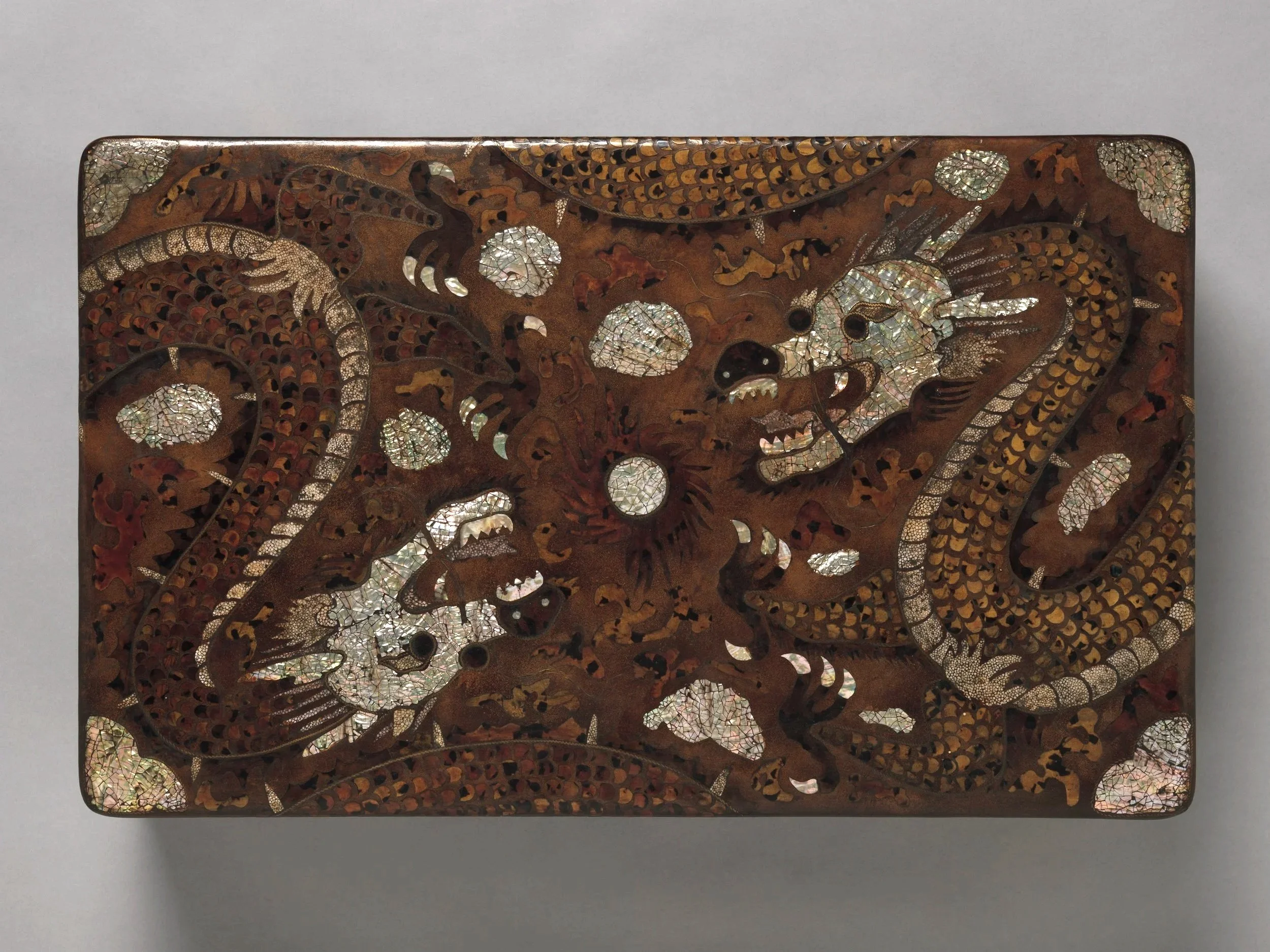
(lid from above) Korean, Joseon dynasty (1392–1910), Clothing box decorated with dragons, 19th C. Lacquer inlaid with mother-of-pearl, tortoiseshell, and ray skin. 6 3/4 x 17 3/4 x 28 3/4 inches. The Metropolitan Museum of Art, New York. Gift of Florence and Herbert Irving, 2015, 2015.500.3.7a,b.
Removing the flaky layers of mother-of-pearl from a shell is a labor-intensive process involving boiling, cutting, cleaning, grinding and polishing. In the early stages of the process, acid may serve to help remove the hard outer layer of shell. The resulting small thin sheets of nacre can then be cut into assorted shapes and sizes and applied to various surfaces. Although there is much waste, since only flat pieces can be used for inlays, the tiny fragments may be embedded in lacquer to create dense patterns resembling the crackling of porcelain or eggshell. This technique finds an especially rich and ingenious expression in decorative lacquers developed in Korea, often in combination with other inlays for pictorial compositions.
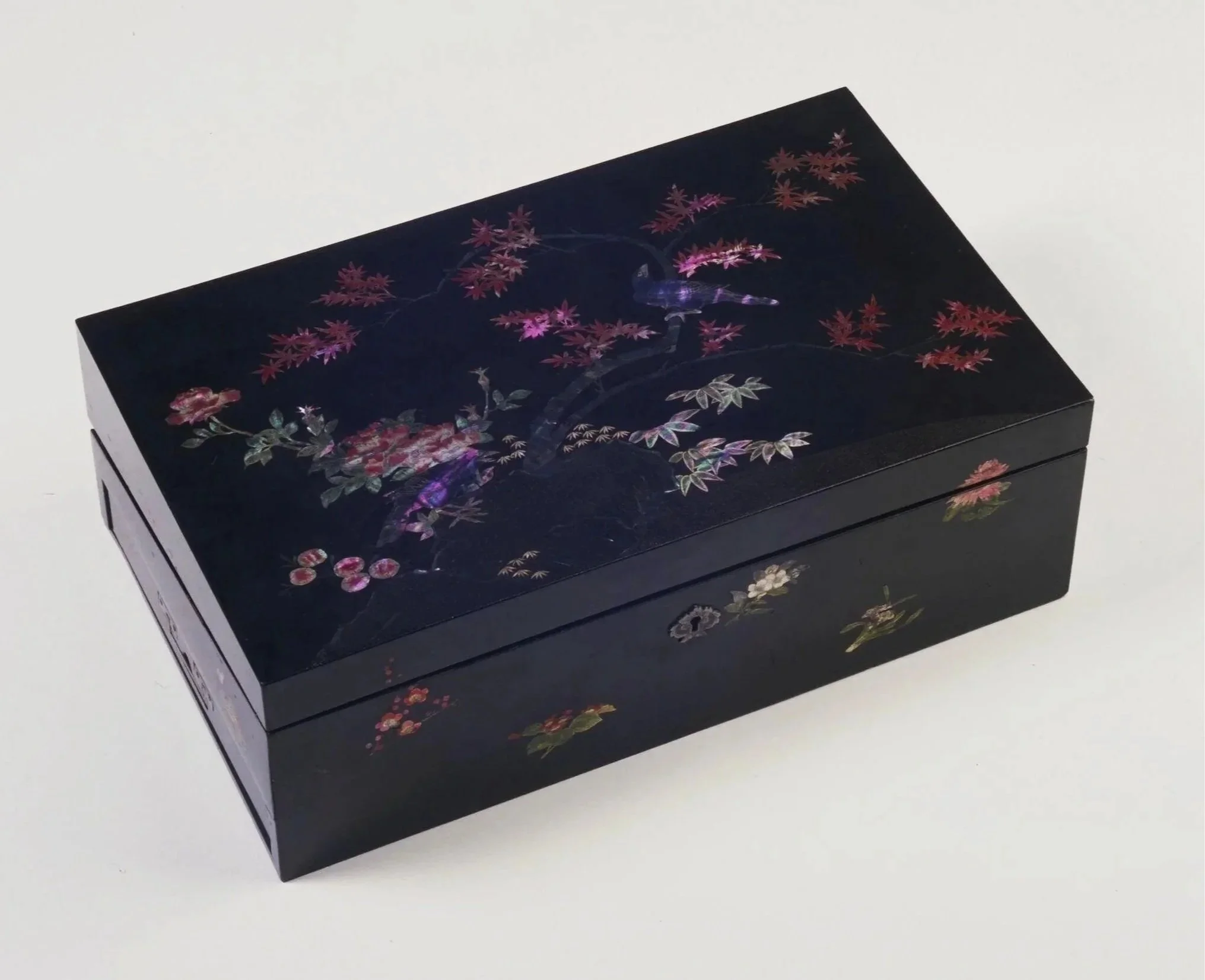
Unknown Maker, Nagasaki, Japan, Writing box, 1800-1850 (made). Wood, covered with black lacquer and inlaid with under-painted mother-of-pearl. Victoria and Albert Museum, East Asia Collection, 51:1 to 3-1852. © Victoria and Albert Museum, London.
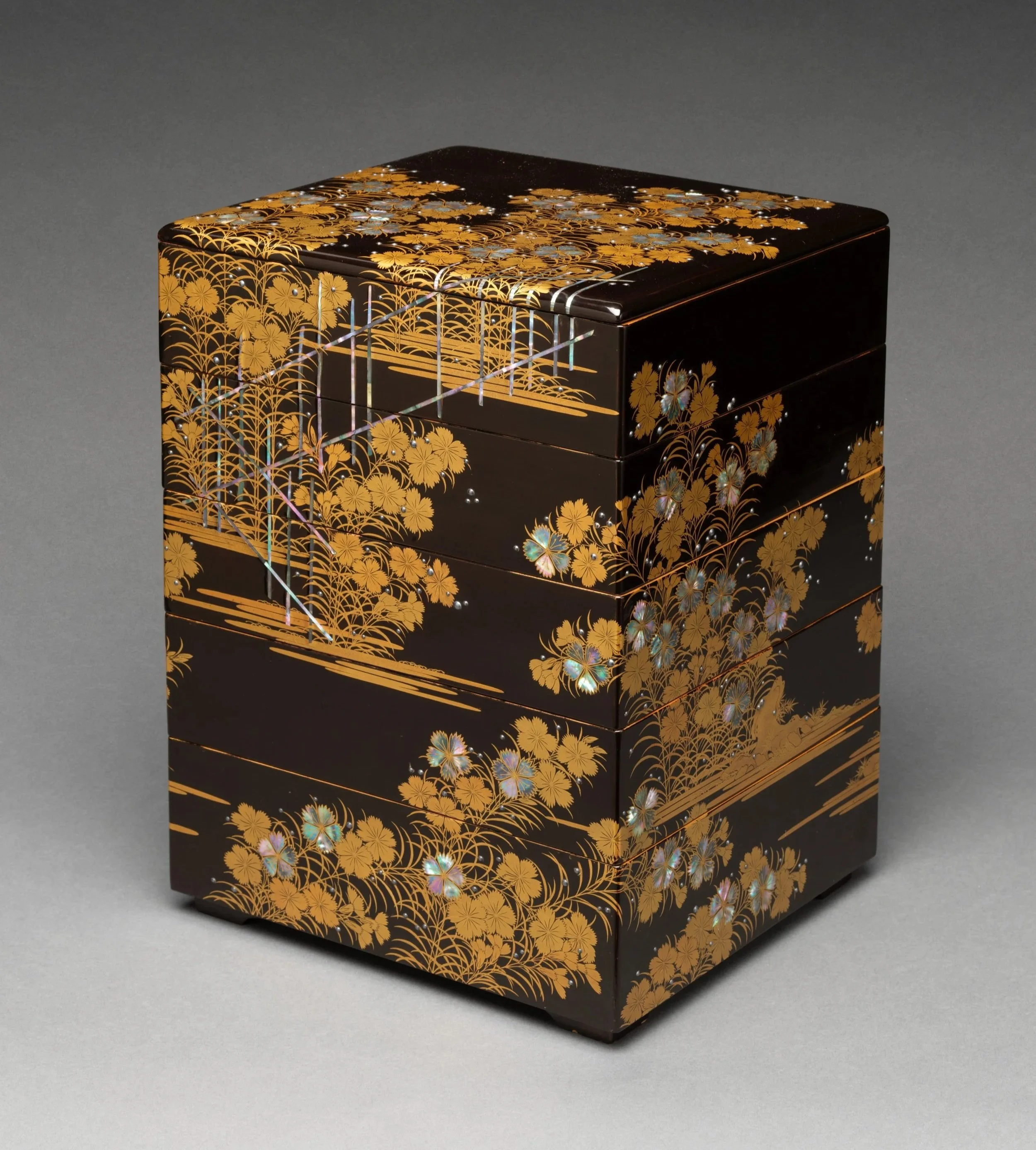
Japanese, Edo period (1615–1868), Five-tiered picnic box with design of wild pinks, 18th C. Gold maki-e, inlaid mother-of-pearl, and applied silver on black lacquer. 13 x 8 1/2 x 9 1/4 inches. The Metropolitan Museum of Art, New York. Gift of Florence and Herbert Irving, 2019, 2019.193.40a–f.