The pearlies
Martin Myrone
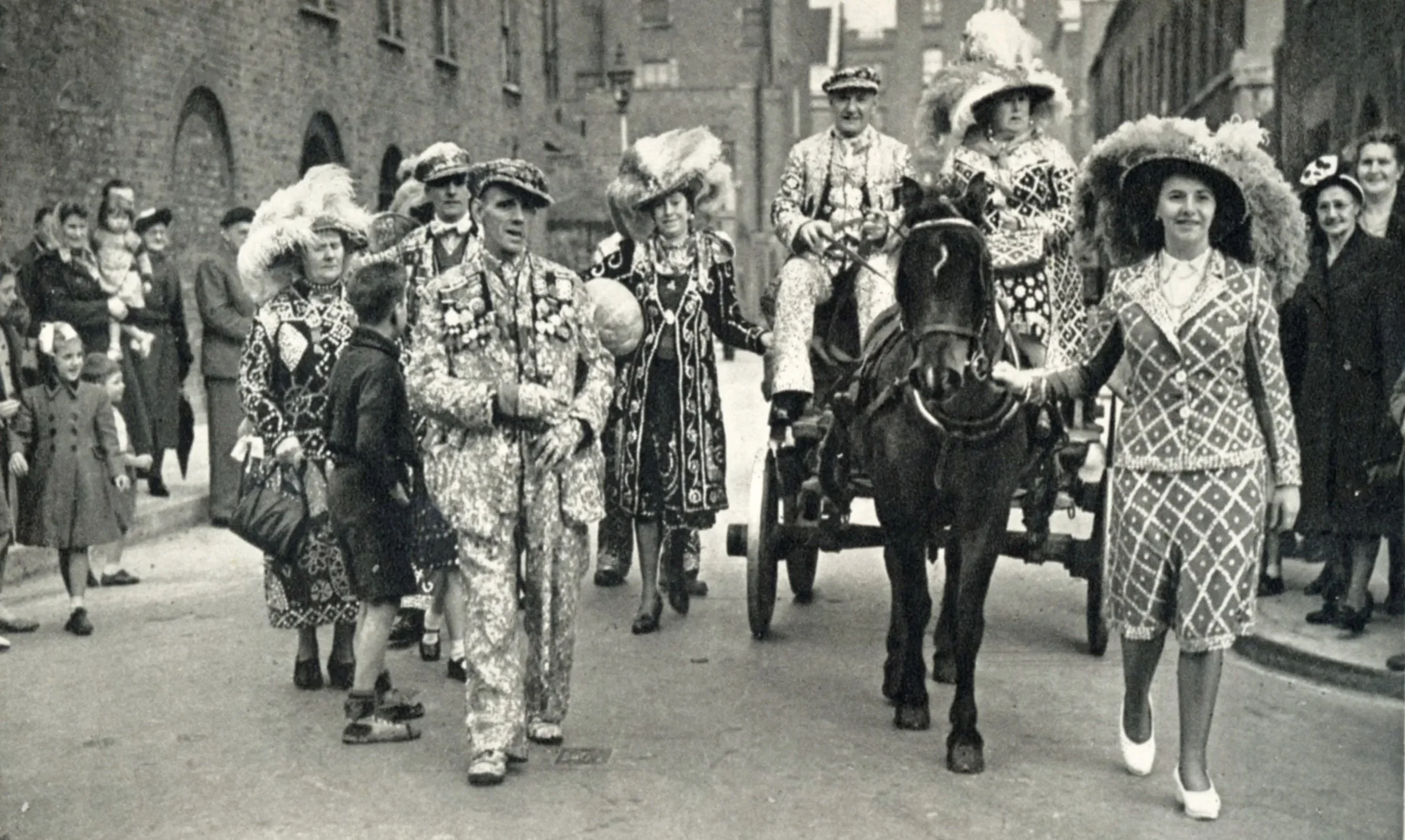
Postcard, "London Life: Costermonger 'Pearly Kings and Queens' in Southwark, ca. 1950. Photo: G.P.U." Image courtesy the author.
Presented so often, and so demonstratively, as the very embodiment of tradition - in England, in London, for the working class - the Pearly Kings and Queens nonetheless raise the question of authenticity. To put it bluntly: are the Pearlies real? They are visible, certainly. Even a succinct list of appearances will dazzle: Mary Poppins (1964) and Trainspotting (1996); the Festival of Britain (1951) and the 2012 Olympics opening ceremony; Ian Drury and The White Stripes; Gear, the celebrated shop in Carnaby Street, selling Pearly fashions at the height of the Swinging Sixties; John Galliano and Alexander McQueen; the nationally famous Pearly King Bert Matthews, who got his own episode of the TV show This is Your Life in 1964; the ubiquitous ‘Lambeth Walk’ from the musical Me and My Girl (1937).
For all this dispersion, the Pearlies have attributed to them a surprisingly concrete date of origin. In 1875, supposedly (the claim achieved newfound definitiveness with 150th anniversary commemorations in 2025), a young road sweeper named Harry Croft adopted a costume of multitudinous mother-of-pearl buttons, sewn onto a black suit, as a visual aid for his charitable fundraising efforts. The pattern was adapted swiftly by others, with various Pearly charitable festivals and associations established in subsequent decades.
There has been little interest in finding formal precedents for Croft’s outfit, beyond a vague notion, little evidenced, that he had simply multiplied the wearing of decorative buttons by street vendors, or “costermongers,” perhaps with music hall costume playing a part as well. The material factors involved in the historical emergence of the Pearlies at this precise moment, however, suggest themselves quite readily. Industrial innovations and intensifying colonial extraction had made mother-of-pearl more prevalent in button manufacture from mid-century, and there was a massive escalation of imports of the raw material from Australia in the 1870s and 1880s.
The Pearlies might therefore appear as an exemplary ‘invention of tradition,’ in Eric Hobsbawn’s well-known formulation, or a specimen of fakelore or folklorismus – a fabrication. However, historians like Gareth Stedman Jones and Raphael Samuel have ultimately rejected such a definitive opposition of real and manufactured, and in any case, notwithstanding the Pearlies’ cultural prominence, they have only hovered around the edges of ‘folkishness’.
Barbara Jones selected a set of Pearly costumes for her seminal popular art exhibition ‘Black Eyes and Lemonade’ (1951), and Pearly costume played a prominent role in the ‘Making Mischief’ research project (2023). But the otherwise omnivorous Jeremy Deller did not include them in his various folk projects, including the well-known Folk Archive, and the historians and curators of folk art generally uninterested. The Pearlies’ political orientation towards class deference, religious conformity and personal sobriety has repelled those hungering after ‘folk opposition.’
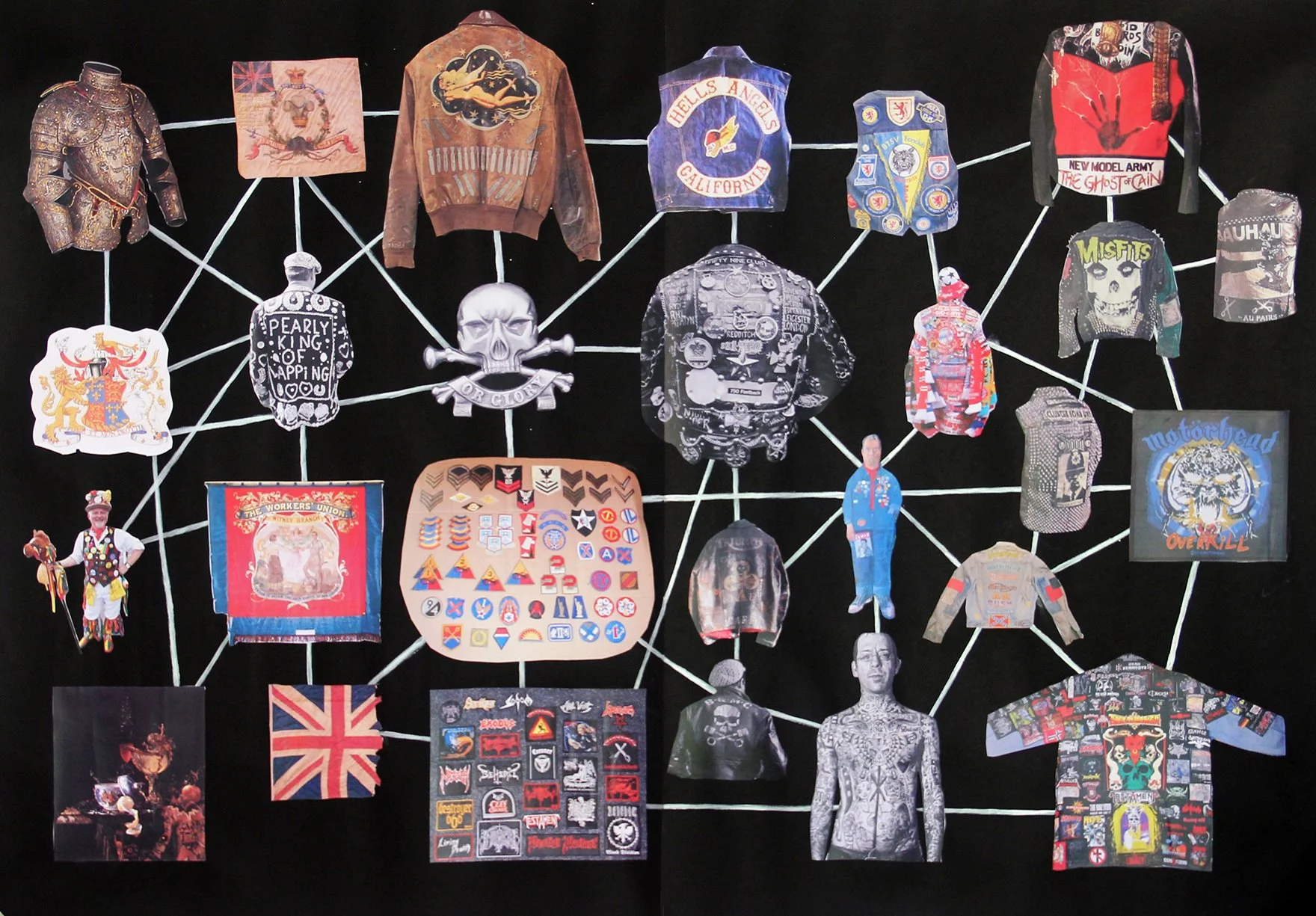
Tom Cardwell, Battle Jacket Map, collage and acrylic paint on paper, 59 x 84 cm (23.23 x 33.07 in.), 2015. Image courtesy the artist.
While manifestly based in shared conventions and self-conscious repetition, Pearly costume is most certainly also an opportunity for individualism. Clive Bennett, Pearly King of Woolwich, puts it like this: ‘as long as you don’t copy anyone’s pattern, verbatim, then you can really put on what you like.’ In its intensive customisation, the Pearly outfit it sits alongside knowingly traditional forms of folk costume adopted for festivals or events, or even the “battle jackets” of heavy metal fandom.
When it comes to the material intelligence of the Pearlies, there are certain ambiguities. The historian Peter F. Brooks, in his 1974 book on the topic, asserted that ‘no self-respecting king or queen would dream of appearing in a suit decorated with plastic buttons.’ In principle, Pearlies swear by ‘authentic’ mother of pearl, though other materials are used too: an anonymous postcard writer, in about 1950, took interested note of ‘imitation pearls & sequins that catch the light with every movement.’
Mother of pearl is already in some sense already a surrogate for actual pearls, while also being its natural source; it can be processed into (not quite-fake) pearls, endowing pearlishness on a budget. The ‘flash’ which has been given attention from the very moment of Pearly conception (Harry Croft being famously the ‘flashiest’) – the ‘gleam’ and ‘glare,’ as others have it – suggests some magic in the iridescence of massed pearl buttons.
Brightness and pearlescent shimmer are heightened by contrast – but also conspicuously wasteful, of material, of time, of labour, with a pedantic insistence in many accounts on the precise numbers and weight of buttons, and the time taken to sew them. What the art historian Natasha Eaton described as the ‘mysterious force’ of pearls in the context of mercantilism, colonial extraction and industrial production, their ‘curious shimmering light’ evoking the ‘mystical and the arcane,’ carries over into relatively plentiful and cheap mother of pearl, processed abundantly into everyday buttons.
The dense, all-over adornment of the ‘smother’ suit provides a pearlescent second skin; the body is shrouded and remade as reptilian and armoured. “Pearly” is both an adjective and a noun: a person materially consumed. Where the button decoration is not so dense, but skeletal – with borders, contours and edges given special attention - there is still magic, of the kind detected in anthropological readings of shamanic costume, in which reflective materials often provide spiritual protection. One might see this talismanic function offering not so much meaning as the refusal of meaning. In a shimmering costume that both asserts and repels, the Pearly hovers queasily between the authentic and inauthentic, the natural and manufactured, the enchanted and the banal – finally calling into question the viability of such oppositions.
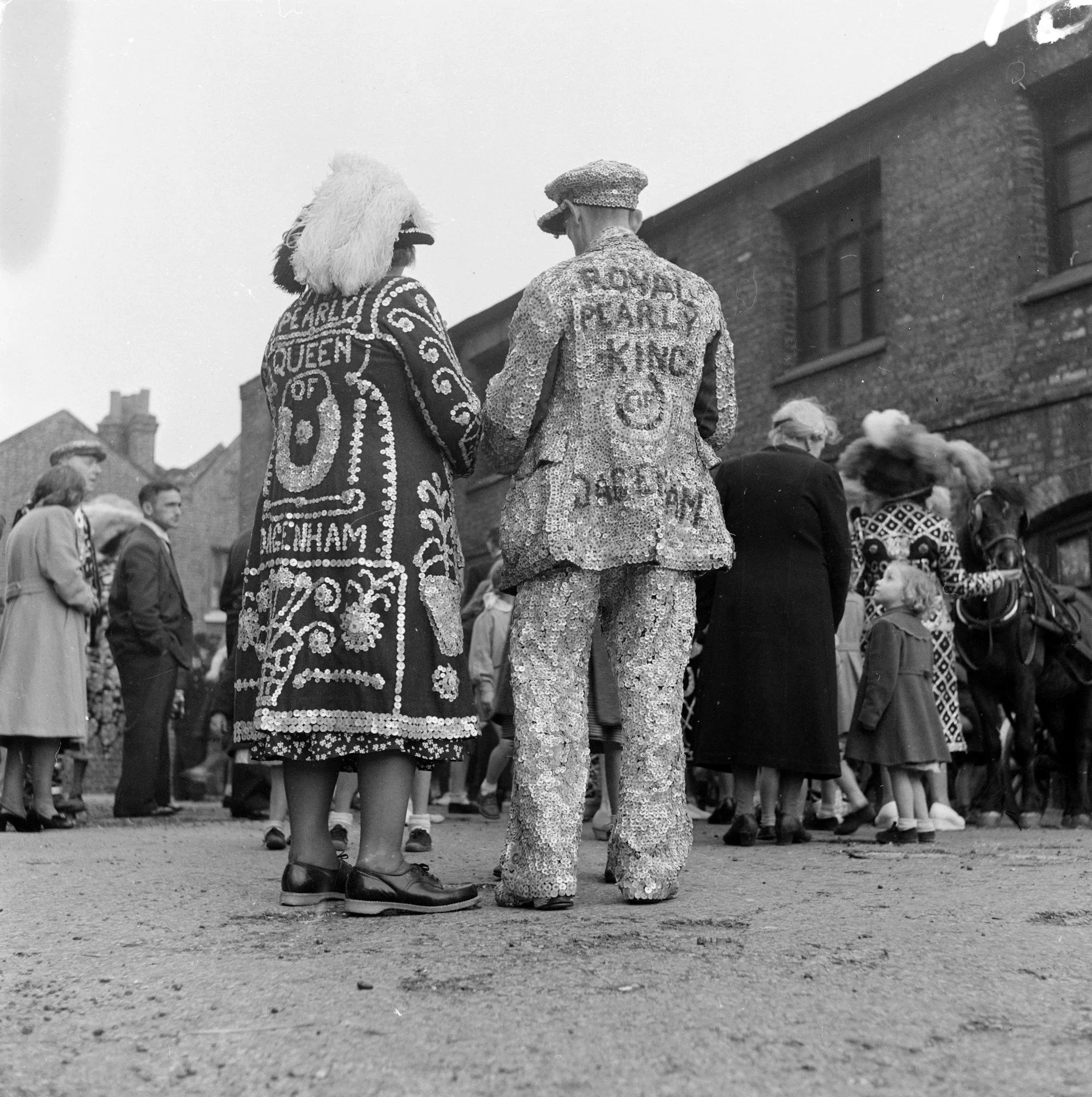
Henry Grant, Pearly King and Queen of Dagenham, 1951. Cellulose acetate photograph. London Museum, Permanent collection, Purchased with V&A Purchase Grant Fund support, HG1328/16. © Henry Grant Collection/London Museum. CC BY-NC 4.0.