Target shooting with mollusks
Jonathan James Tavares
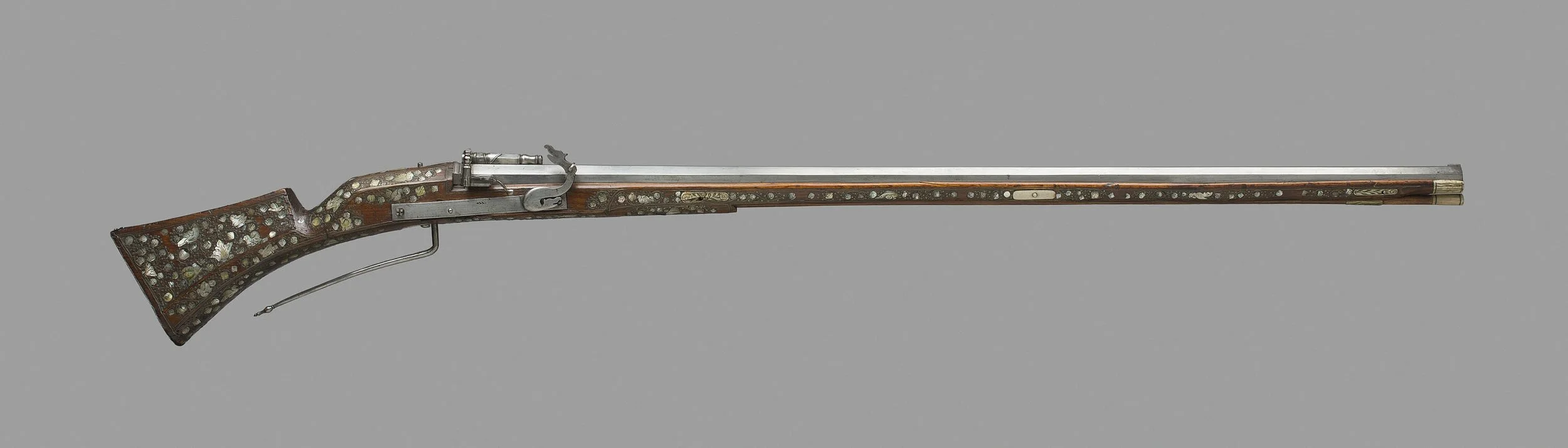
Dutch (probably), Matchlock Musket for Target Shooting for the Court of Christian II, Elector of Saxony, 1600-1610. Steel, brass, walnut, staghorn, and mother-of-pearl. 39 in. (barrel); caliber .64. The Art Institute of Chicao, George F. Harding Collection, 1982.2264. Creative Commons Zero (CC0).
Weapons and mollusk shells might seem a strange combination. There are the pearl-handled revolvers of the American Wild West, of course, but for me, mother-of-pearl (the inner layer of mollusk shells, also known as nacre) stirs images of flashy baroque firearms. The play of light and color inherent in the iridescent material — and its ability to be engraved, sawn, and inlaid alongside hardwood, bone, brass, and antler — made it an ideal ornament for luxury arms. The first half of the seventeenth century saw the introduction of mother-of-pearl on gunstocks, powder flasks, and other hunting and military arms, befitting this moment of maximalist design. What follows is only a brief impression of these extravagant shell-decorated arms and those who used them.
My own museum, the Art Institute of Chicago, houses a matchlock musket produced in the Netherlands around 1600 to 1610; it is profusely inlaid with birds, leaves, and pellets of mother-of-pearl set into a fruitwood stock. The gun is one of over a dozen imported for the Elector Christian II of Saxony for use in target shooting. This sport did not have noble roots, though, as one might expect; it instead developed among bourgeois shooting guilds and civic militia groups, particularly in Germany and the Netherlands, which gathered to practice for defense of the city. Aristocrats wanted in on the shooting, feasting, and drinking of these middle-class groups. Thus, a new genre of firearms—the deluxe military-style musket with an inlaid stock—found a market among the nobility, in addition to the wealthy burghers who had started the shooting trend in the first place.
This fashion is documented in several of the group portraits of civic guards in Amsterdam and other Dutch cities painted in the early seventeenth century. These large canvases fastidiously record the clothes, weapons, and armor of their sitters, announcing their wealth and social prominence. Nicolaes Eliasz Pickenoy’s 1625 painting of a group of civic guards depicts three militiamen clutching heavily worked gunstocks. The glint of mother-of-pearl and horn inlay can be seen on the musket shouldered by the figure in the center of the top balcony; his musket butt shows off large oval plaques engraved with classical heads. Such weapons represented an expense equal to many months of a skilled craftsman’s wages, indicating that these militiamen were by no means common soldiers. The matchlock musket may have been the weapon of a foot soldier, the wealth and position of these men imbued it with a higher status.

Nicolaes Eliasz Pickenoy, Civic Guardsmen of District V from the Company of Captain Matthijs Willemsz. Raephorst and Lieutenant Hendrick Lauwrensz., 1630. Amsterdam Museum, SA 7312. Public domain, via Wikimedia Commons.
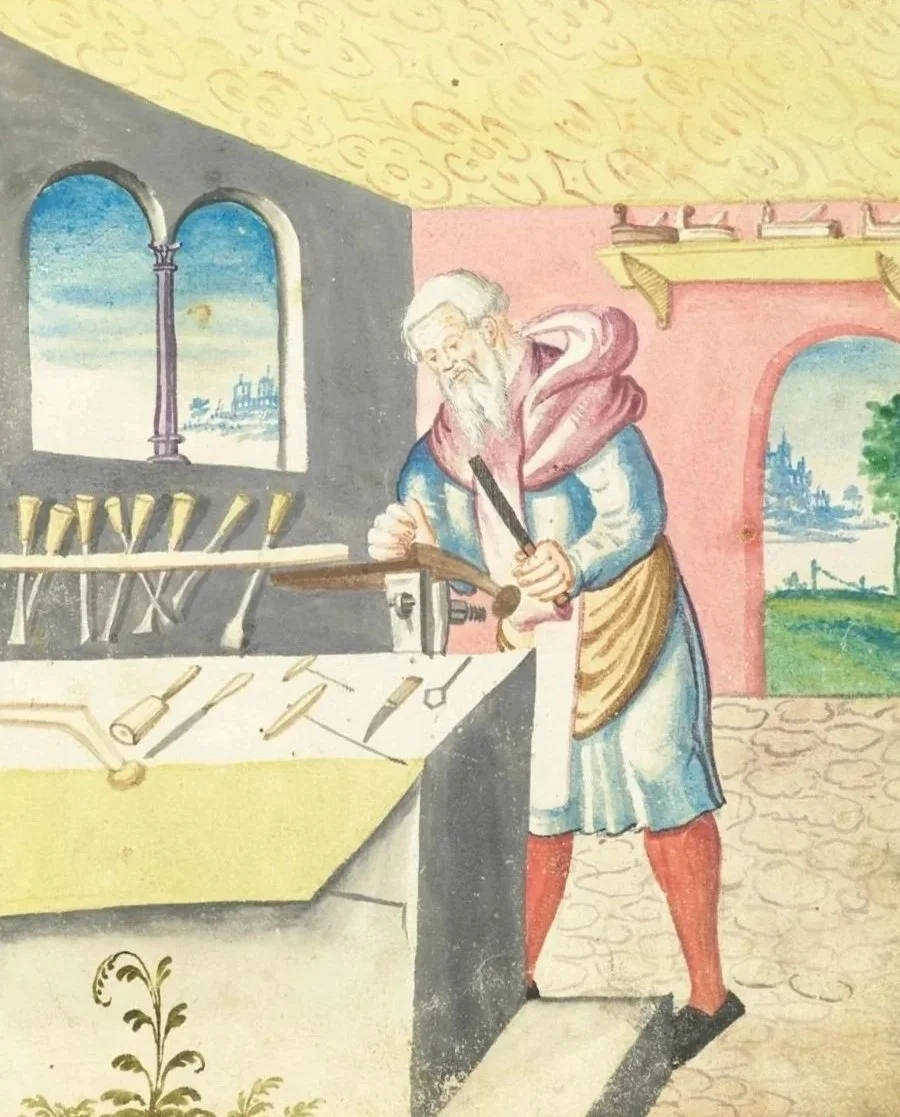
Konrad Mendel and Matthäus Landauer, Mendel II, from the "Hausbücher der Nürnberger Zwölfbrüderstiftungen" (Housebooks of Nuremberg or The Twelve Brethren Books), Stadtbibliothek im Bildungscampus Nürnberg, Amb. 317b.2°, Folio 32 recto. Public Domain Mark 1.0 Universal.
Mother-of-pearl inlay, then, became a vehicle of social cachet for nobles and wealthy burghers alike, but just where this trend originated is unclear. It may have developed first in southern Germany, in major trading and artistic centers like Nuremburg, around the 1590s. A crucial new tool was the fretsaw, a fine-toothed, thin, tempered steel blade capable of cutting intricate plaques of bone, staghorn, or shell to be set into hardwood (especially cherry and pear). This tool was deployed by stock makers (Buchsenschifter), a developing profession of woodworkers born from the chest makers guild (Kistlers) that collaborated closely with gunsmiths, who worked only in metal.
Germany and the Netherlands were not the only places where this lustrous material was used. It was also exploited in Silesia, between the borders of Prussia (Germany), Poland, and Bohemia (Czechia), and in England and France – particularly Alsace, as can be seen in another target-shooting musket stock in the Art Institute’s collection. What do all these regions have in common? The answer may be in the luminous material itself. While it might seem exotic, mother-of-pearl was in fact cut from the thick shells of European freshwater pearl mussels (Margaritifera margaritifera). Now endangered, these mollusks can live to be 125 years or older. They must have a habitat of clean, fast-running water in gravelly riverbeds and streams, and are dependent on fish to aid in their reproductive cycle, all of which makes their existence fragile in today’s conditions of climate change.
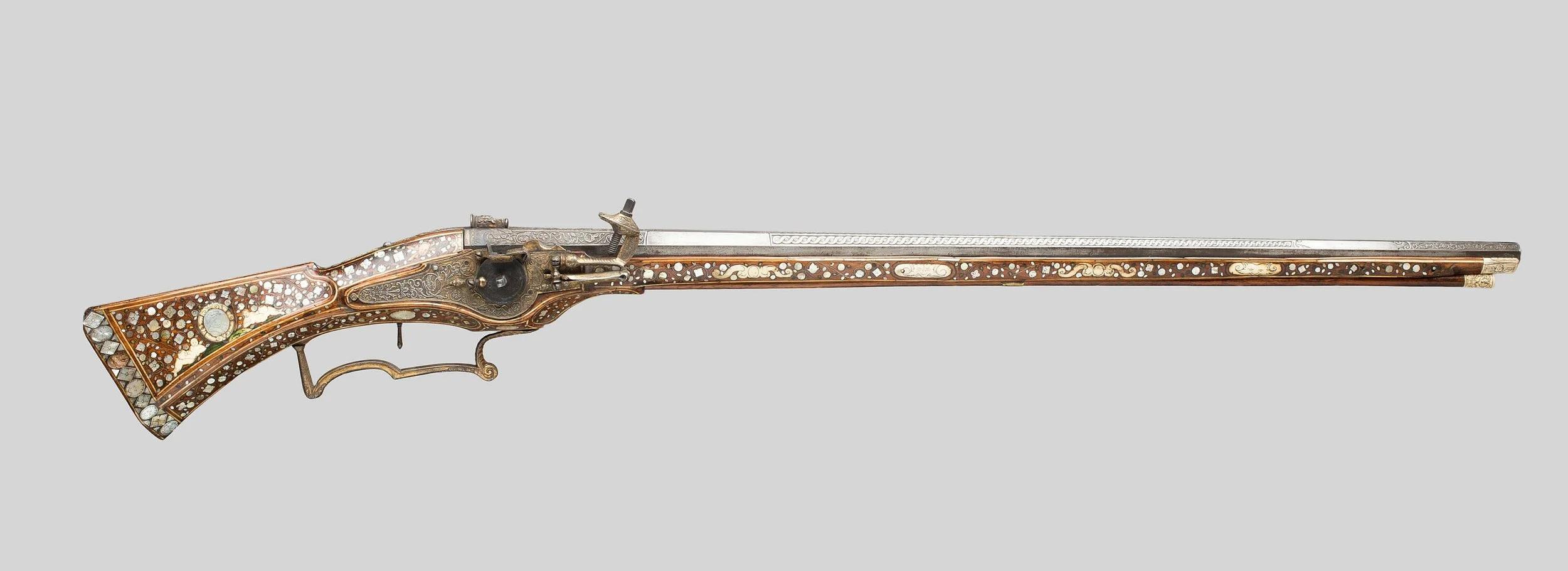
Franco-German; Possibly Alsace; Embellishment probably by Workshop of Frédéric Spitzer (Austrian, active 1815-1890), Paris, Wheellock gun, 1605-1615. Steel, fruitwood, gilding, horn, and ivory. 38 1/2 in. (barrel); caliber .66. The Art Institute of Chicago, George F. Harding Collection, 1982.2847. Creative Commons Zero (CC0).
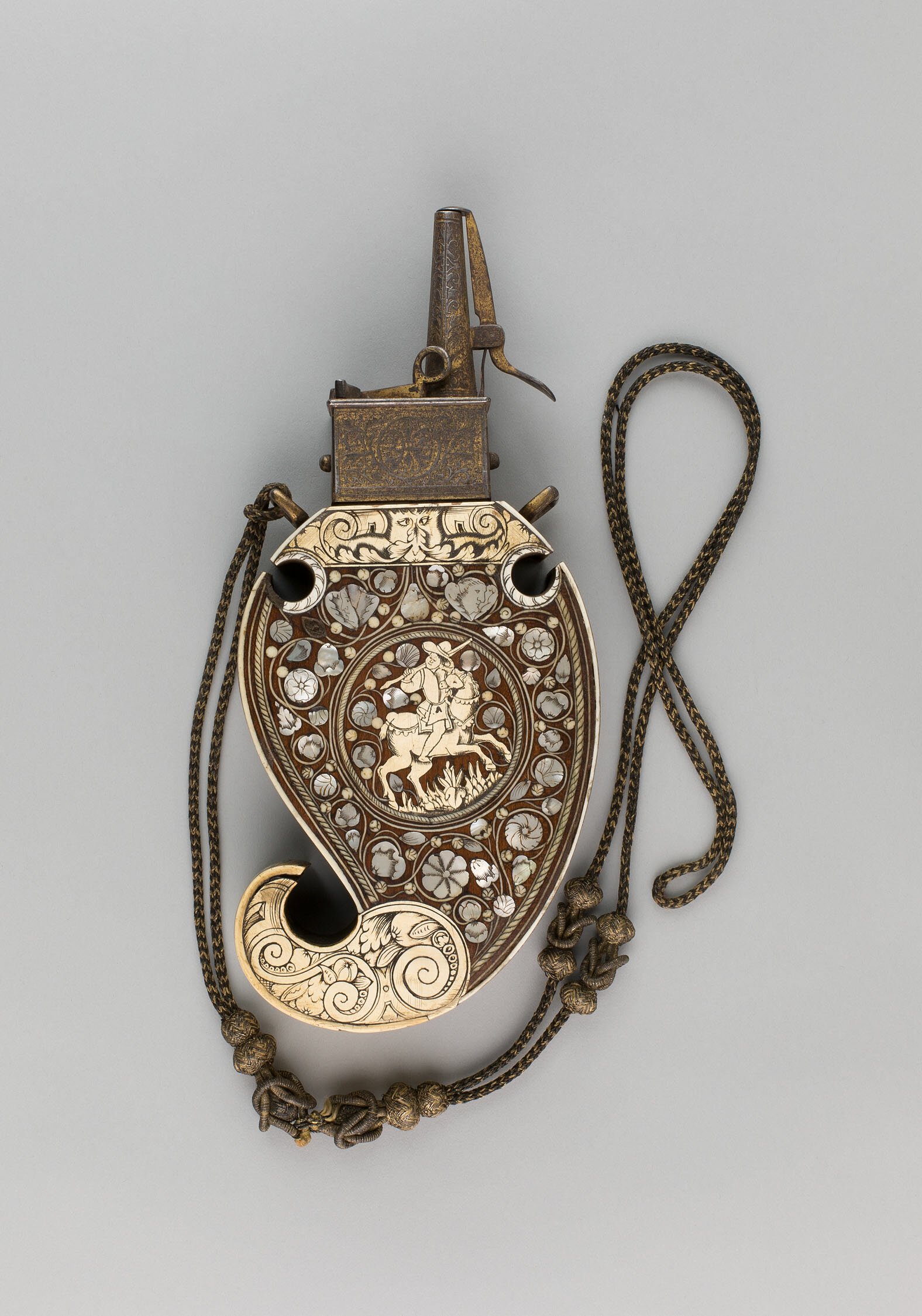
German, Powder Flask, 1610-1640. Walnut, mother-of-pearl, and iron, with gilding. 9 1/2 × 4 1/4 × 1 3/4 in. (flask). The Art Institute of Chicago, George F. Harding Collection, 1982.2272. Creative Commons Zero (CC0).