Nzimbu, an African shell
Chenoa Baker
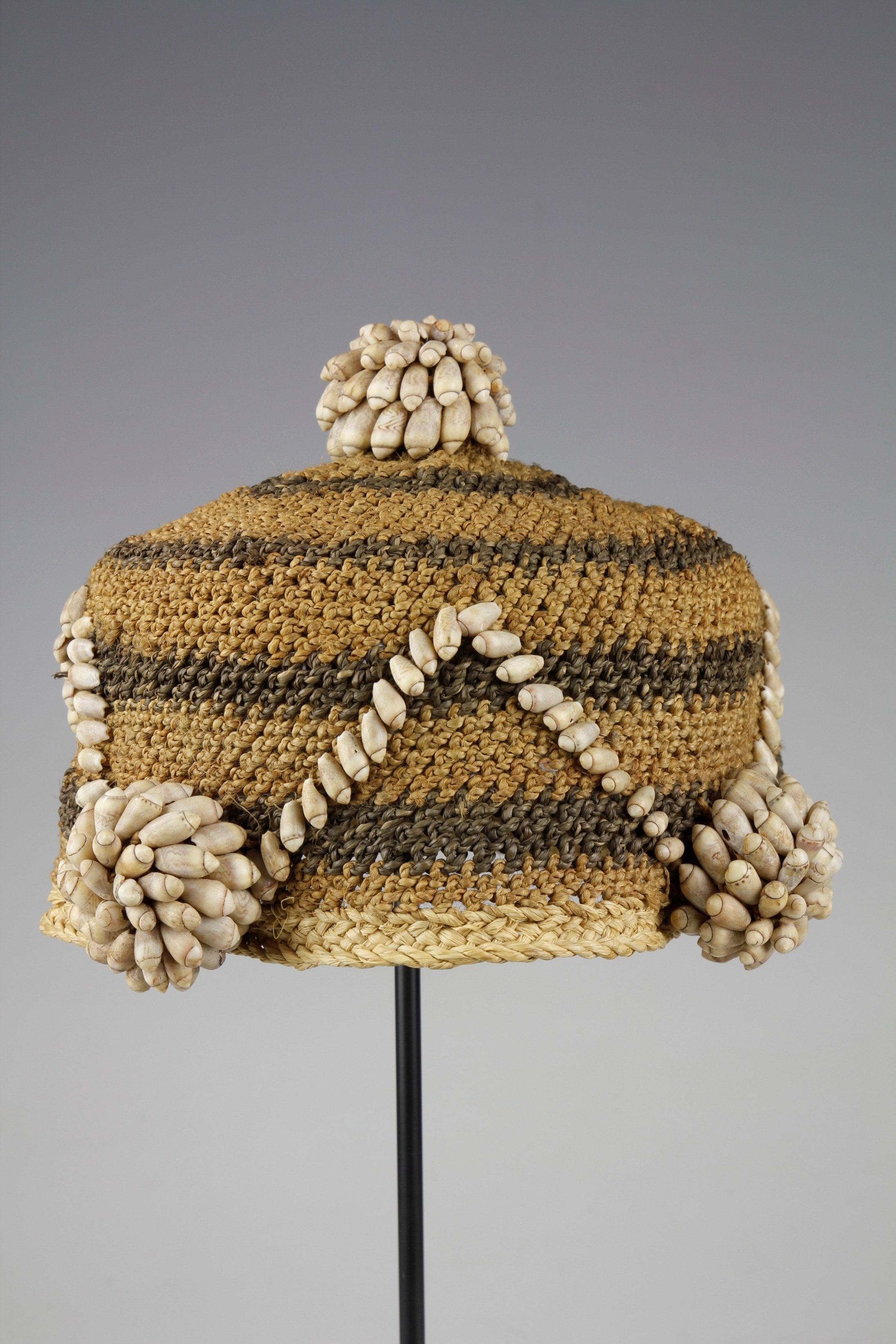
Mbala Culture, Democratic Republic of the Congo, Prestige Cap (Mpu a Nzim), ca. 1930s. Raffia and Olivancillaria shells. Image: Tribal Gathering, London.
They are little dead snails… fished on the beach by order of the King. They are called nzimbu [and] spent by quantities, not one by one.
– Friar Bernardino d’Asti, “Missione in Prattica,” 1750
Cowries tend to dominate the conversation about shell-based African currency. Imported across the Indian Ocean, they first began circulating in Africa during the colonial period, and were widely used in exchange for commodities – as well as enslaved people. However, that well-known story neglects a smaller shell, indigenous to the African continent, that was the precursor to the cowrie: the nzimbu.
This KiKongo word (njimbu in KiMbala) denotes a slender shell with a spiraled minaret body ending in a sharp point; they can have brown zebra-pattern-like striations or natural chevrons. The Head of Mollusks at the Carnegie Museum of Natural History, Tim Pearce, identifies them as sea snails in the Olividae family; further research confirms them to be Olivancillaria nana, which appeared in illustrations made between 1650 and 1750 to guide foreign missionaries through Central Africa.
As early as the 13th century, nzimbu reportedly circulated as currency in the Kingdom of Kongo. Most surviving accounts of their use were recorded by Portuguese and Venetian uninvited observers, so the history of the shell reaches us with inevitable gaps and distortions, filtered through linguistic and cultural translation. Portuguese merchant Duarte Lopez in 1578 and Venetian explorer Antonio Pigafetta in 1591 wrote, “The shells were grouped by sex, because female shells, smaller and brighter, were more valuable.” They further claimed that Nzimbu were collected by women in Benguela along the Angolan coast, and Lopez continued that “The harvest was delivered to the King, who deposited them on a small island, opposite Luanda.” At a time when European economies were backed by precious metals, the monarchs of Kongo set up and maintained an economy based on shells instead. Dr. Edouard Mambu Ma Khenzu who wrote a dissertation called “A Modern History of Monetary and Financial Systems of Congo 1885-1995” wrote that these shells were as “small as a coffee bean.”
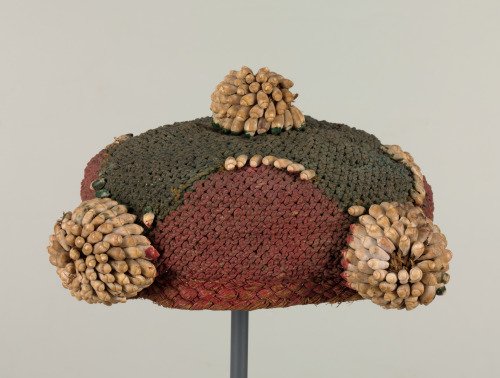
Mbala, Chief’s Hat (Mpu a Nzim), 20th C. Fiber, nzimbu shells, and pigment. 5 x 11 1/2 inches. The Baltimore Museum of Art by Gift of Ed DeCarbo, New York, 2012.72.
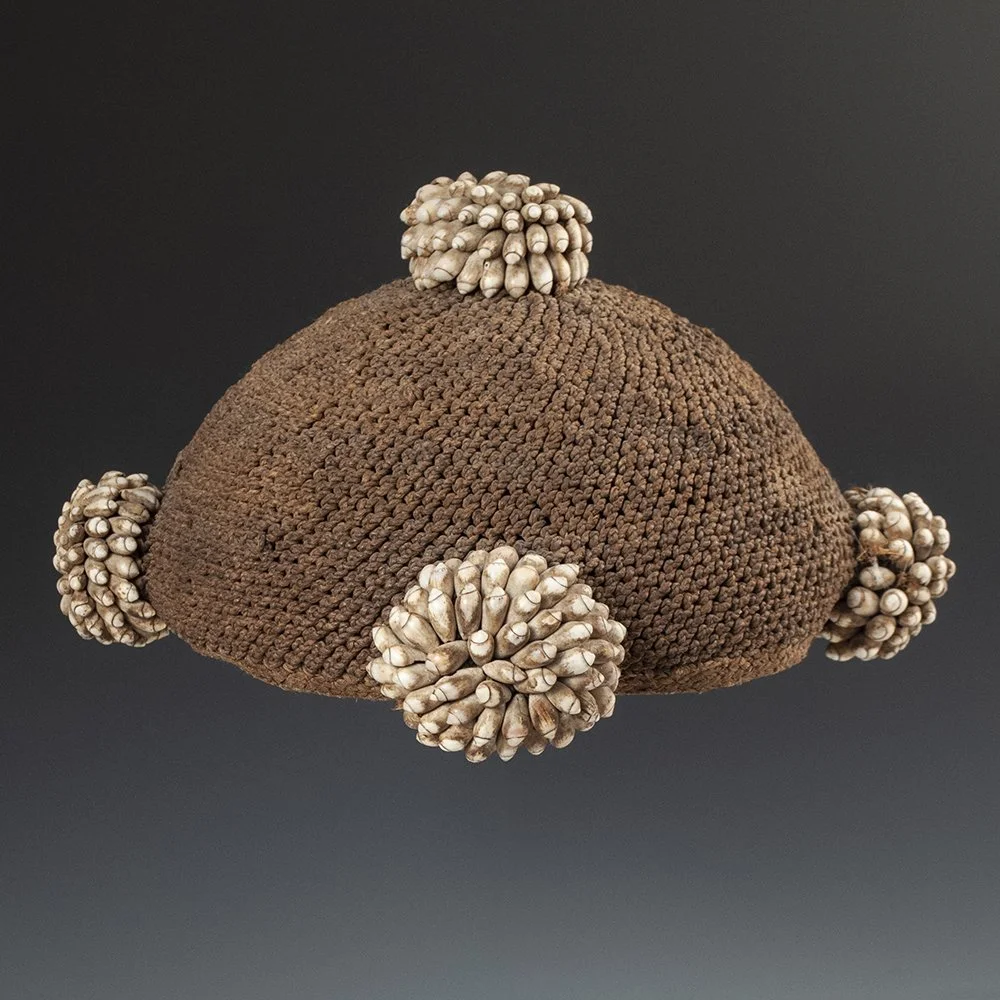
Mbala Culture, Democratic Republic of the Congo, Chief's hat (Mpu a Nzim), 20th C. Raffia palm fiber, raffia, and snail (n’simbu) shells. Image, San Francisco Tribal.
Since kings controlled the initial distribution of nzimbu, it is not surprising that they were used to adorn chief hats (mpu a nzim) designating community leaders. The shells were attached to the hat with raffia, palm fibers, or pineapple leaves, using a complex, months-long knotting technique, still practiced among the Mbala people in the 19th and 20th centuries. A cluster of shells gathered at the top of the hat and the corners, which were connected by diagonal lines of shells. Many of these hats adopt the “radial cluster” style, with another variation covered with the shells, with just a small outline of brown fabric. At the CUNY Art Gallery is a version completely covered in nzimbu with has a forward tail on the top and two side radial clusters, outlined by red, blue, and yellow glass beads. Despite these stylistic differences, these Mpu, or “prestige caps,” were generally worn by men to signify their political and social position, and in some cases might be handed over by a predecessor.
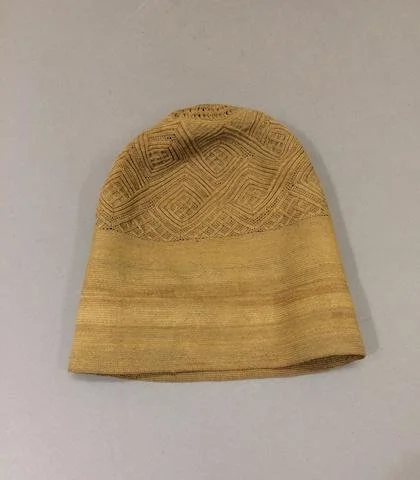
Democratic Republic of the Congo, Prestige Cap (Mpu), 19th C. Raffia or pineapple fiber. 7 1/2 x 7 inches. Yale University Art Gallery, Bequest of Paul F. Walter, 2023.46.5.
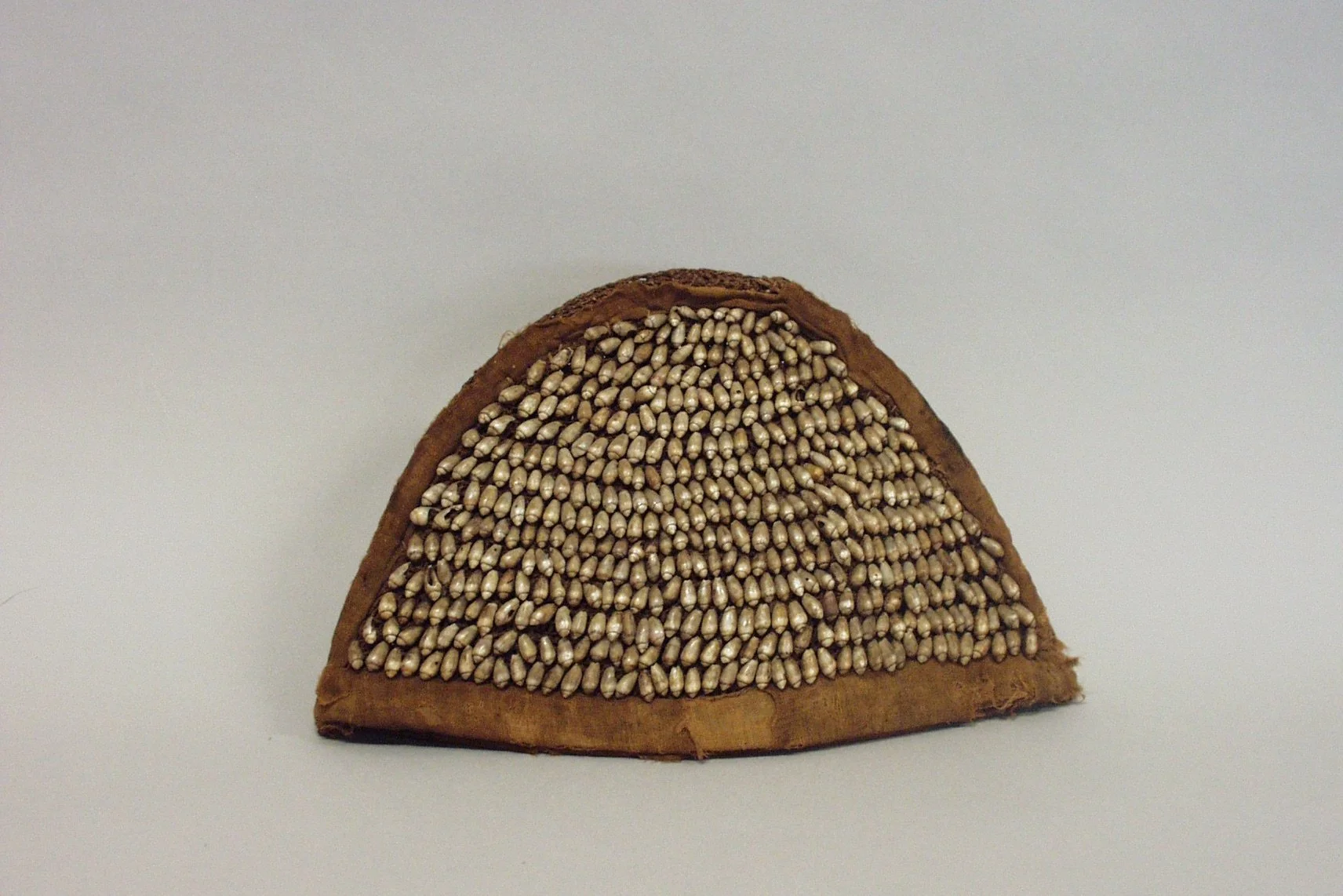
Tsogo, Unknown, Mpu a Nzim (Hat), Fiber, cotton, and shells. University of Iowa, Stanley Museum of Art, Anonymous Gift in Honor of Betty Stanley, 1986.74.