Introduction
Glenn Adamson
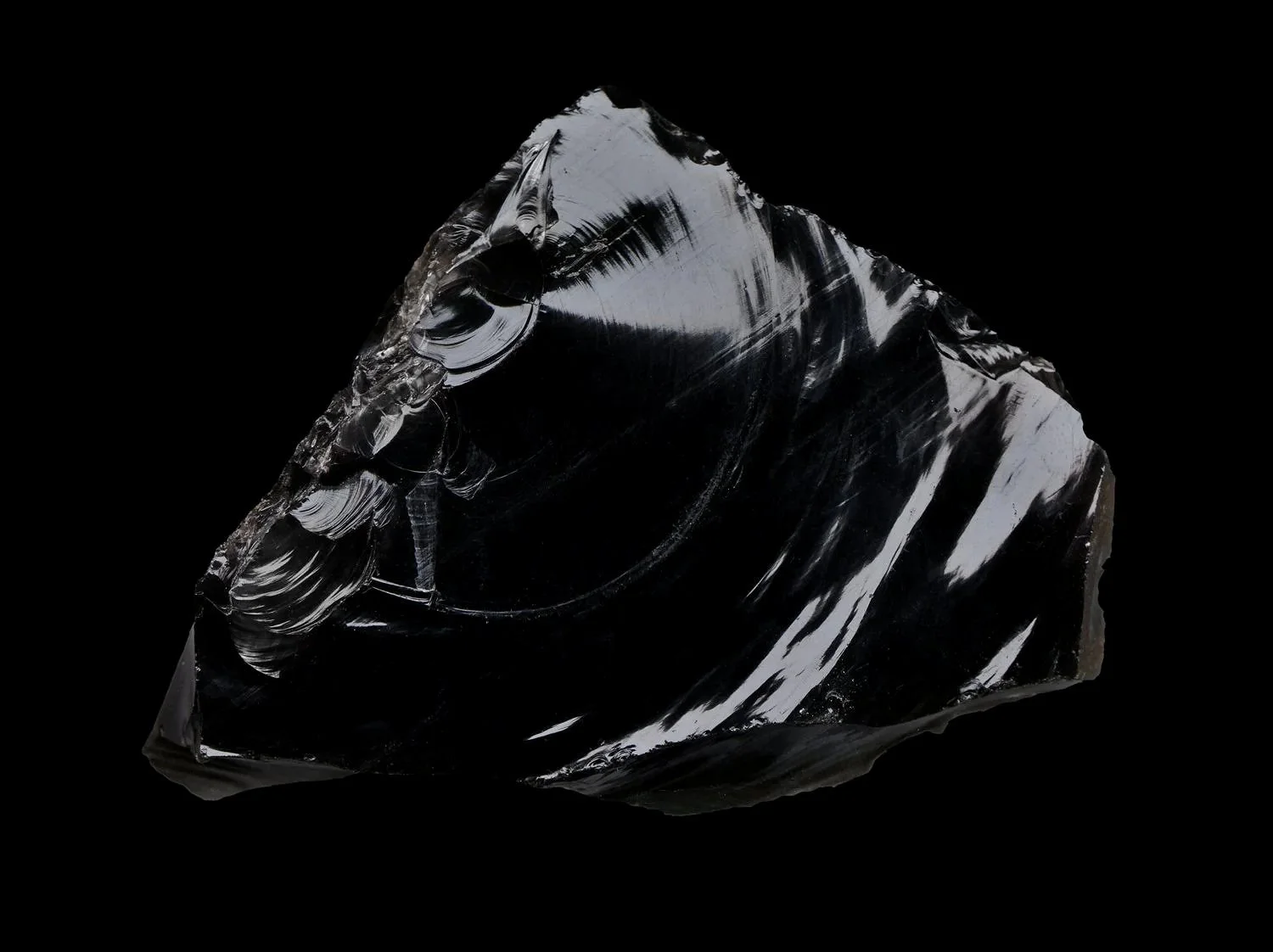
“The noonday sun shone down upon the fast green river; it had great, black chunks of lava with soft-looking edges piled along the shores, fallen there from the sides of the steep slopes on either side. The lava lined the canyon, making it unutterably dark in an unnatural kind of sunny way.” This is Mabel Dodge writing, in The Edge of Taos Desert, the fourth and final installment of her memoirs. She had previously led a cosmopolitan existence, with her Fifth Avenue salon one of the great talking-shops of the avant garde. She was among the organizers of the famous Armory Show, in 1913, which introduced modern art to America. Four years later, ever restless, Dodge went west to find something else.
She found it. Having had quite enough of artistic innovation, she fell in love with New Mexico – settling in Taos, just by the ancient Pueblo there, and eventually marrying a Tiwa man called Antonio (Tony) Lujan. They would go on to attract artists and writers from far and wide, promoting Taos to them as a beautifully-preserved remnant of traditional culture. Her first impression of this new landscape (at least in her somewhat romanticized later telling), the volcanic material she saw along the Rio Grande, was like a premonition of this new life: “I stared, fascinated by it. Where the water had washed it for centuries, it was smooth and shone with a dark, lustrous polish that had something reptilian in it… In this country, everything lives and moves and has its being.”
Dodge little suspected it, but she was only the latest of many to be captivated by obsidian – and her own reflection in it. Though usually described as a stone, it is actually a naturally occurring glass, formed when magma forces itself to the surface and then rapidly cools. Prevalent wherever volcanoes are active – on the south coast of Iceland, where there is a whole obsidian mountain called Hrafntinnusker; across the Americas; in Anatolia, Italy, and the South Pacific - it has played an important cultural role since ancient times, practically, symbolically, and economically. Even as this issue of Material Intelligence was going to press, a cache of 575 obsidian hand-axes, knapped (that is, chipped under pressure) into teardrop shapes for cutting, were discovered in the Awash valley of Ethiopia – evidence of a craft workshop that was active about 1.2 million years ago. For today’s archaeologists and historians, it is an indispensable trace of prehistoric settlement and exchange, providing evidence of communities from small villages up to whole cities, and the complex trade routes between them.
But Dodge didn’t know any of that. Like so many before her, obsidian seemed to her a completely enigmatic substance, emblematic of a “land of enchantment” (a phrase that appears on New Mexico license plates to this day). This attitude, in which European and American outsiders beheld this shining black glass and projected their own desires upon it, goes far back into history. The most famous of all obsidian artifacts is a relic of colonization: an Aztec mirror that came into the possession of John Dee, the famous alchemist-astrologer of the court of Elizabeth I. Now in the British Museum, it was originally looted (likely from the city of Tenochtitlán) following the military conquest led by Hernán Cortés in the 1520s.
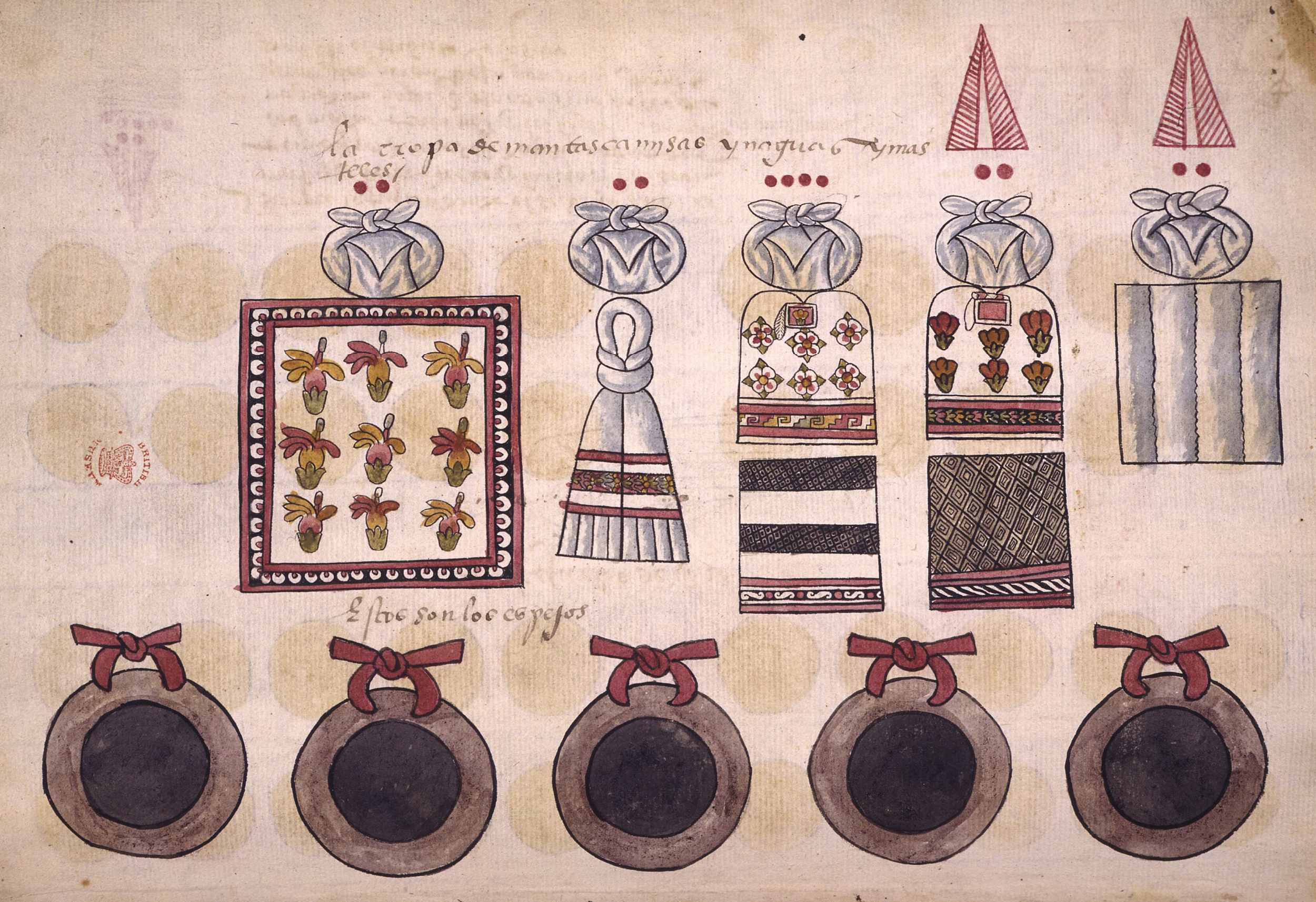
Codex Kingsborough, Petition of the Indians of Tepetlaoztoc. One of 72 leaves from Codex; illustrating Aztec mirrors c. 1550. © The Trustees of the British Museum. Shared under a Creative Commons Attribution-NonCommercial-ShareAlike 4.0 International (CC BY-NC-SA 4.0) licence.
Recent geochemical analysis has demonstrated that the obsidian used to make the mirror is from Pachuca, in the Sierra Las Navajas, one of the richest sources of the material in the Aztec empire. The object’s extremely smooth surface is the result not of natural cleaving, but slow and careful polishing using abrasive sand. Its large size and quality would have made this an exceptional artifact even in its original context (today, only eighteen such circular mirrors are known). Among the Aztec, it would have been associated with the god Tezcatlipoca, whose name means “Smoky Mirror,” and would have served to ward off malevolent spirits and as a divination tool.
It’s not totally clear how or when Dee obtained the mirror – one theory is that he bought it in Bohemia in the 1580s – or what, if anything, he knew of the artifact’s usage among the Aztec. But we do know that he seems to have understood it as a sort of dimensional portal, a “shew-stone” or “scrying glass.” He collaborated with another self-declared magician named Edward Kelly, who claimed to be able to see angels in its reflective surface. The mirror was once in the collection of the eighteenth-century antiquarian Horace Walpole; an inscription its tooled leather case notes that it is “the black stone into which Dr. Dee used to call his spirits'' and also quotes Samuel Butler’s 1663 play Hudibras: “Kelly did all his feats upon The Devil's Looking Glass, a stone; Where playing with him at Bo-peep, He solv'd all problems ne'er so deep.”
Today, it may seem difficult to identify with Dodge and Dee’s exoticizing attitudes. Yet, as viewers of the megahit television series Game of Thrones will be aware, the idea of obsidian as a strange substance with powers of mysterious extent is still very much with us. The show features magical weapons made from ‘Dragon Glass,’ which was inspired by real-world obsidian and looks just like it, but is said to have been created by the fiery breath of the show’s signature flying lizards–though the prop swords, axes, and arrowheads you see on screen are actually made of urethane rubber. The technological sophistication of Native American people, almost needless to say, is nowhere credited or otherwise acknowledged by the series’ producers – no less than it was in John Dee’s magic circle, or in Luhan’s vision. We’re in the domain of the imagination here. George R. R. Martin, whose novels inspired Game of Thrones, has described his literary genre like this:
Fantasy is silver and scarlet, indigo and azure, obsidian veined with gold and lapis lazuli. Reality is plywood and plastic, done up in mud brown and olive drab. Fantasy tastes of habaneros and honey, cinnamon and cloves, rare red meat and wines as sweet as summer. Reality is beans and tofu, and ashes at the end.
It’s an intriguing list, in which materiality itself is divided into two camps, the extraordinary and mundane. And if Martin’s choices on either side of the ledger do make a certain amount of poetic sense, they also tacitly replicate longstanding patterns of cultural projection: the spell cast by other places and cultures. It is no coincidence that most of the materials he considers to be fantastical have inspired violent imperial expansion, here in the real world. The expedition Cortés prosecuted against the Aztec was a bloody quest for gold; the obsidian was an unexpected bonus prize.
Having said this, obsidian truly does have exceptional qualities – notably, its ability to hold a sharp edge, which surpasses that of any other naturally occurring material, even diamond. Still today it is used for surgical tools, used to minimize the width of an incision, as in cosmetic operations. It was due to this very real property – its ability to cut – that obsidian became sacred in the early Americas. In one version of the Aztec creation myth, Coatlicue, the mother of the night sky, is said to have been impregnated by an obsidian knife. Such religious veneration was an extension of the material’s fundamental economic and practical importance. In the form of tools and weaponry, it was so plentifully exchanged that it was sometimes counted by the canoe-load.
This is the main historical context that we have chosen to explore in this fifth issue of Material Intelligence. The contents are based on a “catalytic conversation” held in December of 2021, organized in partnership with the Center for Art Research at the University of Oregon, led by Brian Gillis. The event was a perfect demonstration of the advantages of thinking about materiality across disciplines, with geology, archaeology, history, and art practice all informing one another. As we learned about obsidian together, one thing became clear: if this material seems beguiling from an outside point of view, its meanings become that much more profound through sustained exposure.
The fascination that Dee and Dodge felt for obsidian could not be anything but superficial. For the Aztec and other ancient American cultures, by contrast, spiritual and practical efficacy were inextricably bound together. It may still make sense to think of magic in such a context, but in the sense that Alfred Gell, in his wonderful 1992 essay “The Technology of Enchantment and the Enchantment of Technology,” discussed it: as a “halo effect” of the technical complexity and potential. Gell saw artists and artisans as occult technicians, whose creative transformations of materiality inspires wonder. In so doing, they create objects that can act as focal points within societies, and also communicate across cultural boundaries: “The work of art is inherently social in a way in which the merely beautiful or mysterious object is not,” Gell wrote. “It is a physical entity which mediates between two beings, and therefore creates a social relation between them.” This sort of connective enchantment, both within and across cultures, is an important aspect of material intelligence. An expansive way of thinking, it traverses the divides that are so often imposed between technical and artistic knowledge, the pragmatic and the symbolic.
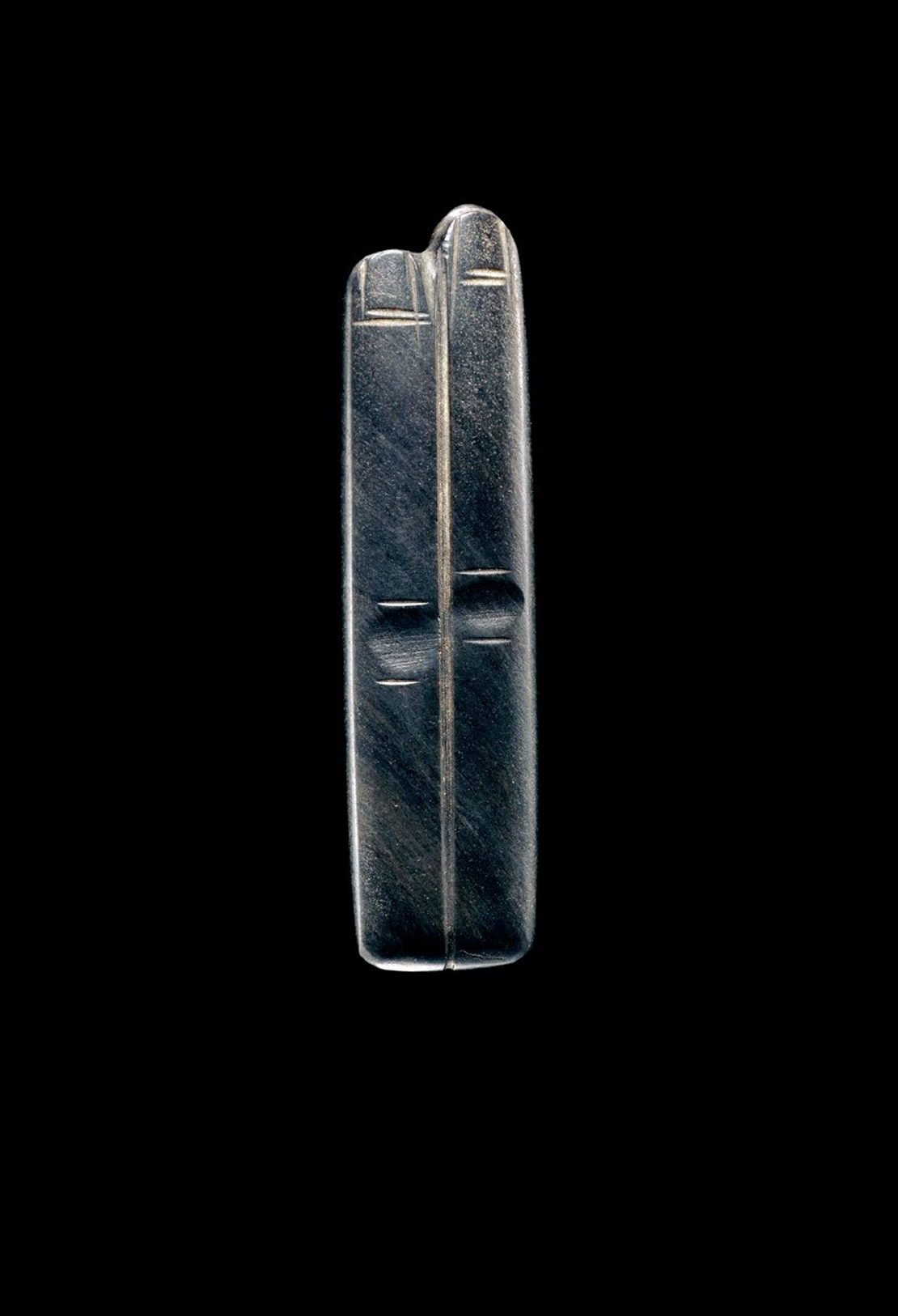
Amulet, Egyptian, Late Period, Incised obsidian, The British Museum, EA59500, © The Trustees of the British Museum.