Obsidian in Mesoamerica
Alejandro Pastrana and David M. Carballo
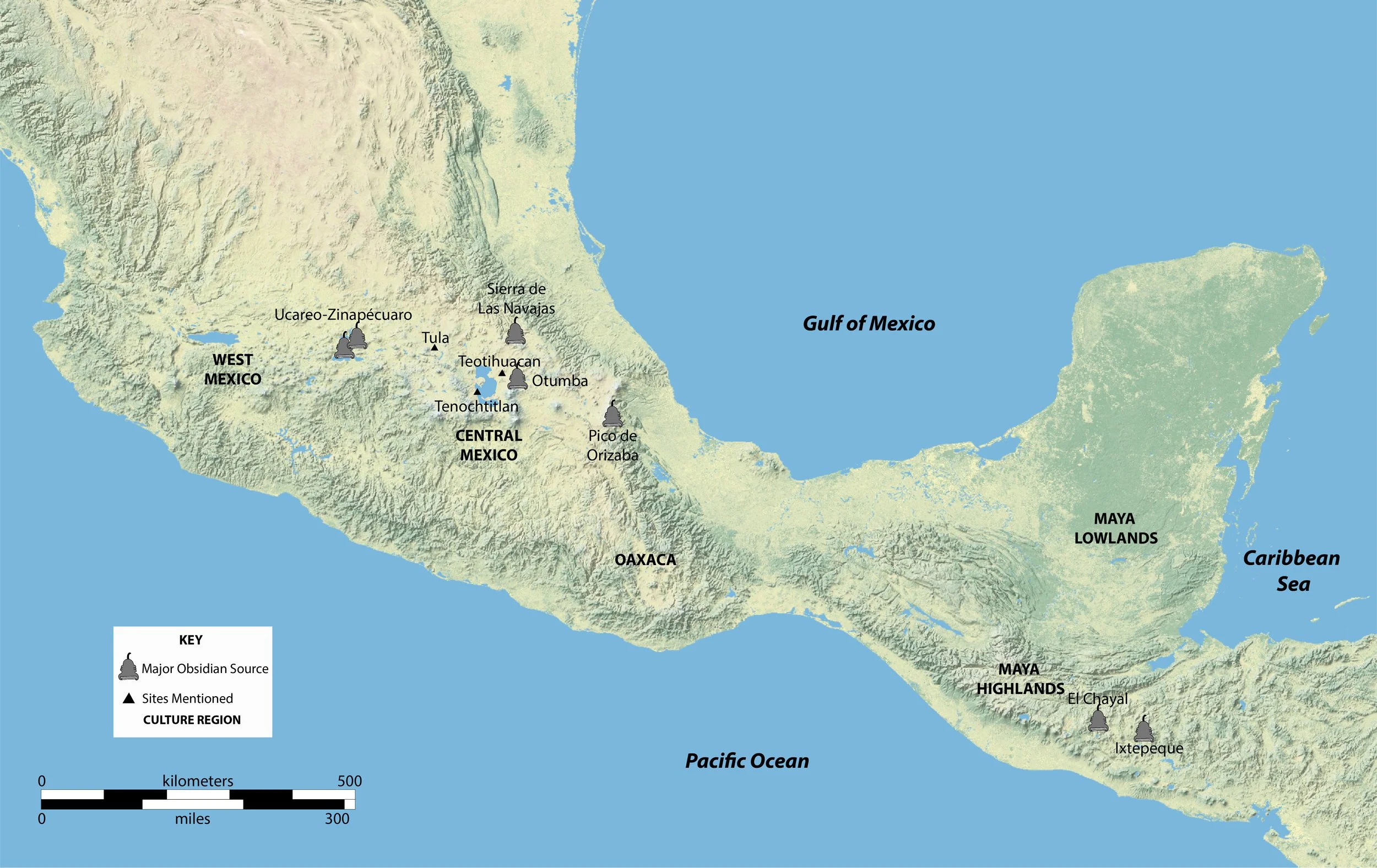
Map of Mesoamerica with locations of major obsidian sources and sites.
Prehispanic Mesoamerica was a diverse place, occupied by cultures such as the Aztec, Maya, Mixtec, Toltec, and Zapotec. Yet the region was unified by certain common features: an agricultural economy based on maize; fundamental religious concepts such as a pantheistic worldview that did not make clear distinctions between the natural and supernatural; and technological knowledge, based in the transformation of certain materials. Foremost among these was obsidian.
Mesoamerican material culture was entirely without utilitarian metals. There was no bronze, no iron, no steel. Some soft metals were worked—copper, tin, lead, pyrite, silver, and gold—but typically only for ornamental or religious objects. Instead, prehispanic tools were made of organics, like fibers, wood, bone, and hides, and various minerals, of which obsidian was pre-eminent. With its vitreous matrix and some microcrystals, it holds a brittle but extremely sharp edge—the sharpest edge known in nature, in fact. Other stones were used too, among them basalt, rhyolite, pumice, chert, chalcedony, and rock crystal. Mesoamericans shaped these materials in a variety of ways, chipping away at their edges, grinding them down, polishing their surfaces.
Though obsidian is a superior tool stone, working it is not without its challenges. From the perspective of an artisan, gas bubbles and particles introduced during the flow of lava are “impurities” that can deviate the intended fracturing of the glass. The best-quality obsidian, distinguished by its conchoidal (shell-like) ripple pattern, fractures cleanly and predictably.
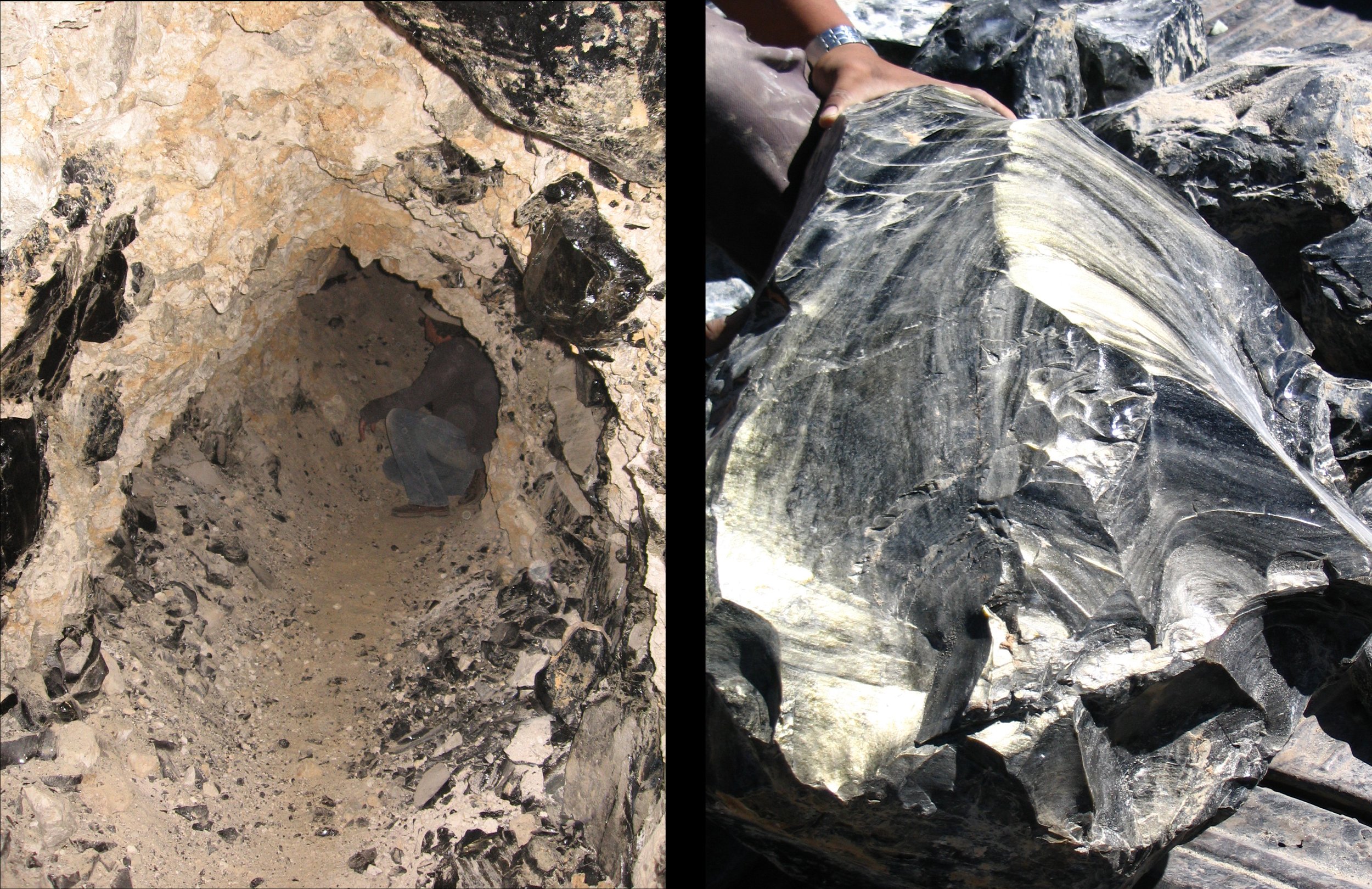
Sierra de Las Navajas; left: prehispanic mine shaft; right: block of obsidian with characteristic green-golden hue. Photo by coauthor, Alejandro Pastrana.
Obsidian working is a subtractive technology. Mesoamericans used a range of methods – direct and indirect percussion, pressure, and friction – but always with the aim of decreasing the quantity of parent material. It a gradual process, with friction applied using progressively harder or more abrasive implements. Fortuitously, this way of working also resulted in accumulations of debris, which are helpful for contemporary analysts such as ourselves, who study ancient artisanship.
The center of Mesoamerica – the central highlands of present-day Mexico– is its most volcanic region. Obsidian was a widely available raw material there, and also had a potent ritual and symbolic significance. It was used not only to fashion weaponry and everyday tools, but also adornments, scepters, and mirrors ascribed with supernatural powers. There seems to have been a conceptual link between the material’s potential for violence - the subduing or sacrificing of an enemy – and crystal-ball like powers of divination. This connection is exemplified in deities such as Tezcatlipoca (Smoking Mirror) and Itzpapalotl (Obsidian Butterfly). One of the avatars of Tezcatlipoca, a high god in the Mexica-Aztec pantheon, was simply called Itztli, also the Nahuatl word for an obsidian blade, and was associated with the ice and hail of central Mexico’s towering volcanoes, from which the glass was mined. The material’s associations with cold, cutting wind were conceived metaphorically as a form of divine justice.
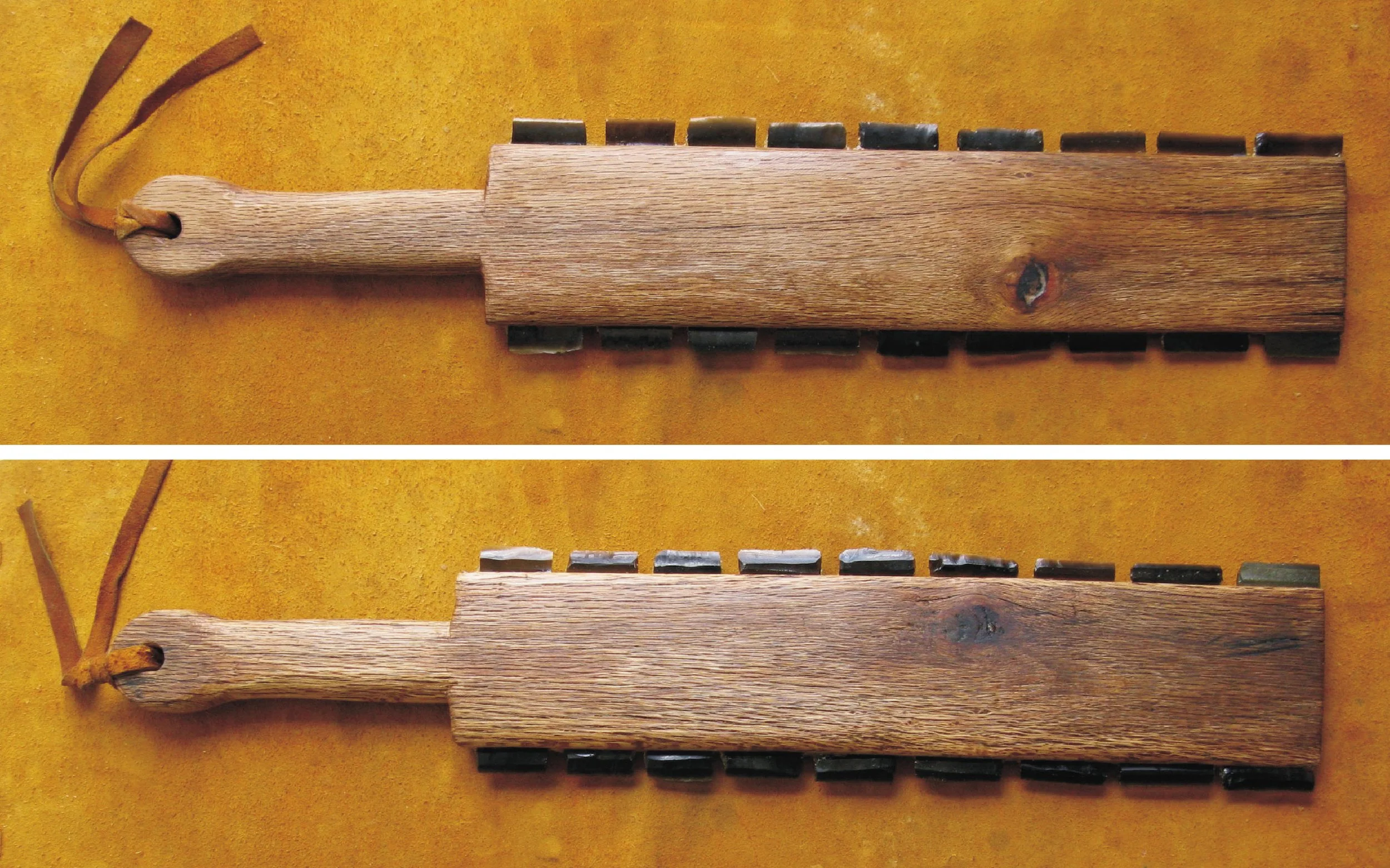
Reproduction of an Aztec machuahuitl, a broadsword with obsidian blades inset into the sides of a wooden handle. Photo by coauthor, Alejandro Pastrana.
Those obsidian mines were also strategically vital, and played an important part in Mesoamerican power politics. The largest and most powerful polities that dominated central Mexico —first Teotihuacan, then the Toltec capital of Tula, and finally the Aztec capital of Tenochtitlan—concentrated primarily on the exploitation of a few mines, particularly one at Sierra de Las Navajas, located in the modern Mexican state of Hidalgo, which yielded a homogenous green-golden glass. The Purépecha (or Tarascan) empire of west Mexico, and the Maya highlands of southern Mexico and Guatemala, also controlled their own obsidian mines. Cultures lacking such resources—such as the Maya lowlands, Gulf of Mexico, and Oaxaca—engaged in long-distance trade to acquire the stone, offering other local materials of theirs in return.
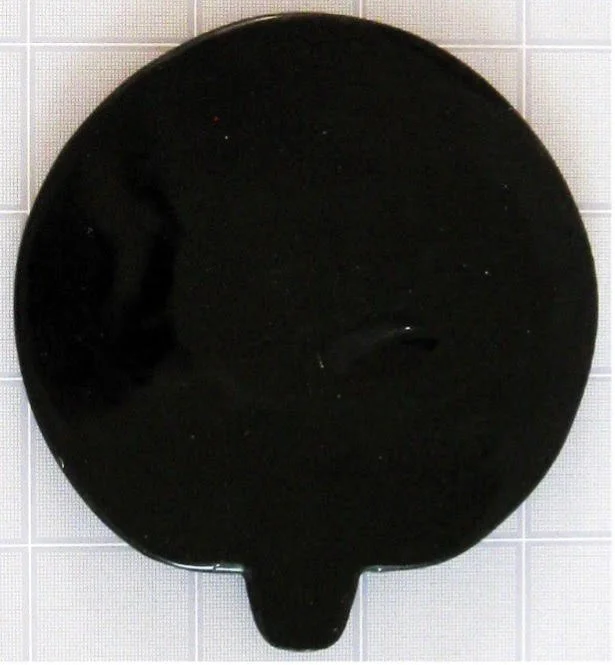
Replica of an Aztec obsidian mirror. Photo by coauthor, Alejandro Pastrana.