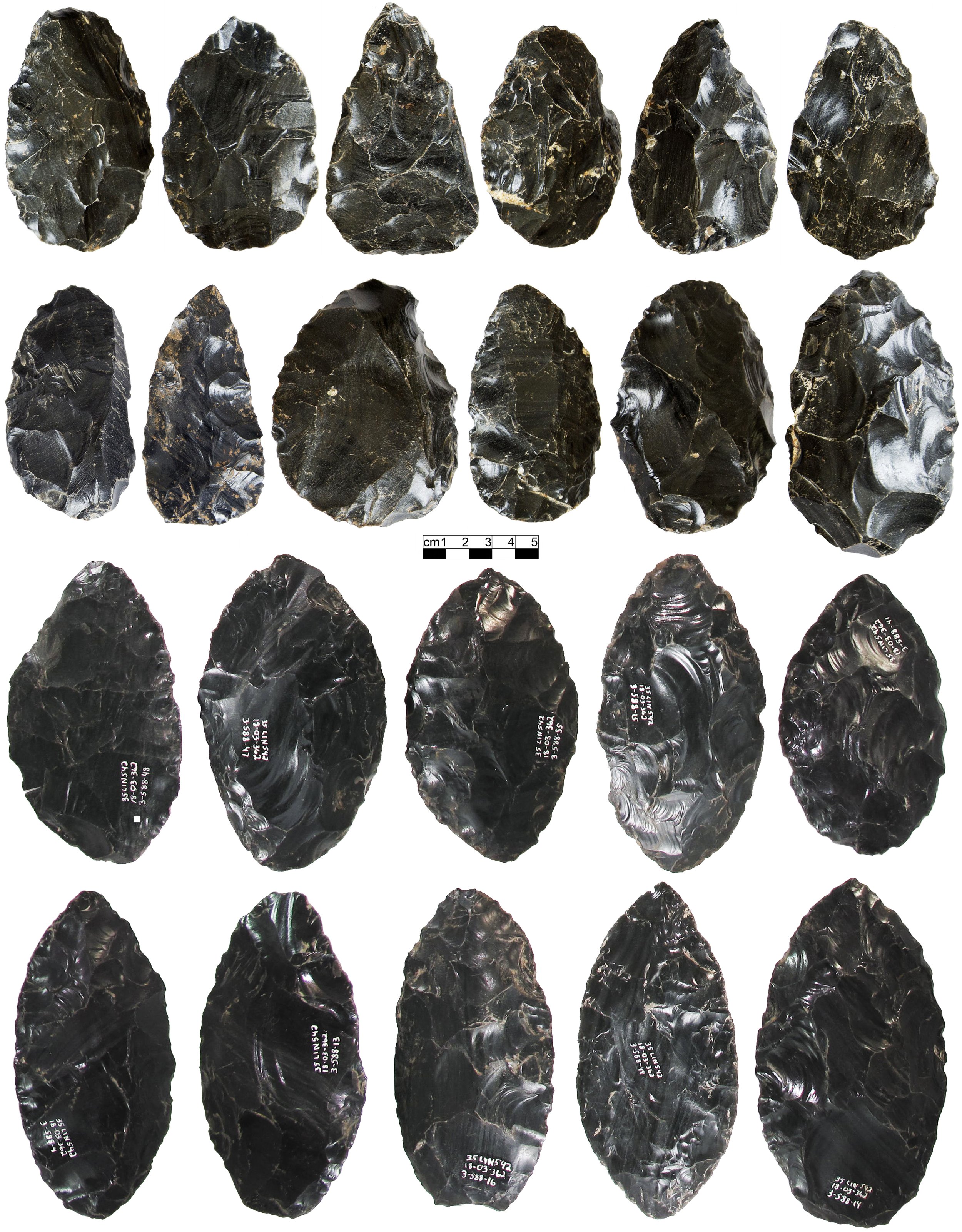
For as long as there have been tools, tools have been made from obsidian. Many archaeologists study the mechanical properties of this volcanic stone to better understand ancient toolmaking practices: the artful reduction of stone blocks to produce functional cutting and piercing implements (an obsidian edge can be sharper than surgical steel). Beyond this, obsidian has qualities that make it an especially useful material for piecing together cultural history. Here I look at two qualities: its physical weathering properties, which provide us with a means of dating archaeological deposits; and its chemical makeup, which allows us to map patterns of land use and trade across the ancient landscape.
From the moment the surface of piece of obsidian is freshly exposed through knapping, water molecules are diffused or ‘adsorbed’ into the surface. Over time, this process forms a visible rind under magnification, allowing us to estimate the age of the stone. The rate of penetration into the artifact surface slows as it progresses, so rind development is not linear, but must be mathematically modeled. And while the shape of the hydration curve is largely predictable, many factors—primarily prevailing temperature—affect the actual speed of the process, so site-specific hydration rates must be determined.
One way to calibrate obsidian’s hydration rate is by pairing hydration rind thickness values (measured in microns; a micron is 1/1000 of a millimeter) with radiocarbon dates. This allows us to assign approximate calendar ages to rind thickness. Measuring a large quantity of artifacts in this way can provide a good outline of a site’s occupation history. For example, at Cascadia Cave, an important site in the mountains of western Oregon, it is possible to determine that while earlier and later site visits occurred, the site was most intensively occupied between about 10,000 and 4,500 years ago.
Obsidian is also critically important in helping to understand social relationships in ancient times, such as commodity conveyance zones and trading networks. Before being erupted from a volcanic vent, molten lava picks up trace residue from the native rock in the walls of the magma chamber. Once extruded and hardened into obsidian, the stone retains a distinctive trace element profile of minerals that are unique to this precise location. Thus, each obsidian source has a unique geochemical profile.
Using both obsidian hydration dating and geochemical identification, obsidian artifacts can be used to track ancient trade patterns. This may be studied through a site-centered view: Where across the landscape did a particular group of people travel? Or a source-centered view: Where did the obsidian from a given flow travel, either through trade or simply by being carried.
An example of the latter is the mapping of obsidian artifacts from two of the most widely used sources in in the Pacific Northwest during ancient times. Newberry Volcano is located in central Oregon, east of the Cascade Range, while the Obsidian Cliffs source is on the western slope of the Cascades, near its summit. The occurrence of artifacts from these sources strongly shows directional flows to the north. Newberry obsidian traveled primarily along the Deschutes River basin, passing through the regional trading center and Native fishery Celilo Falls on the Columbia River. Obsidian Cliffs obsidian was carried through the Western Cascades and Willamette Valley to Willamette Falls and Chinook trading centers in the Portland Basin. From these ancient commercial centers, some Oregon obsidian continued north into lands bordering the Salish Sea (i.e., the Puget Sound-Gulf of Georgia region). Very little from these sources was conveyed to the south.
Obsidian from the northern end of the exchange network, meanwhile, confirms that nearly a quarter of obsidian identified at archaeological sites in British Columbia is from four key Oregon sources: Obsidian Cliffs, Newberry Volcano, and two others east of Newberry, Glass Buttes and Whitewater Ridge. These sources are arrayed in an arc at the southern edge of the Columbia Plateau in central Oregon, and reflect a systematic mining and distribution enterprise maintained by Native tribes of the Pacific Northwest.
Obsidian was transported as a trade commodity in standardized forms. There have been dozens of caches of formed quarry “blanks” or biface found in the Deschutes Basin,the northern Oregon Cascades,and in the Willamette Valley. The number of items in such caches might range from a dozen to thousands. The large-scale uniform production and distribution of these forms is evidence of a surprising large enterprise for the distribution of obsidian tool stone. This evidence helps us to appreciate both the scale of the exchange network and its great antiquity. For many thousands of years, indigenous people manufactured obsidian tools, crucial to survival, in a way that can only be described as an industrial-scale commercial enterprise.